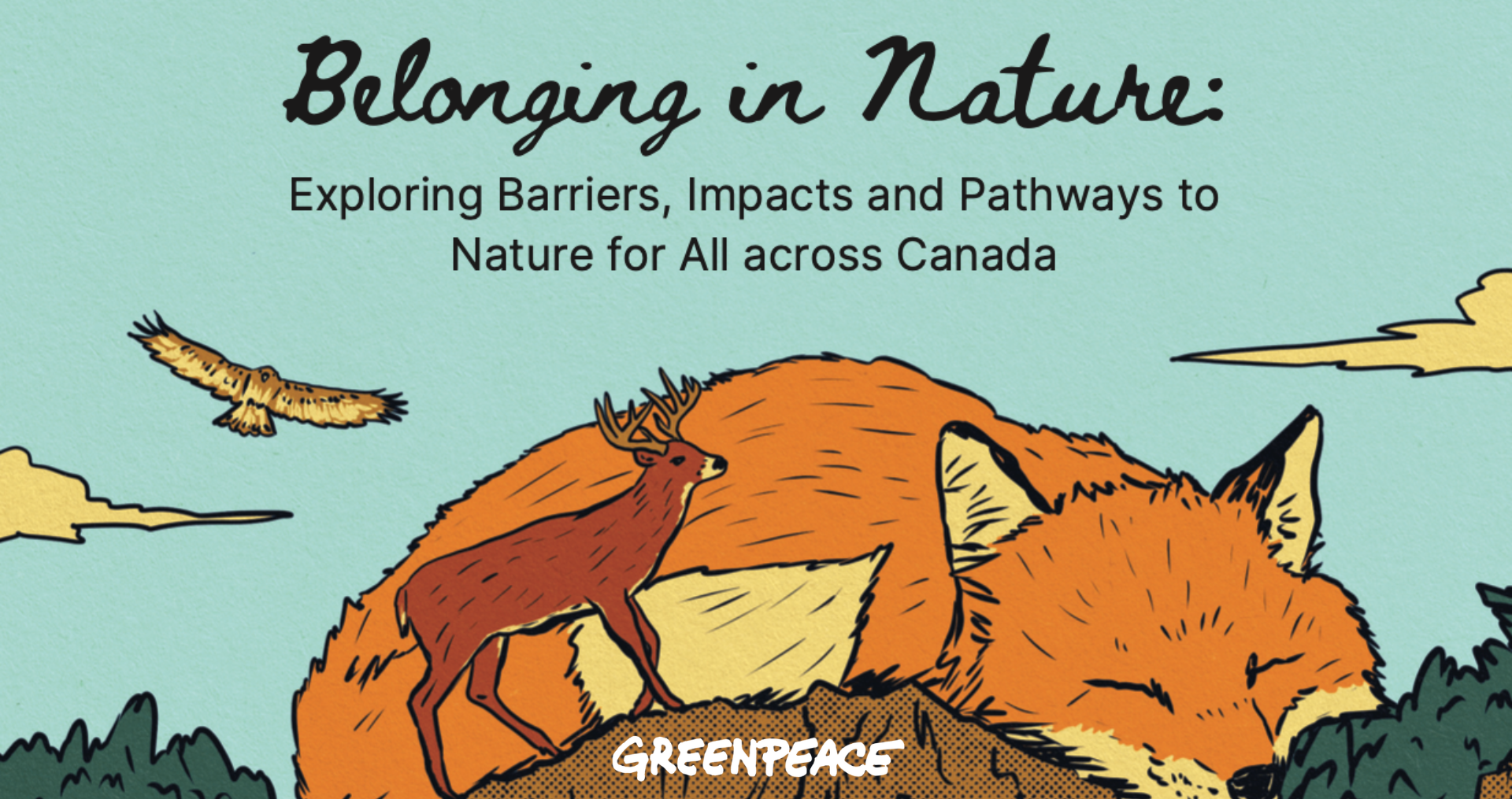
Belonging in Nature: Exploring Barriers, Impacts and Pathways to Nature for All across Canada
Greenpeace Canada’s Belonging in Nature: Exploring Barriers, Impacts and Pathways to Nature for All across Canada, is a landmark report that reveals Canada’s conservation failures and their connections to systemic exclusion. The report was written in solidarity, partnership and close collaboration with consultants from Indigenous and Black-led organizations, disability justice advocates and grassroots groups, including Carolynne Crawley, Demiesha Dennis, Judith Kasiama and Karen Lai. Without their contribution, the data, research and findings from this report would not have been possible. Together, Belonging in Nature, is a call to action to dismantle systemic barriers for belonging that are leading Indigenous, Black, racialized, low-income communities and people living with disabilities to be excluded from spaces in nature, creating elevated climate and environmental risks.
Nature is liberation, not an escape for the privileged few, but rather a living commons where everyone can belong. Last year, Canada fell 11% short of meeting the goal to protect 25% of land and waters, with only 13.8% of land and freshwater and 15.5% of oceans currently protected. As per the 2022 Kunming-Montreal Global Biodiversity Framework, our report calls on Canada to prioritize nature protection and bridge the health equity gaps for historically marginalized communities.
An antidote to Canada’s current colonial conservation model, Belonging in Nature presents belonging-first solutions through a lens that connects people, the land and oceans. The report highlights how systems built on exclusion and exploitation can be reimagined, reinvented and reinvigorated to welcome and center Indigenous Peoples, Black and racialized communities, newcomers, low-income households and people living with disabilities.
Instead of the rippling effects that are producing negative health, mental and climate outcomes impacting the livelihoods of marginalized communities, Belonging in Nature is the first step towards a society where everyone thrives interdependently with nature, regardless of race, income and ability.
This report proposes the following belonging-first solutions that will heal, protect and restore the relationship between nature, people, land and oceans:
- Land Back and Indigenous governance: Centering “Land Back” as the foundational frame for nature protection and honouring Indigenous worldviews
- Implementation of Bill C-73: Legislating nature for all through the Nature Accountability Act to ensure belonging becomes a lived reality rather than a privilege
- Scaling community-led and co-designed solutions: Supporting and piloting initiatives driven by the communities most impacted by nature inequity
- Closing data gaps preventing belonging in nature: Collecting disaggregated data on identity and policy impact to maintain progress and transparency
The executive summary is available here.
Urge the federal government to finally pass a strong nature law.
Sign the petition