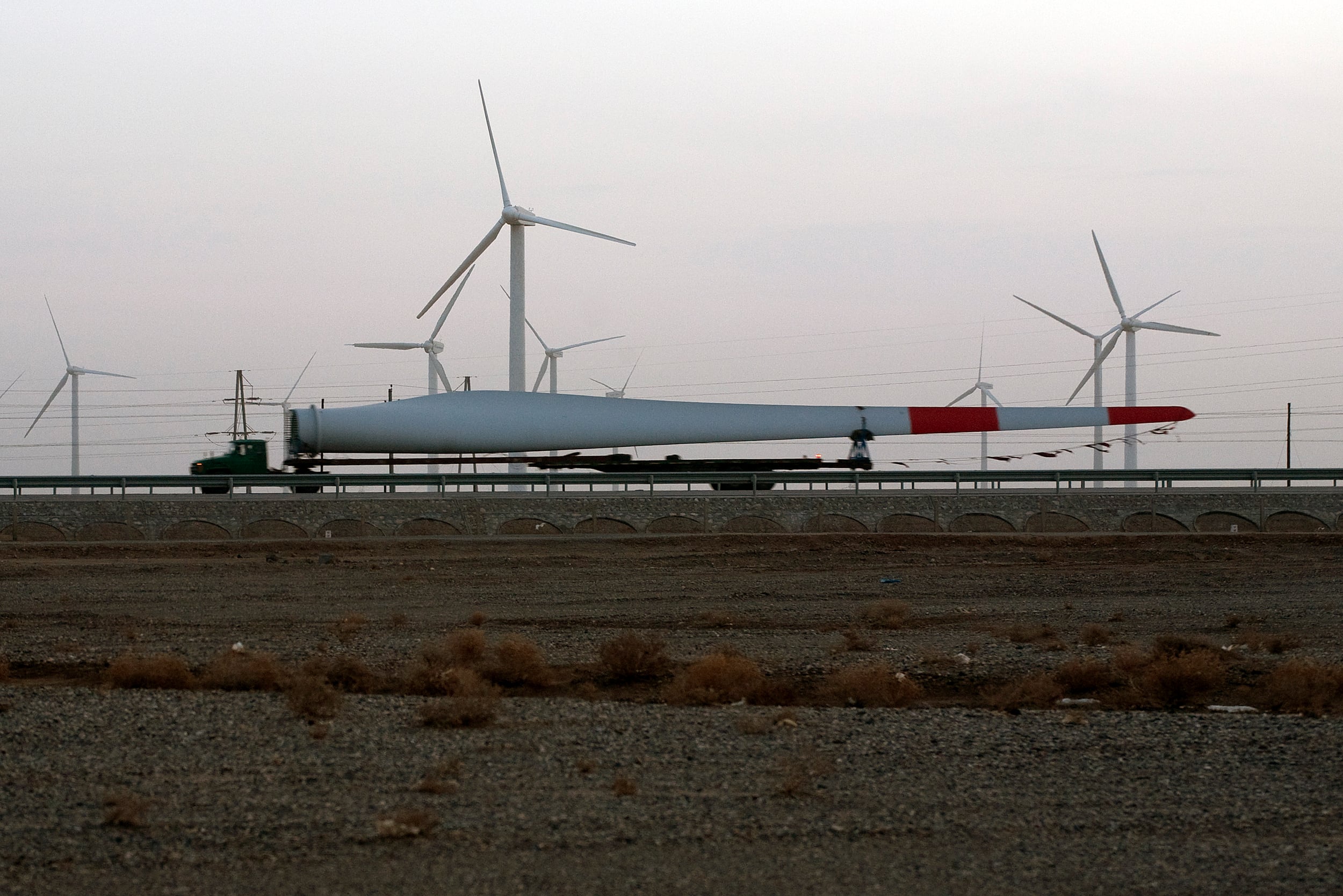
The global shift toward zero-emission transportation is accelerating, but not all car companies are moving at the same speed.
On July 13, Greenpeace Japan hosted its second webinar on green mobility and climate. The session featured Dale Hall from the International Council on Clean Transportation (ICCT) and Erin Eunseo Choi from Greenpeace East Asia, who discussed how the world’s top automakers are faring in the shift to battery-electric vehicles (BEVs).
Three Trajectories in Southeast Asia: Indonesia as a Case Study
Southeast Asia is a strategic battleground for future mobility. Indonesia matters in particular because it is one of the region’s largest auto markets and is positioning itself as an EV hub. In 2025, Indonesia’s BEV market grew rapidly and became Southeast Asia’s third-largest BEV market, with more than 103,000 units sold by year-end. For legacy automakers—especially from Japan—losing ground in Southeast Asia carries heavy long-term consequences.
Automakers from China, Japan, and South Korea illustrate how different strategies yield starkly different results in the region, according to Choi.
China’s Rapid Rise
Chinese automakers, led by BYD and Geely, have aggressively expanded their electric vehicle sales. Despite a contraction in Indonesia’s overall auto market, Chinese brands achieved a massive 153% year-on-year sales surge, nearly tripling their market share to 10%.
BYD emerged as the standout EV leader, capturing more than half of Indonesia’s BEV market. Chinese EV brands also captured more than 90% of Indonesia’s EV sales in H1 2025.
Japan’s Weakening Grip
Japanese brands still hold legacy advantages, but their historic dominance in Southeast Asia is eroding. In Q1 2025, most Japanese brands outside Toyota recorded declines, even as Chinese competitors expanded rapidly.
The core issue is strategic: Japanese manufacturers remain heavily centered on internal combustion engines and hybrids rather than prioritizing Southeast Asia with a clear EV roadmap, said Choi. This delay also drives regional climate inequities, as combustion vehicles sold in Southeast Asia emit vastly more carbon dioxide equivalent per vehicle than those sold in high-adoption markets like Europe—leaving climate-vulnerable communities to bear the burden.
South Korea’s Sharp Decline
South Korea’s trajectory serves as a direct warning sign. In the BEV segment, Hyundai’s sales fell from 7,590 units in 2023 to 1,828 units in 2025, a drop of 75.9%.
Hyundai has articulated clear combustion engine phase-out commitments for Europe and the US, but lacks similar timelines for Southeast Asia. This gap between pledges made in developed markets and actions in the Global South risks damaging its regional competitiveness, said Choi.
“This is not simply a story of government policy succeeding or failing in isolation. It’s a story about which companies adapted their business models fast enough to meet that policy environment — and which didn’t.”
— Erin Eunseo Choi, Climate and Energy Campaigner, Greenpeace East Asia
The ICCT Global Automaker Rating 2025: Leaders vs. Laggards
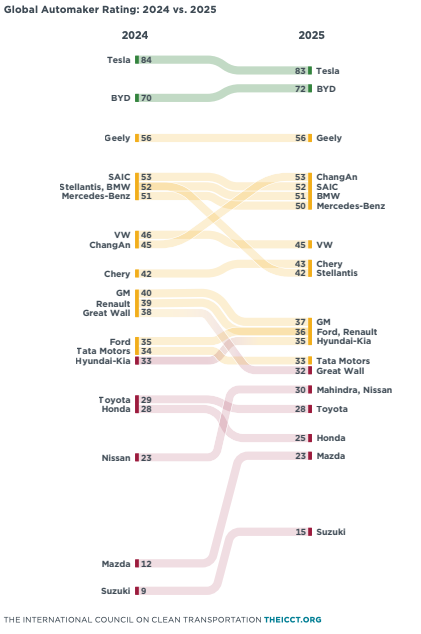
Dale Hall presented findings from the ICCT’s Global Automaker Rating 2025, which evaluates the 22 largest global auto manufacturers across six key markets—representing 80% of global new car sales.
Overall Ranking:
Tesla and BYD lead the global ranking in the top tier. In contrast, Japanese manufacturers occupied the bottom five spots overall, trailing behind global peers.
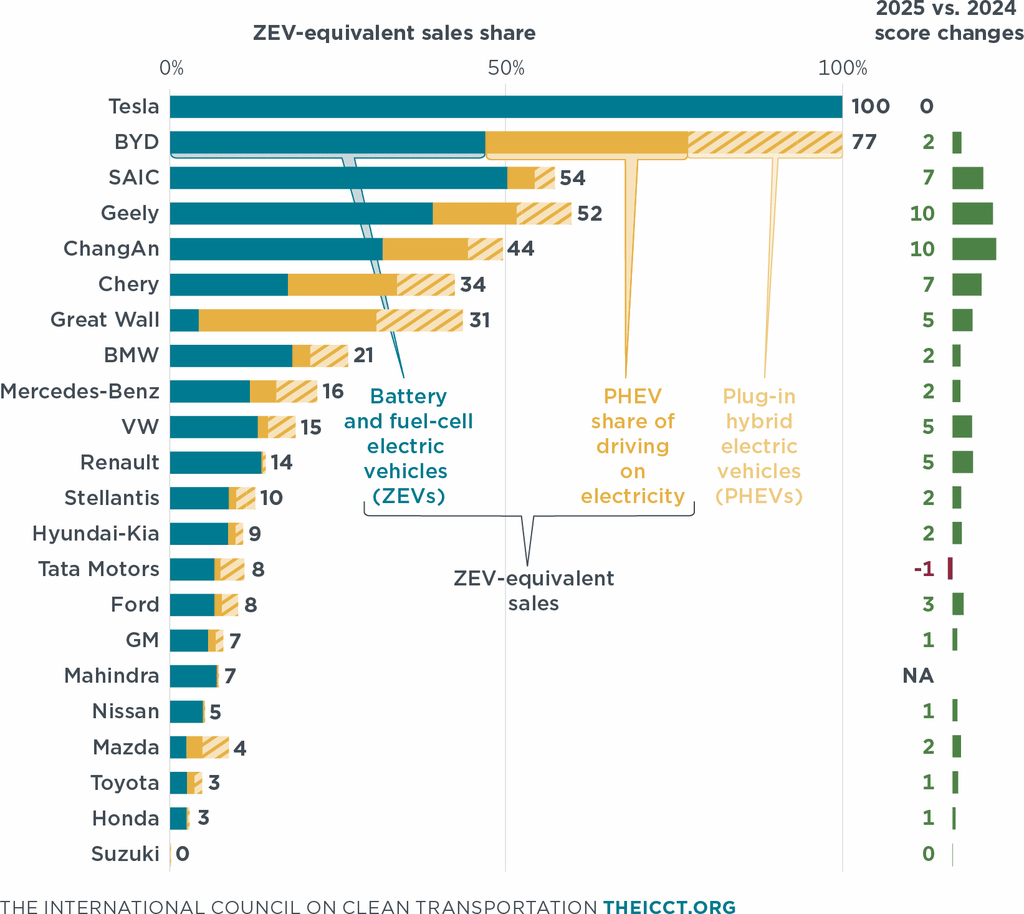
ZEV-Equivalent Sales Share:
Almost all evaluated automakers increased their electric sales share, led by Chinese brands like Geely, Changan, and SAIC. However, legacy foreign automakers still lag far behind and will need to dramatically accelerate sales to meet upcoming climate standards.
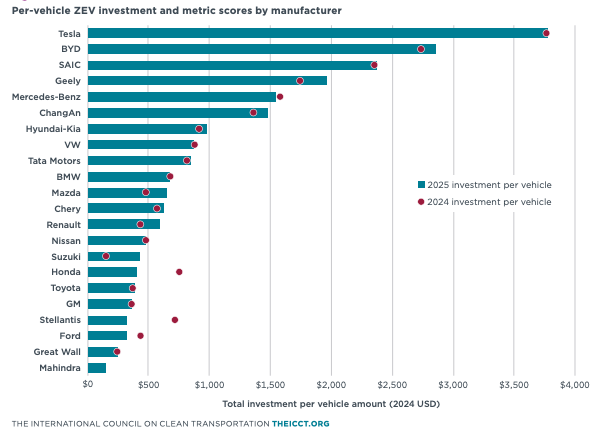
ZEV Investment:
Chinese manufacturers are ramping up capital investments per vehicle to expand overseas in Southeast Asia and Latin America. Meanwhile, legacy automakers in the US, Europe, and Japan have pulled back or kept investments flat, weakening their future market position.
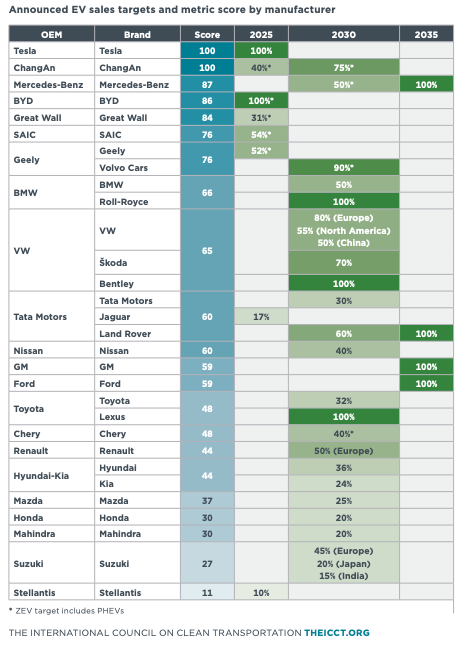
ZEV Targets:
While leaders like Changan and BYD strengthened their goals, several major legacy brands rolled back or lowered their 2030 EV targets to pivot toward hybrids—a retreat that threatens global climate targets.
“In terms of long-term strategic vision, we see a clear divergence across regional lines. Several of the legacy brands—like Stellantis in Europe, Ford in the US, and Honda in Japan—reduced their mid-term targets amid short-term policy changes and are trying to hedge their investments by adopting more flexible platforms and hybrids, reducing their EV investments.
Whereas the market leaders—like BYD, Geely, and SAIC, all from China—are aggressively increasing their EV investments and expanding their production capacity into new markets, again like Southeast Asia and Latin America. That will continue to give them more economies of scale and further footholds in the fastest-growing car markets in the world.”
— Dale Hall, ICCT Global Program Lead
Catch Up on the Series
Missed the first installment of our webinar series? Read our recap of Session 1 here:
Greenpeace Webinar: Can Legacy Automakers Keep Up with Southeast Asia’s EV Boom?