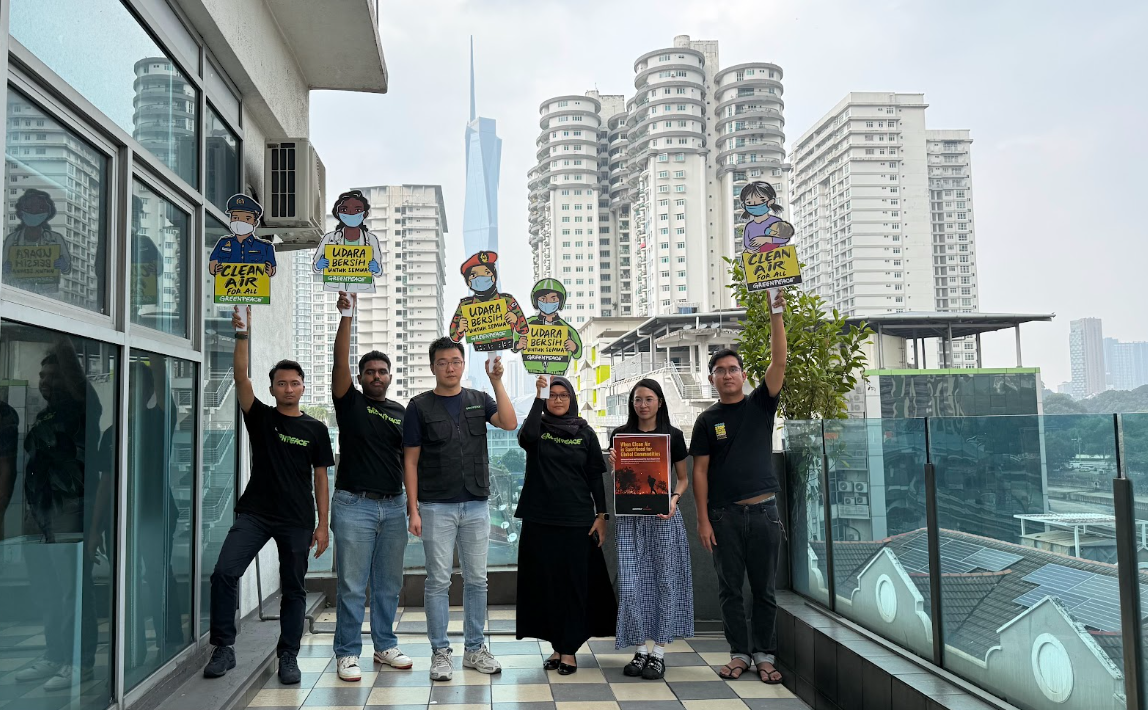
KUALA LUMPUR, 7 October 2026 — Greenpeace Malaysia, Himpunan Advocacy Rakyat Malaysia (HARAM), and representatives from Zero Waste Malaysia (ZWM), Persatuan Aktivis Sahabat Alam (KUASA) and Mandiri marched from Tugu Negara to Parliament as KL reached #1 on IQ Air’s most polluted global major city ranking, calling on the Malaysian Government to strengthen its legal powers to investigate and hold companies accountable for environmental harm linked to Malaysian corporate interests beyond the country’s borders.
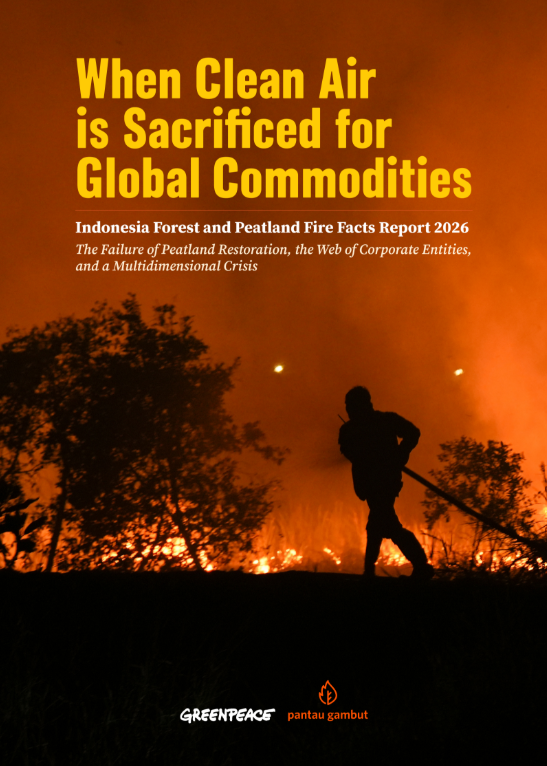
The demonstration follows newly released findings by Greenpeace Indonesia and Malaysia with Pantau Gambut, identifying the top 20 companies and corporate actors linked to haze-source spots and fire-affected areas in Indonesia, including Malaysian and Singaporean-linked companies, strengthening the case for greater transparency and accountability across borders [1]. It also acts as a follow through on a memorandum submitted over a month ago by HARAM and Greenpeace Malaysia to the Embassy of the Republic of Indonesia, calling for greater transparency and disclosure of information on fire locations, concession ownership, investigation findings and companies potentially linked to fires in Indonesia [2].
The peaceful protest comes as the Ministry of Natural Resources and Environmental Sustainability (NRES) confirms that the Government is considering and examining mechanisms to draft specific legislation addressing transboundary haze, including the approach taken by Singapore. NRES also said a special committee comprising relevant ministries and agencies has been established to study measures to strengthen Malaysia’s response to haze [3].
The government’s consideration of a dedicated legislation is welcome progress. However the groups stress that any new framework must provide clear powers to investigate, gather evidence, establish corporate accountability and transparency, and take appropriate enforcement action where companies or corporate actors are found to have contributed to transboundary environmental harm.
Greenpeace Malaysia Campaign Manager Heng Kiah Chun said:
“A transboundary haze law cannot remain on the drawing board while communities continue to bear the health consequences of haze year after year. The Malaysian government announced it is considering legislation. Now, we need to see that consideration translated into swift and urgent action that is concrete and time-bound. Malaysia must have the legal power to investigate and hold companies accountable where credible evidence links them to environmental harm beyond our borders. The haze crosses borders; accountability must be able to do the same.”
HARAM Malaysia chairperson Brendon Gan said:
“We call for action to be taken against, and for accountability from, companies or corporate entities proven to be involved in burning activities that cause pollution and transboundary haze. We are here at Parliament today because we want the MPs, who hold a mandate from the people, to exercise their authority to urge the government to take firmer action and expedite the enactment of specific legislation to address transboundary haze.
Haze is no longer merely a seasonal issue that we can simply wait out. It concerns the people’s right to clean air, public health, and the accountability of those responsible for the pollution.”
The need for stronger domestic legal mechanisms has also been highlighted by the Human Rights Commission of Malaysia (SUHAKAM). In its latest statement, SUHAKAM urged the Government to expedite a Clean Air Act, strengthen access to environmental justice, enhance regional cooperation under the ASEAN Agreement on Transboundary Haze Pollution (AATHP), and fully implement the National Action Plan on Business and Human Rights [4]. This builds on ASEAN leaders’ adoption of the ASEAN Declaration on the Right to a Safe, Clean, Healthy and Sustainable Environment in 2025, which recognises the need to address transboundary environmental concerns and reaffirms the right to a safe, clean, healthy, and sustainable environment.
For decades, transboundary haze exposed vulnerable communities across Southeast Asia to harmful air pollution while raising persistent questions around jurisdiction, access to evidence and corporate responsibility. A domestic transboundary haze law cannot address every regional challenge on its own. Therefore, Malaysia must also continue working through ASEAN mechanisms and bilateral channels to obtain relevant information and evidence from countries where fires originate.
Ensuring Malaysian authorities have the legal tools to investigate and act on credible evidence is critical. Any new framework must provide a clear and enforceable pathway to corporate accountability, transparency, and upholding the fundamental human right to clean air for all.
Following the peaceful demonstration, copies of the new findings of the report were subsequently received by eight Members of Parliament: Kelvin Lii (Bandar Kuching), Young Shefura Othman (Bentong), Khoo Poay Tiong (Kota Melaka), Syerleena Abdul Rashid (Bukit Bendera), Yuneswaran Ramaraj (Segamat), Tan Hong Pin (Bakri), Tan Kar Hing (Gopeng) and Hassan Karim (Pasir Gudang). The MPs also voiced support for stronger legal measures to address the persistent transboundary haze pollution. ZWM co-founder & director Sue Yee Khor and KUASA president Hawa Wahid were also present.
ENDS
Notes:
[1]https://www.greenpeace.org/malaysia/report/84678/when-clean-air-is-sacrificed-for-global-commodities/
[2]https://www.freemalaysiatoday.com/category/nation/2026/09/04/reveal-malaysian-firms-behind-forest-fires-indonesian-embassy-told
[3]https://www.thestar.com.my/news/nation/2026/09/26/transboundary-haze-law-considered
[4]https://suhakam.org.my/2026/09/media-statement-no-57-2026_suhakam-calls-for-urgent-human-rights-based-response-to-escalating-transboundary-haze-crisis/