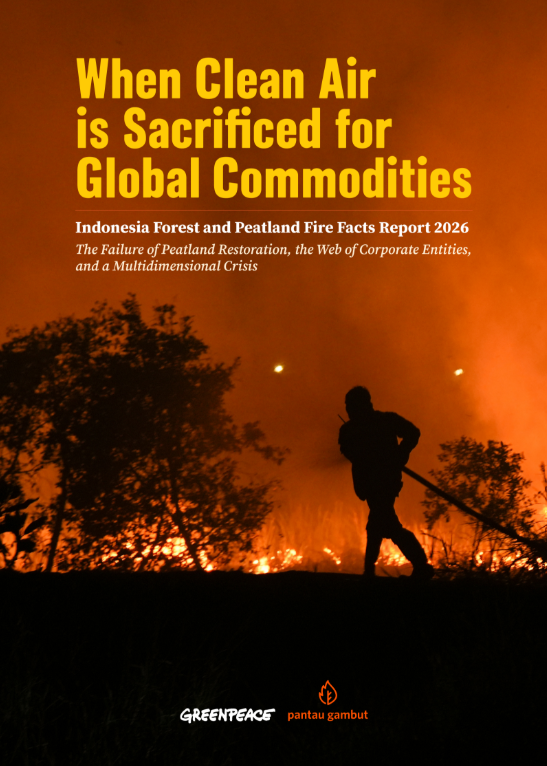
When clean air is sacrificed for global commodities.
Kuala Lumpur, 5 October 2026 – Human tragedy and environmental crisis resulting from forest and peatland fires return to claim lives, underscoring poor environmental governance in Indonesia. Malaysian company Kuala Lumpur Kepong (KLK) Group, a plantation group with ties to Indonesian entity PT Menteng Jaya Sawit Perdana, was identified as one of several Top 20 entities connected to the 2026 findings on fires in Indonesia, based on the haze sources dataset from Aug to 1 October 2026. The same entity was identified as having fires on their land in a 2019 report.
While at least four concessions have been identified as having corporate links to Singaporean business groups, and all of them show the presence of haze source points. These include PT Damai Agro Sejahtera, affiliated with Bumitama Agri Ltd headquartered in Singapore; concession of PT Kayung Agro Lestari, associated with First Resources / ANJ / Fangiono and Singapore-based business groups; PT Mitra concession, under the Fangriono Family / First Resources that is connected to Singapore through parent company First Resources Ltd; and PT Arjuna Utama Sawit recorded as part of First Borneo Plantations, identified as an oil palm plantation originating in Singapore.
Forest and peatland fires that continue to persist are not part of a natural cycle, but a reflection that economic expansion based on global commodities are valued more highly than the lives of citizens. This structured environmental criminal act directly threatens the lives and safety of millions of people while exacerbating the climate crisis. Long-term exposure to harmful PM2.5 particles from peatland fires in Sumatra and Kalimantan is estimated to be associated with approximately 33,100 premature deaths among adults and 2,900 infant deaths each year.
This year alone, the toxic air crisis has triggered more than 4,390 additional hospitalisations due to acute respiratory illnesses, as well as at least 635,000 cases of severe asthma attacks among children in Indonesia. While Malaysia’s Ministry of Health (MoH) recorded a significant rise in asthma by 259% and upper respiratory tract infections (URTI) by 124%. These figures further underscore how pollution from monoculture commodities has undermined the fundamental rights of communities to clean air and safeguard their health.
The root of this entire disaster lies in landscape mismanagement that provides extensive room for agro-extractive activities. A Pantau Gambut study reveals the alarming reality that out of Indonesia’s total 24.2 million hectares of Peat Hydrological Units (KHG), approximately 16.4 million hectares are in fire-prone conditions and 6 million hectares are highly vulnerable to flooding.
The extensive control of land has resulted in at least 8.3 million hectares of peat hydrological companies being attributed to 936 concessions as of July 2025, encompassing oil-palm Cultivation Rights (HGU), Forest Utilisation Business Licences (PBPH), Natural Forests (HA), and Ecosystem Restoration (RE) concessions.
These types of concessions have been shown to reveal widespread and systemic vulnerability, demonstrating a direct correlation between the dominance of corporate business expansion and the destruction of peatland ecosystems.
Out of a total of 5,540 smoke-source points that were identified from 8 August up to 20 September 2026, 859 points were detected directly within 115 PBPH concessions, while 774 points were located within 210 oil-palm plantation concessions. In addition, 2,951 points were located within 114 KHG areas, while 2,211 points were found repeatedly in areas that had previously experienced fires between 2015 and 2023.
The data demonstrates the government’s unwillingness to take firm action against environmental criminals who continue to operate in disaster-prone areas. The crisis has even crossed territorial boundaries, reigniting cross-border tensions. This is reflected in Malaysia’s Prime Minister’s response that echoes the same ‘ASEAN non-interference’ sentiments in 2019, stopping short of stronger action by leaving the Indonesian government to act rather than taking responsibility.
Amid the rapid and extensive pace of environmental destruction, claims of environmental restoration by the government and concession holders in Indonesia have proven to be merely ceremonial, without meaningful implementation. Pantau Gambut’s analysis over the past decade records a stark reality: 97% to 99% of burned areas were never restored. Following the major fires between 2015 and 2019, only 1% to 3% of degraded areas were successfully restored to forest in Indonesia. Most of the previously burned areas were instead left abandoned and became shrubland (41%), or were deliberately converted into large-scale monoculture oil-palm plantations (54%).
This phenomenon underscores a pattern of continued tolerance of fires to facilitate the clearing of land for new commercial development. Greenpeace’s data findings throughout 2026 further strengthen indications of this structured corporate criminality.
The impacts of toxic haze crossing national borders shows that this is no longer merely a matter of technical coordination between countries, but a failure of law enforcement at the domestic level. As of 14 September 2026, the haze was detected affecting air quality for 41 days in Sarawak, 11 days in Sabah, 7 days in Johor, 5 days in Kuala Lumpur, and 3 days in Singapore, while smoke was also detected over areas of Brunei Darussalam and the Philippines.
The export of this toxic haze represents clear evidence of how environmental destruction within the country is undermining the ecological capacity to sustain life across Southeast Asia. The threat of environmental degradation is now also expanding sharply into the eastern region of Indonesia. The expansion of forest and land fires in South Papua in 2026, particularly in Merauke Regency, brings a new and deeply concerning dimension.
Greenpeace recorded 1,069 smoke-source points detected in South Papua out of the national total as of 20 September 2026. More critically, a number of these smoke-source points were found within two important conservation areas in Merauke — an area that is currently being forcibly and aggressively pushed to become a hub for land-based National Strategic Projects (PSN).
Continued exploitation left unchecked that sacrifices the health of citizens and ecosystem sustainability for the sake of commodity exports must no longer be tolerated. The nation must immediately halt the expansion of agro-extractive industries in vulnerable areas, revoke permits of concessions that have been complicit in peatland destruction, as well as take stricter measures against all corporations linked to the recurring forest and land fires without compromise through a stronger legal framework to address transboundary haze, including clear cross-border corporate accountability and effective deterrence mechanisms.
Regional pollution requires regional accountability. As more evidence becomes available, accountability should follow the evidence. Because the right to clean air and guaranteeing the safety of citizens is an absolute right that cannot be continuously traded for the benefits of the global profit.
ENDS