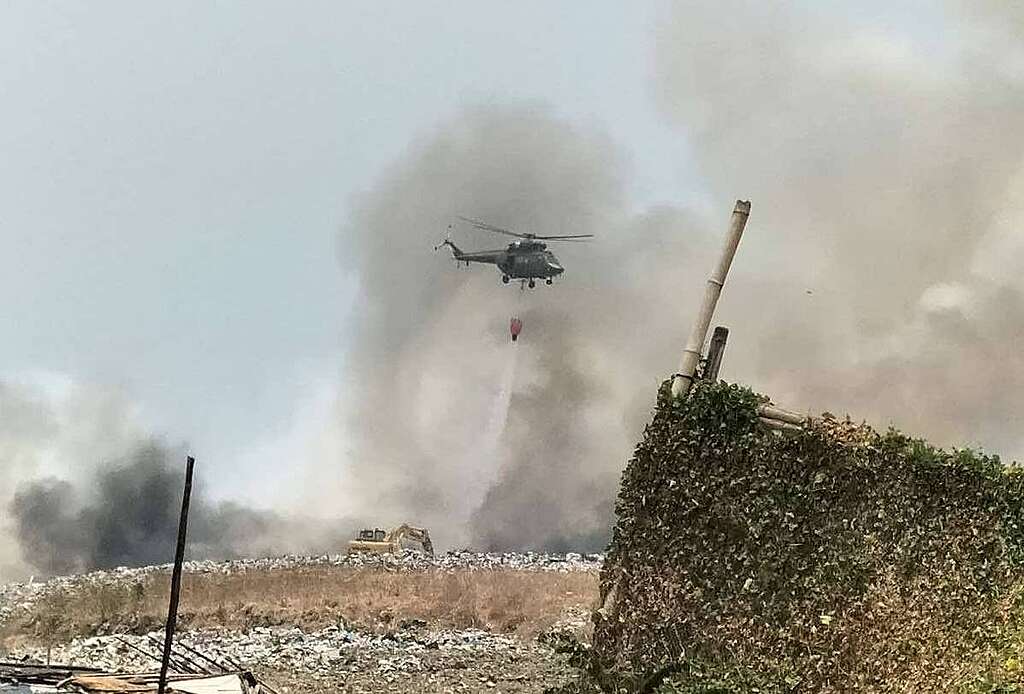
11 April 2026, Quezon City, Philippines — Following the fire at the closed Navotas Sanitary Landfill[1] in Barangay Tanza, Navotas, environmental group Greenpeace Philippines warned that the incident is part of a growing and dangerous pattern of waste catastrophes in the Philippines, underscoring the urgent need to address the country’s waste crisis at source, through reduction.
Reacting to the incident, Greenpeace Philippines campaigner Marian Ledesma said:
“This latest landfill catastrophe—the third so far this year—underscores how the government’s approach to waste is a total disaster. Waste disposal, whether in landfills or in burn facilities, does nothing to address the waste problem and, worse, poses serious risks to nearby communities.
“The fire at the Navotas Sanitary Landfill shows that disposal sites remain hazardous even after closure. Shutting down a landfill does not remove the threats it poses to communities and ecosystems.
“Landfill fires release toxic chemicals such as dioxins[2] and furans produced when plastics are burnt, and which are among the most dangerous persistent organic pollutants in the world. Exposure to these pollutants has been linked to cancer and other serious health impacts. These pollutants stay in the environment and do not break down. They settle into surrounding soil and water, contaminate ecosystems, and can accumulate in the food chain over time, threatening public health.[3]
“The risks are especially concerning in Navotas, where the landfill is located near fishing grounds, aquaculture facilities, and dense residential areas. Pollution and toxic chemicals from the fire threaten marine ecosystems, food production, livelihoods, and the health of communities that depend on these waters.
“At a time when many Filipinos are already struggling with rising costs and economic uncertainty, communities should not have to face added threats to their health and livelihoods because of preventable waste-related disasters.
“These recurring incidents persist because the Philippines continues to rely on weakly enforced and inadequate waste policies that focus on disposal over prevention. Existing laws like the Ecological Solid Waste Management Act recognize waste reduction and segregation, yet implementation remains poor. Moreover, critical gaps in policies like the Extended Producer Responsibility Act continue to allow corporate overproduction and dependence on single-use products and packaging, which are the main contributors to plastic pollution that is driving the increase in waste volumes.
“The Philippine government must act on the waste crisis with urgency. Every delay in reducing waste at source and curbing plastic production deepens the health, economic, and environmental toll on Filipinos. The government must implement strong reduction measures, enforce strict segregation at source, and support a just transition to zero-waste systems like reuse, which can significantly reduce waste volumes.[4]
“Plastic is made from fossil fuels.[5] Its growing presence in the waste stream reflects how deeply the country remains tied to a volatile petrochemical-dependent system that shifts the costs onto the public. As Filipinos grapple with rising prices and unstable livelihoods, waste-related disasters and toxic pollution only add to the burden communities already carry.”
###
Notes to Editors:
[1] The Navotas Sanitary Landfill ceased operations in August 2025 following its closure due to expropriation issues. Since then, waste previously directed to the facility has been diverted to the New San Mateo Sanitary Landfill in Rizal.
[2] World Health Organization on Dioxins
[4] Greenpeace is calling on the Philippine government to establish a national reuse framework that will support a just transition from disposable packaging to reuse systems through enabling policies, support mechanisms, incentives, and investments that will make these systems viable at scale and widely accessible to Filipinos.
[5] Plastic is estimated to comprise 12-24% of the Philippine waste stream. More than 99% of plastic is made from chemicals derived from fossil fuels, which links plastic production directly to the fossil fuel industry. With ongoing global conflicts and supply issues affecting fuel and commodity prices, the country’s reliance on plastic and systems that use a lot of petrochemicals makes communities more vulnerable to economic instability.
For more information and interview requests, please contact:
Karl Orit
Communications Campaigner
Greenpeace Southeast Asia – Philippines
[email protected] | +63 919 457 1064 (Viber & WhatsApp)