


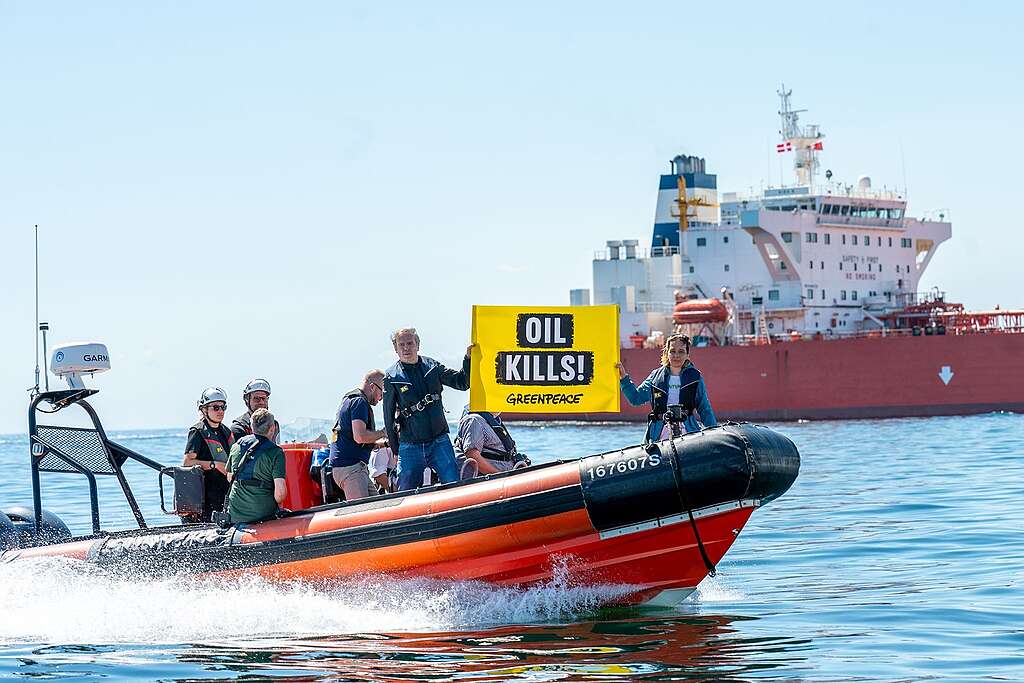
On June 30, during a peaceful monitoring action targeting a Russian shadow fleet tanker in the Baltic Sea, Greenpeace activists witnessed a Russian naval vessel escorting the tanker. The incident took place in Germany’s Exclusive Economic Zone while Greenpeace was documenting the transport of Russian crude oil by the sanctioned tanker Kira K.
More photos and videos are available here.
The joint action brought together Greenpeace activists from Germany, Denmark, Sweden and Ukraine, alongside members of the German Bundestag, the European Parliament and journalists. Photos and video footage were captured from inflatable boats carrying Greenpeace Ukraine Executive Director Natalia Gozak and Greenpeace Ukraine Project Lead Polina Kolodiazhna.
During the action, a Russian warship approached the Greenpeace activists and, through the German Coast Guard, demanded that they move away from the tanker. Despite the intimidation, the team successfully completed the photo and video documentation of both the tanker and the Russian naval vessel escorting it.
“We witnessed that Russia is not only using its shadow fleet to circumvent international sanctions, but is also prepared to openly deploy military vessels to protect it near the shores of the European Union. This once again demonstrates how vital oil export revenues remain for the Kremlin. Baltic states must strengthen enforcement of sanctions against all shadow fleet vessels to protect the Baltic Sea from an environmental disaster and reduce the funding of Russia’s war,” said Natalia Gozak, Executive Director of Greenpeace Ukraine.
The Kira K tanker is already subject to sanctions imposed by the European Union, the United Kingdom, Switzerland, Canada, Australia, New Zealand and Ukraine (but not the United States). Nevertheless, it was transporting Russian crude oil loaded at the port of Ust-Luga while transiting European waters under the Panamanian flag.
Although EU enforcement against sanctioned oil tankers has recently improved, Russia’s shadow fleet continues to exploit loopholes allowing it to operate through European territorial waters. A new Greenpeace Germany investigation reveals a sharp increase in the number of shadow fleet vessels sailing close to Germany’s Baltic coast. After Sweden tightened inspections of oil tankers in the Baltic Sea in early March and stopped five such vessels in its waters, many shadow fleet tankers shifted to the longer route through German territorial waters.
According to the investigation, between March 6 and June 16, 2026, 42 out of 136 shadow fleet tankers sailed along Germany’s Baltic coast near the island of Rügen. During the same period last year, none used this route. Furthermore, 31 of these vessels entered Germany’s 12-nautical-mile territorial waters.
Greenpeace Germany also warns that many shadow fleet vessels are either inadequately insured or completely uninsured and operate under questionable or false flag registrations, significantly increasing the risk of a major oil spill in the Baltic Sea. A legal opinion commissioned by Greenpeace confirms that Germany has the legal authority to inspect such vessels and detain them where violations are identified.
Russia’s shadow fleet is more than a sanctions evasion scheme. Every voyage generates revenue that fuels the Kremlin’s war against Ukraine while simultaneously increasing the risk of an environmental catastrophe in the Baltic Sea. The deployment of a Russian warship to escort an oil tanker underscores the strategic importance Moscow places on protecting its oil revenues.
Greenpeace calls on governments across the Baltic region to make full use of existing legal powers to inspect, detain and deny passage to shadow fleet vessels that violate international requirements on flag registration, insurance and maritime safety.
Russian oil kills!


