


More than half of ZNPP’s external power losses since 2022 occurred in the past seven months- new analysis of Greenpeace Ukraine finds no evidence of claimed Ukrainian strikes
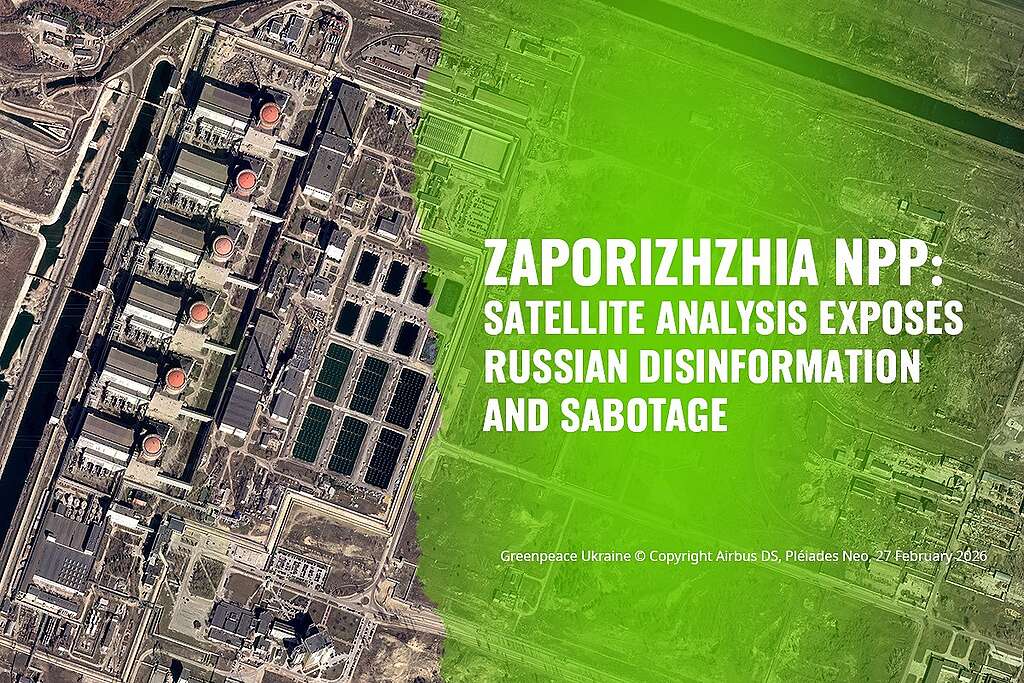
17 September 2026, Kyiv — Russia is deliberately sabotaging and targeting the electricity supply lines to the Zaporizhzhia Nuclear Power Plant (ZNPP), Greenpeace warned today. A new investigation by Greenpeace Ukraine, together with London-based McKenzie Intelligence Services (MIS), exposes the Russian disinformation campaign that claims that Ukrainian artillery and drone strikes have severely damaged critical electricity infrastructure supplying ZNPP.(1) High-resolution satellite imagery analysed by MIS found no evidence of Russian claims of a Ukrainian artillery strike on 10 February 2026 or UAV strike on 4 June 2026 at the Ferosplavna 330 kV switchyard near the Zaporizhzhia Thermal Power Plant (ZTPP).(2)
“The satellite imagery and evidence is clear – Ukraine did not attack its own Zaporizhzhia nuclear plant electricity system – this is part of a massive disinformation campaign, enacted by Moscow to confuse and distract from the real safety threats caused only by their illegal occupation and war. The repeated loss of external power at ZNPP is the result of Russian military attacks on Ukraine’s electricity grid and sabotage operations at ZNPP and associated switchyards. Russia is escalating its attacks on Ukraine’s electricity grid and the consequences for nuclear safety are becoming increasingly serious. More than half of all complete losses of external power at ZNPP since the Russian occupation began in 2022 have occurred in just the past seven months. The priority must be the de-occupation of the Zaporizhzhia nuclear plant of all Russian forces ,” said Shaun Burnie, nuclear specialist at Greenpeace Ukraine.
The MIS analysis reviewed multiple high-resolution Airbus satellite images taken between October 2025 and June 2026, focusing on the Ferosplavna 330 kV open switchyard northeast of the ZTPP. The switchyard contains circuit breakers, switches and current transformers and is part of one of the two external grid connections supplying electricity to ZNPP.
MIS found damage at the switchyard but no evidence that it resulted from the Ukrainian artillery or drone strikes claimed by Russia. Artillery fire would be expected to leave a pattern of impact craters and dispersed damage across the targeted area. The analysis also found that the damage attributed by Russia to a Ukrainian drone strike on 4 June was already visible before the date of the alleged attack.
Greenpeace Ukraine has provided its latest analysis of the situation at ZNPP to governments attending this week’s IAEA General Conference, to counter the disinformation campaign of Russia, and where nuclear safety and security in Ukraine, including the situation at ZNPP, is under review.(3)
The key findings of the McKenzie Intelligence analysis are:
- No evidence of artillery impact craters across the Ferosplavna 330 kV switchyard;
- No evidence of the claimed Ukrainian multiple artillery strikes on 10 February 2026;
- Damage attributed by Russia to the alleged 4 June drone attack was already present before that date;
- No evidence of the claimed Ukrainian 20+ UAV strike on 4 June 2026;
- Damage to the switchyard was confirmed, but the satellite evidence does not support Russian claims that it was caused by Ukrainian artillery or drone attacks.
The Ferosplavna 330 kV line is one of two external grid lines supplying electricity to ZNPP. The other grid line, Dniprovska 750 kV, has been inoperable since 22 May 2026, when Russian military attacks severely damaged the Dniprovska substation approximately 100 km north of the nuclear plant.
External power losses escalate nuclear safety risks
External electricity supply is critical to nuclear safety because it is required to operate essential reactor safety systems, including pumps that provide cooling for nuclear fuel in reactor cores and spent fuel pools.
ZNPP has six reactor units and six spent fuel pools containing hundreds of tonnes of highly radioactive nuclear fuel. Since Russian forces seized the plant in 2022, ZNPP has suffered 26 complete losses of off-site power (LOOPs). Fourteen of those incidents have occurred since February 2026. Each complete loss of external power forces ZNPP to rely on Emergency Diesel Generators to maintain essential nuclear safety functions.
“What Russia is doing in Ukraine is unprecedented in the history of nuclear energy and demonstrates a complete disregard for nuclear safety principles. Repeated loss of external electricity supply to the Zaporizhzhia nuclear plant is a fundamental safety risk. Russia’s escalating attacks on Ukraine’s electricity grid are also threatening nuclear safety at Ukraine’s three other operating nuclear power plants. Maximum international support for Ukraine is essential, yet governments continue to conduct nuclear business with Russia and have failed to impose sanctions on Rosatom. That is inexcusable and must change,” said Jan Vande Putte, radiation and nuclear expert at Greenpeace Ukraine.
Greenpeace has investigated and documented Russian threats to ZNPP since March 2022, including Rosatom’s plans to restart reactors at the plant, which have remained shut down since September 2022. Rosatom has so far failed to restart any of ZNPP’s six reactors, including efforts to connect the plant to the electricity grid in the Russian-occupied areas of Zaporizhzhia, Kherson and Donetsk.(4)
Notes
1 – McKenzie Intelligence Services (MIS) are London based specialists in remote sensing satellite imagery – Link of report. MIS assessed five images were analyzed to determine if the Russian government and Interfax claims were sound. These images were all sourced from Airbus Defense & Space and all from the same platform, Pleiades NEO (PNEO) and are dated 15 October 2025, 27 February 2026, 22 May 2026, 6 June 2026, and 13 June 2026.
2 – The Russian foreign ministry submits documents to the IAEA for distribution to all member states, including Russian Communication from the Permanent Mission of the Russian Federation to the Agency, INFCIRC/1339 12 February 2026, see www.iaea.org/sites/default/files/2026-02/infcirc1339.pdf and Thermal power plant in Zaporozhye Region comes under attack — IAEA, 4 June 2026, see https://tass.com/emergencies/2141321
3 – The IAEA Board of Governors and this week’s General Conference continue to review Russia’s threat to Ukraine nuclear plants. In March 2026 Greenpeace provided detailed analysis of Russian attacks and disinformation on Ukraine’s grid between February 2025-2026 and see IAEA statement of government of Ukraine.
4 – “Satellite images reveal another doomed attempt by Russia to connect Zaporizhzhia NPP to temporarily occupied territories and the Russian energy system”, Greenpeace Ukraine, 21 July 2026,see https://www.greenpeace.org/ukraine/novyny/6352/suputnykovi-znimky-vykryvaiut-cherhovu-pryrechenu-sprobu-rf-pidiednaty-zaporizku-aes-do-tymchasovo-okupovanykh-terytoriy-ta-rosiyskoi-enerhosystemy/

