
Election 2026: Environmental policy election scorecards
Find out how the political parties rank for their election policies on the top issues facing the environment.
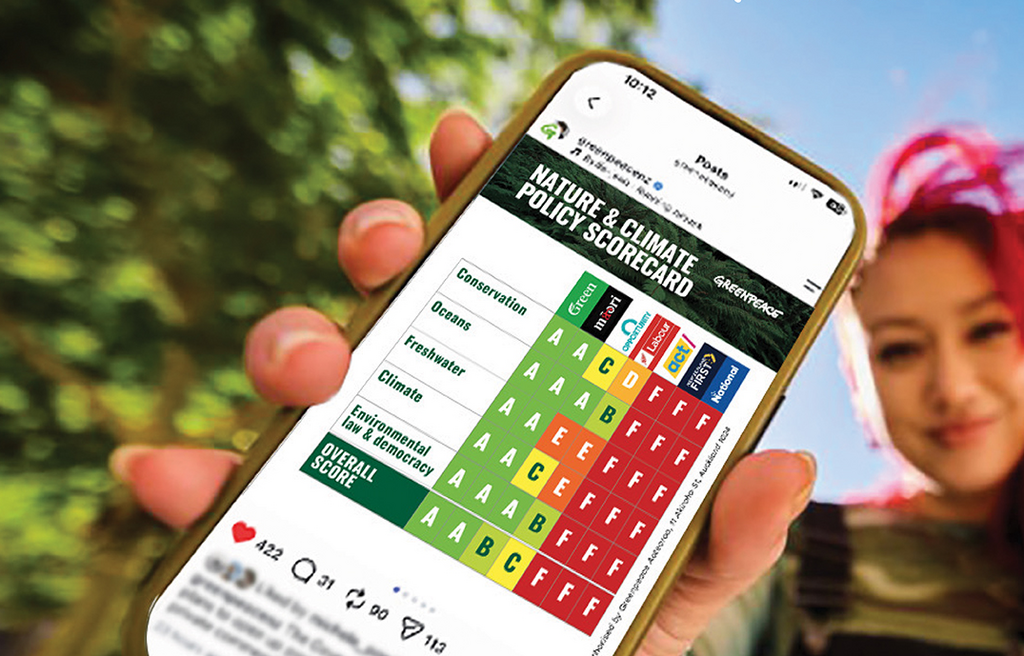
The Greenpeace policy scorecards rank the environmental policies of the seven main political parties for the 2026 General Election.
Use the scorecards to find out which parties have the best and worst policies on conservation, oceans, freshwater, climate, and environmental law. You can also use the scorecard to find out which parties have received donations in the last five years from the industries that need to be regulated to protect nature.
We asked each of the parties the same 20 questions on their policy positions. The results are based on their responses, or their previously established policy positions.
You can also use the scorecard to find out which parties have received donations in the last five years from the industries most affected by environmental protection policies. Many industries have millions of dollars at stake in political decisions, so voters have a right to know which parties those industries are funding – and what those parties are promising for our environment.
Overall environmental scores
The scorecards show that whoever takes the reins of political power in November could lead us in vastly different directions.
Some parties are promising to restore environmental protections that have been stripped away and tackle the industries driving pollution. Other parties plan to drive more mining, more fossil fuels, weaker freshwater rules and more ocean exploitation.
The results are in
Overall across the five priority environmental issues the Green Party and Te Pāti Māori both scored A’s. The Opportunity Party scored with a B while Labour scored a C. The current governing parties Act, NZ First, and National all flunked, receiving Fs in all policy areas.

Nature & climate policy scorecards
Check out the results for each of the five priority environmental issues:
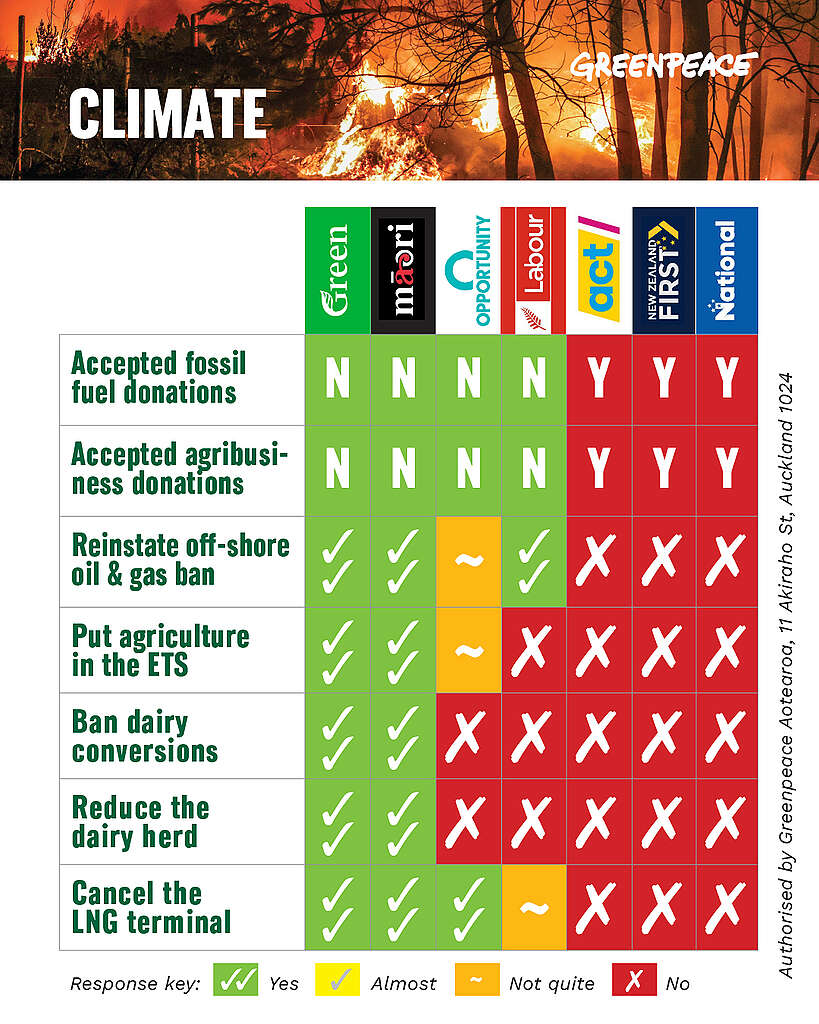
Climate scorecard
You can enlarge and zoom in on the scorecard by clicking on it.
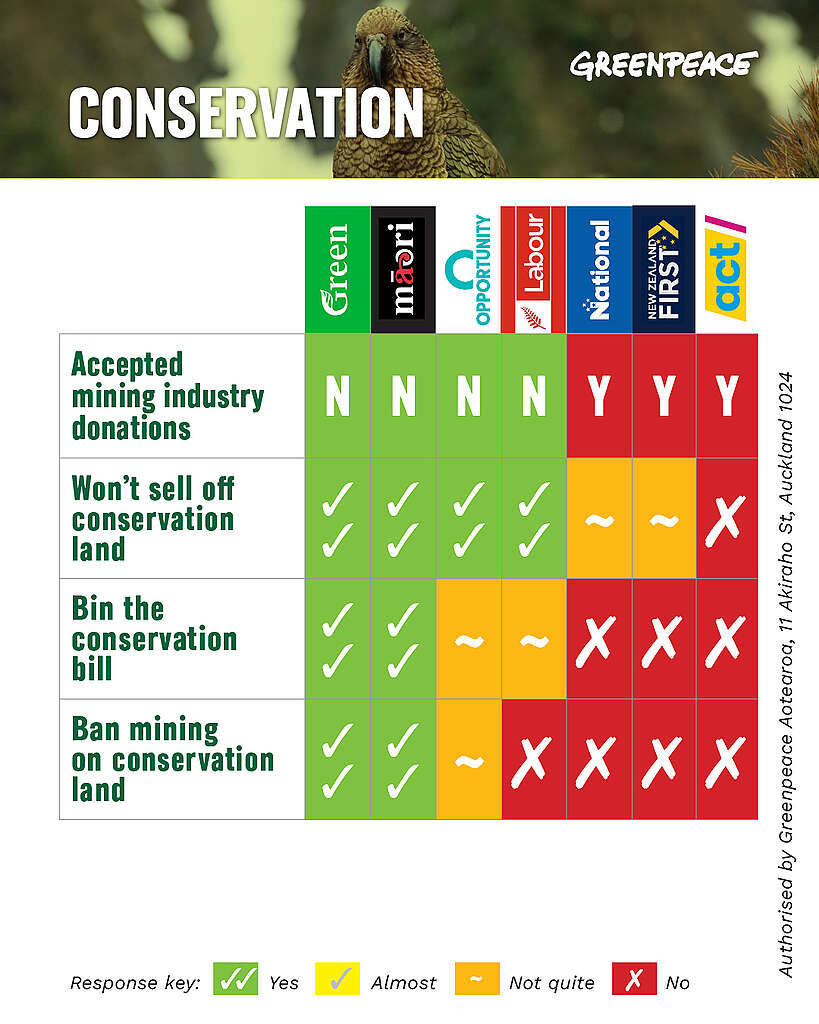
Conservation scorecard
You can enlarge and zoom in on the scorecard by clicking on it.
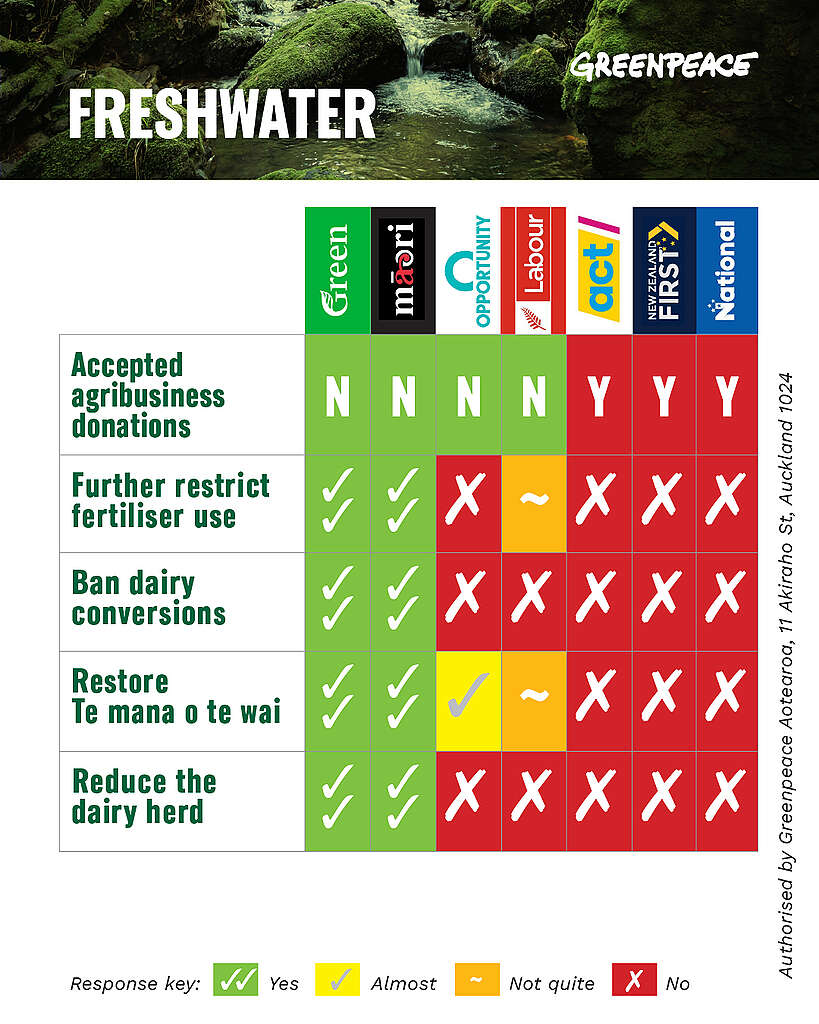
Freshwater scorecard
You can enlarge and zoom in on the scorecard by clicking on it.
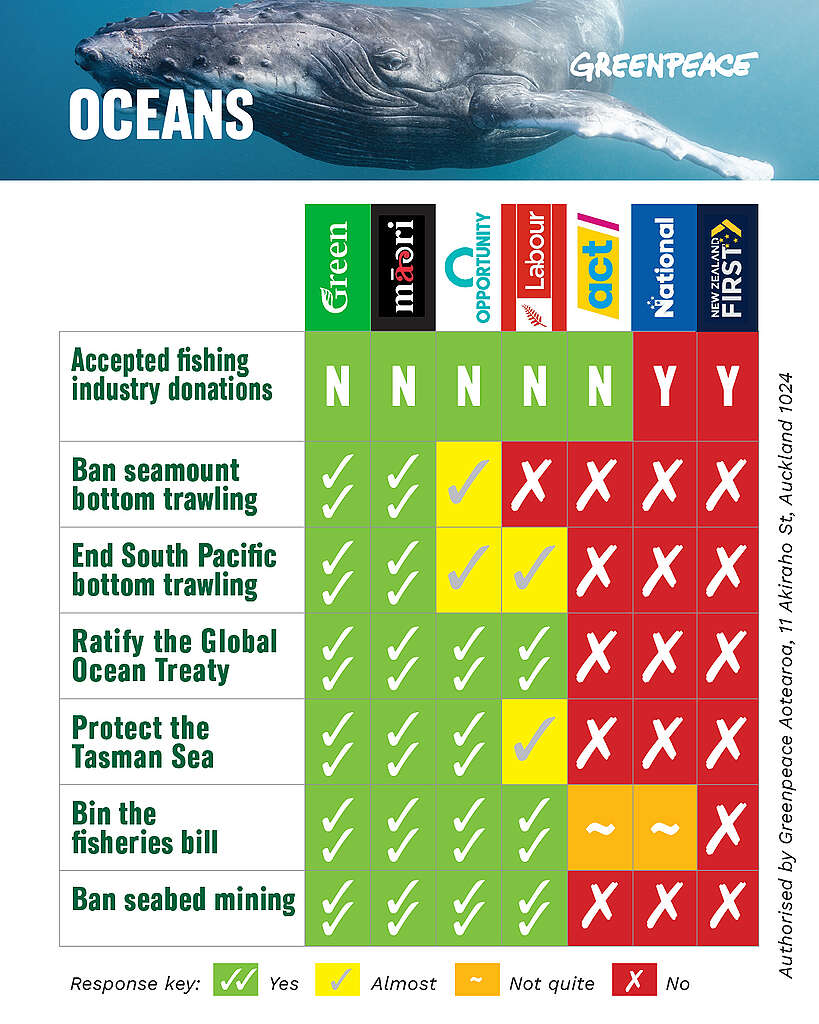
Oceans scorecard
You can enlarge and zoom in on the scorecard by clicking on it.
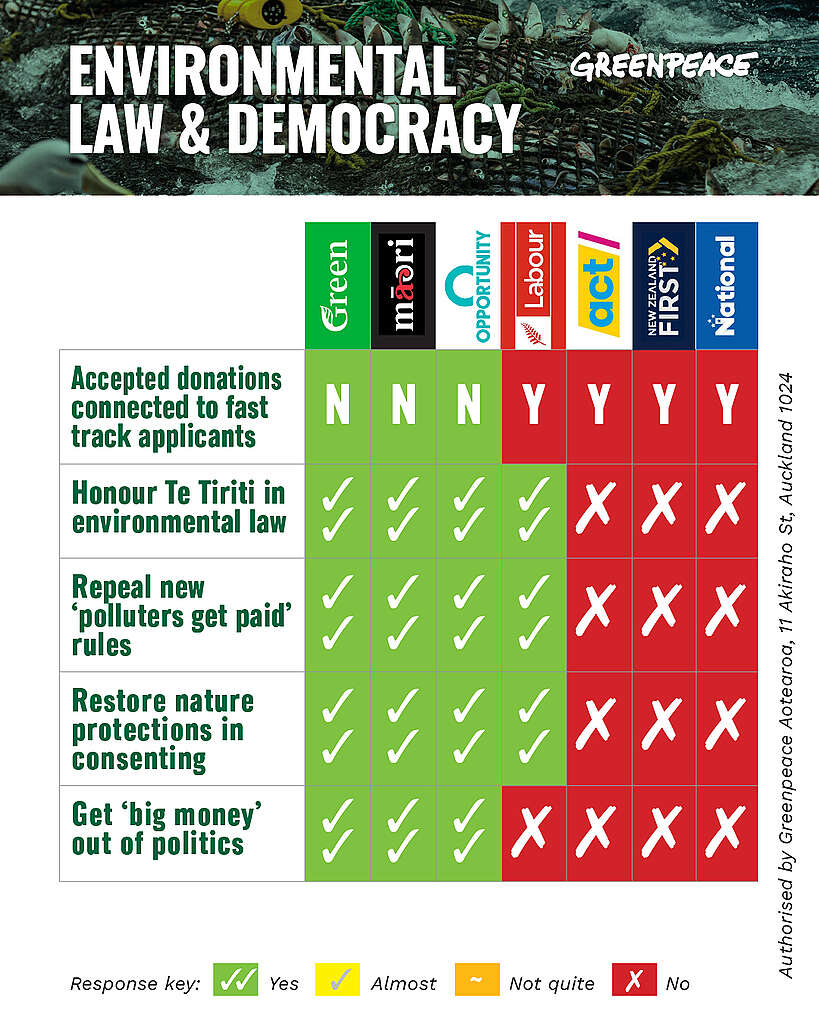
Environmental law and democracy scorecard
You can enlarge and zoom in on the scorecard by clicking on it.
How the environmental scorecards are calculated
Political parties were asked to reply to each question and has been scored based on the following method.
When there was no response to a question, Greenpeace assessed a political party’s position using publicly available evidence over the last parliamentary term.
Parties were also reviewed on their political donations. Greenpeace reviewed Electoral Commission data on donations made directly to political parties from companies operating in a relevant industry, or from an individual with a known connection to that industry, since 2022. Donations made directly to individual candidates were not reviewed or included.
Before publication of the scorecards each party was given a chance to see its provisional score for each question, the evidence used to determine that score, and a chance to supply relevant existing policy evidence that had been overlooked.
Scoring method
🟢 ✓✓ YES — A party has a clear, unambiguous commitment to the policy, or has an existing, explicit and current party policy that commits to the same substantive action.
🟡 ✓ ALMOST — A party supports the substantive policy but places a material qualification on its implementation.
🟠 ~ NOT QUITE — The party supports the general objective but does not commit to the specific policy being scored.
🔴 ✕ NO — Opposes the policy, has a clearly contrary position, or has no identifiable policy position.
Parties were also reviewed on their political donations.
Y — Industry donations identified
N — No industry donations identified
The full breakdown of how we scored the parties based on their responses or stated positions is available below.
Why are we highlighting political donations?
When industries have millions of dollars at stake in political decisions, voters have a right to know which parties they are funding – and what those parties are promising for our environment.
Big industries may have deep pockets, but ultimately voters decide who gets to govern. This scorecard gives people the information they need to look past the political spin, follow the money and vote for a government that will protect nature
Yet the power of the greater numbers of people can still win. If enough people collectively act towards our shared vision we have power. By voting together for the best environmental policies the outcome of the election will work out best for the climate, the conservation estate and for people themselves.
Important dates for the general election
A high number of people who turnout to vote with the environment in mind could have a huge impact on the outcome of the election. Here are the dates to keep in mind for the 2026 general election.
25 October – The last day to enrol to vote
26 October – Advance voting opens
7 November – Election day and last chance to vote. Voting places are open from 9am to 7pm
Authorised by Greenpeace Aotearoa, 11 Akiraho Street, Auckland 1024