In protest over the Conservation Amendment Bill, Greenpeace climbers have hung an eighteen square-metre banner from a giant rimu tree in an ancient West Coast forest.
The action recreates one of New Zealand’s most iconic environmental protests – the Native Forest Action tree occupation and campaign that helped to successfully end logging of native forest on public land.
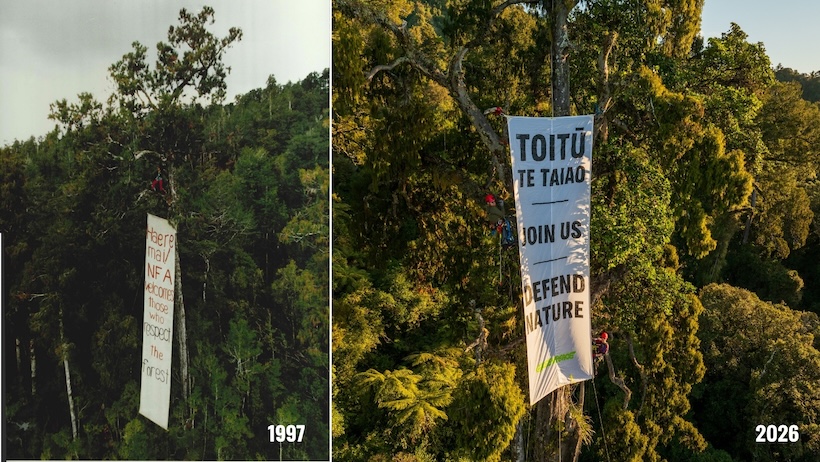
2026 photo: Jase Blair Katabatic Creative; The original Native Forest Action photo: An image from a key poster NFA used for its campaign depicting Pat McNamara in the Awakiri Valley. Produced with support of Tim Barnett, Craig Potton publishing and photographer John McCombe.
Nearly three decades later, on World Conservation Day, Greenpeace says New Zealanders are being called on to defend the forests previous generations fought so hard to save.
“The forests, wildlife and waterways that define Aotearoa are under attack from this Coalition Government’s despicable Conservation Amendment Bill,” says Greenpeace campaigner Gen Toop.
“Hundreds of thousands of New Zealanders spent decades fighting to protect native forests and establish the conservation estate and National Parks we know today. This Government is now trying to dismantle those hard-won protections.”
“Today, on World Conservation Day, we remember all those people who stopped the chainsaws, blockaded the logging roads and defeated all the previous governments that have tried to destroy these native forests before.”
Logging of native rainforest on public land was finally brought to an end in 2002 after decades of public campaigning, including high-profile actions in the podocarp forests of the West Coast, kauri forests of Pūketi, and giant rimu forests of Pureora and Whirinaki-Te Pua-a-Tāne.
The image of the late Pat McNamara suspended high in the forest canopy during a five month long occupation of the Charleston Forest in 1997 by Native Forest Action (NFA) became a defining image of that campaign and inspired people around the country.
The campaign ultimately won an end to native forest logging and saw 130,000 ha of native forest on the West Coast transferred into protection under the Department of Conservation.
Greenpeace says if the Coalition Government’s Conservation Amendment Bill passes it would unravel decades of conservation progress. It proposes to reverse the purpose of the country’s Conservation law from protection, to commercial exploitation “to the greatest extent practicable”, potentially opening conservation land up to logging once more.
“Many native forests only stand today in Aotearoa because people defended them, generation after generation. People who refused to accept their destruction. It’s time for us to do it again,” says Dean Baigent-Mercer, one of the original group who occupied Charleston Forest in 1997.
The banner unfurled by Greenpeace today reads ‘Toitū te Taiao. Join Us. Defend Nature’.
“The generations that came before us fought hard battles, marched, petitioned, occupied trees and never gave up in defence of nature. Today, we inherit that same responsibility to defend these forests for the generations that will come after us, says Toop.
We’re calling on all those who respect the forests, waters and lands of Aotearoa, to join us and defend them from this Government’s Conservation Exploitation Bill.”
Greenpeace is inviting people to join a Nationwide Day of Action on 15 August to say Hands off Conservation Land. The organisation has also teamed up with Forest and Bird and are together inviting people to‘March for Nature’ down Auckland’s Queen Street on September 19.
Notes
- The Native Forest Action campaign to end logging of native forest on the West Coast endured from 1997 till 2002. Helen Clark and the Labour Party committed to a ban prior to the 1999 election. On the first day they were sworn in after the 1999 election they signed an order to stop logging of native forest on public land.
- In May 2001, 130,000 ha of public land was transferred to the conservation estate. About 18,000 ha went to National Parks, Westland Tai Poutini, Kahuranagi and Paparoa, the latter of which increased in size by nearly 25%. Notable and rich additions to the conservation estate included North Ōkarito, Ianthe, Ōpārara, Mokihinui and Saltwater.
- The campaigns to protect the forests of Aotearoa, including NFA’s campaign are documented in the book Fight for Forests by Paul Bensemann.
- Greenpeace Aotearoa is calling for a national day of action on Saturday 15 August to protect the forests of today. People around the country will organise their own actions against the Conservation Amendment Bill. Join or organise an event at binthebill.nz
- Greenpeace Aotearoa with Forest & Bird and allied groups are coordinating a March for Nature. At 1pm on Saturday 19 September 2026 people will come together in Auckland to say ‘hands off conservation land’. Find out more at marchfornature.nz