
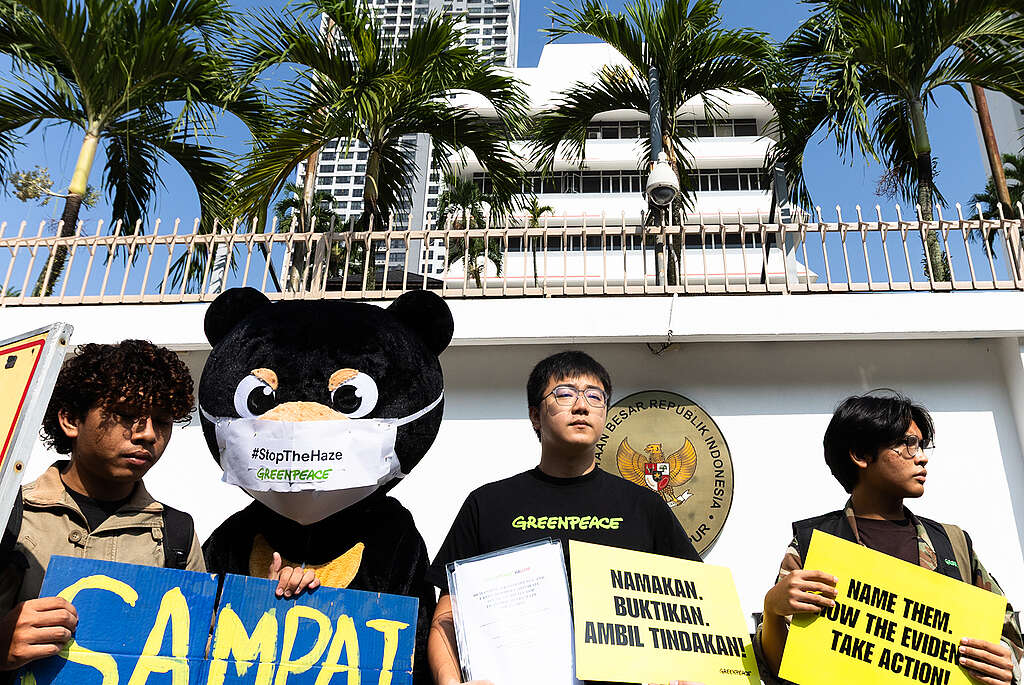
KUALA LUMPUR, 4th September 2026 — Greenpeace Malaysia and Himpunan Advocacy Rakyat Malaysia (HARAM) conducted a peaceful protest and memorandum handover today outside the Embassy of the Republic of Indonesia, in solidarity with haze affected communities and the loss of wildlife, to call the Indonesian Government to expose critical information on fire locations, investigation findings, and concession ownership.
On 31 August, Indonesian authorities announced they were investigating 19 companies holding concessions where fires had affected 11,047 hectares across seven provinces. Authorities said that 42 companies had been identified as holding concessions with high wildfire potential, but the companies under investigation have not been publicly named. [1] The groups are advocating for transparency, and urgent action through corporate accountability, and shared government responsibility in addressing the worsening transboundary haze crisis. Evidence from the Indonesian authorities findings must be made available so that affected countries such as Malaysia, can investigate potential links to companies within their own jurisdictions and supply chains. If Malaysian companies are implicated, Malaysia must take responsibility for investigating, regulating, and taking appropriate action against Malaysian corporate actors tied to the fires in Indonesia. [2]
The organisations stress that the action is to shift the focus to solutions instead of country-versus-country blame. Therefore the memorandum submitted to the Indonesian Embassy outlines several key demands and recommendations for greater transparency, cross-border corporate accountability, and shared government responsibility including calls for:
- The Government of Indonesia formally discloses the concession maps, hotspots, and fire investigation data, and any other evidence in its possession identifying Malaysian-linked companies associated with fires and haze in Indonesia.
- The Government of Indonesia names, specifically and publicly, the Malaysian companies it has identified as being involved, so that Malaysian civil society, regulators and Parliament can pursue accountability within our jurisdiction.
- That the Government of Indonesia commit to sharing such evidence with the Government of Malaysia on an ongoing basis, through existing ASEAN Agreement on Transboundary Haze Pollution (AATHP) mechanisms or direct bilateral channels, rather than through public allegations and press statements alone.
- That both Governments commit to the principle of reciprocal disclosure and enforcement: each state investigates and holds accountable companies domiciled in its own jurisdiction, based on evidence shared openly between them.
Greenpeace Malaysia and HARAM also urges the Malaysian Government to act on credible evidence shared by Indonesia, to ensure that Malaysian companies cannot evade accountability for environmental harm simply because it occurs beyond Malaysia’s borders. Where credible evidence links Malaysian corporate actors to activities contributing to forest fires, peatland degradation, or transboundary haze, Malaysian authorities must have the legal powers and mechanisms to investigate, regulate and, where appropriate, legally hold responsible. This also underscores and strengthens the case for a comprehensive Malaysian legal framework or mechanisms capable of addressing transboundary haze pollution and corporate responsibility across borders.
Greenpeace Malaysia Campaign Manager Heng Kiah Chun said:
“This protest is not about blaming Indonesia for the haze. We understand and acknowledge that Indonesian communities are suffering from these fires too. We are here because the Indonesian government holds information that could help us understand who is responsible, and we are asking them to publicly disclose that evidence. If Malaysian companies are implicated, then we will take that evidence home and demand that our own government hold them accountable. The haze does not stop at Indonesia’s borders, and neither should accountability.”
“At the heart of the haze crisis is a simple question: when companies profit from land and commodities, who pays when forests and peatlands burn? Companies may benefit from land that has been cleared or degraded, but communities bear the consequences. Children breathe polluted air, workers face unsafe conditions, schools and livelihoods are disrupted while governments and families ultimately absorb the health and economic costs.”
HARAM chairman Brendon Gan said:
“There are loopholes in the system which enable large-scale plantations to burn down lands with no legal repercussions whatsoever. This isn’t a climate problem, it’s an enforcement and political problem. While corporate executives sit comfortably in their air-conditioned offices earning millions of dollars in profit, it is the common citizens, workers, students and even the children of Malaysia and Indonesia who are breathing in and dying from the haze. Schools are closing down, and our basic human right to breathe is being taken away from us. Clean air doesn’t have a passport, nor does environmental devastation. We stand firmly in solidarity with the communities in Indonesia who are affected by these fires.”
The transboundary haze pollution is also a test of ASEAN’s commitment to environmental rights. In 2025, ASEAN Member States adopted the ASEAN Declaration on the Right to a Safe, Clean, Healthy and Sustainable Environment, explicitly recognising the growing need to address transboundary environmental concerns. The right to a safe, clean, healthy and sustainable environment also requires access to information and meaningful accountability when environmental harm occurs. Affected communities cannot exercise that right if critical information about who is responsible for environmental destruction remains hidden across borders.
Background Information:
It is worth noting that this is not the first time Malaysian and Singapore-linked corporate actors have been identified or scrutinised in relation to fires and poor land-use practices in Indonesia. A joint Greenpeace research has previously documented fire hotspots within plantations also linked to Malaysian and Singaporean corporations. In 2019, Indonesia’s Environment and Forestry Ministry also sealed land belonging to companies over forest fires, including foreign companies linked to Malaysia and Singapore. [3]
Scientists have warned that severe El Niño conditions this year can intensify drought and fire risks across Southeast Asia, making the protection and restoration of natural ecosystems increasingly urgent. But climate conditions should not become an excuse for inaction. While dry weather creates the conditions for fires, shared decisions about how land is managed becomes the determining factor in how vulnerable landscapes are used as collateral in those fires for quick profits.
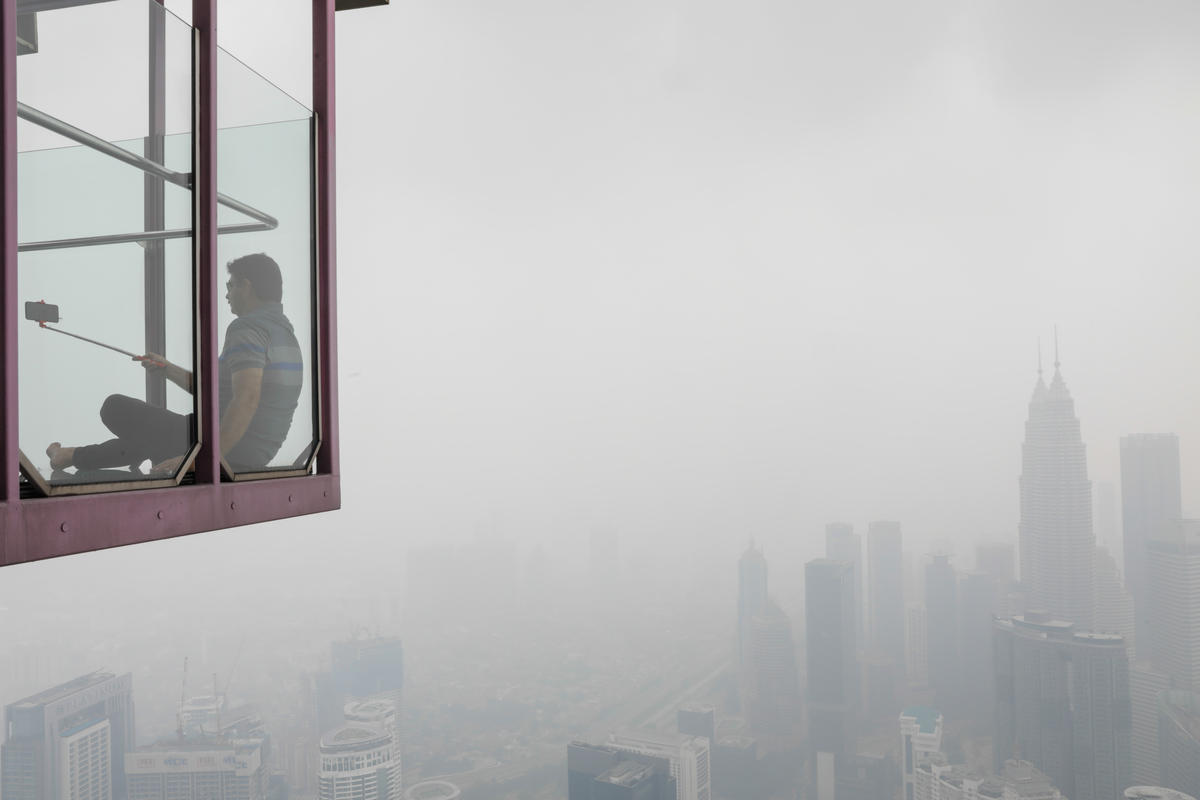
With toxic smoke from forest and peatland fires in Indonesia continuing to affect Malaysia and neighbouring countries, communities across Southeast Asia are once again being forced to bear the health, social and economic costs of a crisis that has persisted for decades. The situation has become particularly severe in parts of Malaysian Borneo, especially Sarawak, where air quality has reached hazardous levels with schools and public events being disrupted and with the Sarawak state government mulling a possible haze emergency for areas above 500 API. [4]
ENDS
Sources:
[1]https://www.reuters.com/business/environment/indonesia-inspects-19-companies-linked-wildfires-official-says-2026-08-31
[2]https://www.reuters.com/business/environment/reducing-indonesia-wildfires-will-be-challenging-el-nio-peaks-this-month-2026-09-01/
[3]https://www.thejakartapost.com/news/2019/09/14/indonesia-seals-land-owned-by-malaysian-singaporean-firms[4]https://www.aljazeera.com/news/2026/9/1/toxic-haze-from-indonesian-fires-chokes-malaysian-borneo
The Memorandum is duly endorsed by the following CSOs, NGOs and actors:
ORGANISATIONS
- Greenpeace Malaysia
- Himpunan Advokasi Rakyat Malaysia (HARAM)
- SUARAM (Suara Rakyat Malaysia)
- KUASA (Persatuan Aktivis Sahabat Alam)
- Ecotourism & Conservation Society Malaysia (ECOMY)
- Pertubuhan Pelindung Khazanah Alam
- Gabungan Darurat Iklim Malaysia (GDIMY)
- Alliance of River Three (ART!)
- Bangsa Mahasiswa Universiti Kebangsaan Malaysia (BMUKM)
- Suara Mahasiswa UMS
- SPARC UTEM
- Federasi Pemuda Kebangsaan (FEDERASI)
- Re-Laut
- MANDIRI
- MUDA
- Kuala Lumpur Residents Action for Sustainable Development Association (KLRA+SD)
INDIVIDUALS
- Nur Sakeenah Omar – Public Engagement Campaigner, Greenpeace Malaysia
- Andrew J Sebastian – President, Founder & Chief Executive Officer, ECOMY
- Qistina Qaisara – Timbalan Presiden MPP UMS