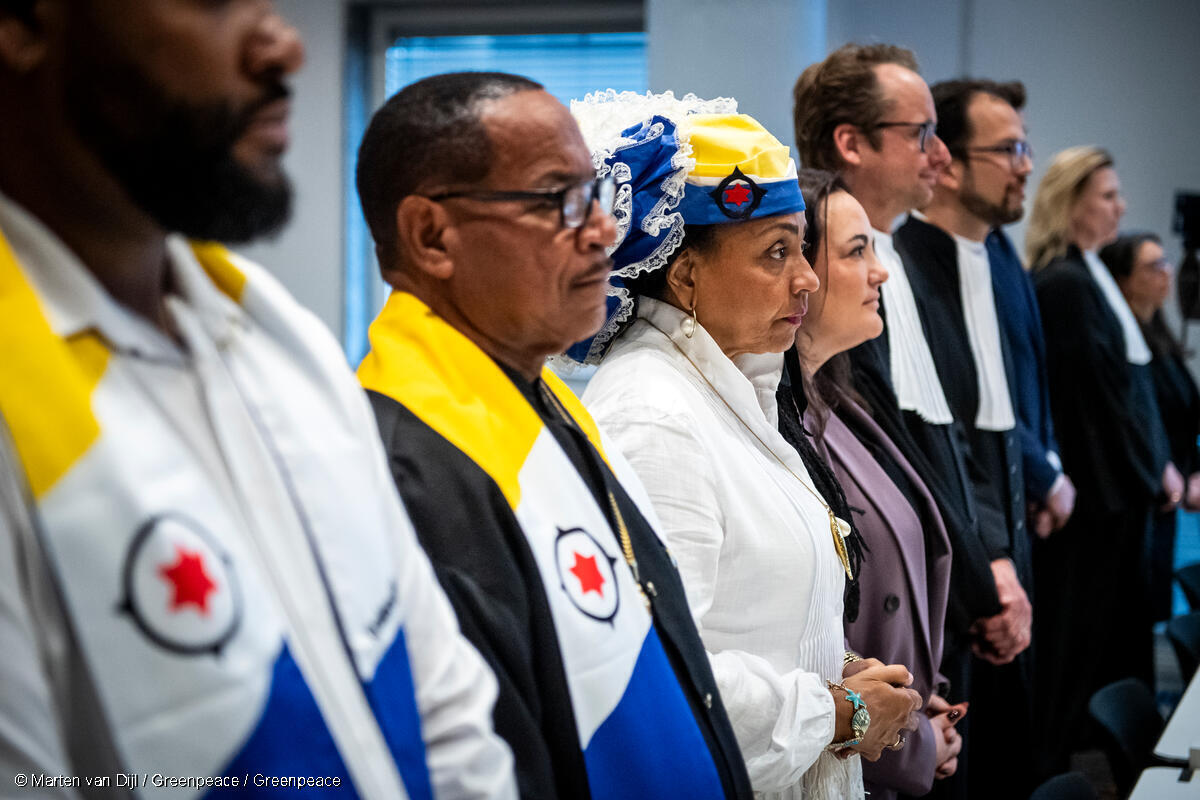
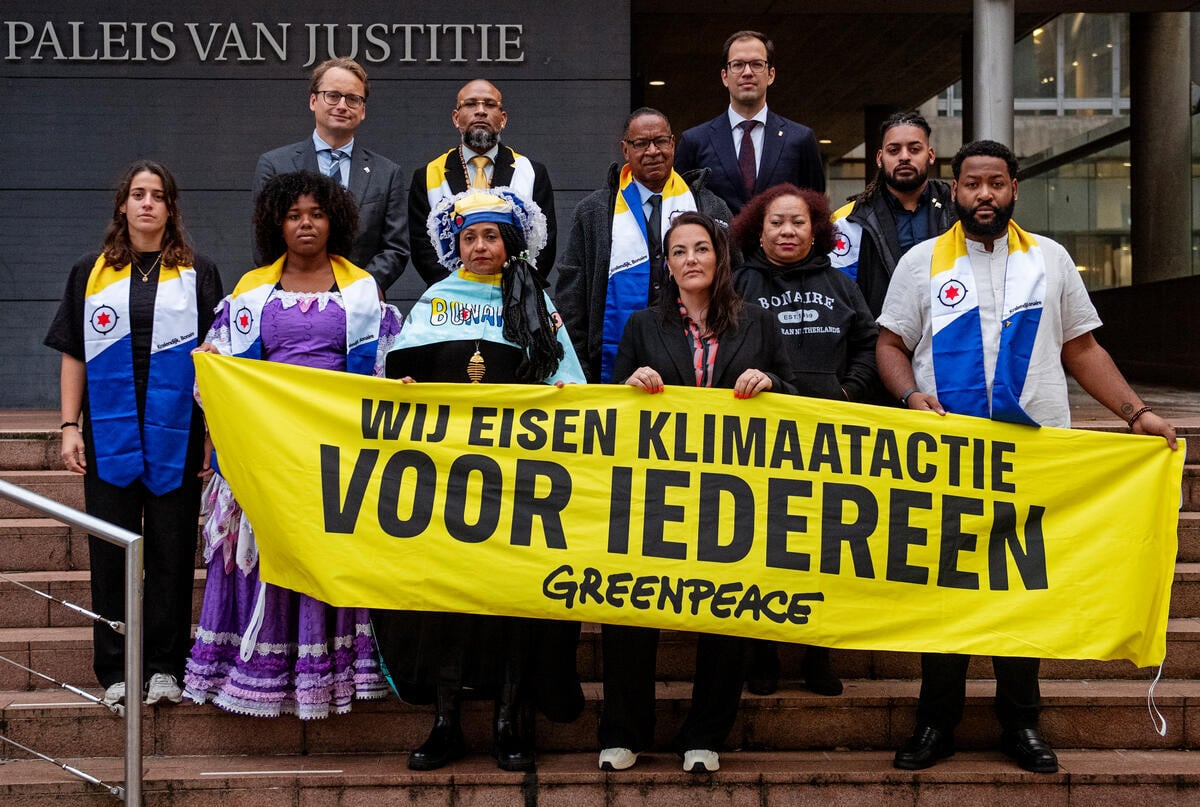
The Hague, January 26, 2026 – On Wednesday, January 28, 2 p.m., the District Court of The Hague will rule on the Bonaire Climate Case, which was brought against the Dutch State by eight residents of the Dutch-Caribbean island Bonaire, together with Greenpeace Netherlands. The court will judge whether the Netherlands is doing enough to protect its own citizens from the effects of the climate crisis. Bonaire is struggling with extreme heat due to climate change, but the Dutch government is failing to take protective measures. The plaintiffs and Greenpeace are demanding a concrete and feasible plan of action to protect Bonaire and urge the government to urgently take more measures to reduce Dutch carbon emissions to zero. “It would be a victory of historic significance, should the court ruling force the State to take concrete measures to protect people from extreme weather and other consequences of the climate crisis,” explains Marieke Vellekoop, director of Greenpeace Netherlands.
First court case on adaptation and test case following international rulings
This is the first case in Europe in which a judge could rule that a country must develop adaptation measures to protect citizens from climate change. It is also one of the first climate cases following the ruling of the European Court of Human Rights in the KlimaSeniorinnen case and the recent Advisory Opinion of the International Court of Justice in The Hague. In the latter, the Court ruled that states must keep global warming to below 1.5°C and that their climate plans must show maximum ambition, taking into account historical emissions and prosperity. This means that countries like the Netherlands have an obligation to do more. This case is therefore the first major test case following the groundbreaking rulings of international courts, and could set a precedent of global relevance.
Marieke Vellekoop, director of Greenpeace Netherlands: “This climate case is crucial. First and foremost for the people of Bonaire, but also for all of us. Residents of Bonaire are already experiencing the effects of climate change on a daily basis, yet receiving less protection than people in the European Netherlands. That is unjust and unacceptable. It shouldn’t matter where you were born: everyone has the right to protection against floods, storms and extreme heat.”
Jackie Bernabela, plaintiff in the Bonaire Climate Case: “This court case offers a glimmer of hope. We, eight citizens of Bonaire, are pursuing this case with Greenpeace Netherlands in order to give leaders a wake up call. We challenge the slow erosion of hope. Because hope is the cornerstone of action. And we need action now. Wealth will not save you when the water rises. Power will not save you when disease spreads. Only compassion, courage, and unity will.”
Government prioritizes big polluters over climate and people
Dutch politicians have significantly watered down climate policy in recent years, and the (caretaker) government is failing to meet the climate target set out in the Dutch Climate Act. Instead, the cabinet is subsidizing fossil fuels and abolishing the CO2 tax for companies. During the formation of the new cabinet, no choices have yet been made that would bring emissions down. “The cabinet is shielding major polluters at the expense of the climate, people, and the future of our planet. It’s not enough to keep the climate targets in sight, we have to achieve them and to accelerate them. It’s high time they stop delaying and postponing. The only way to reduce emissions quickly is by implementing robust and fair measures,” explains Vellekoop. The residents of Bonaire and Greenpeace demand that the Netherlands at least comply with the Dutch Climate Act and contributes its fair share to keeping global warming below 1.5 degrees. This means reducing carbon emissions to zero as quickly as possible. This can be achieved in the Netherlands by 2040.
The Bonaire Climate Case
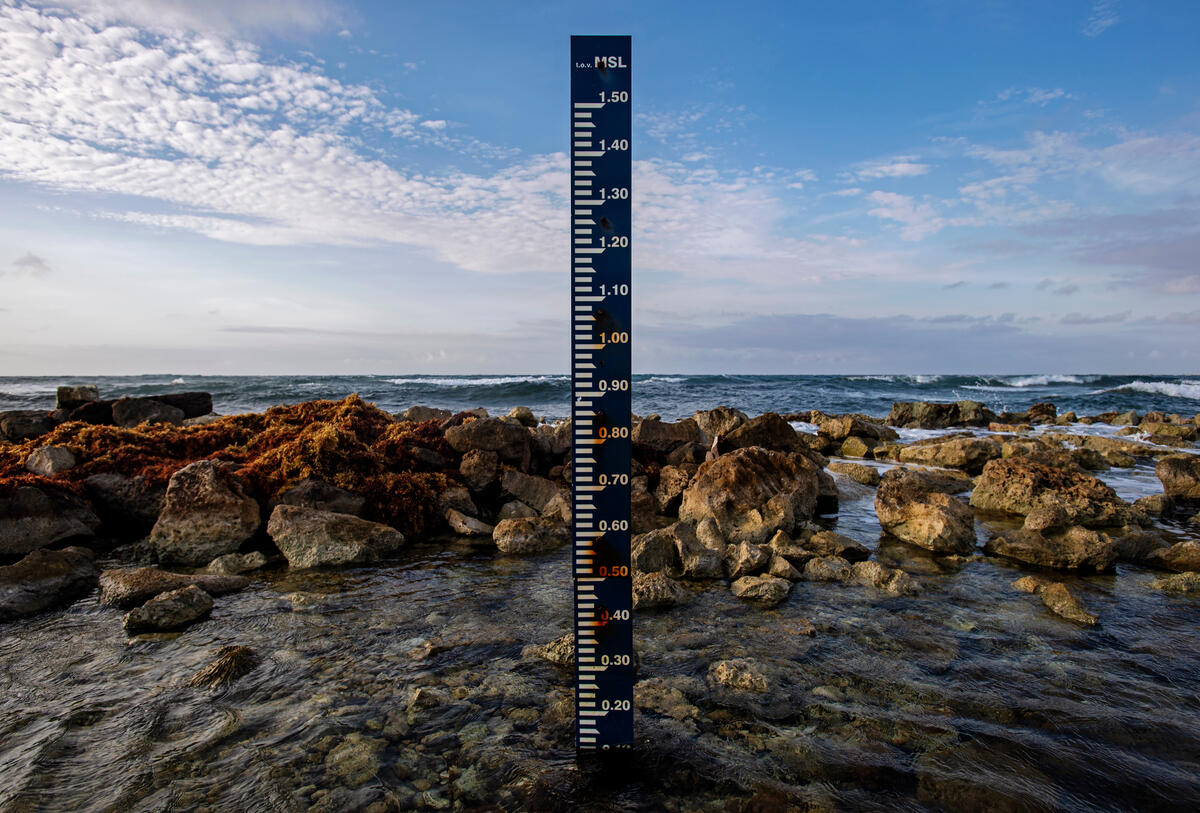
Research commissioned by Greenpeace Netherlands shows that the climate crisis is already affecting daily life on Bonaire. People are experiencing health issues due to the severe heat. Rising sea levels, extreme weather, and dying coral reefs pose major risks to residents. Without action, up to a fifth of the island could disappear under water by the end of this century. That is what motivated eight residents of Bonaire and Greenpeace to take legal action together, demanding fair climate policy from the Dutch government. They are represented by lawyers from the law firms Kennedy van der Laan and Prakken d’Oliveira. The hearings took place on October 7 and 8, 2025, attended by the eight plaintiffs.
For more information:
Laura Polderman – Greenpeace press officer
+31 (0)6 2900 1140 – [email protected]
Greenpeace general press number: +31 (0)6 2129 6895
Saskia van Aalst – Greenpeace press officer on Bonaire
+31(06) 25031014 – [email protected]
The ruling can be followed via a livestream from the court. Onnie Emerenciana and Jackie Bernabela, plaintiffs in the Bonaire Climate Case, will be present at the ruling, together with Marieke Vellekoop, director of Greenpeace Netherlands. The verdict will be published at 3 p.m. on Rechtspraak.nl.