


A new Greenpeace Ukraine report assesses damage and warns about the consequences of the Russian war crime ahead of the 40th anniversary of the Chornobyl disaster
14 April 2026, Kyiv – The Russian war against Ukraine is a direct threat to international efforts to fix the severe damage to the Chornobyl New Safe Confinement (NSC), Greenpeace Ukraine warns ahead of the 40th anniversary of the Chornobyl disaster.
The destruction was caused by a Russian drone attack last year. The ruins of reactor 4 and the Sarcophagus are contained inside the NSC. The Sarcophagus is required to be dismantled as soon as possible but the damage to the NSC means it cannot. Without urgent repairs to the NSC, the Sarcophagus is at increased risk of collapse, a new report from Greenpeace Ukraine finds.
The report was written by engineer Eric Schmieman, who worked at Chornobyl over many years to design and construct the NSC. On 9 April, a Greenpeace investigating team held a joint briefing with the Director of the Chornobyl plant where the risks to the Chornobyl NSC and plans for its restoration were discussed. The severe risks to the Chornobyl plant resulting from Russia’s attack were explained by Director Serhii Tarakanov, including the potential collapse of the Sarcophagus. The Greenpeace report will be submitted to the Office of the Prosecutor General of Ukraine as independent evidence of Russian war crimes.
“In April 1986, Ukraine and the world suffered the worst nuclear disaster in history. Today, decades later, the radioactive hazards at Chornobyl remain – with all efforts being made to contain and manage its toxic legacy. These are incredibly complex challenges. The Russian drone strike has now increased the risk that the Sarcophagus will collapse before it can be carefully dismantled. Greenpeace has a simple and clear message: the Russian crime of attacking Chornobyl must be punished, including maximum sanctions against its nuclear agency, Rosatom”, said Shaun Burnie, senior nuclear specialist at Greenpeace Ukraine.
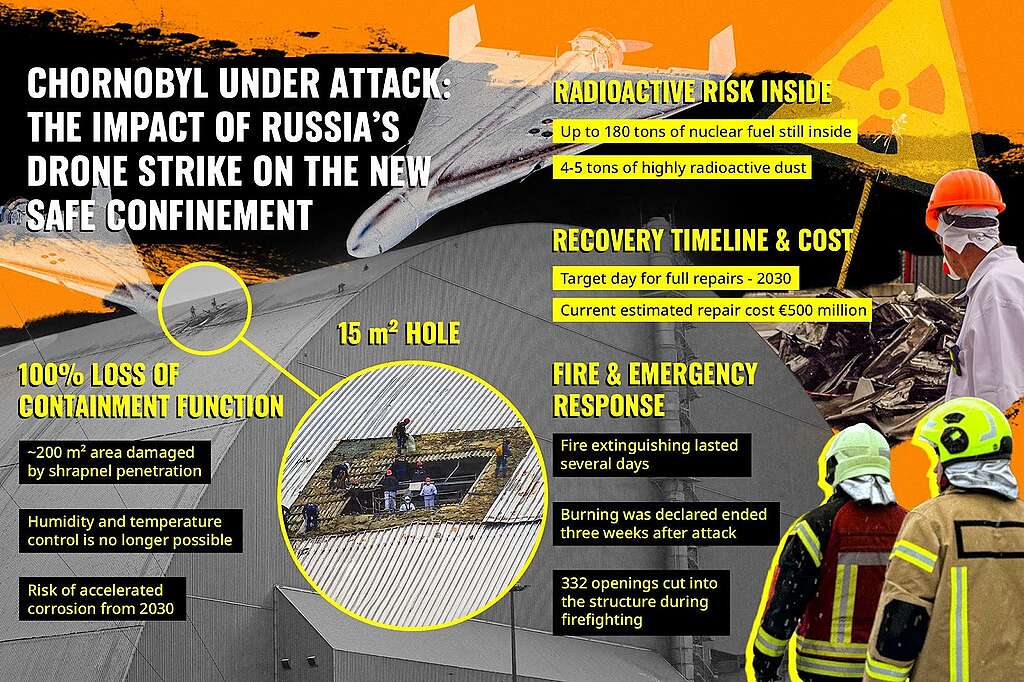
Inside the NSC is the Shelter Object or Sarcophagus which contains the ruins of Chornobyl reactor unit 4, destroyed forty years ago this month. A timetable of four years to fully investigate and carry out repairs at the NSC has been agreed by Ukraine and its international donor nations. However, the Chornobyl plant is under constant threat from Russian missiles and drones, including loss of essential electrical power. Investigations and damage assessments are already underway but under such war conditions it will be near impossible to start major engineering works at the site.
“It’s almost impossible for people to grasp the magnitude of the lethal conditions inside the Sarcophagus. Tons of highly radioactive nuclear fuel, dust and debris. My colleagues and I spent years investigating inside the ruins of Chornobyl reactor 4. We designed and built the New Safe Confinement to protect the environment and people of Ukraine and Europe. It is urgent that all measures are taken to find a way to restore as much of the critical functions of the facility as possible”, said engineer Eric Schmieman.
Greenpeace Ukraine also held a protest against Russia’s drone attack inside the Chornobyl New Safe Confinement, calling for maximum sanctions against Rosatom and continued international support for Ukraine. Standing beneath the Sarcophagus, two activists highlighted the fact that Russia’s drone attack has increased the risk to one of the world’s most hazardous nuclear sites and threatens global efforts to contain its radioactive legacy.
On the first day of Russia’s full-scale invasion, personnel from Rosatom, Russia’s state nuclear corporation, were part of the attack and occupation of Chornobyl nuclear plant. Four years later Rosatom still illegally occupies the Zaporizhzhia nuclear plant. However, all efforts to secure punitive international sanctions against the criminal enterprise Rosatom have been blocked, principally by Hungary and France, while billions of euros are traded in their contracts with Rosatom, directly funding Russia’s war against Ukraine.
“Greenpeace today stands with Ukraine in support against Russian criminal attacks including at Chornobyl. The EU is absolutely right to support Chornobyl and Ukraine’s other nuclear plants against Russian missiles and drones. But it also means ending the duplicity of doing business with the very ‘partners’ that are responsible for war crimes in Ukraine. It means putting real and increased pressure against Russia, terminating all nuclear trade and applying punitive sanctions”, said Jan Vande Putte, radiation protection specialist at Greenpeace Ukraine.
Link to pictures: https://media.greenpeace.org/shoot/27MZIFJH63JYZ
Media enquiries:
Daryna Rogachuk – Greenpeace Ukraine, Kyiv – [email protected]
Cell +380 (63) 598 2600
Theresa Gral – Greenpeace CEE, Vienna – [email protected]
Cell – 43 650 375 1987
Notes
Eric Schmieman led the Battelle Memorial Institute team during the conceptual design of the NSC from 2001 to 2014. He served as the Manager of Environmental Safety and Health Department of the Chornobyl NSC Project Management Unit (PMU), and was the Senior Technical Advisor to the PMU Director. He lived in Slavutych, Ukraine from 2006 to 2013.
While employed at Pacific Northwest National Laboratory, he contributed to projects funded by the US Department of Energy, the US Nuclear Regulatory Commission, the International Atomic Energy Administration, and other government agencies.

