Satellite imagery has revealed Russia’s construction of a new electricity transmission line along the M18 “Highway of Death,” linking Mariupol to Henichesk. The new infrastructure forms a critical part of Moscow’s plan to connect the temporarily occupied Zaporizhzhia Nuclear Power Plant (ZNPP) to the temporarily occupied territories, including Crimea, and the Russian power grid. The project highlights the Kremlin’s plans to permanently integrate the occupied plant into Russia’s energy system. Greenpeace Ukraine’s analysis, however, is that the overall Russian project is increasingly unlikely to succeed and must be stopped to reduce nuclear risks.
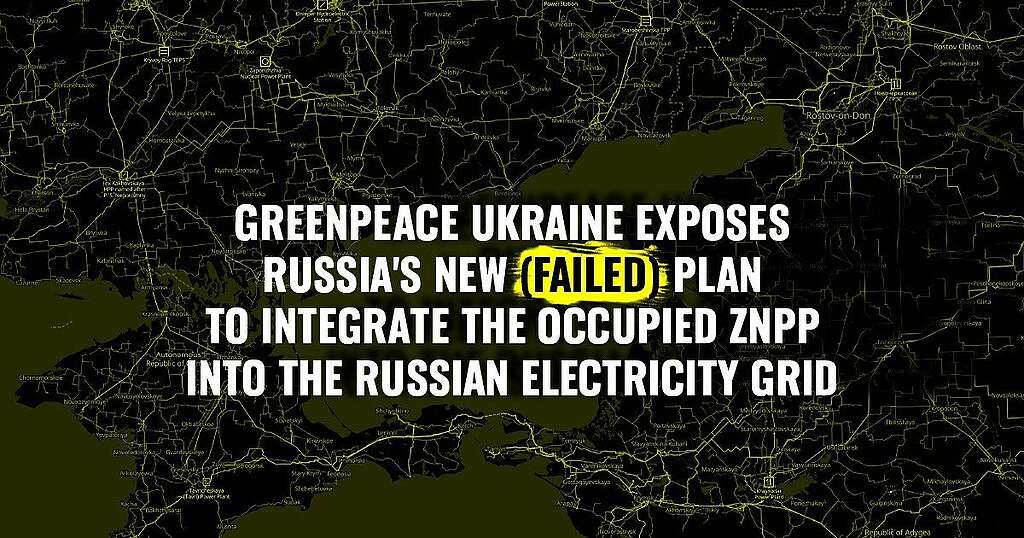
A new Greenpeace Ukraine analysis, based on high-resolution satellite imagery collected between January and July 2026, documents the construction of a new high-voltage electricity transmission line along the M18 highway between the temporarily occupied Melitopol in Zaporizhzhia Region and Henichesk in the temporarily occupied part of Kherson Region. The line, intended to become part of Russia’s effort to reconnect the temporarily occupied Zaporizhzhia Nuclear Power Plant (ZNPP) to the Russian electricity grid, was nearing completion in May before construction was disrupted by repeated Ukrainian drone strikes, including an attack on the Henichesk substation in early July.
Greenpeace Ukraine’s analysis concludes that the new transmission line is designed not only to support Russian military logistics and extractive industries in temporary occupied southern Ukraine, but also as a key element of Moscow’s long-term plan to transmit electricity from the temporarily occupied ZNPP to temporarily occupied territories (including Crimea) and southern Russia.
The report also warns that IAEA Director General Rafael Grossi is reinforcing Russian narratives by suggesting that reactor restarts under Rosatom could be feasible, while failing to emphasise that Russia’s continued occupation of the ZNPP fundamentally violates international nuclear safety and security principles.(2)
“Since 2022, Russia has used its occupation of the Zaporzhzhia nuclear plant as a terror weapon against Europe. In all its other objectives it has failed and will most likely continue to fail, including to reconnect to the temporarily occupied grid and restart reactors. This new electricity line from Melitopol will not reverse the direction of travel that increasingly makes Russia’s occupation of the ZNPP a doomed project. However, the continuing nuclear safety risks posed by Russia at ZNPP mean that the priority of the international community, including the IAEA, must be to accelerate the end to Russia’s occupation of ZNPP through all means, including punitive sanctions”, said Jan Vande Putte, nuclear energy specialist at Greenpeace Ukraine.
In summary, Greenpeace Ukraine analysis reports that Russian strategic objectives with the Zaporizhzhia nuclear plant are:
- Disconnect ZNPP from Ukraine grid
- Restart ZNPP
- Power industry in the temporary occupied Donbas
- Mineral extraction, agriculture in the temporary occupied territories (TOT) for export → fund Russian war
- Electricity to TOT, military logistics
- Electricity supply to southern Russia.
The construction of the new Melitopol – Heniches’k grid line is only part of the overall Russian plan to retain long term occupation of ZNPP and to supply electricity across the TOT of Zaporizhzhia, Kherson, Donbas, Crimea and into the southern Russian energy grid. Rosatom is considering ZNPP as a less expensive alternative to the construction of new nuclear reactors in the Rostov and Krasnodar regions of Russia. While Russian plans for ZNPP look increasingly unattainable, the dangers posed by their illegal occupation are only increasing. Loss of electricity and cooling function to the reactors, and in particular the spent fuel pools, would risk a major release of radioactivity, and is a hazard entirely due to Russia’s occupation and war against Ukraine.
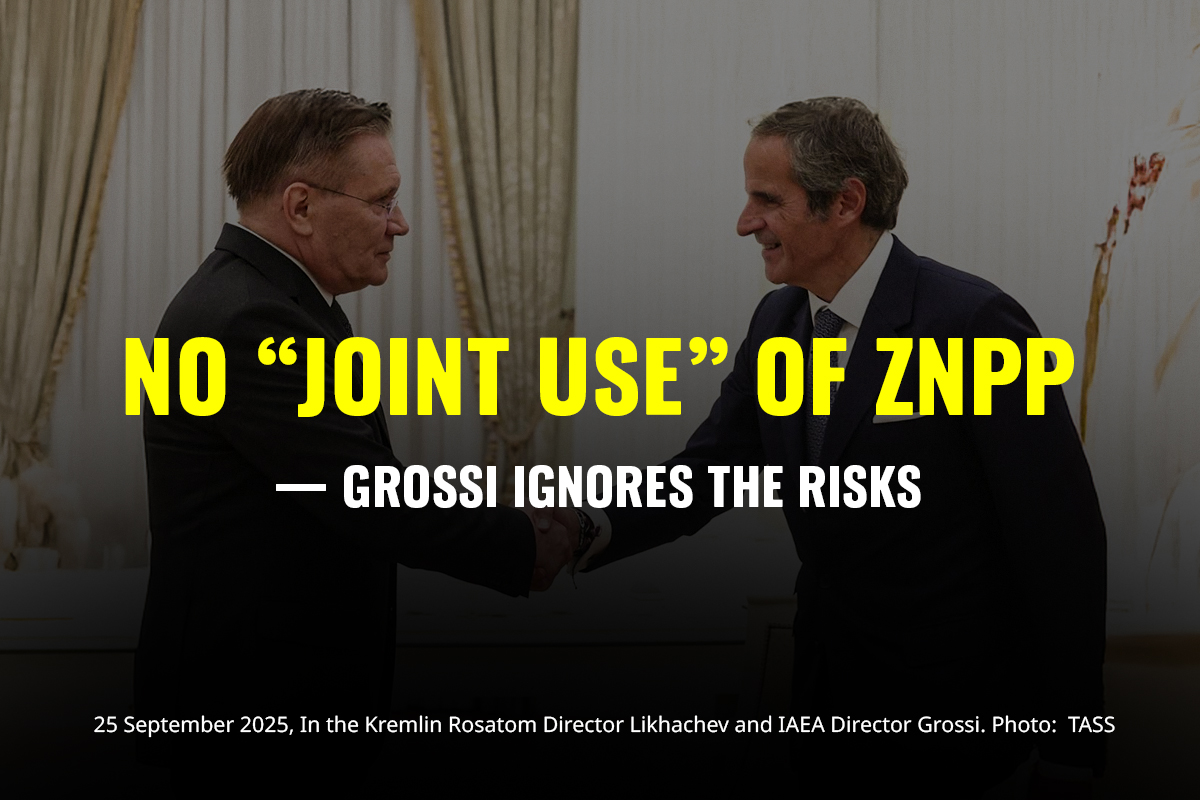
The Russian strategy has been to pressure IAEA Director General Rafael Grossi into following their false narrative on ZNPP, including the so-called inevitability of Russia’s long term occupation of the plant and the restart of the reactors under Rosatom control. Grossi has repeated the propaganda claims of Rosatom Director Alexei Likhachev that restart is feasible and that there are potential agreements for operating the plant to share electricity.(3)
“IAEA Director General Rafael Grossi continues to undermine international efforts to end Russia’s illegal occupation of the Zaporizhzhia Nuclear Power Plant. It is extraordinary that someone seeking to become the next UN Secretary-General is promoting a position that contradicts multiple IAEA Board of Governors resolutions and the principles of the UN Charter. Russia’s plans to restart the reactors and integrate the plant into the Russian power grid are both illegal under international law and increasingly unrealistic. That is the message the IAEA should be delivering to Rosatom and the Russian government,” said Shaun Burnie, senior nuclear specialist at Greenpeace Ukraine.
Greenpeace Ukraine has investigated and exposed Russian plans to restart the Zaporizhzhia Nuclear Power Plant since 2023. In September 2025 we reported that Russian proposals to potentially share the electricity output of ZNPP were indication of a weakening in Russian options for the nuclear plant.(5)
Notes
2 – BBC, IAEA: Joint use of the ZNPP by Ukraine and Russia is possible. The Chernobyl sarcophagus must be repaired after Moscow’s attack, 26 April 2026, seehttps://www.bbc.com/ukrainian/articles/cde5el7y6ddo and Grossi interview with Russian media Kommersant, “I always try to approach all issues as impartially as possible.” 15 March 2026, see https://www.kommersant.ru/doc/8512521?from=glavnoe_1
3 – Rosatom has allowed the restart of the Zaporizhzhia NPP to take place in the foreseeable future – State Corporation CEO Alexey Likhachev identified two important conditions for restarting the station, 5 June 2026, see LINK
4 – IAEA, IAEA Board of Governors September 9-13, 2024, Agenda Item 9, Nuclear Safety, Security and Safeguards in Ukraine U.S. Statement, see https://vienna.usmission.gov/wpcontent/uploads/sites/54/2024/09/Agenda-Item-9-September-BoG-2024.pdf
5 – TASS, Russia ready to cooperate with United States, Ukraine at Zaporozhye nuke plant — Putin, 2 September 2025, see https://tass.com/politics/2010895