Hope is a natural resource too, and it can sometimes feel in short supply. Here are 10 important and inspiring wins for people and the planet this year: let’s joyfully celebrate them and renew our strength to keep pushing for change in 2022. Forward!

1. Netherlands – Court orders oil giant Shell to cut emissions
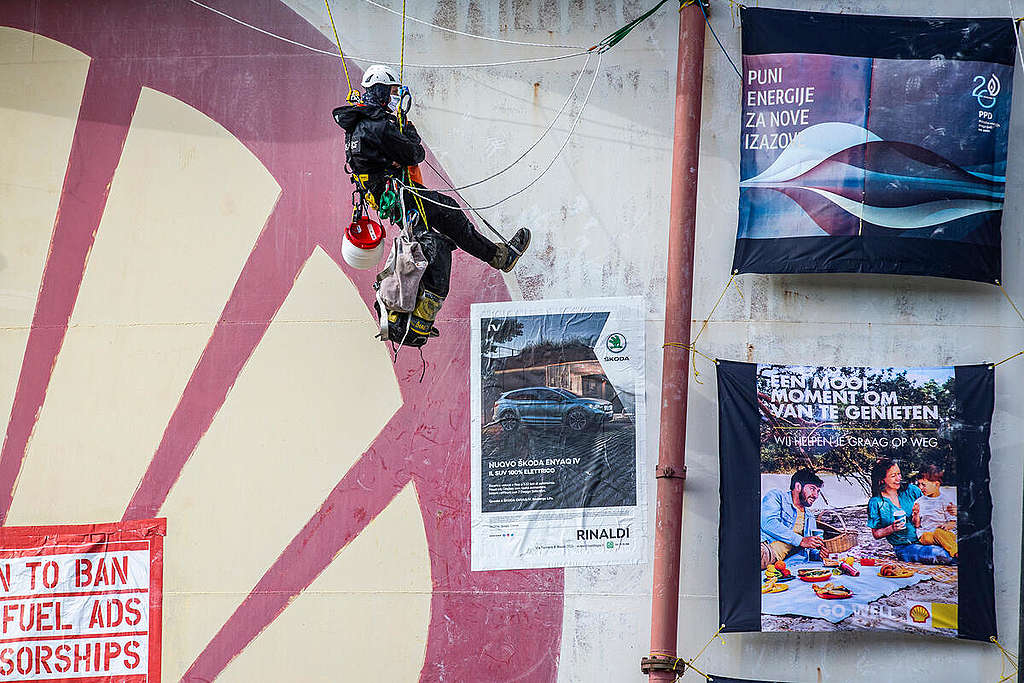
Blockade of Shell's Harbour in Rotterdam. © Bart Hoogveld / Greenpeace
October 2021 – Blockade of Shell’s Harbour in Rotterdam – Greenpeace NL activists climb a Shell oil silo in Pernis, the Netherlands, and paste advertisements for fossil fuel industries. © Bart Hoogveld / Greenpeace

In a historic verdict, a Dutch court ruled that Shell is liable for damaging the climate. It is the first time that a major fossil fuel company is held accountable for its contribution to climate change and ordered to reduce its carbon emissions throughout its whole supply chain. Shell is one of the 10 most climate polluting companies in the world. 

This verdict means that Shell now has to radically change course and reduce its CO2 emissions by 45% by 2030, in line with limiting global warming to 1.5 degrees. The climate case was brought by Friends of the Earth Netherlands (Milie�nsie), along with Greenpeace Netherlands, ActionAid, Both ENDS, Fossielvrij NL, Jongeren Milieu Actief, the Waddenvereniging and 17,379 individual co-plaintiffs.

2. Canada – Keystone XL oil pipeline canceled
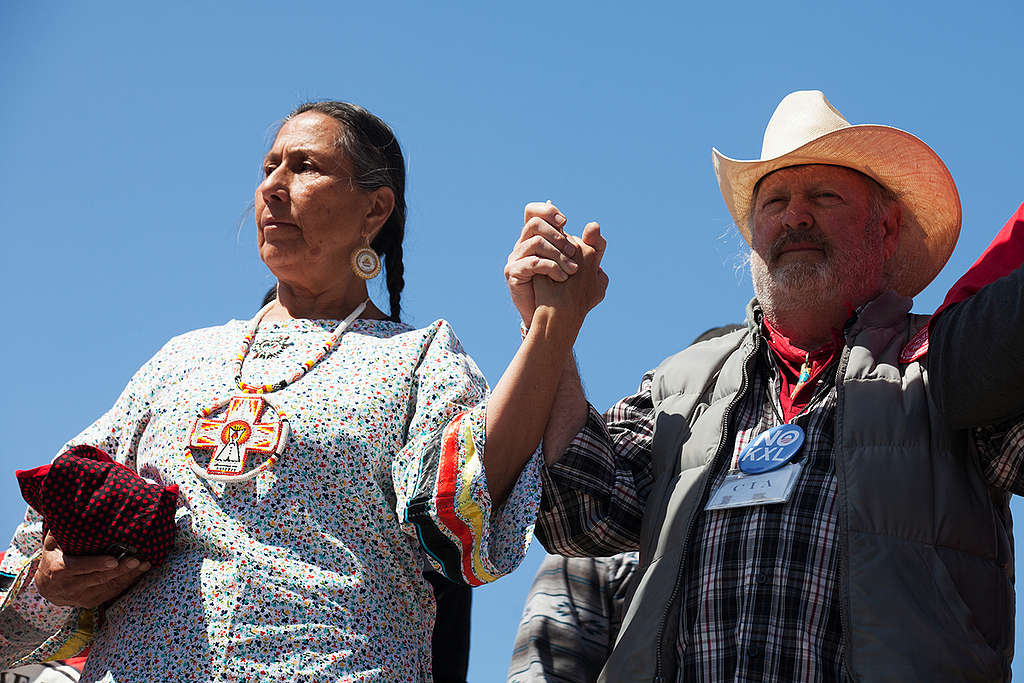
"Reject & Protect" at Lincoln Memorial in Washington D.C. © Douglas Reyes-Ceron / Greenpeace
The Reject and Protect movement led an action at the Lincoln Memorial, protesting the Keystone XL pipeline in 2014. The Cowboy Indian Alliance led the action on the national mall with signage and a large replica of the proposed pipeline. © Douglas Reyes-Ceron / Greenpeace

In June 2021, the Calgary-based company TC Energy canceled the problem-plagued Keystone XL pipeline. This is a major victory for people who’ve been resisting new fossil fuel infrastructure and calling for alternatives and it was made possible by Indigenous communities who resisted this destruction on their lands — and never gave up. People power will light the way to a world beyond fossil fuels!

In the United States and Canada, at least 21 fossil fuel projects have been prevented or delayed by Indigenous-led resistance. That’s the equivalent of 400 coal-fired power plants’ worth of pollution, according to analysis from the Indigenous Environmental Network (IEN) and Oil Change International.

3. Indonesia – Landmark victory against air pollution
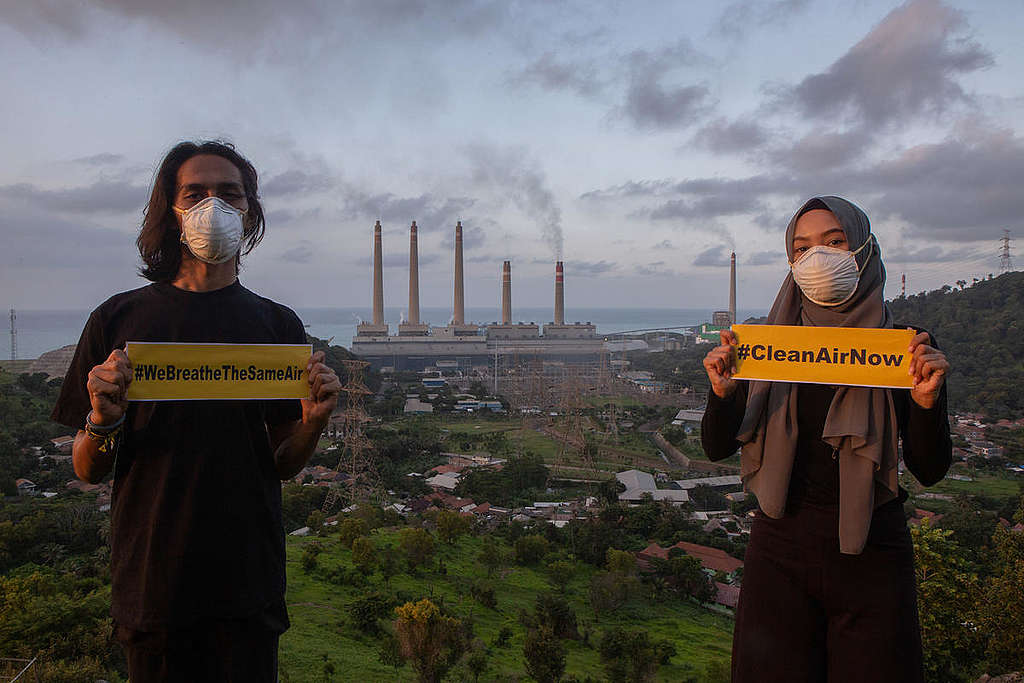
Clean Air Now Photo Op in Banten. © Rendra Hernawan / Greenpeace
Greenpeace volunteers hold signs reading “Clear Air Now” in front of  the Suralaya coal power plant in Cilegon city, Banten Province, Indonesia (February 2020). © Rendra Hernawan / Greenpeace

As COP26 was coming to a close in Glasgow, the Central District Court of Jakarta has ordered President Joko Widodo as well as the Governor of Jakarta to clean up Jakarta’s notorious air pollution, ruling that the Indonesian administration had been negligent in protecting citizens.

This landmark victory for class action and environment campaigners in Indonesia ends a two-year legal challenge brought by 32 Jakarta citizens against Indonesian President Joko Widodo, three cabinet ministers, the Governor of Jakarta, and two provincial leaders.

4. France – Court ruling against the French State’s climate inaction
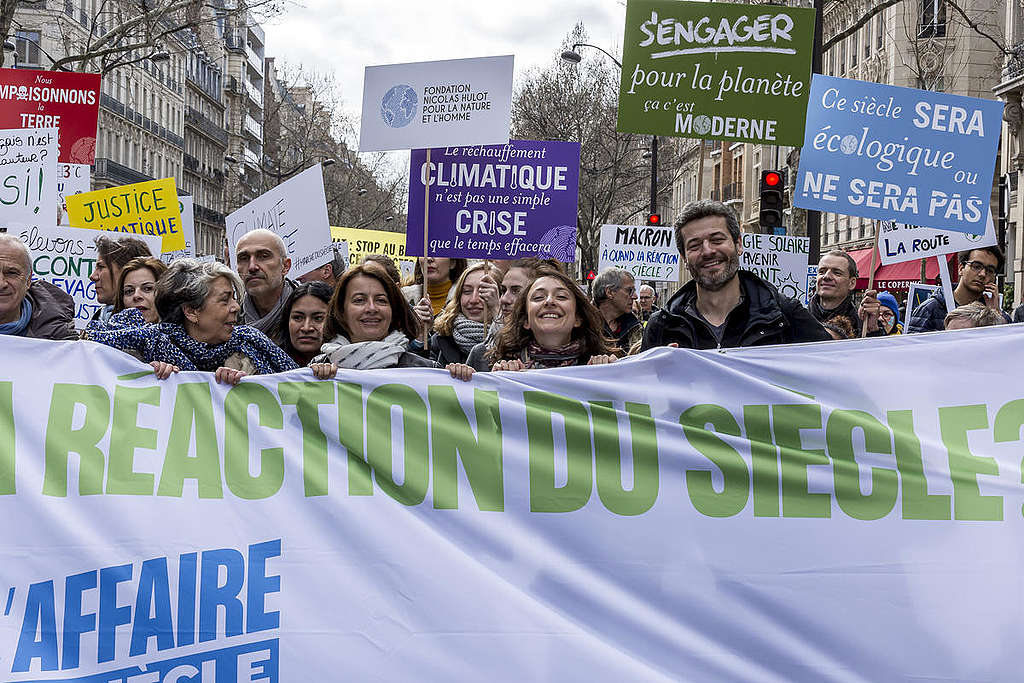
Walk for the Climate in Paris. © Omar Havana / Greenpeace
Protesters and NGO directors hold a banner of the L’Affaire Du Siecle campaign organised by a collective of environmental organisations during a demonstration on climate change in Paris, France. (march 2019) © Omar Havana / Greenpeace

This is another major victory for the climate: in February 2021, a landmark ruling by the Paris Administrative Court found the French State at fault for not doing enough to tackle the climate crisis. The Court ordered the French government to take additional measures to increase its emissions reductions.

Following the landmark decision in the Urgenda case in the Netherlands in 2019 and the Irish Supreme Court’s decision on the national Climate Case in 2020, France becomes the third EU Member State that is judged to fail in protecting citizens from the climate crisis. Governments need to do better, much better, and fast.

5. The Gambia – Government stops the expansion of major fishmeal and fish oil plant
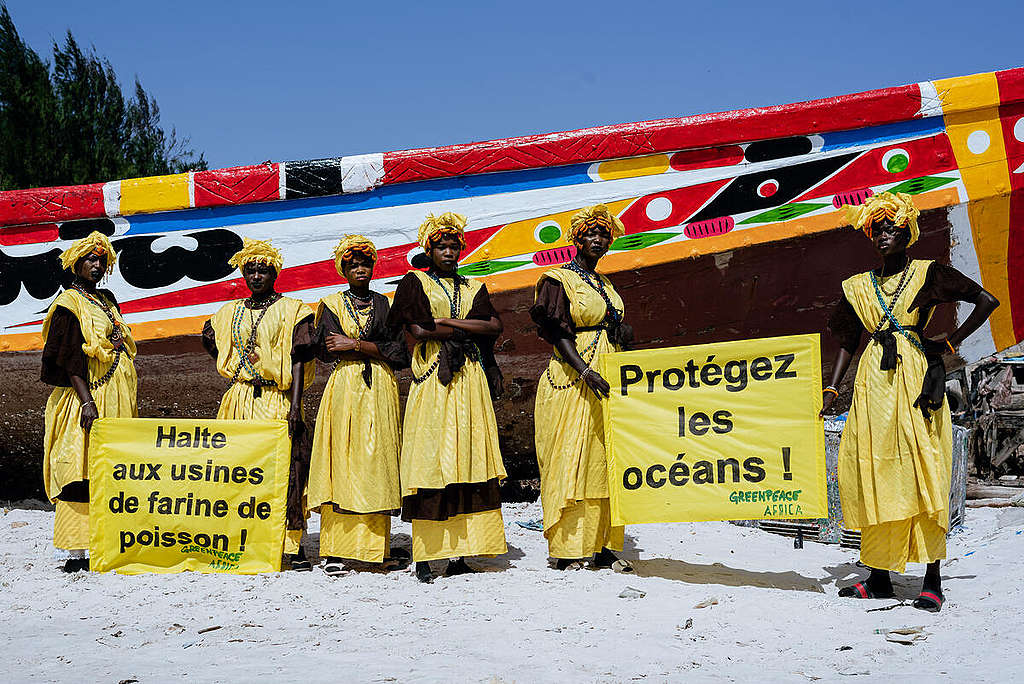
World Fisheries Day Event in Dakar. © Omar Bayo Fall / Greenpeace
With almost one thousand women fish processors, community leaders and Civil Society Organisations representatives from all over the country, Greenpeace Africa demands of the Senegalese government to stop the fishmeal industries and to stop granting new fishing licences, and instead to support women processors and fishing communities, to protect the ocean and to ensure people’s food security. © Omar Bayo Fall / Greenpeace

In April 2021, the government of The Gambia issued a “Stop Notice” to Golden Lead, a Chinese Fishmeal plant located in Gunjur, a small coastal town in south-western Gambia. 

A good day for the people of The Gambia and for the ocean and its biodiversity: fishmeal plants are repeatedly exposed as destructive for fish stocks, as well as the health of the population. The fish oil industry is stripping life from African oceans, and depriving African fishing communities of their livelihoods. 

In October 2021, an investigation by Greenpeace Africa revealed recent trade figures showing that the fishmeal and fish oil industry in the region has grown at an alarming rate during the COVID-19 pandemic.

6. Aotearoa – Supreme Court slams door on seabed mining
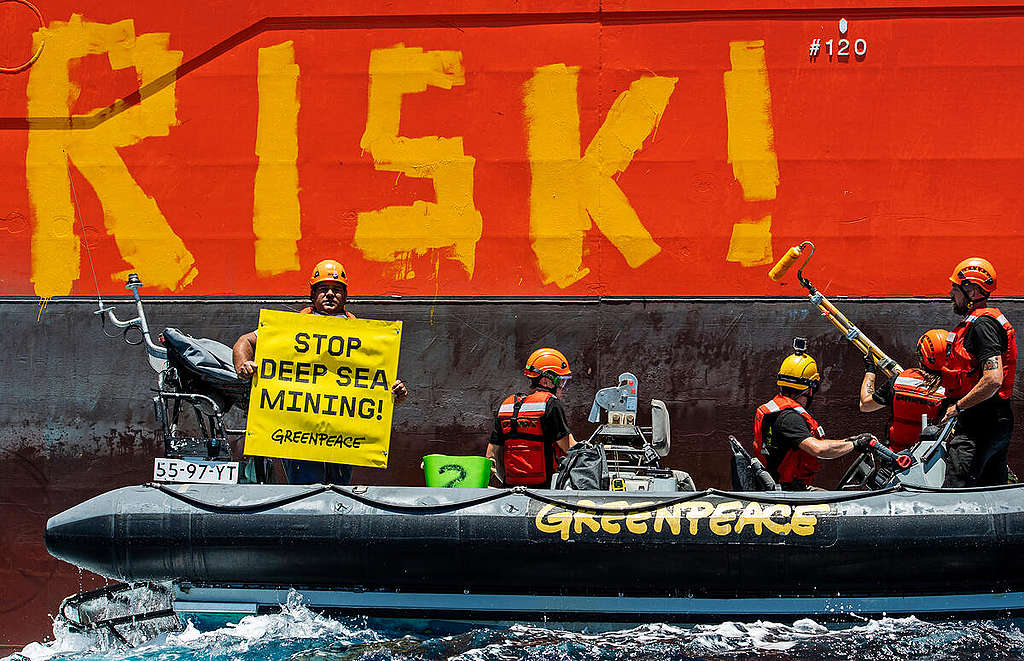
Activists Paint Deep Sea Mining Industry Vessel in the Pacific Ocean. © Marten van Dijl / Greenpeace
Greenpeace International activists paint the word ‘RISK!’ on the starboard side of Normand Energy, a Deep Sea Mining industry vessel chartered by the Belgian company Global Sea Mineral Resources (GSR). © Marten van Dijl / Greenpeace

This ruling is a victory for the ocean, and for people power!

In September 2021, New Zealand’s Supreme Court said ‘no’ to seabed mining and quashed a 2017 decision giving miners resource consent to begin a giant seabed mining operation in the South Taranaki Bight (a large bay on the west coast of Aotearoa – New Zealand).

The South Taranaki Bight is home to New Zealand’s own population of Pygmy blue whales, māui dolphins and blue penguins. It also has a vibrant coral reef system. This decision sends a clear message to other mining companies waiting in the wings: you’re not wanted in Aotearoa or the Pacific.

7. China, Japan, South Korea – Another step towards the end of the coal era
<div class="post-content">
			
				<div>
	<p></p><div class="imageframe imgalignright"><a href="/aotearoa/community_images//77/34977/8683_16056.jpg" class="BlogEnlargeImage"><img src="/aotearoa/community_images//77/34977/8683_14088.jpg" width="200" height="133" alt="Heathrow.jpg"></a><div>British comedian Alistair McGowan stands at a plot of land in Sipson near Heathrow airport, site of the planned third runway project.©Jiri Rezac / GREENPEACE </div></div>In a canny move, Greenpeace UK – along with Oscar winning actress Emma Thompson, comedian Alistair McGowan (pictured) and prospective Conservative parliamentary candidate Zac Goldsmith - has purchased a piece of land smack bang in the middle of the proposed third runway site at Heathrow Airport near London. <!--more--><p>The UK government plans to go ahead with airport expansions across the country even though this would wipe out its chance of meeting its legally binding climate emission reduction targets. For some perspective on aviation’s contribution to the UK’s emissions, consider this: even if the whole rest of the UK economy shut down and reduced its emissions to zero, if every power station switched off and every car was taken off the road – aviation under the Government’s plan would alone still make the UK well in excess of its CO2 targets and a climate criminal.</p><p>SO, on the eve of the government's expected announcement that it wants to go ahead with the expansion, Greenpeace UK revealed that it had bought a piece of the land at the heart of the airport expansion site. We can defend the land itself and physically block the bulldozers when they come to destroy the village of Sipson (due to be flattened by the plans) and prevent them laying the 2km tarmac strip that would spell the end of the UK's climate targets. </p><p>(BBC version of map) - <a href="http://news.bbc.co.uk/1/hi/england/london/7825169.stm">http://news.bbc.co.uk/1/hi/england/london/7825169.stm</a> </p><p><a href="/aotearoa/community_images//77/34977/8684_16057.jpg" class="BlogEnlargeImage"><img src="/aotearoa/community_images//77/34977/8684_14089.jpg" width="200" height="133" alt="Heathrow-2.jpg"></a>This plot of land will become a focus for climate campaigners across Britain and worldwide – campaigners will stand shoulder to shoulder with the villagers of Sipson who will have their homes destroyed, the hundreds of thousands of Londoner's whose quality or life and air quality will be destroyed by noise and pollution and most importantly of all the millions of people worldwide who face climate disaster unless projects such as this one are stopped in their tracks.</p><p>Actress Emma Thomson, and British comedian Alistair MacGowan as well as the main UK opposition party (The Conservatives) environment advisor, Zac Goldsmith, have bought the land with Greenpeace. MPs from all parties, as well as a Royal Society scientist and other prominent figures, are also named on a legal deed of trust for the land and are supporting the campaign are asking thousands of people - worldwide - to 'join the plot' and sign up to join the legal deed of trust as well. </p><p>This means that Greenpeace and our three deed holders can represent thousands of people in court if it comes to that, and bring the climate concerns of people worldwide - including those facing the worst impacts of climate change - right into the heart of the legal and political process.</p><p>Heathrow expansion isn't only an issue for those unfortunate enough to live on the flight path. If expansion goes ahead Heathrow will become the largest single source of greenhouse gas emissions in the UK - the effects of which will be felt across the world. The UK government's plans to expand airports across the country mean it will be impossible for it to meet its commitment to reduce emissions and stop runaway climate change. We need your help. You can sign up now to get your own piece of the plot. It's not a financial thing, but you can be included as a beneficial owner on the legal deed of trust. Join the airplot here: http://<a href="http://www.greenpeace.org/archive-international/news/join-the-plot-to-stop-airport-14012009">www.greenpeace.org/international/news/join-the-plot-to-stop-airport-14012009</a></p><p>
</p>
</div> 
				
			</div>
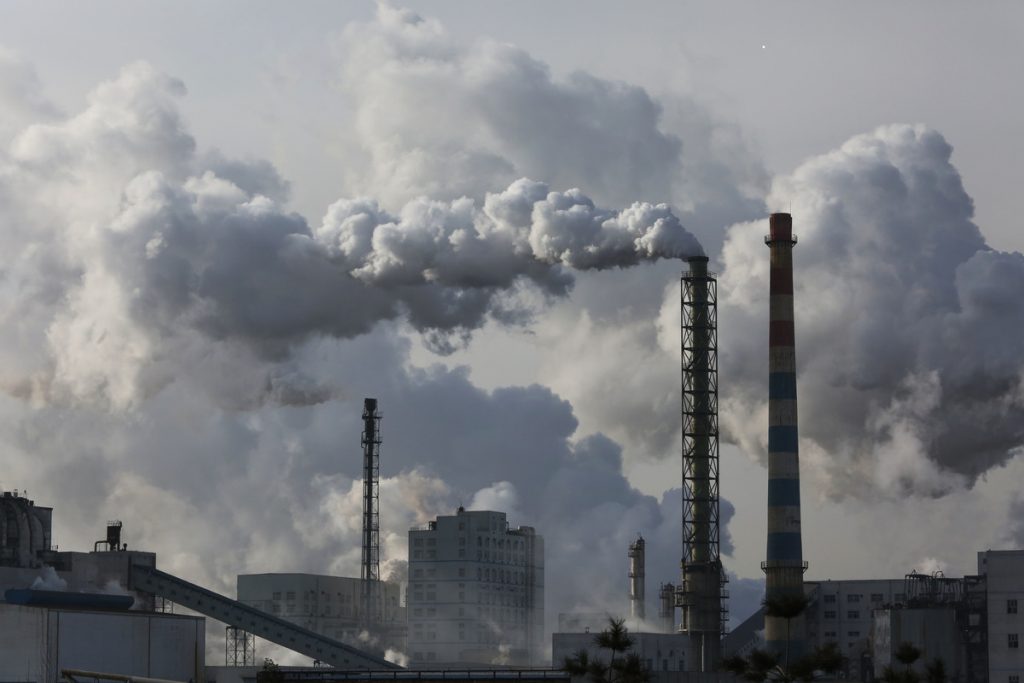
Yulin, located in Shenfu coalfield, together with Ordos and Shuozhou (Shanxi), is called the “Golden Triangle of Coal” in China. © Nian Shan / Greenpeace

In September 2021, China’s President Xi Jinping pledged that China will not build any new coal-fired power projects overseas. Earlier this year, similar commitments came from top coal financiers South Korea and Japan.

As the world’s largest public financier of overseas coal plants, It is now really important that China follows a similar path domestically, for the health of its people and the planet. Since 2014, the country has funded 12,622 MW of wind and solar along the Belt and Road – a huge increase. But it has also funded 67.9GW to coal (six times more), the vast majority in South and South East Asia.

Ending coal-fired power is a global imperative – for the climate and public health. In 2020 a report from Greenpeace South East Asia showed that air pollution generated from burning fossil fuels is attributed to approximately 4.5 million premature deaths worldwide every year.

8. Russia – Norilsk Nickel mining firm pays record $2bn fine over Arctic oil spill

This is the largest compensation for environmental damage in the history of Russia.

On May 29, 2020 over 20 thousand tons of diesel leaked into the water and soil from a storage tank owned by Norilsk Nickel near Norilsk, turning the Ambarnaya River red. According to official data, the oil spill in Norilsk is the largest ever in the polar Arctic.

In February 2021, the Krasnoyarsk Arbitration Court ordered Norilsk Nickel to pay 146 billion rubles (nearly 2 billion USD) for this oil spill in the Taimyr Peninsula. In Russia, accidents involving oil and oil products spills regularly occur. It is necessary to move to new carbon-free energy technologies as soon as possible, especially in such a vulnerable region as the Arctic.

9. Mexico – A ban on glyphosate and genetically modified corn
<!-- wp:paragraph -->
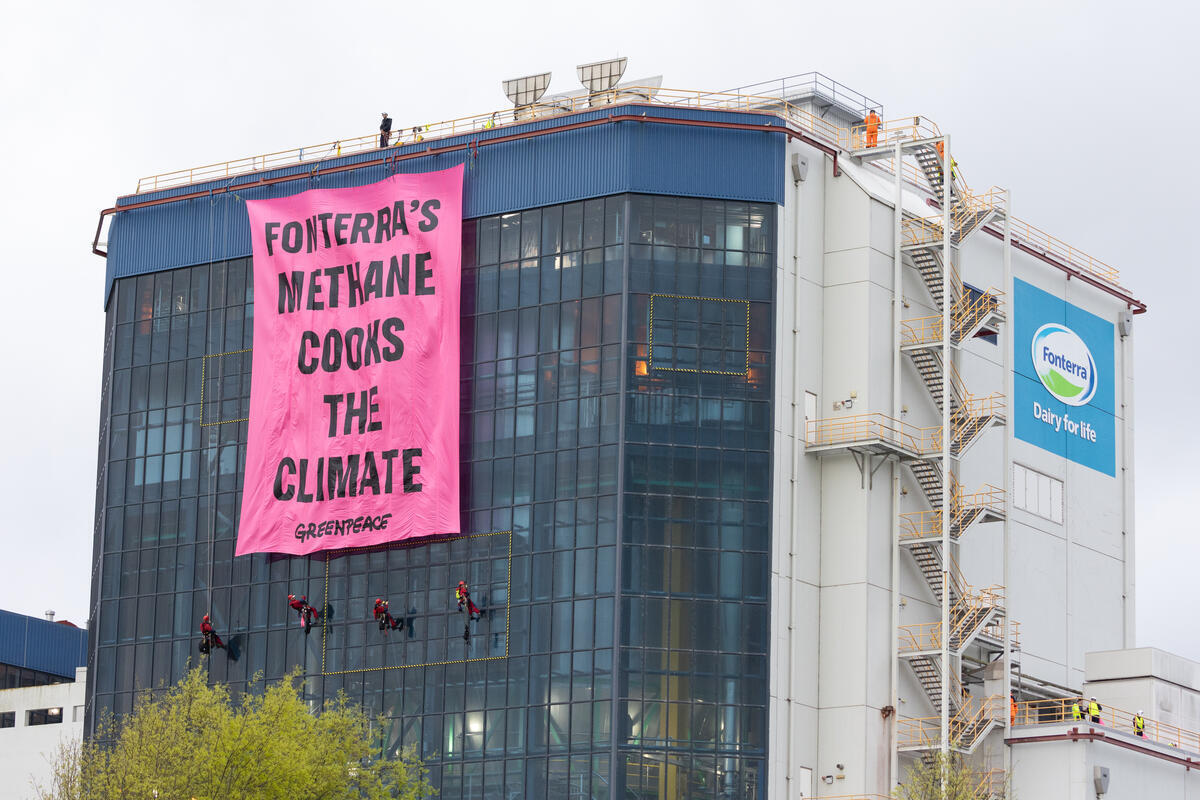
<p>Since the start of the dairy boom in the 1990s, cow numbers in New Zealand have doubled. In some areas, the numbers have grown even more dramatically. In Canterbury, they have increased tenfold. Southland has seen an even starker intensification, with the number of cows increasing 16 times.<br><br>Several factors are responsible for fueling this dairy expansion. Irrigation enabled dairying in Canterbury alone takes around 2 million Olympic-size swimming pool’s worth of irrigation water each year, largely in areas with stoney soils or low rainfall, unsuitable for dairy farming. New Zealand is the biggest global importer of palm kernel expeller from Indonesian rainforests, which is used for cow feed to prop up more cows than nature can handle. </p>
<!-- /wp:paragraph -->

<!-- wp:paragraph -->
<p>But there’s one thing in particular driving dairy herd expansion and emissions. The use of <a href="https://www.greenpeace.org/aotearoa/story/new-zealands-hidden-climate-killer-synthetic-nitrogen/">synthetic nitrogen fertilise</a>r. This has increased almost sevenfold since 1990. Synthetic nitrogen fertiliser is like crack cocaine for plants. It is a departure from traditional farming and it is destructive. Synthetic nitrogen fertiliser produces more than twice the emissions of domestic aviation in New Zealand, chokes waterways with algae, and drinking water with <a href="https://www.1news.co.nz/2022/03/17/nitrate-levels-in-nz-water-breaching-human-rights-greenpeace/">cancer-causing nitrate.</a> It enables the reckless explosion of cow numbers, which drives New Zealand’s emissions to be among the highest per capita in the OECD.       </p>
<!-- /wp:paragraph -->

<!-- wp:image {"id":51776,"sizeSlug":"large","linkDestination":"none"} -->
<figure class="wp-block-image size-large"><img src="https://www.greenpeace.org/static/planet4-aotearoa-stateless/2022/04/3aee0ff3-dji_0143sdzdf-1024x682.jpg" alt="" class="wp-image-51776"/><figcaption>Cows of a Southland farm I Geoff Reid</figcaption></figure>
<!-- /wp:image -->

<!-- wp:paragraph -->
<p>In terms of climate pollution, industrial dairy is to New Zealand what coal is to Australia or tar sands are to Canada. Agriculture is responsible for half of New Zealand’s emissions. So, it’s no wonder the latest Intergovernmental Panel on Climate Change (IPCC) report reminds us that a shift to plant-based diets offers a positive pathway for reducing emissions.</p>
<!-- /wp:paragraph -->

<!-- wp:paragraph -->
<p>Intensive dairy is a false economy. While the benefits accrue to small numbers in the industry, the costs are externalised. The costs often fall upon those who have done least to cause climate change, and those who are already most vulnerable. </p>
<!-- /wp:paragraph -->

<!-- wp:paragraph -->
<p>Selwyn District Council alone estimated it could cost 2 million to implement nitrate water treatment at its sites - almost five times their annual rate take. If anyone is paying the costs of this nitrate contamination, it is certainly not the industrial dairy industry. Every year, approximately 100 people will suffer and 40 will die, from bowel cancer, after drinking nitrate-contaminated water. The costs of nitrate related bowel cancer alone are estimated at .1million NZD per annum. Preterm births from nitrate laden drinking water bring additional costs.</p>
<!-- /wp:paragraph -->

<!-- wp:paragraph -->
<p>There are the costs to the climate, of billions of dollars of infrastructure being destroyed by extreme weather events and sea level rise. There are costs to our rivers, and to the soil. These costs are far greater than the profit intensive dairy makes for New Zealand. There can be no winners in an ecosystem and an economy that farms animals beyond the planet’s biophysical limits.</p>
<!-- /wp:paragraph -->

<!-- wp:paragraph -->
<p>Already, climate change and biodiversity thresholds have been exceeded. Feedback loops mean life on earth is under threat. The IPCC says we have until 2025 to act.</p>
<!-- /wp:paragraph -->

<!-- wp:paragraph -->
<p>There are no techno-fixes to address methane from cows, so reducing the dairy herd is essential. Around 0million has been spent on research and development to reduce emissions over the last few decades, but still dairy emissions increase.  New Zealand is among the world’s worst performers on emissions reduction. </p>
<!-- /wp:paragraph -->

<!-- wp:paragraph -->
<p>Breeding fewer cows will turn off the tap on dairy emissions. It’s clear the herd is oversupplied. Millions of cows are culled for being surplus to requirements every year, including two million calves killed within four days of birth, solely for being born male.</p>
<!-- /wp:paragraph -->

<!-- wp:paragraph -->
<p>It’s also no solution to simply expect herd numbers to drop and for each cow to produce more to sustain current production levels. Just as it’s wrong to farm beyond nature’s limits, it’s wrong for the dairy industry to keep farming cows beyond their physical limits too. </p>
<!-- /wp:paragraph -->

<!-- wp:paragraph -->
<p>It’s more efficient to grow crops to feed people directly, than it is to grow crops to feed cows with all the consequent long-term environmental and public health harm. <a href="https://www.theguardian.com/environment/2021/dec/15/netherlands-announces-25bn-plan-to-radically-reduce-livestock-numbers">Other countries such as the Netherlands have acknowledged this and begun buying out farmers to reduce agricultural pollution</a>. New Zealand is falling behind.</p>
<!-- /wp:paragraph -->

<!-- wp:paragraph -->
<p>New Zealand has too many cows, too many emissions, too much water pollution, <a href="https://www.1news.co.nz/2022/03/17/nitrate-levels-in-nz-water-breaching-human-rights-greenpeace/">too much bowel cancer in rural communities</a> and the Government is making too many political concessions to industrial dairy. The Government must get serious about the climate - the science is clear. The only real way to ease the burden on water, land and the climate, is to phase out synthetic nitrogen fertiliser and halve the herd.</p>
<!-- /wp:paragraph -->

<!-- wp:planet4-blocks/take-action-boxout {"take_action_page":51438} /-->
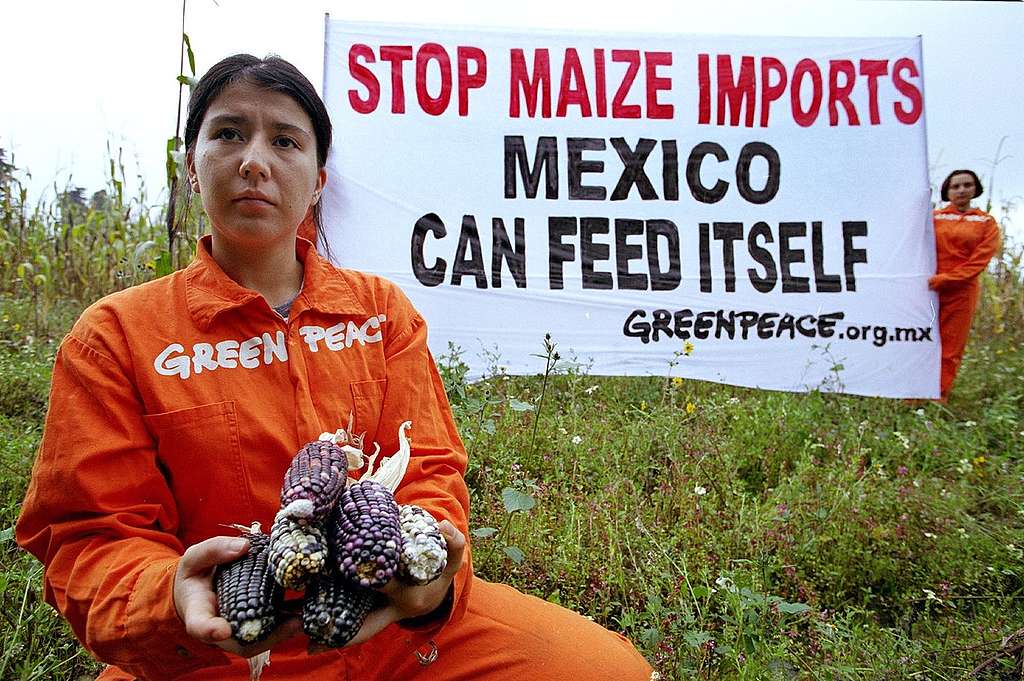
Action against GE Maize in Mexico (October 2001). Greenpeace activists occupy a maize field highlighting it as an example of one of the 300 local varieties at risk of being genetically contaminated. © Greenpeace / Tomas Bravo Garcia

Did you know that Mexico is considered the center of origin, domestication and diversification of 59 different types of corn?

In January 2021, a presidential decree in Mexico established the prohibition of genetically modified corn as well as the phasing out of glyphosate by 2024. 

The continued use of contaminants like GMOs and glyphosate would put Mexican agricultural biodiversity at risk, jeopardise entire ecosystems and move Mexico away from the path towards food sovereignty and self-sufficiency. Securing the ban of GMOs has been the center of countless battles for Greenpeace Mexico over the past 21 years; battles fought alongside various farmer organisations, consumers, academics, researchers, artists and intellectuals.

The 2021 ban on transgenic corn and glyphosate is an important step to advance towards Greenpeace Mexico’s ultimate goal: transformation of the agri-food system from the roots and producing healthy food that does not harm the environment and guarantees the health of farmers and consumers.

10. Turkey – Victory against plastic waste imports
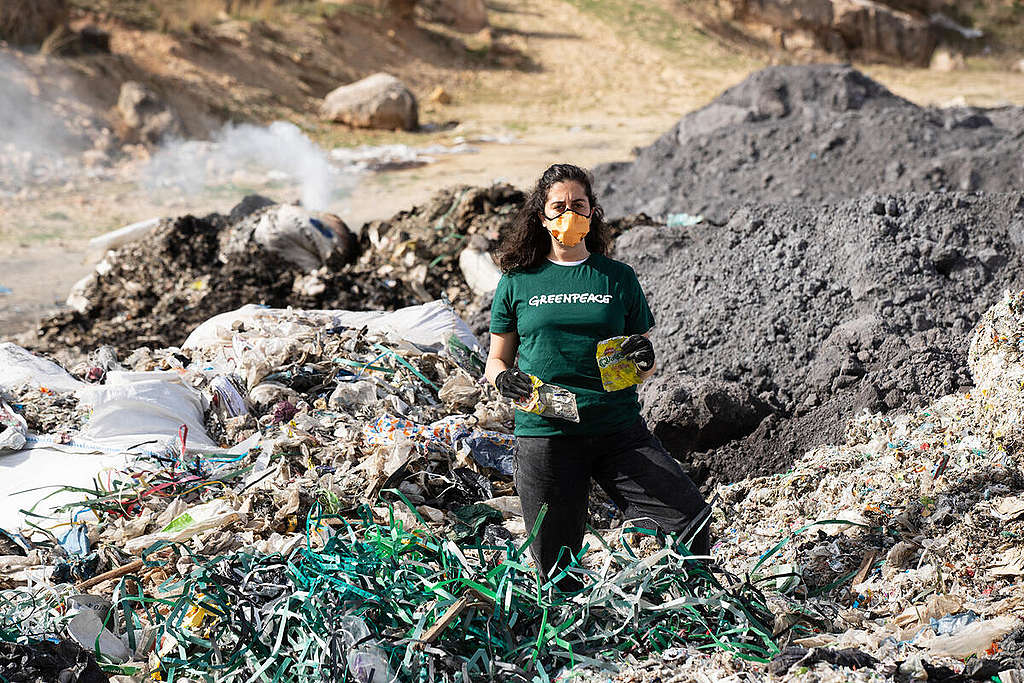
Waste Dump in Karahan, Adana Province, Turkey. © Caner Ozkan / Greenpeace
Waste Dump in Karahan, Adana Province, Turkey, seen during an investigation into plastic waste that is dumped and burned in Turkey. The Greenpeace Med team found plastic packaging from UK, German and global food and drinks brands and supermarkets. © Caner Ozkan / Greenpeace

In May 2021, the Turkish government banned the importation of plastic waste belonging to the ethylene polymer group, a group which has the largest share in plastic waste imports and is frequently used in daily life.

The Greenpeace Mediterranean campaign “Don’t Let Turkey Become a Garbage Dump” played an important role in this victory. In 2020, the UK exported 210,000 tons of plastic waste to Turkey, while Germany sent 136,000 tons. Our colleagues in Turkey have been fighting for a long time to achieve this ban. This victory against plastic pollution is also a victory for health and social justice.


Every fraction of a degree matters. Every ecosystem supporting the livelihoods of people and countless species of animals and plants matters. In 2022, let’s keep fighting against extractivist fossil fuel companies, corporate polluters, greenwashing, false solutions and governments putting profits over people and the planet.