During our field trip to the Amazon, our visit to the city of Porto Velho was quick but intense. We talked to several people who are being impacted by the expansion of agribusiness in the region. The last person I interviewed was an agroextractivist, a person whose livelihood depends on sustainably sourcing products such as rubber, nuts and açaí berries from the forest and had been forced out of his land by large-scale landowners, said something that stuck in my head: when he was approached to sell his land, he was told “you can either sell me your land for the price we are paying, or it will only cost 4 Brazilian Reais”. The price of a bullet.

This is what the violence linked to the so-called development that has historically prevailed in the Amazon looks like. A development that never actually serves the people of the region, who instead, end up being forced to abandon their lands and livelihoods and migrate over a “promise of opportunity” that never arrives.

The people we spoke to are especially concerned about the latest of such promises of regional development, one that imitates the expansion of the agribusiness in the Cerrado – a biome in Brazil that has been highly consumed by industrial agriculture, leaving behind a trail of injustice and violence. 
Fire Monitoring in the Amazon in Brazil in September, 2021. © Victor Moriyama / Amazônia em Chamas
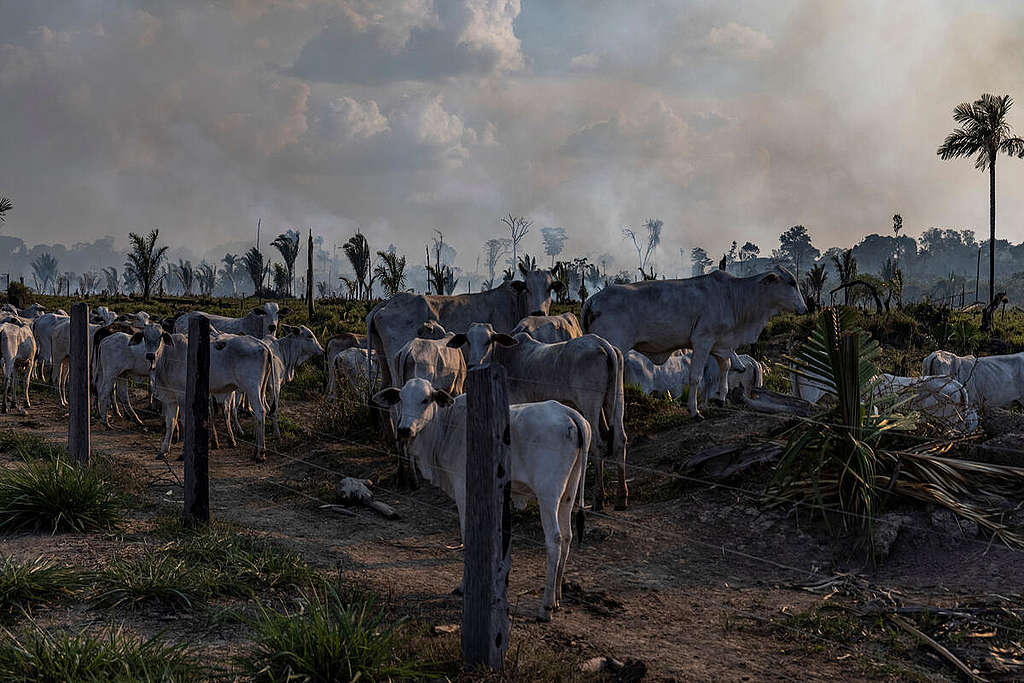
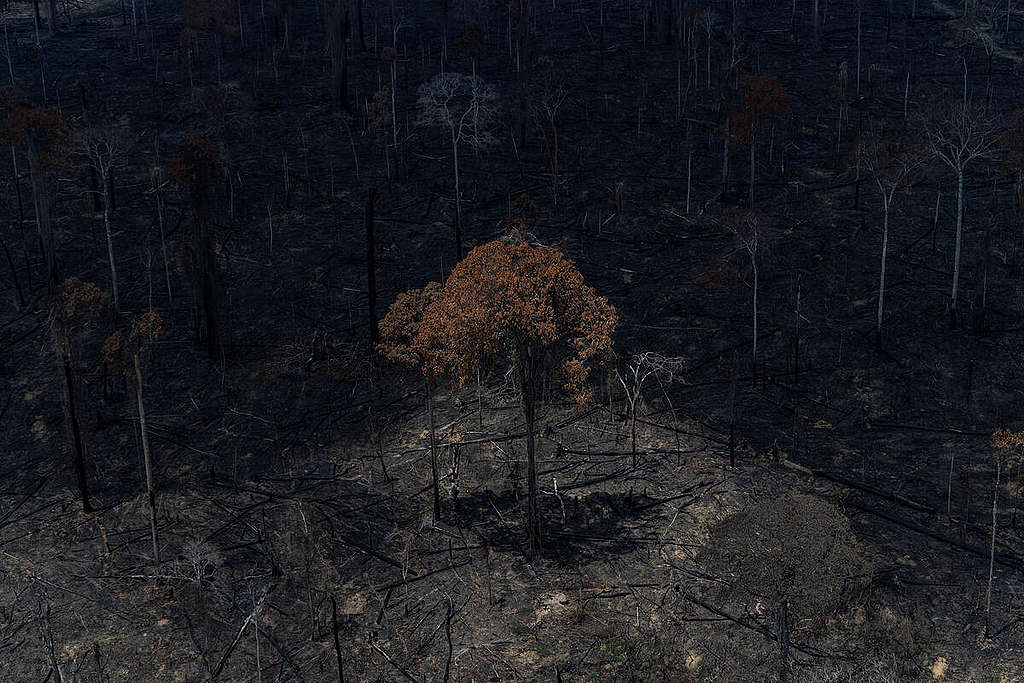
Cattle in a ranching area, next to a recently deforested and burnt area, in Candeias do Jamari, Rondônia state. The Amazon rainforest is covered in smoke and torn by criminal and unrestrained destruction. © Victor Moriyama / Amazônia em Chamas

According to professor and geographer Amanda Michalski, the development strategy for the southern region of the Amazon – which includes parts of Amazonas, Acre and Rondônia states, although framed as sustainable, is based on industrial agriculture and not on sustainable practices, in which policies are geared towards large-scale properties. 

What this means, in reality, is the intensification of deforestation in the southern region of the Amazon, where, for instance, the local government of Rondônia State has reduced the size of Conservation Units, benefiting land-grabbers, and opened up mining on one of the main rivers in the area.

One of the actions foreseen within the scope of public investments to make the development of the region viable is the expansion of infrastructure, which facilitates the advancement of the deforestation frontier and gradually opens the way for agribusiness to consolidate itself more and more in the area. One of the projects that make up this plan is the paving of a key highway connecting the cities of Manaus and Porto Velho.

The concern is that branches will start to establish off of the highway between more remote municipalities, literally opening the way for deforestation – exactly what happens today in the most critical deforestation frontier in the Amazon, in the state of Pará, along another big highway.

There are reports that two of these branches are already under construction off of two small towns in the Amazon. That means opening access to an almost intact part of Amazonian forests where there is a large stock of carbon and biodiversity. Unfortunately, Brazil has not been able to properly mitigate the environmental impacts of projects like this before carrying them out. The highway in the state of Pará is again an example of such mismanagement. 
<!-- wp:paragraph -->
<p>Whether or not there’s a cousin Greg in your life, here’s how you can follow Uncle Ewan’s footsteps and <a href="https://www.greenpeace.org/aotearoa/act/donate-to-greenpeace-in-your-will/">remember Greenpeace in your Will</a> - or just chip in a few dollars today.  </p>
<!-- /wp:paragraph -->

<!-- wp:buttons -->
<div class="wp-block-buttons"><!-- wp:button {"className":"is-style-donate"} -->
<div class="wp-block-button is-style-donate"><a class="wp-block-button__link" href="https://www.greenpeace.org/aotearoa/act/donate/">Donate to Greenpeace</a></div>
<!-- /wp:button --></div>
<!-- /wp:buttons -->

<!-- wp:paragraph -->
<p><em>(If you’re not caught up on Succession season three, there are a few spoilers below, so save this article and come back!)</em></p>
<!-- /wp:paragraph -->

<!-- wp:image {"id":49940,"sizeSlug":"large","linkDestination":"none"} -->
<figure class="wp-block-image size-large"><img src="https://www.greenpeace.org/static/planet4-aotearoa-stateless/2021/11/e7b919c4-sue-greenpeace-1024x576.png" alt="Whether or not there’s a cousin Greg in your life, here’s how you can follow Uncle Ewan’s footsteps and remember Greenpeace in your Will - or just chip in a few dollars today." class="wp-image-49940"/></figure>
<!-- /wp:image -->

<!-- wp:paragraph -->
<p>If you’ve tuned in to HBO’s hit series Succession recently, you may have been surprised to hear Greenpeace’s name-dropped by one of the show’s main characters, Cousin Greg. </p>
<!-- /wp:paragraph -->

<!-- wp:paragraph -->
<p>Succession follows an ultra rich media mogul and his family’s quest to retain control of their business and is an intimate portrait of corporate greed at the highest levels.</p>
<!-- /wp:paragraph -->

<!-- wp:paragraph -->
<p>When Uncle Ewan, fed up with his family’s obsession with wealth and power, announced that he would be leaving his grandson’s inheritance to Greenpeace, the world was <a href="https://www.theguardian.com/environment/2021/nov/27/successions-plot-twist-prompts-thousands-to-leave-money-to-greenpeace-in-their-wills" target="_blank" rel="noreferrer noopener">left wondering</a>… ‘why would you leave a gift in your Will to Greenpeace?’</p>
<!-- /wp:paragraph -->

<!-- wp:paragraph -->
<p>While Cousin Greg may not have been fond of the idea, which ultimately prompted him to ‘sue Greenpeace’, we’re here to tell you a few reasons why you should follow in Uncle Ewan’s footsteps and leave a gift in your Will to Greenpeace Aotearoa.</p>
<!-- /wp:paragraph -->

<!-- wp:buttons -->
<div class="wp-block-buttons"><!-- wp:button {"className":"is-style-donate"} -->
<div class="wp-block-button is-style-donate"><a class="wp-block-button__link" href="https://www.greenpeace.org/aotearoa/act/donate-to-greenpeace-in-your-will/">Donate to Greenpeace in your Will</a></div>
<!-- /wp:button --></div>
<!-- /wp:buttons -->

<!-- wp:embed {"url":"https://www.youtube.com/watch?v=G-bS9GxlpZU","type":"video","providerNameSlug":"youtube","responsive":true,"className":"wp-embed-aspect-16-9 wp-has-aspect-ratio"} -->
<figure class="wp-block-embed is-type-video is-provider-youtube wp-block-embed-youtube wp-embed-aspect-16-9 wp-has-aspect-ratio"><div class="wp-block-embed__wrapper">
https://www.youtube.com/watch?v=G-bS9GxlpZU
</div><figcaption>Greg explains how he is going to sue Greenpeace</figcaption></figure>
<!-- /wp:embed -->

<!-- wp:heading -->
<h2><strong>Why you should leave a gift in your Will to Greenpeace Aotearoa</strong></h2>
<!-- /wp:heading -->

<!-- wp:paragraph -->
<p>You’ve put your heart and soul into protecting the planet. But you know the job’s not finished yet. With a gift in your Will, you can keep protecting our planet long into the future. Like Uncle Ewan, you know that we cannot continue with ‘business as usual” when it comes to the climate crisis—we need bold action now.</p>
<!-- /wp:paragraph -->

<!-- wp:paragraph -->
<p>From our beginnings as a small group of activists protesting against nuclear testing off the coast of Alaska, Greenpeace has grown into a global movement for change. Today, for the millions of people who believe in a cleaner, greener, more peaceful planet that can sustain us all, we are the world’s most effective environmental campaigning organisation, and a beacon of hope.</p>
<!-- /wp:paragraph -->

<!-- wp:paragraph -->
<p>With a gift in your Will, that hope can live on.</p>
<!-- /wp:paragraph -->

<!-- wp:paragraph -->
<p>Leaving a gift in your Will to Greenpeace Aotearoa is a way to keep putting your beliefs into action, long after your lifetime. Any gift that you choose to leave, large or small, will support our work for years to come. In fact, gifts in Wills now fund over 10% of our campaign work.</p>
<!-- /wp:paragraph -->

<!-- wp:paragraph -->
<p>Having an up-to-date Will is, of course, vital to protecting your family’s future. But once you’ve provided for your loved ones and friends, a gift to Greenpeace Aotearoa will help protect the Earth for all future generations.</p>
<!-- /wp:paragraph -->

<!-- wp:paragraph -->
<p>Get in touch with our dedicated team to learn more about starting your legacy and how to complete your will.</p>
<!-- /wp:paragraph -->

<!-- wp:buttons -->
<div class="wp-block-buttons"><!-- wp:button -->
<div class="wp-block-button is-style-secondary"><a class="wp-block-button__link" href="https://www.greenpeace.org/aotearoa/act/donate-to-greenpeace-in-your-will/">Contact us</a></div>
<!-- /wp:button --></div>
<!-- /wp:buttons -->

<!-- wp:paragraph -->
<p>With the help of supporters like you, we’ve defied the nuclear arms race. We’ve stood between whales and the harpoons. We’ve protected the Antarctic. We’ve saved rainforests from the chainsaw, and stopped toxic waste dumps in our seas.</p>
<!-- /wp:paragraph -->

<!-- wp:paragraph -->
<p>With a gift in your Will, we can carry on protecting the planet and everything that lives on it, long into the future. You’ll also be joining the likes of Uncle Ewan who is, out of the entire Roy family, the person we’d most like to sit next to at family dinner.</p>
<!-- /wp:paragraph -->

<!-- wp:paragraph -->
<p>If you’re not ready to leave a gift in your Will, no worries! You can donate now to help fight the climate crisis.</p>
<!-- /wp:paragraph -->

<!-- wp:buttons -->
<div class="wp-block-buttons"><!-- wp:button /--></div>
<!-- /wp:buttons -->
<!-- wp:planet4-blocks/take-action-boxout {"take_action_page":192} /-->
Aerial view of fire and expansion for livestock in the Amazon, in Trairão, Pará state. © Victor Moriyama / Greenpeace

In two towns of Humaitá and Lábrea, in the south of the Amazon, you can already feel the land speculation in the air. The quiet Lábrea, where the Purus river runs and the Transamazônica highway starts, did not experience deforestation and fires (which tend to be concentrated in the south of the municipality) closely, but this has changed in recent years. We even went into a newly deforested area that was still burning.

In Lábria, we also heard reports of the accumulation of land nearby, invasions of Indigenous Lands, and something else that caught our attention: the city’s plan to build a bus station and that recently new bus lines were established between Lábrea and the cities of Humaitá, Manaus and Porto Velho – the two main cities in the region. The flow of people through the city is expected to increase soon.

In Humaitá, we were able to see some areas being prepared for soy. It is a very characteristic type of intervention, due to the removal of all the branches from the ground so that the machinery can operate in the field. Humaitá was the first city in the state of Amazonas to have soy plantations, and the advancement of the grain in the region, as well as in the north of Rondônia state, also appeared as a concern.

In the cycle of land-use change, soy is usually the third element. The beginning is usually through the predatory removal of timber, then the use of the areas are converted for a few years to cattle ranching (and depending on the location it remains as livestock) and after the land conversion is more consolidated, that’s where soy comes. From both the cities of Porto Velho and Humaitá, infrastructure projects indicate that soy will advance through the region, occupying areas previously used as pasture. 

Despite having witnessed many sad reports and seen newly deforested and burned areas up close, we were also able to see some light at the end of the tunnel. We went to meet those who are doing it differently, fighting for forms of development that coexist with the forest and bring permanent progress.

Stay tuned for the next chapter of this story, and join the movement to Stand with the Guardians of the Amazon.

PETITION: Save the Amazon

Add your name to tell the Brazilian government to save the Amazon Rainforest and protect the lands of Indigenous and traditional communities.

Take Action