The phrase ‘ocean protection’ will usually conjure up images of how human activities and our rapidly changing climate are impacting marine life. From fishing vessels with nets the size of football fields decimating fish populations, to turtles trapped in plastic debris or marine wildlife caught up in the destructive race to drill for oil or mine the seafloor, there are many critical issues facing the millions of species which call our oceans home. 
An oil exploration ship at the centre of a storm of controversy for its seismic blasting agenda earlier this year in New Zealand is on its way back.

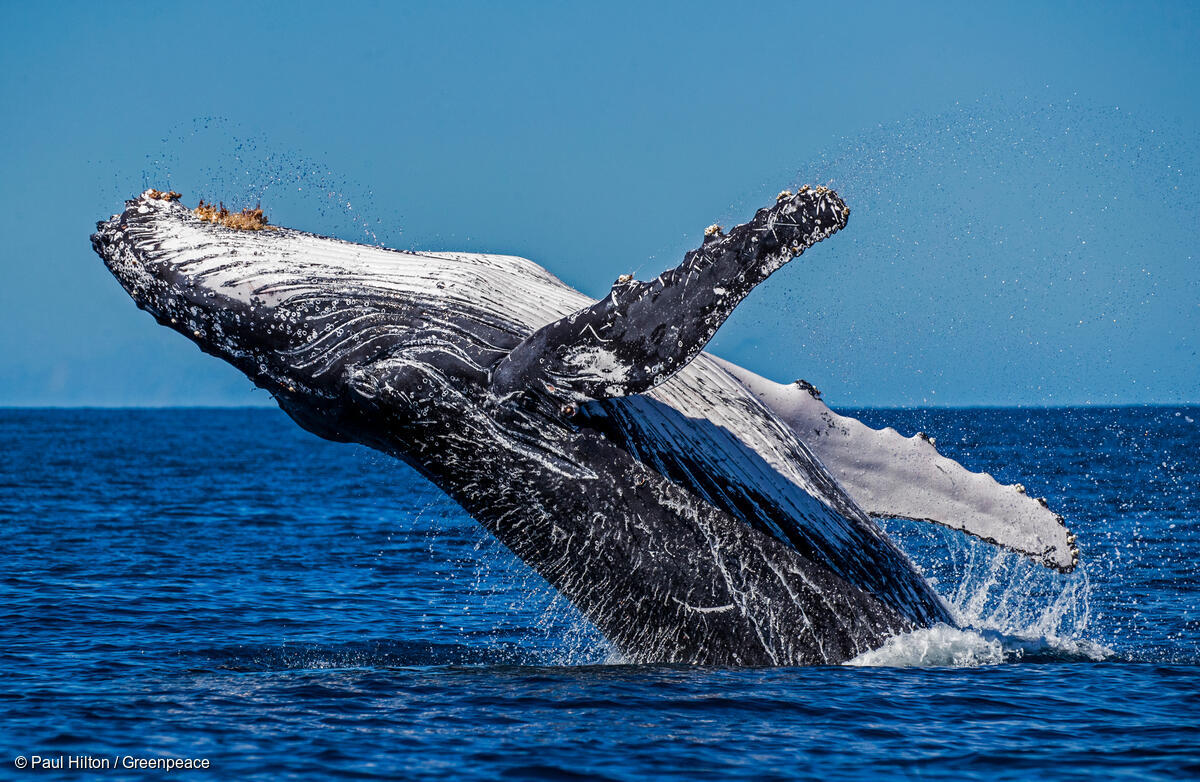
The Schlumberger owned Amazon Warrior, the world’s largest seismic exploration ship, is just two days away from the South Taranaki Bight, where it plans to seismic blast for oil right in the middle of blue whale habitat.

It will be searching for oil on behalf of Austrian oil giant, OMV.

Greenpeace climate campaigner, Kate Simcock, says the Government still has a chance to reject the ship’s oil exploration application.

“Although the Amazon Warrior is heading straight for us, the Government has not yet approved Schlumberger’s request to seismic blast across almost 20,000 square kilometres of the Taranaki Basin. There is still time to turn this ship around, but they must do it urgently,” she says.

“We understand Schlumberger is proposing up to three months of constant blasting, every 10 seconds, 24 hours a day. The impacts on blue whales in this area are likely to be torturous, interfering with their communication and feeding.

“As well as the harmful impacts on marine life, science tells us we can’t afford to burn most of the fossil fuel reserves we know about if we’re to have a chance at stabilising our climate. Searching for new oil makes zero sense.

“Jacinda Ardern says climate change is her generation’s nuclear free moment. Going nuclear free meant stopping the nuclear ships. Taking action on climate change means stopping the oil ships. We’d like to see the Prime Minister back up her bold words with strong action.”

https://www.youtube.com/embed/gQW2MB3XiXI

Renowned marine ecologist, Dr Leigh Torres, recently released underwater recordings taken from the South Taranaki Bight that capture seismic blasting from an oil exploration ship drowning out the calls of a blue whale. She compared the blasting to a nail gun going off in your kitchen every eight seconds for months on end.

Simcock says the Amazon Warrior should prepare for public resistance when it enters New Zealand waters.

It faced mass opposition last summer as it searched for oil on behalf of Statoil, Chevron, and OMV off the Wairarapa Coast. Thousands signed petitions, crowdfunded a boat to confront it at sea, and sent emails of complaint to Statoil and Chevron. East Coast iwi, Ngāti Kahungunu, sent their voyaging waka, Te Matau a Māui, to deliver a message on behalf of more than 80 hapū of Te Ikaroa.

In April, Greenpeace activists, including Executive Director Dr Russel Norman and volunteer Sara Howell, swam in front of the Amazon Warrior 60 nautical miles out to sea, stopping it from seismic blasting for the day.

The activists and Greenpeace were charged by the oil division of the Ministry of Business Innovation and Employment (MBIE), under the 2013 Amendment to the Crown Minerals Act known as the 'Anadarko Amendment'. They face a year in jail and up to 0,000 in collective fines.

They have pleaded Not Guilty and will face trial in April next year.

ENDS
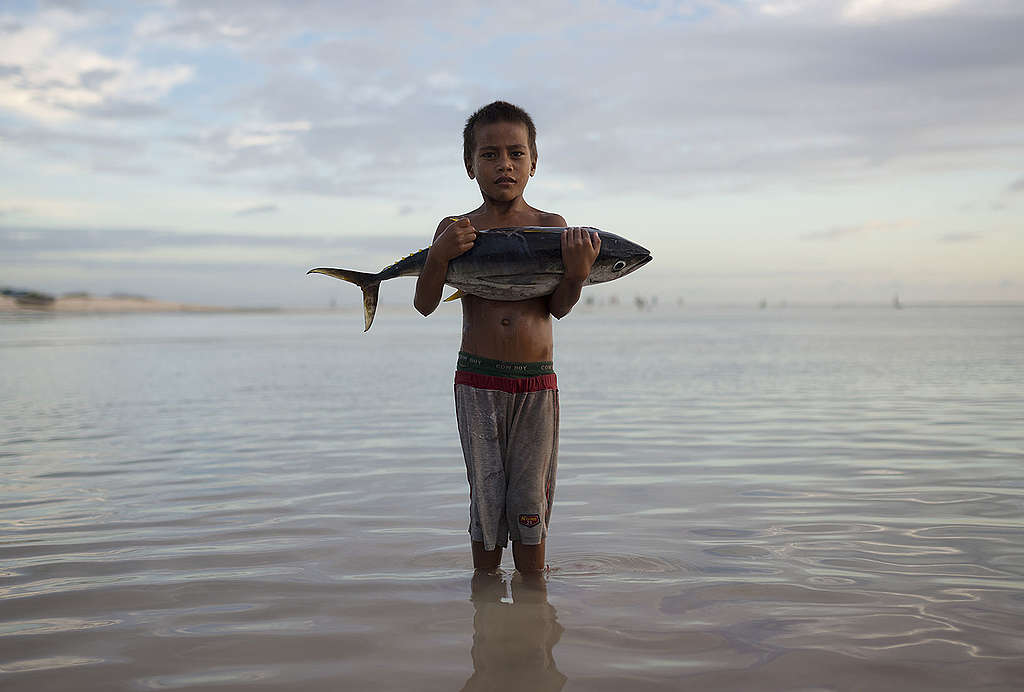
8 years old Tokabwebwe Teinaura from the village Te O Ni Beeki, helping carry a yellowfin tuna to the shore on Tarawa Island, Kiribati. © Christian Åslund / Greenpeace

However, there is another group of creatures whose survival is equally dependent on healthy oceans, but aren’t always mentioned in conversations around ocean conservation: Humans.

How humans depend on the ocean

More than 3 billion people rely on the ocean for their livelihoods, the vast majority of which are in the Global South. The ocean provides coastal communities with jobs in small-scale fishing, a practice that has been passed down through generations, as well as newer industries, like tourism. The oceans also keep us fed. Seafood is a key part of billions of people’s diets, and many people rely on it to survive.

Communities all over the world have deep cultural and spiritual connections to the ocean, and many Indigenous Peoples in particular have put the sea at the centre of community life for generations.
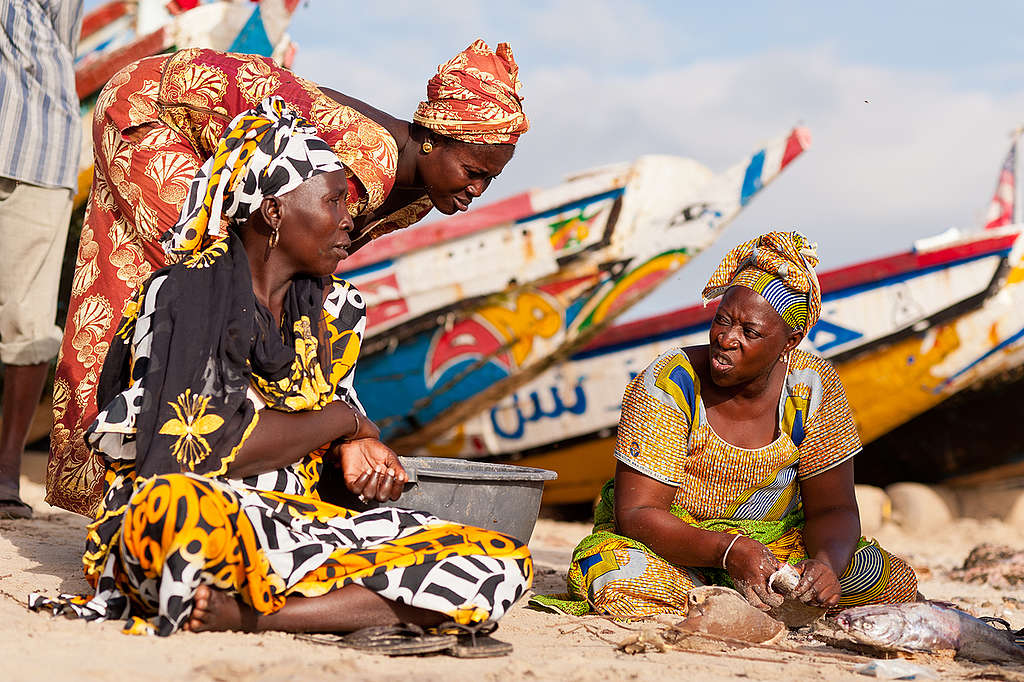
Women in Senegal. © Clément  Tardif / Greenpeace
Women at the fishing port of Kafountine, Senegal. © Clément Tardif / Greenpeace

How humans are impacting the oceans

While some people are working hard to protect our oceans, other members of our species are exploiting our oceans for profit, threatening the livelihoods of other people globally.

Destructive industries like industrial fishing are emptying our oceans of life, including in international waters which have very few laws to stop these activities.
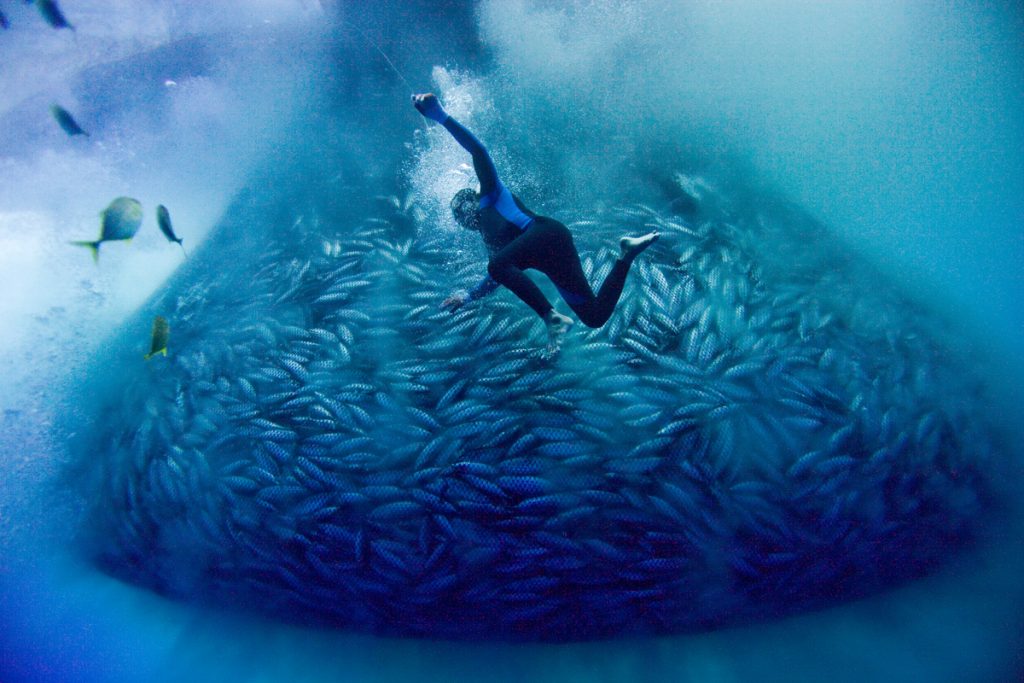
Philippine Purse Seine Fishing Operation © Alex Hofford / Greenpeace
A diver from the Philippine purse seiner ‘Vergene’ at work around a skipjack tuna purse seine net in international waters © Alex Hofford / Greenpeace

This fishing free-for-all in international waters is having a devastating impact on coastal communities. The UN estimates that around 60 million people are employed worldwide in fishing and fish farming. Most are in developing countries, and are small-scale, artisanal fishers and fish farmers. Often, there aren’t enough fish being caught to make a living out of or feeding families so people have to fish for more days of the week.   
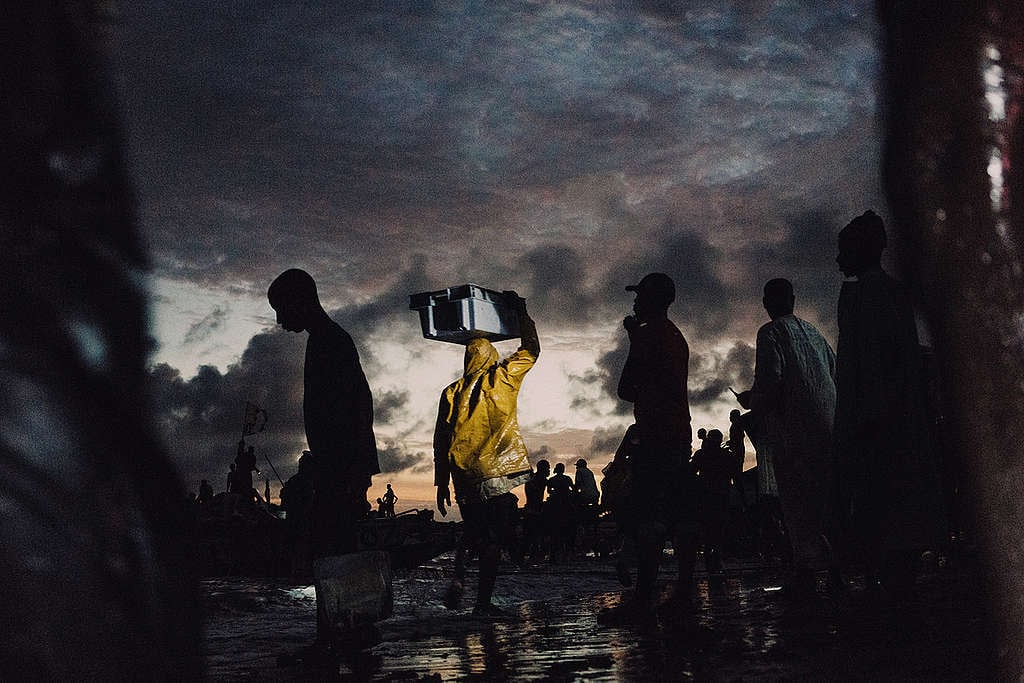
West African Small-scale Local Fishermen in Senegal. © Liu Yuyang / Greenpeace
As night begins to fall, Joal Fadiout is more lively than ever, with artisanal fishing boats returning to shore to sell their catch. Fish is the principle source of protein in Senegal. © Liu Yuyang / Greenpeace

For example, we spoke to Oke, a fisherman in Nigeria who said, “Our children are not able to frequently go to school anymore. It has affected our wives’ being able to sell their wares, the cost of living has skyrocketed.”. 

Hear more from Oke in this video from our Vital Voices series: Play

This is just one example of what is happening to coastal communities all over the world.

The industrial fishing companies don’t just harm coastal communities – their own workers are suffering too. Recent investigations revealed that migrants from the Philippines, Indonesia, Ghana, Sri Lanka and India working on boats in UK waters reported shocking conditions, working 20 hour shifts while having to endure violence and racism. 

We all need healthy oceans

Even if you live thousands of miles from the oceans, they’re still crucial to your future. Healthy oceans are key to tackling climate change. Our oceans have absorbed 20-30% of recent emissions, buying us a little more time to avoid the worst impacts of climate breakdown. But unless we protect the habitats and systems that keep ocean life healthy, they’ll stop being able to absorb carbon dioxide, and climate change will accelerate. 
Our new report “How Clean is Your Cloud”  is out today - to show that the massive increase in Internet use is  mainly being powered by dirty energy. Apple, Amazon and Microsoft all  score badly in the report for relying on dirty coal and dangerous  nuclear power for their data centres.Since 2010, and again in  2011, we have been calling on all the major Internet companies to come  clean about the amount and type of power behind the Internet services we  use everyday. Today Apple responded (via the New York Times):<div class="post-content">
			
				<div>
	<div class="post-content">
<div>
<p>Our new report “<a href="http://www.greenpeace.org/archive-international/en/publications/Campaign-reports/Climate-Reports/How-Clean-is-Your-Cloud/">How Clean is Your Cloud</a>”  is out today - to show that the massive increase in Internet use is  mainly being powered by dirty energy. Apple, Amazon and Microsoft all  score badly in the report for relying on dirty coal and dangerous  nuclear power for their data centres.<br><br>Since 2010, and again in  2011, we have been calling on all the major Internet companies to come  clean about the amount and type of power behind the Internet services we  use everyday. <br><br>Today Apple responded (<a class="zoom" href="http://www.nytimes.com/2012/04/18/business/energy-environment/cloud-services-rely-on-coal-or-nuclear-power-greenpeace-says.html" target="_blank" rel="noopener noreferrer">via the New York Times</a>):</p>
<blockquote>
<p>In a statement issued in response to the report, Apple disclosed for  the first time that the data center would consume about 20 million watts  at full capacity - much lower than Greenpeace's estimate, which is 100  million watts. In territory served by Duke, a million watts is enough to  power 750 to 1,000 homes.</p>
<p>Kristin Huguet, a spokeswoman for Apple, added that the company is  building two large projects intended to offset energy use from the grid  in North Carolina: an array of solar panels and a set of fuel cells.</p>
</blockquote>
<p>While it is good to see Apple acknowledge it should reveal more  details of the energy consumption of its data centres, the information  they released today does not add up with what they have reported to be  the size of the investment and physical size of the data centre.</p>
<p>When Apple announced they were building a data centre in North  Carolina, they announced a commitment to invest <img decoding=
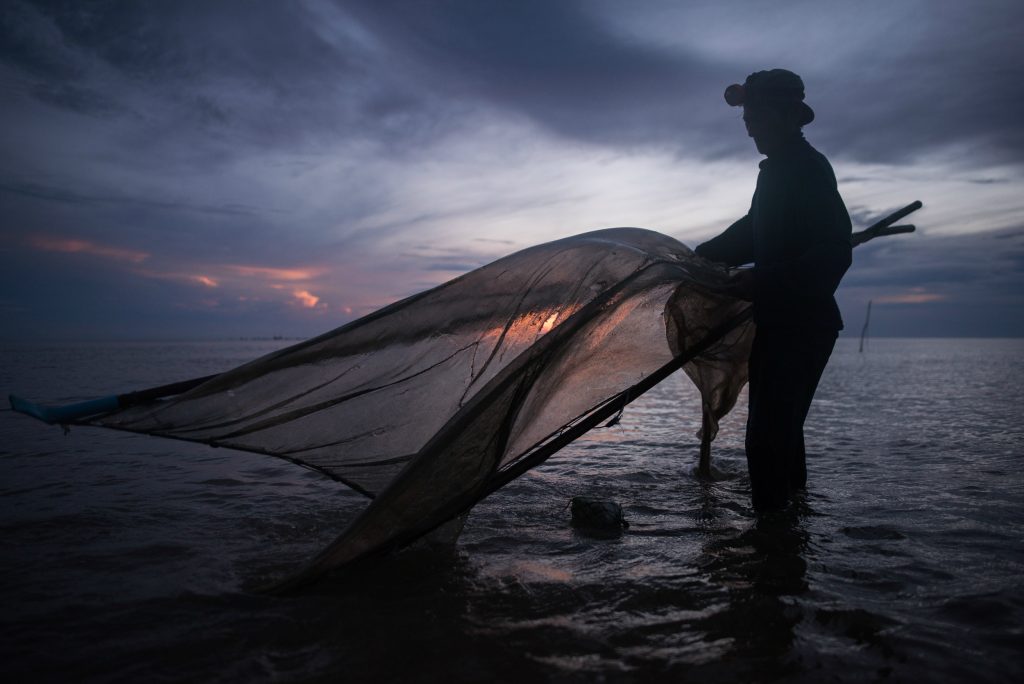
At sunrise, a local fisher washes his krill net by the beach in Thepha, Songkhla province, Thailand. © Sirachai Arunrugstichai / Greenpeace

That’s why World Oceans Day isn’t just about marine wildlife. When we fail to protect the oceans, we’re failing to protect ourselves.

From coastal communities to migrant workers on ships to everyone who relies on a stable climate, we all lose out when the oceans are being exploited.

A strong Global Ocean Treaty would help keep parts of the high seas off limits to destructive industries.