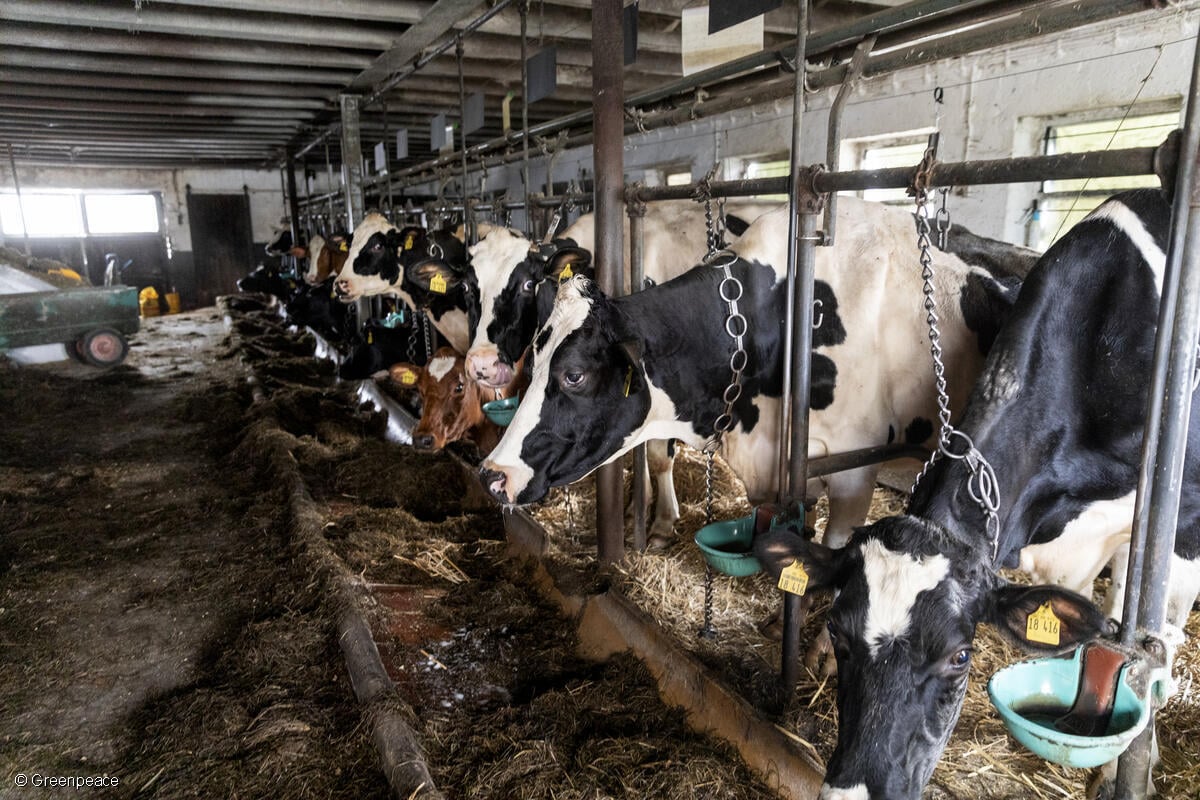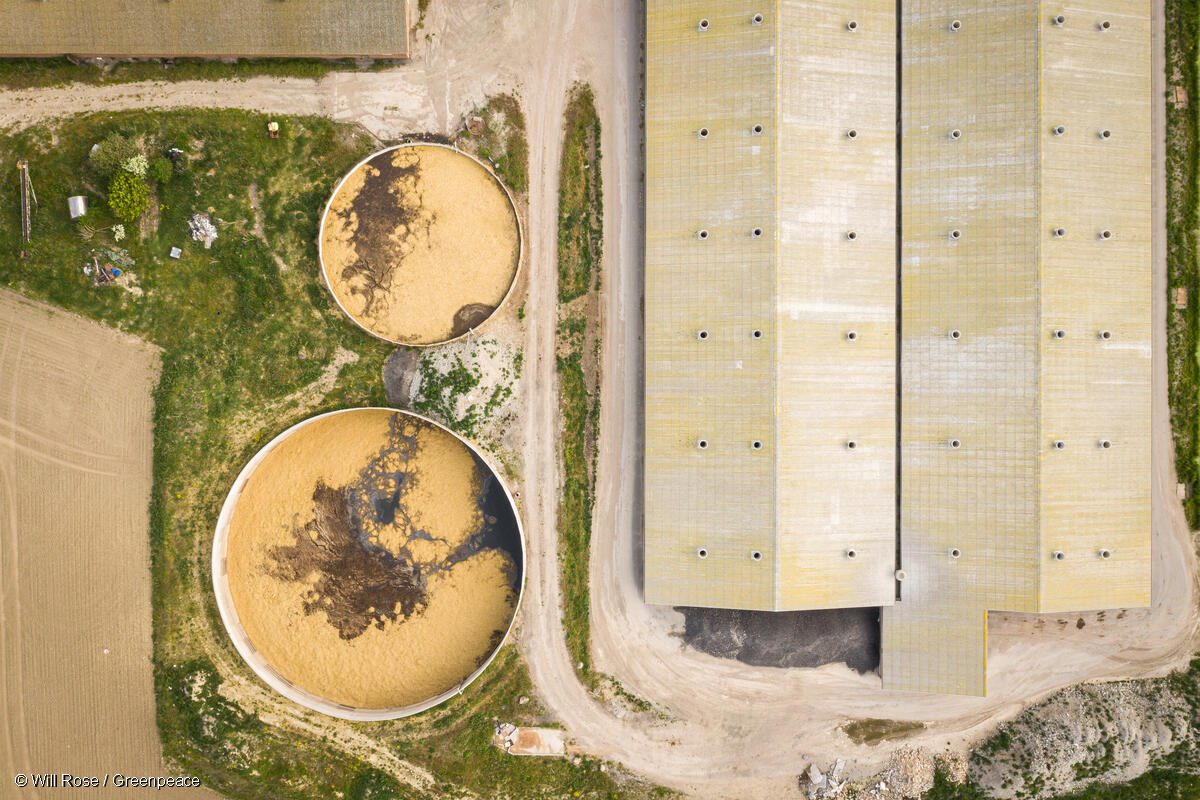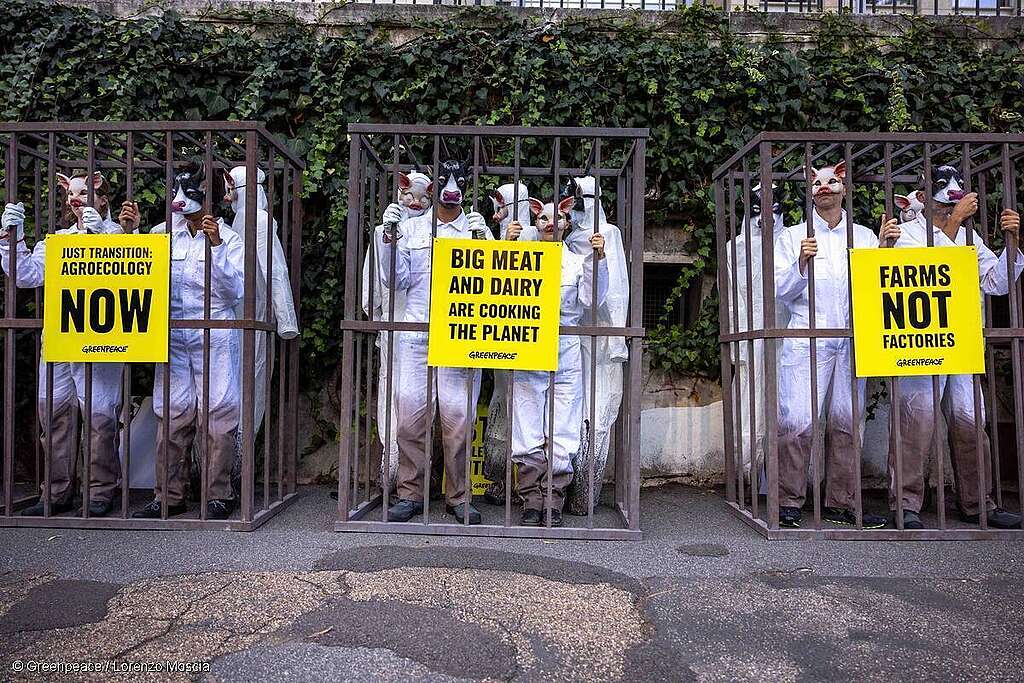
Brussels, 7 July 2026 – The European Commission’s new livestock strategy fails to address the problems caused by the EU’s dominant intensive factory farming model that is responsible for devastating European rural communities and the environment, as well as drastically undermining climate goals, says Greenpeace.
The strategy makes no mention of the growing body of scientific evidence that nitrates pose a danger to human health at concentrations far below the current outdated European limit of 50 mg/L for drinking water, and only indirectly alludes to the role of intensive animal farming as the main cause of nitrate pollution.
It also suggests, in very ambiguous language, that the Commission may move to change the way agricultural methane is counted, using an accounting trick that simply assumes that the current level of methane emissions is sustainable, thereby removing the need for major reductions. This trick, known as “no additional warming” or “temperature neutrality” is not compatible with the UN Intergovernmental Panel on Climate Change’s methodology for calculating climate impacts.
Greenpeace EU agriculture policy director Marco Contiero said: “The Commission’s livestock strategy seems keen to avoid the hard questions or to confront the urgent need to reverse the destructive process of intensification in the EU livestock sector. Pollution from nitrates – which recent research links to cancer at much lower concentrations than what’s currently allowed in the EU – barely gets a mention, except to say that the Nitrates Directive is in the firing line for deregulation. This, and vague promises of future innovation do not represent a serious attempt to tackle the complex problems in the livestock sector. Intensive livestock farming is devastating to regions where it is highly concentrated and cannot be made sustainable. When too many animals are packed too densely together in ever bigger factory farms, the result is soil, water and air pollution and the release of vast quantities of methane that rapidly heat the planet. ”
Ignoring science
According to the European Environment Agency (EEA) livestock production accounts for more than 65% of agricultural greenhouse gas emissions in the EU, and agriculture was responsible for around 94% of EU ammonia emissions in 2023, almost all coming from livestock.
By opening the door to the “no additional warming” approach, the strategy would in particular put the responsibility for reaching Europe’s climate neutrality by 2050 on all sectors of the EU economy except farming.
Methane is a super-heating gas which traps 80 times more heat than carbon dioxide over a twenty-year timeframe. Cuts to methane emissions would have an outsized impact on keeping global temperature rise as low as possible. According to the World Meteorological Organisation, methane emissions in 2021 were 262% higher than in pre-industrial levels.
The “no additional warming” approach to calculating methane’s climate impacts is also profoundly unfair and inappropriate as it can consider countries with identical methane emissions as having different climate impacts due to their different development histories. An industrialised country which has long had a massive national herd of cattle, for instance, could maintain that herd and be considered as climate neutral under this approach, while a developing country starting from a much smaller herd would be considered a climate killer if that herd were to increase in number at all.
“Livestock farming is responsible for 65% of agricultural greenhouse gas emissions in the EU, and these have reduced only 7% since 2005. The equivalent reduction for buildings, for example, is 43%. The livestock sector is a laggard, so why is the Commission so coy about how it plans to address this? The strategy is worryingly vague, suggesting that the Commission may be planning to adopt the ‘temperature neutrality” accounting trick, favoured by countries like Ireland and New Zealand, to declare that methane coming from farmed animals is ‘natural’ and that no deep and sustained cuts are actually needed. This kind of wishful thinking from the Commission would be a scandal,” added Contiero.
Contacts:
Marco Contiero, Greenpeace EU agriculture policy director: +32 (0)477 777034, [email protected]
Greenpeace EU press desk: +32 (0)2 274 1911, [email protected]
For breaking news and comment on EU affairs: Bluesky