March for Nature
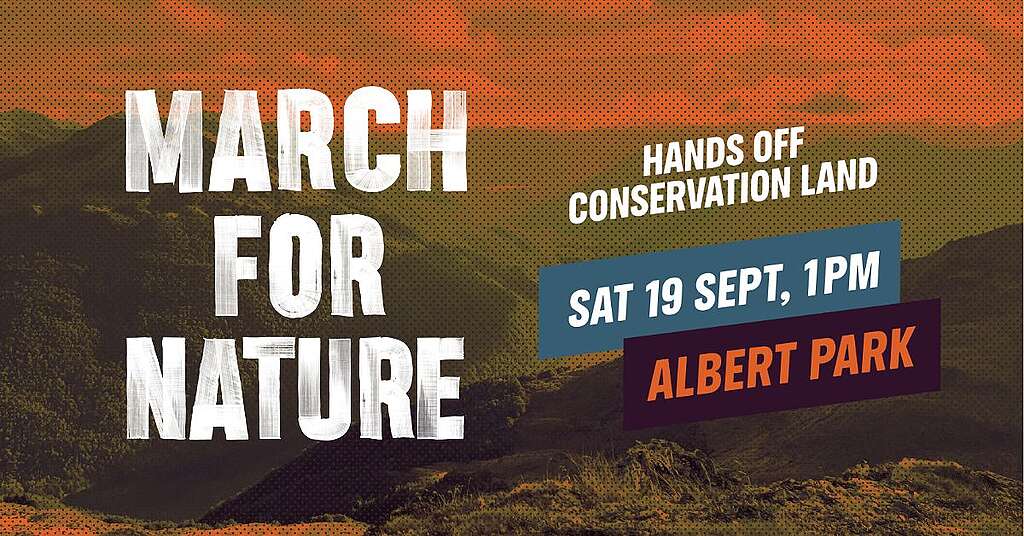
Albert Park to Queen Street – 1pm Saturday, September 19th 2026.
Join us in Auckland for a peaceful protest to defend conservation land.
What is the March for Nature?
On Saturday 19 September 2026, at 1pm people from across Aotearoa will come together in Auckland to stand up for nature and defend conservation land.
We will meet in Albert Park and march down Queen Street.
The Luxon Government has waged a war on nature over the last three years and this attack on conservation land is the last straw. The Government is trying to push through the Conservation Amendment Bill to make it easier to exploit and even sell off public conservation land. From forests and wetlands to rivers, coastlines and mountain ranges, the places that belong to Aotearoa are under threat.
But we’ve stopped attacks on nature before.
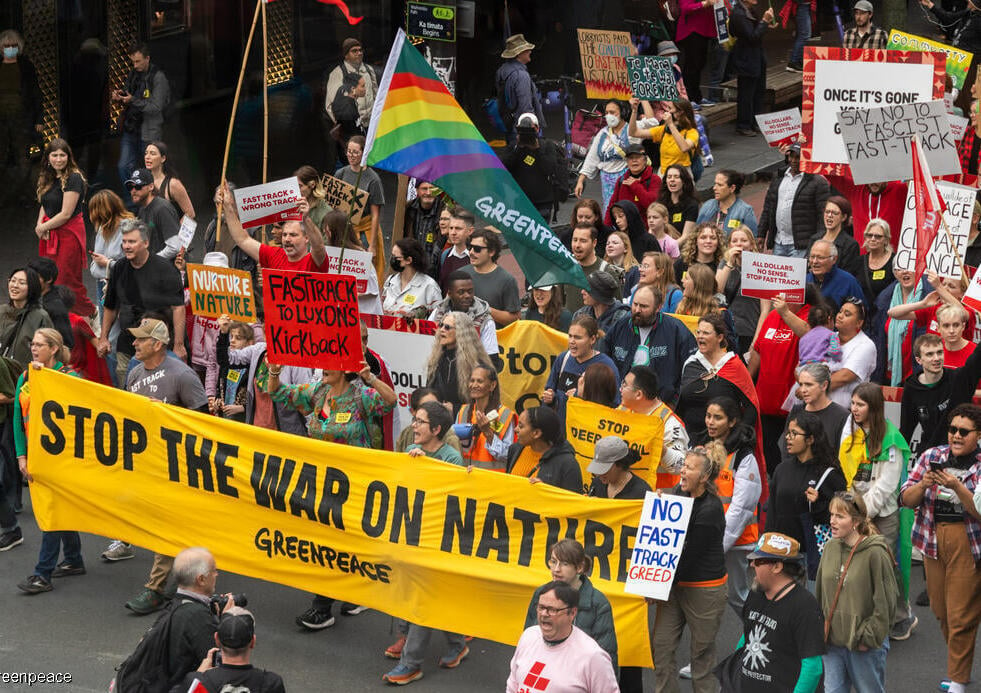
Fifteen years ago, tens of thousands of New Zealanders marched to stop plans to mine the most highly protected conservation land in Aotearoa – and we won. And in 2024, when we last marched for nature over 20,000 people turned up. The march filled Queen Street from Aotea Square to the sea!
Once again, let’s stand together and defend the wild places we love.
Bring your friends, whānau, tramping buddies and community groups. Whether you’re passionate about wildlife, conservation, climate, hunting, fishing, tramping or simply protecting the places that make Aotearoa special, this march is for you.
Where is the March for Nature?
The March for Nature is a protest march walking down Queen Street Auckland at 1pm Saturday, 19 September, starting from Albert Park. We march against the Conservation Amendment Bill, against the ‘war on nature’.
The march starts at Albert Park, in Auckland’s CBD. Everyone will gather at the band rotunda at Albert Park at 1pm for speeches. About 1.30 the front of the march will start moving.
The route starts at Albert Park, goes from Princes Street to Wellesley Street, turns into Queen Street and will finish at Te Komititanga Square.

What’s the best way to get to Albert Park and the March for Nature?
The CRL: The new CRL train lines open on 13 September! This means it’s easy to arrive at Britomart from anywhere in the Auckland area. Use the CRL Journey Planner to plan your trip.
Walk eleven minutes from Britomart Place to Albert Park.
Bus: The route 70 bus leaves every 10 minutes from Britomart Place. It’s a 13 minute trip to Albert Park. Get off the bus at the ‘Auckland Universities’ stop and walk five minutes.
Cycle: Use the Auckland Bike Map to plan your journey!
Taxi or ride share: A close taxi or uber drop off point to Albert Park is on Princes Street – be aware the street will be partly closed; or alternatively on Symonds Street at Auckland University.
Driving: We recommend leaving your car at home as parking will be difficult in the central city. However there are parking buildings close by at Victoria Street Car Park, Shortland Street Carpark, Civic Square Parking under Aotea Square and ParkAt the Chancery Car Park.
Accessibility information
Arriving at Albert Park
The most accessible entrance will be the Princes Street entrance near the Caretaker’s Cottage. The stage area will be at the Princes Street entrance. Pathways will be kept clear by marshalls to be able to approach the stage area. Arriving at Albert Park from the Kitchener St side has steep paths. There are stairs from the Art Gallery. There are wharepaku (bathrooms) at Albert Park.
Stage and speeches
There will be a clear space kept in front of the stage for everyone with access needs. There will be some limited seating. Speeches are due to start at 1pm and will last approximately half an hour. Sign language interpreters will be present during the speeches.
The route and march
The route is all downhill and the distance is about 2km overall. From Albert Park the march will exit onto Princes Street, turn right onto Wellesley Street East, then turn right onto Queen Street. It will end at Te Komititanga Square.
Timing
We’re expecting thousands of people to attend the march. It may be a half an hour to walk the route together, but it could take up to an hour longer for everyone to start and finish, depending on numbers.
Quieter area
There will be loud chanting, but the rear of the march will be encouraged to be a quieter area without megaphones. Earplugs and noise-cancelling headphones are recommended for the rest of the march.
If you need any help look for the marshalls in the green vests.
Help us raise $30,000 to power the March for Nature
We need to make this a moment that our political leaders cannot ignore, and show that thousands of everyday people are ready to stand together to defend nature and wildlife in Aoteaora. We need the March for Nature to be powerful, loud and impossible to ignore.
We’re raising $30,000 to ensure we have all the essential resources needed to make this march an unforgettable part of the story of Aotearoa’s environmental movement.
Your donation will go towards everything we need to make this march a success, including:
- Protest banners and signs to send a clear message
- Promotional materials to advertise the march far and wide
- Equipment needed on the day, including megaphones, radios, hi-vis jackets, and first-aid kits
- Stage equipment hire, including a sound system
- Training sessions for volunteer marshals to keep people safe
- Beyond the march, a gift today also powers our ongoing, uncompromising work to defend nature, and ensures dedicated Greenpeace staff are there every day, countering corporate lobbyists and fighting for all our futures.
From megaphones to marshals, we need your support to make this march safe and successful. Please donate today and help us reach our goal and support this moment.
What is the Conservation Amendment Bill?
The Luxon Government is planning a ram raid on public conservation land.
They are proposing to change the entire purpose of the Conservation Act and the Department of Conservation to make it easier to sell off public conservation land or open it up to private commercial exploitation.
Here is a breakdown of what the Government is proposing with the Conservation Amendment Bill:
- It expands the types of conservation land that can be sold or swapped. This means roughly five million hectares, roughly 60% of all public conservation land, could become eligible for sale or exchange.
- It changes the entire purpose of the Department of Conservation. Since 1987, DOC’s primary job has been to protect nature but the Bill would force DOC to enable commercial exploitation of public conservation land.
- It ‘unleashes’ commercial exploitation of protected lands, which could lead to faster approvals for mining and facilitate more intensive development within public conservation land.
This is the biggest attack on conservation land in New Zealand’s history. And it is the darkest and most critical moment in the fight to protect Aotearoa from destructive mining.
How can I defend conservation land?