Fossil fuels are more expensive, less reliable and worse for the climate than renewables.
The OECD, possibly the western world’s premier economic think tank, has just given the Luxon Government an “F” on energy policy as part of its just published Economic Survey of New Zealand.
Every two years OECD experts publish an analysis of their member countries’ economic situation. Last week was New Zealand’s turn and one of the main focus areas of the report was energy policy.
The OECD’s experts think the extensive NZ Government support for fossil fuels won’t help with energy affordability, nor security of supply, and certainly not with climate action.
The Government’s centrepiece energy policies of a $200m subsidy to oil and gas exploration, and an LNG import terminal, were a particular focus. These policies “are not likely to materially improve electricity affordability and risk locking in fossil fuel dependence, weakening investment signals for competing seasonal (dry-year) firming technologies such as biomass (wood), or pumped hydro.” (OECD p.50)
In the polite world of OECD-speak, this is a withering criticism. The OECD had a few home truths for a government that is focused on fossil fuels.
Luxon responded by calling the OECD report “a load of rubbish” and stated that the coalition government was not going to tolerate “bumper sticker” policies or “kumbaya and mush”.
I can see why he is a bit hysterical. The OECD’s report is closely aligned to the arguments Greenpeace and others have been making – that fossil fuels are expensive, unreliable and bad for the climate. We got an A while he got an F!
So putting aside Luxon’s name calling, let’s look at the arguments.
- Fossil gas makes electricity more expensive.
The OECD points out that NZ has high electricity prices because fossil gas sets the price for electricity for 70% to 90% of the time (p.55). Generating power from fossil gas is expensive and, due to the way the New Zealand electricity market works, when fossil gas generators are running, they set a high price for all electricity generators. When any gas is running, even super cheap wind gets paid the same price as super expensive fossil gas.
The lack of investment in new generation by the big electricity companies over the last decade drove this dependence on gas which produced higher prices (which also increased profits for big electricity generators).
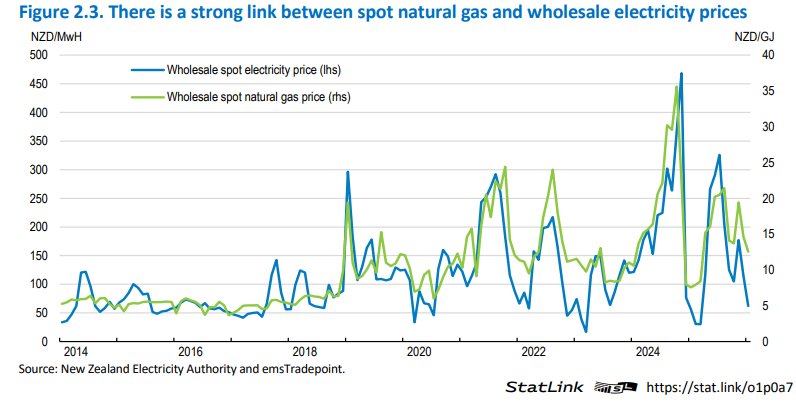
- Breaking the dependence on fossil gas will make electricity cheaper
The OECD thinks the LNG import terminal will extend the dependence on gas and hence won’t make electricity prices lower. But do you know what they think will cut electricity prices: cutting fossil gas dependence out of the electricity market.
“A publicly announced government strategy to break the dependence of the electricity market on gas could bring immediate gas and electricity price relief to households and industry, if backed by minority stake Crown co-investments in non-gas firming.” (p.60)
Moving on from fossil gas dependency means cheaper electricity for households and industry. Yep that’s according to the western world’s leading economic think tank!
- Breaking the dependence on fossil gas will increase energy security
Breaking the connection between electricity and fossil gas also increases energy security, because we won’t be gambling on fossil gas prices and availability. We won’t be gambling on finding more gas through exploration, nor gambling on importing it via an LNG import terminal, which as we’ve seen since Trump’s war, can be expensive and unreliable.
A “prudent strategy under high uncertainty is to reduce electricity’s structural dependence on gas by progressively replacing gas peaking with batteries and expanding non‑gas seasonal firming generation (e.g. pumped hydro), supported by greater demand‑side flexibility”. (p.55)
- Meeting peak electricity load doesn’t need gas
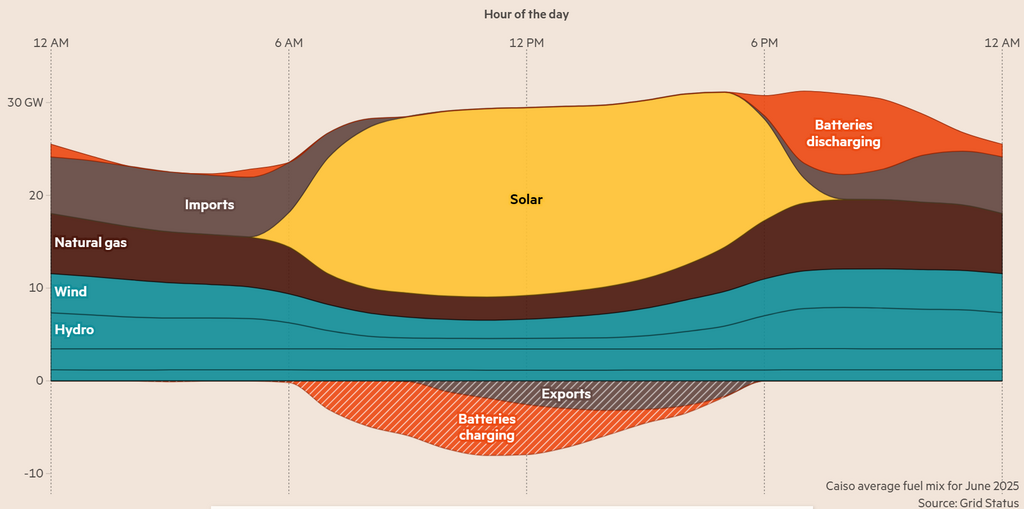
We have relied on fossil gas to meet peak demand but we don’t need to anymore. Batteries and renewables are covering more of the evening peak load in many places, displacing gas. Spain has already effectively decoupled the electricity price from the gas generation price because it has loads of renewables and storage. This FT graph from California shows how batteries are extending the period of decoupling, and this is just the beginning.
- Gas won’t solve the dry year challenge and will increase prices
The NZ electricity system has a particular challenge which is the dry year risk. Because half the generation is from hydro, when we are short of rain we can face electricity generation constraints. Hence we need some kind of longer term back up over weeks or even months, which the OECD calls ‘seasonal firming’.
Gas doesn’t solve this problem as there is not enough of it and it is too unreliable, which “underscores why gas cannot remain the backbone of seasonal electricity firming.” (p.56) The coal stockpile at Huntly is not enough and is very polluting.
Building an LNG import terminal only makes the price problem worse and will lock us into high and volatile international gas prices. “Once LNG is in place, the international LNG price would set the New Zealand gas price…gas prices will continue to set marginal electricity prices both during dry and indeed most of the time, keeping wholesale and forward prices elevated.” (p.57)
- There are solutions to the dry year risk
The OECD identifies pumped hydro, biomass, geothermal and demand side response as the menu of solutions to dry year risk. Pumped hydro simply reverses the flow of water to store energy for later, though we may need more storage than we currently have. Biomass can burn forestry waste to generate power – currently this supplies 13% of Finland’s electricity needs and the OECD estimates it could supply 16% in NZ. Demand side response means providing financial incentives for large consumers to cut power use during dry periods.
The OECD is a market focused thinktank so unsurprisingly they argue for the creation of a market in ‘firming’ to create a financial incentive. But even there they argue that the government should provide minority investment in firming projects to get them over the line and to keep them independent of the existing oligopolistic gentailers.
- LNG is a really really bad idea
The Government’s idea of taxing electricity consumers to pay for an LNG import terminal, at a cost of $6 to $8 billion, comes in for particularly heavy critique. It would lock us into unreliable and expensive gas which would drive even more businesses to the wall.
“Public sponsorship of LNG risks locking‑in fossil dependence and weakening incentives for alternatives such as biomass, pumped hydro and demand response. The conflict in the Middle East underlines that introducing reliance on LNG would exacerbate New Zealand’s already high vulnerability to imported liquid fuels shortages. In addition, it would create a single-point-of-failure risk because there is only one viable port of entry in Taranaki.” (p.57 emphasis added)
“For many internationally‑exposed industries, LNG‑linked energy prices would likely be too high to sustain competitiveness, risking further rapid deindustrialisation.” (p.57)
- Supporting EVs is a strategic necessity for NZ
The NZ Government has systematically rolled back incentives to electrify transport, such as the clean car discount and fuel efficiency standards. But the OECD points out that decarbonising transport is important for climate goals as well as energy security and economic resilience. Fossil fuel supplies are expensive, polluting and vulnerable.
“Maintaining a strong differential in operating costs between ICE vehicles and EVs is therefore important not only for emissions reduction but also on energy‑security and economic‑resilience grounds. New Zealand is highly exposed to disruptions in imported liquid fuel supply, with potentially severe consequences for transport, supply chains and critical services. This vulnerability is underscored by recent conflict in the Middle East.
“Accelerating transport electrification would materially reduce exposure to such shocks by shifting energy demand toward domestically produced electricity.
“From this perspective, preserving and, if necessary, strengthening incentives for EV uptake should be treated as a strategic national priority.’ (p.44)
- The tax system is subsidising heavy fossil fuel cars which is an energy problem
The OECD experts point out that NZ’s system of charging Road User Charges forces the driver of a small electric vehicle (EV) to pay the same RUC as a massive 3.5 tonne diesel SUV. This is in spite of the greater road damage that larger vehicles cause and the increased risk of injury and death they pose to other road users. The NZ Government plans to roll out this system across the rest of the vehicle fleet which would subsidise giant internal combustion engine (ICE) cars and penalise EVs.
“The proposed flat charging per kilometre schedule on vehicles weighing up to 3500kg is not sufficiently aligned with the social costs as it lumps together small three-door city cars, large SUVs and internal combustion engine (ICE) vehicles and EVs. … A graduated schedule should be calibrated to take account of higher risk of injury and death for pedestrians, cyclists and occupants of other vehicles that heavier vehicles impose.” (p.44)
- Govt should direct gentailers to invest more in new generation
Finally the OECD dug into the key driver for underinvestment in new generation, and hence ongoing reliance on expensive gas peakers – the electricity market structure and vertical integration of the gentailers.
The gentailers are incentivized to underinvest in new generation, as this underinvestment keeps gas generation as a necessary part of the system, with gas setting high wholesale electricity prices most of the time this results in large profits for the gentailers. It also blocks new retail entrants as the gentailers can pass on cheaper power internally to their retail division, cheaper than independent retailers can buy on the wholesale market.
The impact of this underinvestment, combined with high wholesale prices, is that the gentailers have had a lot of income which they haven’t needed to spend on investment. They have had such a flood of money that their dividends have been twice as large as their net profits .
“Gentailers have consistently paid out 90–240% of net income in dividends (Figure 2.8), totalling NZD 11.8 billion over the decade to 2025, exceeding net profits by NZD 4.5 billion. In 2023, gentailers paid NZD 1.2 billion in dividends off just NZD 530 million in net profit. The high dividend ratios have constrained investment, with only NZD 1 invested in renewables for every NZD 2.41 paid out in dividends.” (pp.68-9)
Dividend payouts above 80% are generally considered too high as it doesn’t allow for sufficient investment – NZ gentailers were paying out 160%, on average for a decade! In 2023 it hit an astounding 225%.
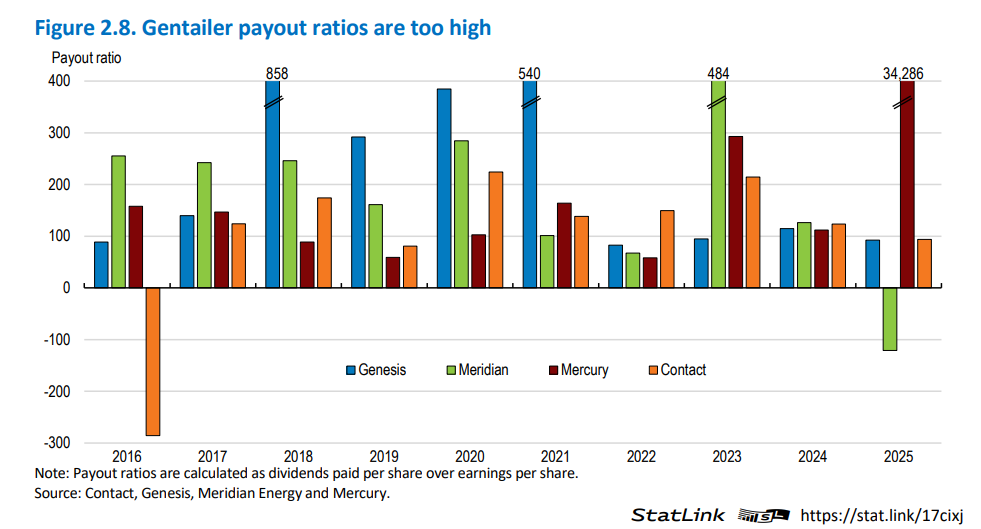
The gentailers have underinvested in new generation, resulting in ongoing dependence on gas peakers, driving high wholesale prices, and they have paid out huge dividends.
But there is a solution. The Government owns 51% of three of these gentailers so is in a position to give greater direction supporting new investment, but so far has failed to do so.
This is at odds with OECD best practice guidelines which “recommend that governments publish a formal ownership policy for companies that it has a controlling stake, clarifying their strategic objectives, dividend expectations, and performance metrics.”
“New Zealand lacks such a policy for its Mixed Ownership Model gentailers, creating ambiguity around whether these firms should prioritise shareholder returns or system investment.” (p.69)
Meanwhile people have had expensive power and the system remains dependent on gas.
11. Fossil fuel companies need political protection from the economics of renewables
So in spite of what the Luxon Government says, the OECD concludes that we find ourselves in the fortuitous situation where the cheapest and most reliable power is also the best for the climate.
Solar+wind+geothermal+hydro+batteries+EVs
will beat
coal+gas+oil+ICE
on price, reliability and sustainability
It is a happy place if you care about climate change and life on earth.
The decarbonisation transition is a no-brainer for New Zealand, in particular, as we are not big fossil fuel producers nor ICE manufacturers. We have everything to gain by embracing this transition and much to lose by sticking with fossil fuels (like $8billion a year importing transport fuel).
In light of their dramatic disadvantages, fossil fuel companies are increasingly relying on right-wing governments to protect them. Whether you see it as the fossil fuel industry colonising the political right, or the political right throwing in its lot with the fossil fuel industry, this corruption of the right has become a problem for all humanity.
The right-wing is using state power to protect the fossil fuel industry from their more efficient renewable competitors. They are doing this through the use of taxpayer subsidies, as the OECD has pointed out in this report. Or they are doing it by passing laws to protect fossil fuel companies from common law damages claims, as the Luxon Government announced this week.
The donations flowing from fossil fuel companies into right-wing parties in NZ and around the world are the last throw of the dice to influence the democratic process to get the state to impede the progress of renewables.
We will win eventually, and renewables are growing fast globally, but, when it comes to climate change, every tonne of emissions counts. So we need to win as fast as possible and part of that means cutting off the corrosive flow of money from fossil fuel companies to right-wing political parties. This money flow is both undermining our democracy and leading to the state protecting fossil fuel companies from their more efficient and cleaner renewable energy competitors.