

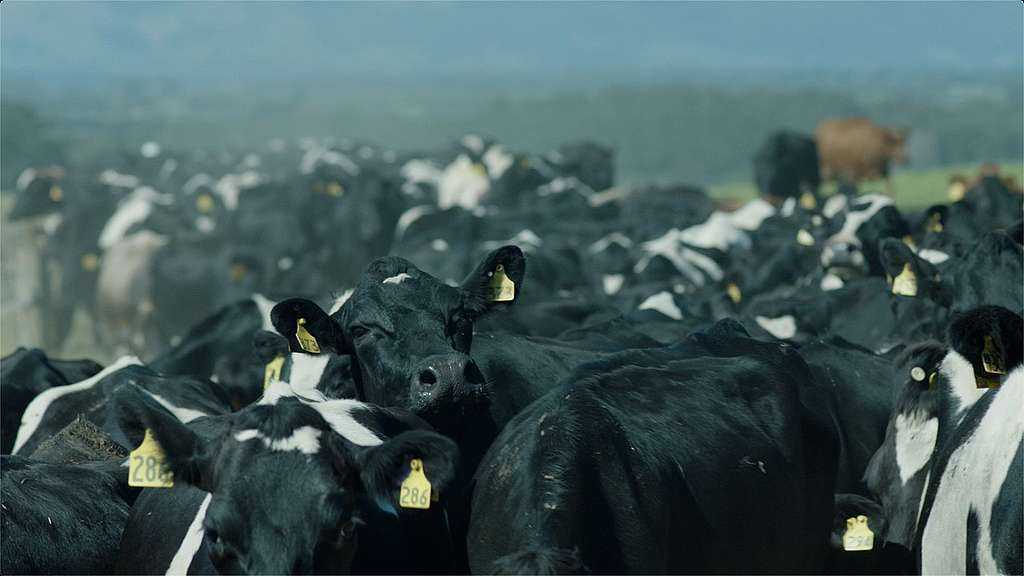
It shouldn’t have taken a devastating war in the Middle East and a global supply chain crisis to make us realise our farming system is a house of cards. For decades, we’ve watched a slow-motion disaster unfold – nitrate-poisoned bore water and unswimmable rivers – but the collective response from both the industry and political parties (across the spectrum) has been a shrug of, “that’s just the cost of our sacred dairy industry.”
Now, the bill has finally come due.
How did New Zealand get into this mess? Fonterra created a urea addiction.
To understand why New Zealand is so vulnerable to fertiliser shocks caused by geopolitical crisis, you have to understand our system:
Traditionally, cows eat the grass that grows naturally. But the New Zealand dairy industry moved to a model that forces the grass to grow through a synthetic process:
- Farmers buy massive amounts of synthetic nitrogen fertiliser (mostly in the form of urea). It’s made using huge amounts of fossil gas. A third of the world’s fertiliser is shipped through the Strait of Hormuz, which means global prices have skyrocketed.
- This synthetic nitrogen acts like a steroid for grass. It forces it to grow faster than nature intends.
- Because there is now a chemically-charged grass that is growing too quickly, farmers can pack the land with more cows than it can naturally support.
- These extra cows produce more urine than the soil can absorb. That excess nitrogen washes into our groundwater, causing nitrate-contamination.
- When the artificial grass growth slows down, farmers have to buy PKE (Palm Kernel Expeller) from overseas just to keep the bloated dairy herd fed.
New Zealand farmers are left on a frantic, expensive treadmill – buying gas-dependent fertiliser to forcibly grow grass to feed too many cows to pay off the interest on a $300,000 tractor.
Much of the vegetation we grow gets fed to dairy cows. And a massive portion of the milk we produce gets processed into powder and used to make confectionery (i.e. Nestle chocolate bars), not nutritious food.
New Zealanders have been sold a lie about our farming industry.
The dairy industry often balks at the suggestion of transitioning to ecological and regenerative farming – largely due to the debt left over from the current farming practice, and the 3-5 year wait for a different crop to grow.
But a small silver lining in the war that the US and Israel have waged against Iran and Lebanon, is that our dairy-dependent economy is facing a reckoning. Farmers are now in a position where considering a more sustainable, regenerative, and environmentally conscious alternative may be a lifeboat for them.
Farmers can solve this by going back to the logic of the land
First, the reality is that we must reduce the dairy herd size. We have to stop trying to put cows on every square inch of Aotearoa. But for the cows left over, this is how we remove the reliance on synthetic nitrogen fertiliser:
- Instead of buying urea, we plant legumes like clover and lucerne. These plants have a superpower – they pull nitrogen out of the air and put it into the soil.
- Instead of just one type of grass, we plant multispecies – chicory, plantain, and deep-rooted plants, which dig deep into the earth and draw up water and nutrients from within the soil.
- Move away from unnatural monocultures where we just grow one thing on farms, into a more diverse farm with different crops, trees and animals, so our farms start to mimic our natural ecosystems.
Secondly, if we are to swap intensive dairy for an ecological farming future, we need to focus on crops that thrive in our temperate climate, require minimal synthetic intervention, and command premium prices in a world that is increasingly “wellness-interested” and carbon-conscious:
1. Kiwifruit and Premium Pipfruit (done right)
We are already world leaders here. In June 2025, horticulture exports hit NZD 8.5 billion and are forecasted to hit NZD 9.2 billion in 2026. Kiwifruit alone provides over half of this figure. These are perennial crops. Once established, they don’t require the aggressive, seasonal nitrogen “reset” that dairy pasture does. By expanding these into traditional dairy regions, we trade high-emission milk for high-value, low-emission fruit that the many in the middle class cannot get enough of. This, of course, needs to be done in hand with regenerative farming practices.
2. Plant-Based Proteins
The global plant-based protein market is projected to hit NZD 60 billion by the end of 2030. Instead of growing grass to feed a cow to get protein, we start to grow protein directly.
Southland and Canterbury are perfectly primed for high-grade oats (for the oat milk market) and peas for meat alternatives. These crops can be grown using “green manure” cycles, fixing their own nitrogen (and keeping our drinking water free of nitrate contamination.)
3. High-Value “Bio-Actives” and Nutriceuticals
The world wants health and wellness. New Zealand’s high UV light and unique soil profiles produce plants with higher levels of antioxidants. Blackcurrants, cherries, and hops are raw materials for a global supplements industry. They are light to ship (lower carbon emissions) and incredibly high-value per hectare compared to milk solids.
4. Indigenous Superfoods
New Zealand can scale exports of Mānuka honey derivatives, Kawakawa-based products, and specialty grains like Kūmara-based flours. These carry a story of provenance and sustainability that synthetic-fed dairy simply cannot compete with in 2026.
The beauty of this pivot is that it means that New Zealand will never be at the mercy of geopolitical crises like the Strait of Hormuz closure again. A horticultural future that relies on local biological cycles. Perhaps most importantly, horticulture uses water far more efficiently than dairy.
To support the transition, we need better policy
Most farmers won’t be able to carry the cost of switching. Many of them are already in debt. The government must implement structural policies to support this transition:
- A farmer won’t grow oats if there is no factory to process them. The government must use regional development funds to co-invest in new oat milk factories and bio-active processing hubs in traditional dairy strongholds. Build the bridge, and the farmers will cross it.
- The government should act as a guarantor for loans to do a green transition. If a farmer wants to transition to horticulture or plant-based proteins, they need low-interest loans with deferred repayments, allowing them to survive the 3-to-5-year gap before a new crop yields its first commercial harvest.
- To break the urea addiction, the government must implement a sinking cap and targeted tax on synthetic nitrogen feritliser. This forces the market to account for environmental damage and levels the playing field, making regenerative farming financially competitive.
This is an economic survival strategy that New Zealand can’t afford to miss. We have been scammed into believing that New Zealand’s destiny is to be the world’s commodity milk shed. This catastrophic war has exposed the current farming model for what it is – a dangerous dependency.
To the agribusiness lobbyists resisting the change – your social license is expiring, and your supply chain is burning. A lifeboat is floating nearby. It’s time to climb in.
To the rest of NZ – it’s time to demand a food system that prioritises soil and water safety. Let’s stop being the world’s most vulnerable dairy farm and start being its most sophisticated garden.
