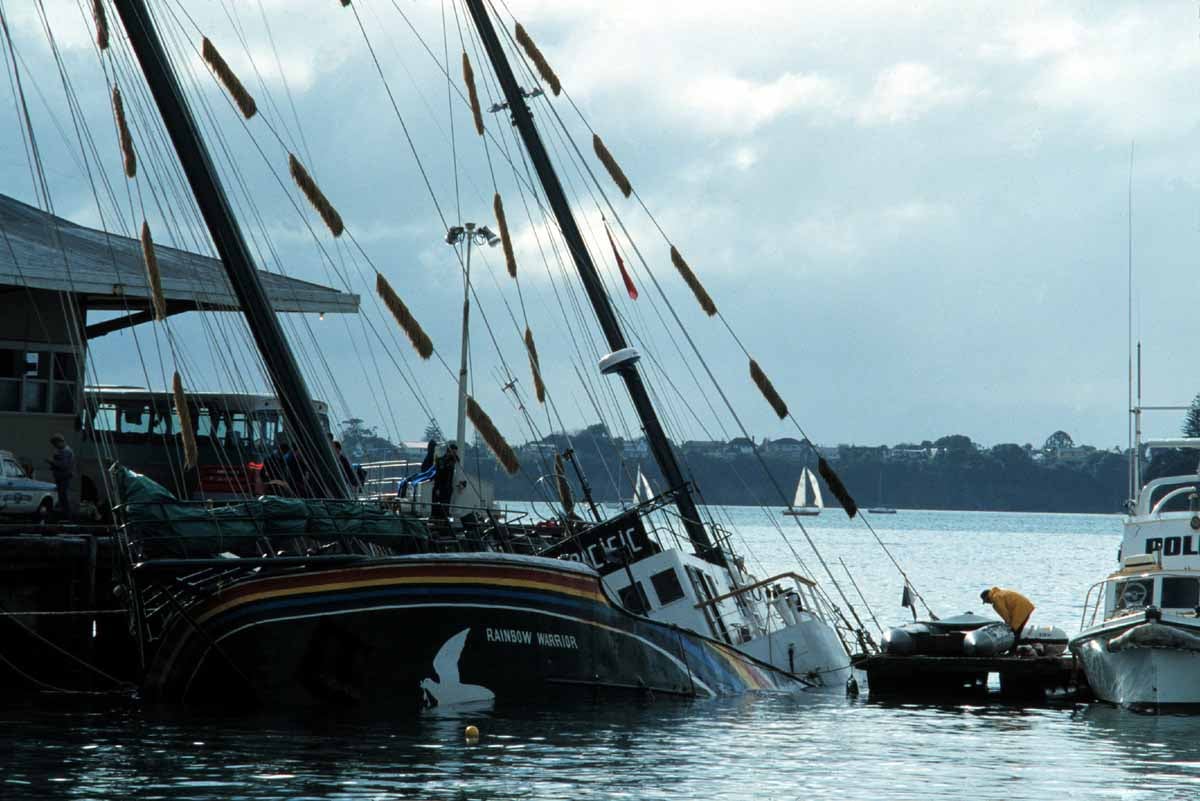
We’ve visited Ground Zero. Not once, but three times. But for generations, before these locations were designated as such, they were the ancestral home to the people of the Marshall Islands.
As part of a team of Greenpeace scientists and specialists from the Radiation Protection Advisors team, we have embarked on a six-week tour on-board the Rainbow Warrior, sailing through one of the most disturbing chapters in human history: between 1946 and 1958, the United States detonated 67 nuclear bombs across the Marshall Islands — equivalent to 7,200 Hiroshima explosions.
During this period, testing nuclear weapons at the expense of wonderful ocean nations like the Marshall Islands was considered an acceptable practice, or as the US put it, “for the good of mankind”. Instead, the radioactive fallout left a deep and complex legacy—one that is both scientific and profoundly human, with communities displaced for generations.
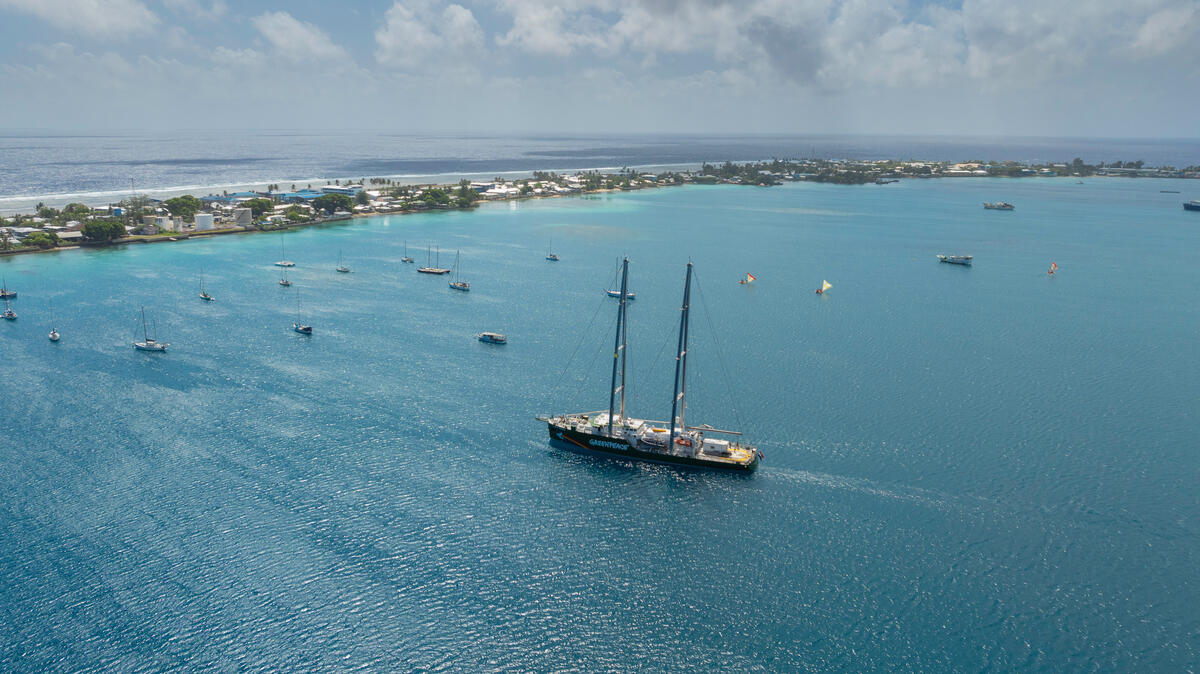
Between March and April, we travelled on the Greenpeace flagship vessel, the Rainbow Warrior, throughout the Marshall Islands, including to three northern atolls that bear the most severe scars of Cold War nuclear weapons testing:
- Enewetak atoll, where, on Runit Island, stands a massive leaking concrete dome beneath which lies plutonium-contaminated waste, a result of a partial “clean-up” of some of the islands after the nuclear tests
- Bikini Atoll, a place so beautiful, yet rendered uninhabitable by some of the most powerful nuclear detonations ever conducted;
- And Rongelap atoll, where residents were exposed to radiation fallout and later convinced to return to contaminated land, part of what is now known as Project 4.1, a U.S. medical experiment to test humans’ exposure to radiation.
This isn’t fiction, nor the distant past. It’s a chapter of history still alive through the environment, the health of communities, and the data we’re collecting today. Each location we visit, each sample we take, adds to a clearer picture of some of the long-term impacts of nuclear testing—and highlights the importance of continuing to document, investigate, and attempt to understand and share these findings.
These are our field notes from a journey through places that hold important lessons for science, justice, and global accountability.
Our mission: why are we here?
![<!-- wp:paragraph -->
<p><strong>When the Luxon-led coalition took office nearly two years ago, its war on nature started within days of taking office. In that time, the government has made a bewildering number of changes leading to environmental harm. Greenpeace Aotearoa Executive Director Russel Norman has undertaken the gargantuan task of tracking them all.</strong></p>
<!-- /wp:paragraph -->
<!-- wp:separator -->
<hr class="wp-block-separator has-alpha-channel-opacity"/>
<!-- /wp:separator -->
<!-- wp:html -->
<span id="top"></span>
<!-- /wp:html -->
<!-- wp:paragraph -->
<p>It has been nearly two years since the 2023 election that led to the formation of the Christopher Luxon led Government, a coalition between the National, Act and NZ First parties.</p>
<!-- /wp:paragraph -->
<!-- wp:paragraph -->
<p id="top">It has been two years of a veritable war on nature. New Zealand and the world is already facing a climate crisis and a biodiversity crisis, and this Government has been systematically making it worse.</p>
<!-- /wp:paragraph -->
<!-- wp:paragraph -->
<p>There have been so many anti-environment initiatives, across so many government agencies, through so many law and regulation changes, it is hard to keep track of them all. The aim of this article is to create a comprehensive timeline of them.</p>
<!-- /wp:paragraph -->
<!-- wp:paragraph -->
<p>I’ve gone through every week of the last two years of the Luxon Government to pull out their environment policies and laid them out below. I’m afraid this is really more of a reference document than an easy-to-read narrative, and it is unpleasant reading at the best of times. So here goes.</p>
<!-- /wp:paragraph -->
<!-- wp:group {"metadata":{"categories":[],"patternName":"core/block/66310","name":"Blog Table of Contents"},"style":{"spacing":{"padding":{"top":"var:preset|spacing|30","bottom":"var:preset|spacing|30","left":"var:preset|spacing|30","right":"var:preset|spacing|30"}}},"backgroundColor":"beige-100","layout":{"type":"constrained"}} -->
<div class="wp-block-group has-beige-100-background-color has-background" style="padding-top:var(--wp--preset--spacing--30);padding-right:var(--wp--preset--spacing--30);padding-bottom:var(--wp--preset--spacing--30);padding-left:var(--wp--preset--spacing--30)"><!-- wp:heading {"level":4} -->
<h4 class="wp-block-heading" id="h-on-this-page-the-war-on-nature-timeline">On this page: the War on Nature timeline</h4>
<!-- /wp:heading -->
<!-- wp:columns -->
<div class="wp-block-columns"><!-- wp:column -->
<div class="wp-block-column"><!-- wp:list -->
<ul class="wp-block-list"><!-- wp:list-item -->
<li><strong><a href="#h-2023-war-on-nature">2023</a></strong><!-- wp:list -->
<ul class="wp-block-list"><!-- wp:list-item -->
<li><a href="#h-october-december-2023">October - December 2023</a></li>
<!-- /wp:list-item --></ul>
<!-- /wp:list --></li>
<!-- /wp:list-item -->
<!-- wp:list-item -->
<li><strong><a href="#h-2024-war-on-nature">2024</a></strong><!-- wp:list -->
<ul class="wp-block-list"><!-- wp:list-item -->
<li><a href="#h-january-2024">January - March 2024</a></li>
<!-- /wp:list-item -->
<!-- wp:list-item -->
<li><a href="#h-april-2024">April - June 2024</a></li>
<!-- /wp:list-item -->
<!-- wp:list-item -->
<li><a href="#h-july-2024">July - September 2024</a></li>
<!-- /wp:list-item -->
<!-- wp:list-item -->
<li><a href="#h-october-2024">October - December 2024</a></li>
<!-- /wp:list-item --></ul>
<!-- /wp:list --></li>
<!-- /wp:list-item --></ul>
<!-- /wp:list --></div>
<!-- /wp:column -->
<!-- wp:column -->
<div class="wp-block-column"><!-- wp:list -->
<ul class="wp-block-list"><!-- wp:list-item -->
<li><strong><a href="#h-2025-war-on-nature">2025</a></strong><!-- wp:list -->
<ul class="wp-block-list"><!-- wp:list-item -->
<li><a href="#h-january-2025">January - March 2025</a></li>
<!-- /wp:list-item -->
<!-- wp:list-item -->
<li><a href="#h-april-2025">April - June 2025</a></li>
<!-- /wp:list-item -->
<!-- wp:list-item -->
<li><a href="#h-july-2025">July - September 2025</a></li>
<!-- /wp:list-item -->
<!-- wp:list-item -->
<li><a href="#h-october-2025">October 2025</a></li>
<!-- /wp:list-item --></ul>
<!-- /wp:list --></li>
<!-- /wp:list-item -->
<!-- wp:list-item -->
<li><strong><a href="#h-two-years-of-the-war-on-nature">Two years of the War on Nature</a></strong></li>
<!-- /wp:list-item --></ul>
<!-- /wp:list --></div>
<!-- /wp:column --></div>
<!-- /wp:columns --></div>
<!-- /wp:group -->
<!-- wp:heading -->
<h2 class="wp-block-heading" id="h-2023">2023</h2>
<!-- /wp:heading -->
<!-- wp:heading {"level":3} -->
<h3 class="wp-block-heading" id="h-october-december-2023">October - December 2023</h3>
<!-- /wp:heading -->
<!-- wp:paragraph -->
<p>Voting in the New Zealand general election finished on <strong>October 14, 2023</strong> and the Luxon Coalition Government was sworn in on <strong>November 27, 2023.</strong></p>
<!-- /wp:paragraph -->
<!-- wp:paragraph -->
<p>On <strong>December 3, 2023</strong>, six days later, they announced they were <a href="https://www.beehive.govt.nz/release/lake-onslow-pumped-hydro-scheme-scrapped">cancelling</a> the New Zealand Battery Project. The Battery Project was designed to provide large-scale long-term storage to give security to the electricity network. We need this security because fossil gas has been declining for the last 20 years, the grid is moving to close to 100% renewable electricity, and we are electrifying transport and industrial processes. The Battery would have stored around 5TWh (5,000,000 MWh) of electricity in a pumped hydro scheme to cover the risk of a dry winter. This is about 1000 times the storage in the world’s largest lithium battery, or about 25,000 times Meridian’s <a href="https://www.meridianenergy.co.nz/news-and-events/completion-of-ruakaka-battery-energy-storage-system">largest</a> lithium battery in New Zealand currently.</p>
<!-- /wp:paragraph -->
<!-- wp:paragraph -->
<p>Two years after Luxon cancelled the NZ Battery project, New Zealand is <a href="https://www.rnz.co.nz/news/national/561157/transpower-warns-of-higher-blackout-risk-in-winter-2026">facing</a> major security of supply issues, as well as high wholesale electricity prices, in part due to insufficient storage. A wave of deindustrialisation has followed as factories have closed up.</p>
<!-- /wp:paragraph -->
<!-- wp:paragraph -->
<p>On <strong>December 6th</strong>, <strong>2023 </strong>the first Emissions Trading Scheme (ETS) auction under the new Government <a href="https://businessdesk.co.nz/article/markets/carbon-auction-set-to-fail-depriving-the-govt-of-900m">failed</a> to attract a single bid. National promoted the ETS as its main tool to cut climate pollution, and was relying on raising 0m from ETS auctions to fund tax cuts. </p>
<!-- /wp:paragraph -->
<!-- wp:paragraph -->
<p>On <strong>December 11th 2023</strong> Cabinet <a href="https://www.mbie.govt.nz/dmsdocument/29064-2324-1197-reprioritising-the-government-investment-in-decarbonising-industry-fund-pdf">abolished</a> the 0m <a href="https://www.eeca.govt.nz/co-funding-and-support/approved-gidi-projects/">Government Investment in Decarbonising Industry</a> fund, as part of the mini budget. GIDI was used to support around 80 different industrial projects, including large ones at NZ Steel and Fonterra, to cut emissions in industrial processes by reducing fossil fuel use. Officials estimated that removing this fund would result in ten million tonnes of extra emissions by 2050. Removing the Fund also increased the economic risk of declining gas supplies. </p>
<!-- /wp:paragraph -->
<!-- wp:paragraph -->
<p>The oil and gas lobby group <a href="https://www.scoop.co.nz/stories/PO2312/S00190/ending-gidi-a-win-for-climate-action.htm">celebrated</a> the end of the fund. Luxon said he didn’t want to subsidise business to cut emissions, however as we found out in the 2025 Budget, he was happy to subsidise oil and gas companies to increase emissions. </p>
<!-- /wp:paragraph -->
<!-- wp:paragraph -->
<p>On <strong>December 13</strong>, <strong>2023 </strong>Nicola Willis, the Finance Minister, <a href="https://www.beehive.govt.nz/release/additional-ferry-funding-request-declined">cancelled</a> the new interisland ferries. The ferries were not only more carbon efficient than the old ones but underpinned the future of rail freight across the country, which is the most carbon-efficient form of freight. The cost of the cancellation was a staggering loss of $<a href="https://www.rnz.co.nz/news/political/570081/final-cost-of-breaking-south-korean-ferry-contract-revealed">671m</a> for zero ferries. Efforts are underway to find replacement ferries, at higher cost.</p>
<!-- /wp:paragraph -->
<!-- wp:paragraph -->
<p>On <strong>December 14 2023</strong>, to the joy of agribusiness, the Luxon Government <a href="https://www.beehive.govt.nz/release/government-takes-first-steps-towards-pragmatic-and-sensible-freshwater-rules">announced</a> the beginning of the process to replace the clean water rules - the National Policy Statement on Freshwater Management 2020, a regulation under the Resource Management Act that was one of the most important policies to cut climate and water pollution. Without the clean water rules (and/or a price on dairy emissions) dairy herds are <a href="https://businessdesk.co.nz/article/primary-sector/could-canterbury-be-on-the-cusp-of-another-dairy-conversion-boom">likely</a> to grow again resulting in more climate and freshwater pollution. Dairy is the country’s most climate polluting industry and Fonterra is by far the single biggest climate polluting company. Agribusiness opposed the clean water rules and, with the former head of Federated Farmers, Andrew Hoggard, as Associate Agriculture Minister, they were well placed to remove them.</p>
<!-- /wp:paragraph -->
<!-- wp:paragraph -->
<p>Transport is the country’s second biggest source of greenhouse emissions and measures to cut transport emissions were next on the chopping block.</p>
<!-- /wp:paragraph -->
<!-- wp:paragraph -->
<p>On <strong>December 17 2023</strong>, they <a href="https://www.beehive.govt.nz/release/ministers-mayor-and-chair-agree-end-let%E2%80%99s-get-wellington-moving">killed</a> off Wellington’s low emissions transport plan and moved to replace it with an alternate plan with higher emissions and car dependency.</p>
<!-- /wp:paragraph -->
<!-- wp:paragraph -->
<p>On <strong>December 20</strong>, <strong>2023 </strong>they <a href="https://www.beehive.govt.nz/release/nba-and-spa-successfully-repealed">repealed</a> the Natural and Built Environment Act which was the result of years of work by government, industry and environment NGOs to update and replace the Resource Management Act (RMA). Luxon would soon move to a fast track RMA approval process, while removing environmental guardrails.</p>
<!-- /wp:paragraph -->
<!-- wp:paragraph -->
<p>On <strong>December 31, 2023</strong> the Gas Transition Plan was due for <a href="https://www.mbie.govt.nz/dmsdocument/20265-terms-of-reference-gas-transition-plan">publication</a> but it didn’t appear. The Plan was meant to lay out a pathway to reduce use and dependence on fossil gas. It may have been abandoned by the new Government as unnecessary, as they <a href="https://www.beehive.govt.nz/release/decreasing-gas-reserves-data-highlights-need-reverse-oil-and-gas-exploration-ban">claimed</a> that the gas shortage was a result of the 2018 ban on new oil and gas exploration permits. This was in spite of the <a href="https://www.rnz.co.nz/news/national/568869/why-drilling-for-fossil-fuels-is-not-expected-to-fix-our-energy-crisis">evidence</a> that it takes at least a decade to bring on new gas fields after issuing an exploration permit, and that there were no new major gas discoveries for <a href="https://www.energyresources.org.nz/assets/Uploads/2019-20-NZ-Offshore-Drilling-Campaign-RELEASE.pdf">20 years</a> regardless. </p>
<!-- /wp:paragraph -->
<!-- wp:paragraph -->
<p>The Luxon Government’s decisions to end the NZ Battery Project, close GIDI, stop work on the Gas Transition Plan, and (as we will see later) fast track seabed mining thereby blocking offshore wind generation, left New Zealand dangerously exposed to an energy shock. Reality was about to impose itself on the Government’s ideology.</p>
<!-- /wp:paragraph -->
<!-- wp:heading -->
<h2 class="wp-block-heading" id="h-2024">2024</h2>
<!-- /wp:heading -->
<!-- wp:heading {"level":3} -->
<h3 class="wp-block-heading" id="h-january-2024">January 2024</h3>
<!-- /wp:heading -->
<!-- wp:paragraph -->
<p>They began <strong>2024 </strong>by <a href="https://www.beehive.govt.nz/release/government-ends-%E2%80%98ute-tax%E2%80%99">killing</a> off the clean car discount on <strong>January 1st</strong>, resulting in a <a href="https://newsroom.co.nz/2024/11/06/new-zealand-now-14000-evs-short-after-subsidy-scrapped/">collapse</a> of sales of low emission vehicles.</p>
<!-- /wp:paragraph -->
<!-- wp:paragraph -->
<p>On <strong>January 14 2024</strong> they <a href="https://www.beehive.govt.nz/release/government-cancels-auckland-light-rail">cancelled</a> the project to build light rail in Auckland.</p>
<!-- /wp:paragraph -->
<!-- wp:paragraph -->
<p>They rounded off the month on <strong>January 30 2024</strong> by <a href="https://www.greenpeace.org/aotearoa/press-release/nz-backtracks-on-south-pacific-ocean-protection-lobbies-for-more-bottom-trawling/">reversing</a> New Zealand’s previous support for restrictions to bottom trawling seamounts in international waters, to the joy of the fishing industry. Bottom trawling releases masses of carbon stored on the ocean floor and causes destruction of ancient deep ocean corals.</p>
<!-- /wp:paragraph -->
<!-- wp:heading {"level":3} -->
<h3 class="wp-block-heading" id="h-february-2024">February 2024</h3>
<!-- /wp:heading -->
<!-- wp:paragraph -->
<p>On <strong>February 14 2024</strong> they <a href="https://www.beehive.govt.nz/release/labour%E2%80%99s-three-waters-legislation-repealed">repealed</a> the Three Waters process for supporting councils to improve their water supply and waste water treatment plants. The repeal will ultimately <a href="https://www.thepress.co.nz/nz-news/360799217/mayor-confronts-ungodly-price-three-waters-reform">result</a> in more water pollution and higher costs to councils, rural councils in particular.</p>
<!-- /wp:paragraph -->
<!-- wp:heading {"level":3} -->
<h3 class="wp-block-heading" id="h-march-2024">March 2024</h3>
<!-- /wp:heading -->
<!-- wp:paragraph -->
<p>On <strong>March 1 2024</strong>, they announced that marine farming consents would simply be <a href="https://www.rnz.co.nz/news/country/510602/environmental-group-rails-against-proposal-to-automatically-extend-marine-farm-resource-consents">rolled</a> over for 25 years and not reviewed, in spite of the significant environmental impact of marine farms using public spaces.</p>
<!-- /wp:paragraph -->
<!-- wp:paragraph -->
<p><strong>March 4th 2024</strong> they <a href="https://www.beehive.govt.nz/release/gps-2024-over-20-billion-get-transport-back-track">announced</a> the draft government policy statement on land transport, which slashed spending on cycling and walking and increased funding to motorways. These decisions will increase emissions and hence it was no coincidence that they <a href="https://www.rnz.co.nz/news/political/511387/advocates-attack-removal-of-climate-change-from-government-s-draft-transport-policy">removed</a> climate change as a consideration in transport funding decisions.</p>
<!-- /wp:paragraph -->
<!-- wp:paragraph -->
<p>On <strong>March 6th 2024</strong> they <a href="https://www.beehive.govt.nz/release/auckland-regional-fuel-tax-abolished">cancelled</a> the Auckland regional fuel tax which was funding the expansion of the Eastern Busway, which then had to be <a href="https://newsroom.co.nz/2024/05/15/auckland-wont-complete-big-busway-in-pm-and-ministers-electorates/">cancelled</a>.</p>
<!-- /wp:paragraph -->
<!-- wp:paragraph -->
<p>On <strong>March 7 2024</strong>, former tobacco lobbyist and current Minister for RMA Reform, Chris Bishop, <a href="https://newsroom.co.nz/2025/02/17/environment-was-fast-track-priority-before-ministers-intervention/">rejected</a> officials’ advice to include ‘sustainable management’ in the purposes clause of the fast track law. The absence of environmental guardrails in the purposes clause of the bill meant the fast track law could, and would, be used for projects causing immense environmental harm and climate pollution, such as new coal mines and irrigation expansion.</p>
<!-- /wp:paragraph -->
<!-- wp:paragraph -->
<p><strong>March 14 2024</strong> saw Andrew Hoggard, former Federated Farmers president and current Associate Minister of Agriculture, <a href="https://www.beehive.govt.nz/release/significant-natural-areas-requirement-be-suspended">announce</a> that the Government suspended the requirement for councils to identify Significant Natural Areas so they could be protected. These remnant areas of native vegetation are an important reservoir of carbon and biodiversity. As the Environmental Defence Society <a href="https://eds.org.nz/resources/documents/media-releases/2024/minister-tells-councils-to-break-the-law-in-latest-attack-on-our-environment/">pointed</a> out, the law required councils to continue with the SNA work and Hoggard was acting like Muldoon in illegally overriding rule of law.</p>
<!-- /wp:paragraph -->
<!-- wp:paragraph -->
<p><strong>March 21st 2024</strong> saw an <a href="https://www.beehive.govt.nz/release/direction-new-speed-limits-rule-announced">announcement</a> about plans for higher speeds on roads, which not only increases fuel consumption and carbon emissions, but by making it more dangerous for cyclists and pedestrians will reduce cycling and walking, further increasing emissions (and <a href="https://www.phcc.org.nz/briefing/increasing-speed-limits-defies-science-more-deaths-and-pollution-expected">deaths and injuries</a>).</p>
<!-- /wp:paragraph -->
<!-- wp:paragraph -->
<p><strong>March 22nd 2024</strong> saw <a href="https://www.beehive.govt.nz/release/some-commercial-fishery-catch-limits-increased">increased</a> commercial catch limits for fishing companies. This was in line with fishing company requests and at odds with environmental concerns. They even increased catch limits for endangered bluefin tuna.</p>
<!-- /wp:paragraph -->
<!-- wp:paragraph -->
<p><strong>March 25 2024</strong> saw Luxon <a href="https://www.nzherald.co.nz/nz/politics/pm-christopher-luxon-bemoans-red-tape-after-dolphins-scupper-sailgp-racing/I2KNZ7IWXNBIJOCYR6HQXVSBTE/">complaining</a> about protections for endangered Hectors dolphins, whose presence had restricted racing in the SailGP yacht race. <strong>March 28th</strong> saw them <a href="https://www.beehive.govt.nz/release/kermadec-ocean-sanctuary-plan-halted">cancel</a> work to increase marine protection in Rangitahua, the Kermadecs.</p>
<!-- /wp:paragraph -->
<!-- wp:paragraph -->
<p>Fresh from removing support for electric vehicles, on <strong>March 28 2024</strong> they announced moves to subsidise the most inefficient fossil fuelled vehicles and punish electric vehicles, with the <a href="https://www.rnz.co.nz/news/political/512934/ev-and-plug-in-hybrid-ruc-legislation-passes-through-parliament">changes</a> to the petrol tax and road user charge regime. Academics found that this would <a href="https://www.researchgate.net/publication/392086171_The_emissions_impact_of_a_shift_to_universal_road_user_charging_in_New_Zealand/citation/download">increase</a> emissions.</p>
<!-- /wp:paragraph -->
<!-- wp:paragraph -->
<p>Sometime in <strong>March 2024</strong>, officials prepared a secret <a href="https://www.rnz.co.nz/news/political/570686/officials-warn-of-damage-to-diplomatic-relations-in-secret-climate-change-memo">briefing</a> on the Paris climate target. They told the Government that there was a risk that, if New Zealand did not meet its emissions targets, then it would undermine global efforts to cut emissions as it would give an excuse for bigger polluters to do less. The briefing was accidentally released by officials who then asked the media to hand it back - they refused. The Government has still failed to release a credible plan on how it will meet its Paris target.</p>
<!-- /wp:paragraph -->
<!-- wp:heading {"level":3} -->
<h3 class="wp-block-heading" id="h-april-2024">April 2024</h3>
<!-- /wp:heading -->
<!-- wp:paragraph -->
<p><strong>April 6th 2024</strong> saw them <a href="https://www.beehive.govt.nz/release/methane-targets-be-independently-reviewed">announce</a> a hand-picked review of the country’s methane reduction targets, based on the ‘no additional warming’ metric being <a href="https://www.nzherald.co.nz/the-country/news/methane-nzs-new-look-approach-problematic-top-climate-scientist-says/4BKV2FSK3FAWVNHQRQW5G5RO3E/">promoted</a> by the global and domestic livestock industry. This metric is at odds with the metric used by the Intergovernmental Panel on Climate Change, and opposed by the Climate Commission and the Parliamentary Commissioner for the Environment. Federated Farmers, the lobby group for agribusiness, applauded, and the review was <a href="https://www.beehive.govt.nz/release/independent-panel-review-methane-science-and-targets-appointed">chaired</a> by a former director of Fonterra. Methane has so far <a href="https://www.iea.org/reports/global-methane-tracker-2022/methane-and-climate-change">contributed</a> 30% to global heating. </p>
<!-- /wp:paragraph -->
<!-- wp:image {"id":74279,"sizeSlug":"full","linkDestination":"none"} -->
<figure class="wp-block-image size-full"><img src="https://www.greenpeace.org/static/planet4-aotearoa-stateless/2025/10/ea43d764-source-of-global-methane-emissions-1850-2020.png" alt="" class="wp-image-74279"/><figcaption class="wp-element-caption">Source: Parliamentary Commissioner for the Environment September 30 2024</figcaption></figure>
<!-- /wp:image -->
<!-- wp:paragraph -->
<p><strong>April 8th 2024</strong> saw <a href="https://www.nzherald.co.nz/nz/ministry-for-the-environment-staff-told-redundancies-likely-amidst-cost-cuts/ZAIBVYIW6VE6JCNFR7DZHXIHC4/">cuts</a> to Ministry for the Environment staffing.</p>
<!-- /wp:paragraph -->
<!-- wp:paragraph -->
<p>But <strong>April 9th 2024</strong> saw new <a href="https://www.beehive.govt.nz/release/enhanced-partnership-reduce-agricultural-emissions">money</a> to subsidise agribusiness research into magic methane reduction technology- the same research that has failed for two decades to produce any meaningful results. Fonterra’s Annual Report had to <a href="https://businessdesk.co.nz/article/primary-sector/methane-reducing-products-to-help-hit-emissions-targets">acknowledge</a> that these novel technologies may never emerge. The real purpose of the research is to maintain the fantasy that New Zealand can cut emissions without reducing dairy cow numbers. Meanwhile the National Institute of Water and Atmospheric Research had funding <a href="https://www.rnz.co.nz/news/political/513799/niwa-proposes-to-cut-up-to-90-jobs-union">cuts</a>.</p>
<!-- /wp:paragraph -->
<!-- wp:paragraph -->
<p>On <strong>April 10th 2024 </strong>the Government returned their attention to freshwater rules by <a href="https://www.beehive.govt.nz/release/freshwater-farm-plan-systems-be-improved">announcing</a> that Freshwater Farm Plans would be changed. Previously these plans were mandatory audited plans linked to achieving the actual in-stream water quality outcomes required by the National Policy Statement on Freshwater Management. Under the new industry-approved freshwater farm plans all that was required was to show industry ‘best practice’ regardless of whether that actually led to cleaner rivers. This announcement created regulatory confusion as regional councils in Waikato, Southland, the West Coast, Otago, and Manawatū-Whanganui had already started implementing the real freshwater farm plans.</p>
<!-- /wp:paragraph -->
<!-- wp:paragraph -->
<p>New Zealand’s threatened sealions were the next target on <strong>April 10 2024</strong>, with Shane Jones, the unapologetic recipient of <a href="https://www.rnz.co.nz/news/in-depth/410299/concerns-over-secret-fisheries-donations-to-nz-first-foundation">donations</a> from the fishing industry, <a href="https://www.rnz.co.nz/national/programmes/afternoons/audio/2018933680/sea-lions-under-threat-in-new-commercial-fishing-net-changes">announcing</a> that there would henceforth be no limits on the number of sealions that could be drowned in trawl nets. There are fewer than 5000 of these sealions <a href="https://newsroom.co.nz/2025/05/05/nz-sea-lion-officially-endangered-as-population-falls-below-5000/?mc_cid=71fe5b3327&mc_eid=6ce727d9d1">remaining</a> on the planet.</p>
<!-- /wp:paragraph -->
<!-- wp:paragraph -->
<p>Funding cuts to the Department of Conservation were leading to cuts in science and the ability to protect endangered species, it was <a href="https://www.rnz.co.nz/news/national/514031/department-of-conservation-set-to-lose-scientific-expertise-in-job-cuts">revealed</a> on <strong>April 11 2024</strong>.</p>
<!-- /wp:paragraph -->
<!-- wp:paragraph -->
<p>On <strong>April 14 2024</strong> it was <a href="https://www.thepost.co.nz/politics/350242260/caught-out-cameras-boats-reveal-massive-under-reporting-wildlife-deaths">revealed</a> that the cameras on boats program, long opposed by Shane Jones and his fishing company donors, had shown much higher numbers of dolphins and albatrosses being killed by the fishing industry. There was a six-fold increase in reported dolphin deaths and a three-fold increase in albatross deaths. </p>
<!-- /wp:paragraph -->
<!-- wp:paragraph -->
<p>The number of endangered Hector's dolphins which the fishing industry reported killing, jumped from two per year to 15 in a single year. The Ministry of Primary Industries <a href="https://www.mpi.govt.nz/dmsdocument/68775-South-Island-Hectors-Dolphin-Bycatch-Reduction-Plan-Annual-Report-202324/">stated</a> that this level of killing of Hector's Dolphins was assumed to be happening previously, but had not been reported until the rollout of cameras on boats. In the banal language of government officials describing illegal behaviour by fishing companies not reporting dolphin deaths they stated “Experience overseas, and in New Zealand, is that monitoring of fishing by observers or cameras generally leads to more accurate reporting.” You don’t say.</p>
<!-- /wp:paragraph -->
<!-- wp:image {"id":74281,"sizeSlug":"full","linkDestination":"none"} -->
<figure class="wp-block-image size-full"><img src="https://www.greenpeace.org/static/planet4-aotearoa-stateless/2025/10/aff0cb1d-hectors-dolphin-bycatch-annual.png" alt="" class="wp-image-74281"/><figcaption class="wp-element-caption">Source: Fisheries NZ March 2025: South Island Hectors Dolphin Bycatch Reduction Plan Annual Report 2023/24</figcaption></figure>
<!-- /wp:image -->
<!-- wp:paragraph -->
<p>This did not prompt the Minister to ask why the fishing industry had previously been failing to report the deaths, as they were legally obliged to, but rather he suggested that the fishing companies should take over management of the cameras.</p>
<!-- /wp:paragraph -->
<!-- wp:paragraph -->
<p><strong>April 18 2024</strong>, Ministry officials <a href="https://www.rnz.co.nz/news/national/541386/shane-jones-told-plans-for-limiting-oil-clean-up-liability-more-lenient-than-australia-uk">told</a> Resource Minister Shane Jones that his proposal to reduce the liability of oil companies for decommissioning end-of-life oil fields, would mean that New Zealand had weaker liability laws for oil companies than other countries. But he ignored the officials’ advice and carried on.</p>
<!-- /wp:paragraph -->
<!-- wp:paragraph -->
<p>The Luxon Government rounded out the month on <strong>30 April 2024</strong> by <a href="https://www.1news.co.nz/2024/03/09/govt-axes-kids-youth-public-transport-discounts-funding/">abolishing</a> financial support for lower public transport fares for young people.</p>
<!-- /wp:paragraph -->
<!-- wp:heading {"level":3} -->
<h3 class="wp-block-heading" id="h-may-2024">May 2024</h3>
<!-- /wp:heading -->
<!-- wp:paragraph -->
<p><strong>May 23 2024</strong> was a red letter day with the first Resource Management Act Amendment Bill being <a href="https://www.beehive.govt.nz/release/first-rma-amendment-bill-introduced-parliament">introduced</a>. It removed <em>Te Mana o Te Wai</em>, the hierarchy embedded in the National Policy Statement on Freshwater Management, that directed decision makers to prioritise ecosystem health and human health, when making resource consent decisions such as freshwater allocation. <em>Te Mana o te Wai</em> was at the centre of a <a href="https://newsroom.co.nz/2023/03/30/finally-waters-health-is-being-put-first/">decision</a> to decline applications to take millions of litres from Hawkes Bay’s already overallocated aquifers for agribusiness. The consent panel in that case prioritised ecosystem health ahead of agribusiness. The Amendment Bill aimed to change this, so that commercial applications were given the same priority as ecosystems and human health in freshwater allocation. </p>
<!-- /wp:paragraph -->
<!-- wp:paragraph -->
<p>The Bill also removed the rules keeping cows out of mud i.e. intensive winter grazing. And it removed the RMA blockage to new coal mines. This all means more cows and dirty rivers and coal mines and climate and water pollution.</p>
<!-- /wp:paragraph -->
<!-- wp:paragraph -->
<p>Budget Day 2024 was on <strong>May 30</strong>. MfE officials who normally vet the climate impacts of the budget were kept out of the loop but Treasury did some rough calculations to <a href="https://newsroom.co.nz/2024/09/13/budgets-climate-impact-equal-to-100000-more-cars-on-the-road/">show</a> the Budget would increase emissions by about 2.8 million tonnes. Government <a href="https://www.rnz.co.nz/news/national/518301/budget-2024-what-survived-and-what-was-cut-from-climate-emergency-response-fund">cut</a> about](https://www.greenpeace.org/static/planet4-international-stateless/2025/04/5a2fd9e2-gp0su56xn.jpg "'Jimwe im Maron - Justice' Banner on Rainbow Warrior in Rongelap, Marshall Islands. © Greenpeace / Chewy C. Lin")
With the permission and support of the Marshallese government, a group of Greenpeace science and radiation experts, together with independent scientists, are in the island nation to assess, investigate, and document the long-term environmental and radiological consequences of nuclear weapons testing in the Marshall Islands.
Our mission is grounded in science. We’re conducting field sampling and radiological surveys to gather data on what radioactivity remains in the environment – isotopes such as caesium-137, strontium-90 and plutonium-239/240. These substances are released during nuclear explosions and can linger in the environment for decades, posing serious health risks, such as increased risk of cancers in organs and bones. But this work is not only about radiation measurements, it is also about bearing witness.
We are here in solidarity with Marshallese communities who continue to live with the consequences of decisions made decades ago, without their consent and far from the public eye.
Stop 1: Enewetak Atoll – the dome that shouldn’t exist
![<!-- wp:paragraph -->
<p><strong>When the Luxon-led coalition took office nearly two years ago, its war on nature started within days of taking office. In that time, the government has made a bewildering number of changes leading to environmental harm. Greenpeace Aotearoa Executive Director Russel Norman has undertaken the gargantuan task of tracking them all.</strong></p>
<!-- /wp:paragraph -->
<!-- wp:separator -->
<hr class="wp-block-separator has-alpha-channel-opacity"/>
<!-- /wp:separator -->
<!-- wp:html -->
<span id="top"></span>
<!-- /wp:html -->
<!-- wp:paragraph -->
<p>It has been nearly two years since the 2023 election that led to the formation of the Christopher Luxon led Government, a coalition between the National, Act and NZ First parties.</p>
<!-- /wp:paragraph -->
<!-- wp:paragraph -->
<p id="top">It has been two years of a veritable war on nature. New Zealand and the world is already facing a climate crisis and a biodiversity crisis, and this Government has been systematically making it worse.</p>
<!-- /wp:paragraph -->
<!-- wp:paragraph -->
<p>There have been so many anti-environment initiatives, across so many government agencies, through so many law and regulation changes, it is hard to keep track of them all. The aim of this article is to create a comprehensive timeline of them.</p>
<!-- /wp:paragraph -->
<!-- wp:paragraph -->
<p>I’ve gone through every week of the last two years of the Luxon Government to pull out their environment policies and laid them out below. I’m afraid this is really more of a reference document than an easy-to-read narrative, and it is unpleasant reading at the best of times. So here goes.</p>
<!-- /wp:paragraph -->
<!-- wp:group {"metadata":{"categories":[],"patternName":"core/block/66310","name":"Blog Table of Contents"},"style":{"spacing":{"padding":{"top":"var:preset|spacing|30","bottom":"var:preset|spacing|30","left":"var:preset|spacing|30","right":"var:preset|spacing|30"}}},"backgroundColor":"beige-100","layout":{"type":"constrained"}} -->
<div class="wp-block-group has-beige-100-background-color has-background" style="padding-top:var(--wp--preset--spacing--30);padding-right:var(--wp--preset--spacing--30);padding-bottom:var(--wp--preset--spacing--30);padding-left:var(--wp--preset--spacing--30)"><!-- wp:heading {"level":4} -->
<h4 class="wp-block-heading" id="h-on-this-page-the-war-on-nature-timeline">On this page: the War on Nature timeline</h4>
<!-- /wp:heading -->
<!-- wp:columns -->
<div class="wp-block-columns"><!-- wp:column -->
<div class="wp-block-column"><!-- wp:list -->
<ul class="wp-block-list"><!-- wp:list-item -->
<li><strong><a href="#h-2023-war-on-nature">2023</a></strong><!-- wp:list -->
<ul class="wp-block-list"><!-- wp:list-item -->
<li><a href="#h-october-december-2023">October - December 2023</a></li>
<!-- /wp:list-item --></ul>
<!-- /wp:list --></li>
<!-- /wp:list-item -->
<!-- wp:list-item -->
<li><strong><a href="#h-2024-war-on-nature">2024</a></strong><!-- wp:list -->
<ul class="wp-block-list"><!-- wp:list-item -->
<li><a href="#h-january-2024">January - March 2024</a></li>
<!-- /wp:list-item -->
<!-- wp:list-item -->
<li><a href="#h-april-2024">April - June 2024</a></li>
<!-- /wp:list-item -->
<!-- wp:list-item -->
<li><a href="#h-july-2024">July - September 2024</a></li>
<!-- /wp:list-item -->
<!-- wp:list-item -->
<li><a href="#h-october-2024">October - December 2024</a></li>
<!-- /wp:list-item --></ul>
<!-- /wp:list --></li>
<!-- /wp:list-item --></ul>
<!-- /wp:list --></div>
<!-- /wp:column -->
<!-- wp:column -->
<div class="wp-block-column"><!-- wp:list -->
<ul class="wp-block-list"><!-- wp:list-item -->
<li><strong><a href="#h-2025-war-on-nature">2025</a></strong><!-- wp:list -->
<ul class="wp-block-list"><!-- wp:list-item -->
<li><a href="#h-january-2025">January - March 2025</a></li>
<!-- /wp:list-item -->
<!-- wp:list-item -->
<li><a href="#h-april-2025">April - June 2025</a></li>
<!-- /wp:list-item -->
<!-- wp:list-item -->
<li><a href="#h-july-2025">July - September 2025</a></li>
<!-- /wp:list-item -->
<!-- wp:list-item -->
<li><a href="#h-october-2025">October 2025</a></li>
<!-- /wp:list-item --></ul>
<!-- /wp:list --></li>
<!-- /wp:list-item -->
<!-- wp:list-item -->
<li><strong><a href="#h-two-years-of-the-war-on-nature">Two years of the War on Nature</a></strong></li>
<!-- /wp:list-item --></ul>
<!-- /wp:list --></div>
<!-- /wp:column --></div>
<!-- /wp:columns --></div>
<!-- /wp:group -->
<!-- wp:heading -->
<h2 class="wp-block-heading" id="h-2023">2023</h2>
<!-- /wp:heading -->
<!-- wp:heading {"level":3} -->
<h3 class="wp-block-heading" id="h-october-december-2023">October - December 2023</h3>
<!-- /wp:heading -->
<!-- wp:paragraph -->
<p>Voting in the New Zealand general election finished on <strong>October 14, 2023</strong> and the Luxon Coalition Government was sworn in on <strong>November 27, 2023.</strong></p>
<!-- /wp:paragraph -->
<!-- wp:paragraph -->
<p>On <strong>December 3, 2023</strong>, six days later, they announced they were <a href="https://www.beehive.govt.nz/release/lake-onslow-pumped-hydro-scheme-scrapped">cancelling</a> the New Zealand Battery Project. The Battery Project was designed to provide large-scale long-term storage to give security to the electricity network. We need this security because fossil gas has been declining for the last 20 years, the grid is moving to close to 100% renewable electricity, and we are electrifying transport and industrial processes. The Battery would have stored around 5TWh (5,000,000 MWh) of electricity in a pumped hydro scheme to cover the risk of a dry winter. This is about 1000 times the storage in the world’s largest lithium battery, or about 25,000 times Meridian’s <a href="https://www.meridianenergy.co.nz/news-and-events/completion-of-ruakaka-battery-energy-storage-system">largest</a> lithium battery in New Zealand currently.</p>
<!-- /wp:paragraph -->
<!-- wp:paragraph -->
<p>Two years after Luxon cancelled the NZ Battery project, New Zealand is <a href="https://www.rnz.co.nz/news/national/561157/transpower-warns-of-higher-blackout-risk-in-winter-2026">facing</a> major security of supply issues, as well as high wholesale electricity prices, in part due to insufficient storage. A wave of deindustrialisation has followed as factories have closed up.</p>
<!-- /wp:paragraph -->
<!-- wp:paragraph -->
<p>On <strong>December 6th</strong>, <strong>2023 </strong>the first Emissions Trading Scheme (ETS) auction under the new Government <a href="https://businessdesk.co.nz/article/markets/carbon-auction-set-to-fail-depriving-the-govt-of-900m">failed</a> to attract a single bid. National promoted the ETS as its main tool to cut climate pollution, and was relying on raising 0m from ETS auctions to fund tax cuts. </p>
<!-- /wp:paragraph -->
<!-- wp:paragraph -->
<p>On <strong>December 11th 2023</strong> Cabinet <a href="https://www.mbie.govt.nz/dmsdocument/29064-2324-1197-reprioritising-the-government-investment-in-decarbonising-industry-fund-pdf">abolished</a> the 0m <a href="https://www.eeca.govt.nz/co-funding-and-support/approved-gidi-projects/">Government Investment in Decarbonising Industry</a> fund, as part of the mini budget. GIDI was used to support around 80 different industrial projects, including large ones at NZ Steel and Fonterra, to cut emissions in industrial processes by reducing fossil fuel use. Officials estimated that removing this fund would result in ten million tonnes of extra emissions by 2050. Removing the Fund also increased the economic risk of declining gas supplies. </p>
<!-- /wp:paragraph -->
<!-- wp:paragraph -->
<p>The oil and gas lobby group <a href="https://www.scoop.co.nz/stories/PO2312/S00190/ending-gidi-a-win-for-climate-action.htm">celebrated</a> the end of the fund. Luxon said he didn’t want to subsidise business to cut emissions, however as we found out in the 2025 Budget, he was happy to subsidise oil and gas companies to increase emissions. </p>
<!-- /wp:paragraph -->
<!-- wp:paragraph -->
<p>On <strong>December 13</strong>, <strong>2023 </strong>Nicola Willis, the Finance Minister, <a href="https://www.beehive.govt.nz/release/additional-ferry-funding-request-declined">cancelled</a> the new interisland ferries. The ferries were not only more carbon efficient than the old ones but underpinned the future of rail freight across the country, which is the most carbon-efficient form of freight. The cost of the cancellation was a staggering loss of $<a href="https://www.rnz.co.nz/news/political/570081/final-cost-of-breaking-south-korean-ferry-contract-revealed">671m</a> for zero ferries. Efforts are underway to find replacement ferries, at higher cost.</p>
<!-- /wp:paragraph -->
<!-- wp:paragraph -->
<p>On <strong>December 14 2023</strong>, to the joy of agribusiness, the Luxon Government <a href="https://www.beehive.govt.nz/release/government-takes-first-steps-towards-pragmatic-and-sensible-freshwater-rules">announced</a> the beginning of the process to replace the clean water rules - the National Policy Statement on Freshwater Management 2020, a regulation under the Resource Management Act that was one of the most important policies to cut climate and water pollution. Without the clean water rules (and/or a price on dairy emissions) dairy herds are <a href="https://businessdesk.co.nz/article/primary-sector/could-canterbury-be-on-the-cusp-of-another-dairy-conversion-boom">likely</a> to grow again resulting in more climate and freshwater pollution. Dairy is the country’s most climate polluting industry and Fonterra is by far the single biggest climate polluting company. Agribusiness opposed the clean water rules and, with the former head of Federated Farmers, Andrew Hoggard, as Associate Agriculture Minister, they were well placed to remove them.</p>
<!-- /wp:paragraph -->
<!-- wp:paragraph -->
<p>Transport is the country’s second biggest source of greenhouse emissions and measures to cut transport emissions were next on the chopping block.</p>
<!-- /wp:paragraph -->
<!-- wp:paragraph -->
<p>On <strong>December 17 2023</strong>, they <a href="https://www.beehive.govt.nz/release/ministers-mayor-and-chair-agree-end-let%E2%80%99s-get-wellington-moving">killed</a> off Wellington’s low emissions transport plan and moved to replace it with an alternate plan with higher emissions and car dependency.</p>
<!-- /wp:paragraph -->
<!-- wp:paragraph -->
<p>On <strong>December 20</strong>, <strong>2023 </strong>they <a href="https://www.beehive.govt.nz/release/nba-and-spa-successfully-repealed">repealed</a> the Natural and Built Environment Act which was the result of years of work by government, industry and environment NGOs to update and replace the Resource Management Act (RMA). Luxon would soon move to a fast track RMA approval process, while removing environmental guardrails.</p>
<!-- /wp:paragraph -->
<!-- wp:paragraph -->
<p>On <strong>December 31, 2023</strong> the Gas Transition Plan was due for <a href="https://www.mbie.govt.nz/dmsdocument/20265-terms-of-reference-gas-transition-plan">publication</a> but it didn’t appear. The Plan was meant to lay out a pathway to reduce use and dependence on fossil gas. It may have been abandoned by the new Government as unnecessary, as they <a href="https://www.beehive.govt.nz/release/decreasing-gas-reserves-data-highlights-need-reverse-oil-and-gas-exploration-ban">claimed</a> that the gas shortage was a result of the 2018 ban on new oil and gas exploration permits. This was in spite of the <a href="https://www.rnz.co.nz/news/national/568869/why-drilling-for-fossil-fuels-is-not-expected-to-fix-our-energy-crisis">evidence</a> that it takes at least a decade to bring on new gas fields after issuing an exploration permit, and that there were no new major gas discoveries for <a href="https://www.energyresources.org.nz/assets/Uploads/2019-20-NZ-Offshore-Drilling-Campaign-RELEASE.pdf">20 years</a> regardless. </p>
<!-- /wp:paragraph -->
<!-- wp:paragraph -->
<p>The Luxon Government’s decisions to end the NZ Battery Project, close GIDI, stop work on the Gas Transition Plan, and (as we will see later) fast track seabed mining thereby blocking offshore wind generation, left New Zealand dangerously exposed to an energy shock. Reality was about to impose itself on the Government’s ideology.</p>
<!-- /wp:paragraph -->
<!-- wp:heading -->
<h2 class="wp-block-heading" id="h-2024">2024</h2>
<!-- /wp:heading -->
<!-- wp:heading {"level":3} -->
<h3 class="wp-block-heading" id="h-january-2024">January 2024</h3>
<!-- /wp:heading -->
<!-- wp:paragraph -->
<p>They began <strong>2024 </strong>by <a href="https://www.beehive.govt.nz/release/government-ends-%E2%80%98ute-tax%E2%80%99">killing</a> off the clean car discount on <strong>January 1st</strong>, resulting in a <a href="https://newsroom.co.nz/2024/11/06/new-zealand-now-14000-evs-short-after-subsidy-scrapped/">collapse</a> of sales of low emission vehicles.</p>
<!-- /wp:paragraph -->
<!-- wp:paragraph -->
<p>On <strong>January 14 2024</strong> they <a href="https://www.beehive.govt.nz/release/government-cancels-auckland-light-rail">cancelled</a> the project to build light rail in Auckland.</p>
<!-- /wp:paragraph -->
<!-- wp:paragraph -->
<p>They rounded off the month on <strong>January 30 2024</strong> by <a href="https://www.greenpeace.org/aotearoa/press-release/nz-backtracks-on-south-pacific-ocean-protection-lobbies-for-more-bottom-trawling/">reversing</a> New Zealand’s previous support for restrictions to bottom trawling seamounts in international waters, to the joy of the fishing industry. Bottom trawling releases masses of carbon stored on the ocean floor and causes destruction of ancient deep ocean corals.</p>
<!-- /wp:paragraph -->
<!-- wp:heading {"level":3} -->
<h3 class="wp-block-heading" id="h-february-2024">February 2024</h3>
<!-- /wp:heading -->
<!-- wp:paragraph -->
<p>On <strong>February 14 2024</strong> they <a href="https://www.beehive.govt.nz/release/labour%E2%80%99s-three-waters-legislation-repealed">repealed</a> the Three Waters process for supporting councils to improve their water supply and waste water treatment plants. The repeal will ultimately <a href="https://www.thepress.co.nz/nz-news/360799217/mayor-confronts-ungodly-price-three-waters-reform">result</a> in more water pollution and higher costs to councils, rural councils in particular.</p>
<!-- /wp:paragraph -->
<!-- wp:heading {"level":3} -->
<h3 class="wp-block-heading" id="h-march-2024">March 2024</h3>
<!-- /wp:heading -->
<!-- wp:paragraph -->
<p>On <strong>March 1 2024</strong>, they announced that marine farming consents would simply be <a href="https://www.rnz.co.nz/news/country/510602/environmental-group-rails-against-proposal-to-automatically-extend-marine-farm-resource-consents">rolled</a> over for 25 years and not reviewed, in spite of the significant environmental impact of marine farms using public spaces.</p>
<!-- /wp:paragraph -->
<!-- wp:paragraph -->
<p><strong>March 4th 2024</strong> they <a href="https://www.beehive.govt.nz/release/gps-2024-over-20-billion-get-transport-back-track">announced</a> the draft government policy statement on land transport, which slashed spending on cycling and walking and increased funding to motorways. These decisions will increase emissions and hence it was no coincidence that they <a href="https://www.rnz.co.nz/news/political/511387/advocates-attack-removal-of-climate-change-from-government-s-draft-transport-policy">removed</a> climate change as a consideration in transport funding decisions.</p>
<!-- /wp:paragraph -->
<!-- wp:paragraph -->
<p>On <strong>March 6th 2024</strong> they <a href="https://www.beehive.govt.nz/release/auckland-regional-fuel-tax-abolished">cancelled</a> the Auckland regional fuel tax which was funding the expansion of the Eastern Busway, which then had to be <a href="https://newsroom.co.nz/2024/05/15/auckland-wont-complete-big-busway-in-pm-and-ministers-electorates/">cancelled</a>.</p>
<!-- /wp:paragraph -->
<!-- wp:paragraph -->
<p>On <strong>March 7 2024</strong>, former tobacco lobbyist and current Minister for RMA Reform, Chris Bishop, <a href="https://newsroom.co.nz/2025/02/17/environment-was-fast-track-priority-before-ministers-intervention/">rejected</a> officials’ advice to include ‘sustainable management’ in the purposes clause of the fast track law. The absence of environmental guardrails in the purposes clause of the bill meant the fast track law could, and would, be used for projects causing immense environmental harm and climate pollution, such as new coal mines and irrigation expansion.</p>
<!-- /wp:paragraph -->
<!-- wp:paragraph -->
<p><strong>March 14 2024</strong> saw Andrew Hoggard, former Federated Farmers president and current Associate Minister of Agriculture, <a href="https://www.beehive.govt.nz/release/significant-natural-areas-requirement-be-suspended">announce</a> that the Government suspended the requirement for councils to identify Significant Natural Areas so they could be protected. These remnant areas of native vegetation are an important reservoir of carbon and biodiversity. As the Environmental Defence Society <a href="https://eds.org.nz/resources/documents/media-releases/2024/minister-tells-councils-to-break-the-law-in-latest-attack-on-our-environment/">pointed</a> out, the law required councils to continue with the SNA work and Hoggard was acting like Muldoon in illegally overriding rule of law.</p>
<!-- /wp:paragraph -->
<!-- wp:paragraph -->
<p><strong>March 21st 2024</strong> saw an <a href="https://www.beehive.govt.nz/release/direction-new-speed-limits-rule-announced">announcement</a> about plans for higher speeds on roads, which not only increases fuel consumption and carbon emissions, but by making it more dangerous for cyclists and pedestrians will reduce cycling and walking, further increasing emissions (and <a href="https://www.phcc.org.nz/briefing/increasing-speed-limits-defies-science-more-deaths-and-pollution-expected">deaths and injuries</a>).</p>
<!-- /wp:paragraph -->
<!-- wp:paragraph -->
<p><strong>March 22nd 2024</strong> saw <a href="https://www.beehive.govt.nz/release/some-commercial-fishery-catch-limits-increased">increased</a> commercial catch limits for fishing companies. This was in line with fishing company requests and at odds with environmental concerns. They even increased catch limits for endangered bluefin tuna.</p>
<!-- /wp:paragraph -->
<!-- wp:paragraph -->
<p><strong>March 25 2024</strong> saw Luxon <a href="https://www.nzherald.co.nz/nz/politics/pm-christopher-luxon-bemoans-red-tape-after-dolphins-scupper-sailgp-racing/I2KNZ7IWXNBIJOCYR6HQXVSBTE/">complaining</a> about protections for endangered Hectors dolphins, whose presence had restricted racing in the SailGP yacht race. <strong>March 28th</strong> saw them <a href="https://www.beehive.govt.nz/release/kermadec-ocean-sanctuary-plan-halted">cancel</a> work to increase marine protection in Rangitahua, the Kermadecs.</p>
<!-- /wp:paragraph -->
<!-- wp:paragraph -->
<p>Fresh from removing support for electric vehicles, on <strong>March 28 2024</strong> they announced moves to subsidise the most inefficient fossil fuelled vehicles and punish electric vehicles, with the <a href="https://www.rnz.co.nz/news/political/512934/ev-and-plug-in-hybrid-ruc-legislation-passes-through-parliament">changes</a> to the petrol tax and road user charge regime. Academics found that this would <a href="https://www.researchgate.net/publication/392086171_The_emissions_impact_of_a_shift_to_universal_road_user_charging_in_New_Zealand/citation/download">increase</a> emissions.</p>
<!-- /wp:paragraph -->
<!-- wp:paragraph -->
<p>Sometime in <strong>March 2024</strong>, officials prepared a secret <a href="https://www.rnz.co.nz/news/political/570686/officials-warn-of-damage-to-diplomatic-relations-in-secret-climate-change-memo">briefing</a> on the Paris climate target. They told the Government that there was a risk that, if New Zealand did not meet its emissions targets, then it would undermine global efforts to cut emissions as it would give an excuse for bigger polluters to do less. The briefing was accidentally released by officials who then asked the media to hand it back - they refused. The Government has still failed to release a credible plan on how it will meet its Paris target.</p>
<!-- /wp:paragraph -->
<!-- wp:heading {"level":3} -->
<h3 class="wp-block-heading" id="h-april-2024">April 2024</h3>
<!-- /wp:heading -->
<!-- wp:paragraph -->
<p><strong>April 6th 2024</strong> saw them <a href="https://www.beehive.govt.nz/release/methane-targets-be-independently-reviewed">announce</a> a hand-picked review of the country’s methane reduction targets, based on the ‘no additional warming’ metric being <a href="https://www.nzherald.co.nz/the-country/news/methane-nzs-new-look-approach-problematic-top-climate-scientist-says/4BKV2FSK3FAWVNHQRQW5G5RO3E/">promoted</a> by the global and domestic livestock industry. This metric is at odds with the metric used by the Intergovernmental Panel on Climate Change, and opposed by the Climate Commission and the Parliamentary Commissioner for the Environment. Federated Farmers, the lobby group for agribusiness, applauded, and the review was <a href="https://www.beehive.govt.nz/release/independent-panel-review-methane-science-and-targets-appointed">chaired</a> by a former director of Fonterra. Methane has so far <a href="https://www.iea.org/reports/global-methane-tracker-2022/methane-and-climate-change">contributed</a> 30% to global heating. </p>
<!-- /wp:paragraph -->
<!-- wp:image {"id":74279,"sizeSlug":"full","linkDestination":"none"} -->
<figure class="wp-block-image size-full"><img src="https://www.greenpeace.org/static/planet4-aotearoa-stateless/2025/10/ea43d764-source-of-global-methane-emissions-1850-2020.png" alt="" class="wp-image-74279"/><figcaption class="wp-element-caption">Source: Parliamentary Commissioner for the Environment September 30 2024</figcaption></figure>
<!-- /wp:image -->
<!-- wp:paragraph -->
<p><strong>April 8th 2024</strong> saw <a href="https://www.nzherald.co.nz/nz/ministry-for-the-environment-staff-told-redundancies-likely-amidst-cost-cuts/ZAIBVYIW6VE6JCNFR7DZHXIHC4/">cuts</a> to Ministry for the Environment staffing.</p>
<!-- /wp:paragraph -->
<!-- wp:paragraph -->
<p>But <strong>April 9th 2024</strong> saw new <a href="https://www.beehive.govt.nz/release/enhanced-partnership-reduce-agricultural-emissions">money</a> to subsidise agribusiness research into magic methane reduction technology- the same research that has failed for two decades to produce any meaningful results. Fonterra’s Annual Report had to <a href="https://businessdesk.co.nz/article/primary-sector/methane-reducing-products-to-help-hit-emissions-targets">acknowledge</a> that these novel technologies may never emerge. The real purpose of the research is to maintain the fantasy that New Zealand can cut emissions without reducing dairy cow numbers. Meanwhile the National Institute of Water and Atmospheric Research had funding <a href="https://www.rnz.co.nz/news/political/513799/niwa-proposes-to-cut-up-to-90-jobs-union">cuts</a>.</p>
<!-- /wp:paragraph -->
<!-- wp:paragraph -->
<p>On <strong>April 10th 2024 </strong>the Government returned their attention to freshwater rules by <a href="https://www.beehive.govt.nz/release/freshwater-farm-plan-systems-be-improved">announcing</a> that Freshwater Farm Plans would be changed. Previously these plans were mandatory audited plans linked to achieving the actual in-stream water quality outcomes required by the National Policy Statement on Freshwater Management. Under the new industry-approved freshwater farm plans all that was required was to show industry ‘best practice’ regardless of whether that actually led to cleaner rivers. This announcement created regulatory confusion as regional councils in Waikato, Southland, the West Coast, Otago, and Manawatū-Whanganui had already started implementing the real freshwater farm plans.</p>
<!-- /wp:paragraph -->
<!-- wp:paragraph -->
<p>New Zealand’s threatened sealions were the next target on <strong>April 10 2024</strong>, with Shane Jones, the unapologetic recipient of <a href="https://www.rnz.co.nz/news/in-depth/410299/concerns-over-secret-fisheries-donations-to-nz-first-foundation">donations</a> from the fishing industry, <a href="https://www.rnz.co.nz/national/programmes/afternoons/audio/2018933680/sea-lions-under-threat-in-new-commercial-fishing-net-changes">announcing</a> that there would henceforth be no limits on the number of sealions that could be drowned in trawl nets. There are fewer than 5000 of these sealions <a href="https://newsroom.co.nz/2025/05/05/nz-sea-lion-officially-endangered-as-population-falls-below-5000/?mc_cid=71fe5b3327&mc_eid=6ce727d9d1">remaining</a> on the planet.</p>
<!-- /wp:paragraph -->
<!-- wp:paragraph -->
<p>Funding cuts to the Department of Conservation were leading to cuts in science and the ability to protect endangered species, it was <a href="https://www.rnz.co.nz/news/national/514031/department-of-conservation-set-to-lose-scientific-expertise-in-job-cuts">revealed</a> on <strong>April 11 2024</strong>.</p>
<!-- /wp:paragraph -->
<!-- wp:paragraph -->
<p>On <strong>April 14 2024</strong> it was <a href="https://www.thepost.co.nz/politics/350242260/caught-out-cameras-boats-reveal-massive-under-reporting-wildlife-deaths">revealed</a> that the cameras on boats program, long opposed by Shane Jones and his fishing company donors, had shown much higher numbers of dolphins and albatrosses being killed by the fishing industry. There was a six-fold increase in reported dolphin deaths and a three-fold increase in albatross deaths. </p>
<!-- /wp:paragraph -->
<!-- wp:paragraph -->
<p>The number of endangered Hector's dolphins which the fishing industry reported killing, jumped from two per year to 15 in a single year. The Ministry of Primary Industries <a href="https://www.mpi.govt.nz/dmsdocument/68775-South-Island-Hectors-Dolphin-Bycatch-Reduction-Plan-Annual-Report-202324/">stated</a> that this level of killing of Hector's Dolphins was assumed to be happening previously, but had not been reported until the rollout of cameras on boats. In the banal language of government officials describing illegal behaviour by fishing companies not reporting dolphin deaths they stated “Experience overseas, and in New Zealand, is that monitoring of fishing by observers or cameras generally leads to more accurate reporting.” You don’t say.</p>
<!-- /wp:paragraph -->
<!-- wp:image {"id":74281,"sizeSlug":"full","linkDestination":"none"} -->
<figure class="wp-block-image size-full"><img src="https://www.greenpeace.org/static/planet4-aotearoa-stateless/2025/10/aff0cb1d-hectors-dolphin-bycatch-annual.png" alt="" class="wp-image-74281"/><figcaption class="wp-element-caption">Source: Fisheries NZ March 2025: South Island Hectors Dolphin Bycatch Reduction Plan Annual Report 2023/24</figcaption></figure>
<!-- /wp:image -->
<!-- wp:paragraph -->
<p>This did not prompt the Minister to ask why the fishing industry had previously been failing to report the deaths, as they were legally obliged to, but rather he suggested that the fishing companies should take over management of the cameras.</p>
<!-- /wp:paragraph -->
<!-- wp:paragraph -->
<p><strong>April 18 2024</strong>, Ministry officials <a href="https://www.rnz.co.nz/news/national/541386/shane-jones-told-plans-for-limiting-oil-clean-up-liability-more-lenient-than-australia-uk">told</a> Resource Minister Shane Jones that his proposal to reduce the liability of oil companies for decommissioning end-of-life oil fields, would mean that New Zealand had weaker liability laws for oil companies than other countries. But he ignored the officials’ advice and carried on.</p>
<!-- /wp:paragraph -->
<!-- wp:paragraph -->
<p>The Luxon Government rounded out the month on <strong>30 April 2024</strong> by <a href="https://www.1news.co.nz/2024/03/09/govt-axes-kids-youth-public-transport-discounts-funding/">abolishing</a> financial support for lower public transport fares for young people.</p>
<!-- /wp:paragraph -->
<!-- wp:heading {"level":3} -->
<h3 class="wp-block-heading" id="h-may-2024">May 2024</h3>
<!-- /wp:heading -->
<!-- wp:paragraph -->
<p><strong>May 23 2024</strong> was a red letter day with the first Resource Management Act Amendment Bill being <a href="https://www.beehive.govt.nz/release/first-rma-amendment-bill-introduced-parliament">introduced</a>. It removed <em>Te Mana o Te Wai</em>, the hierarchy embedded in the National Policy Statement on Freshwater Management, that directed decision makers to prioritise ecosystem health and human health, when making resource consent decisions such as freshwater allocation. <em>Te Mana o te Wai</em> was at the centre of a <a href="https://newsroom.co.nz/2023/03/30/finally-waters-health-is-being-put-first/">decision</a> to decline applications to take millions of litres from Hawkes Bay’s already overallocated aquifers for agribusiness. The consent panel in that case prioritised ecosystem health ahead of agribusiness. The Amendment Bill aimed to change this, so that commercial applications were given the same priority as ecosystems and human health in freshwater allocation. </p>
<!-- /wp:paragraph -->
<!-- wp:paragraph -->
<p>The Bill also removed the rules keeping cows out of mud i.e. intensive winter grazing. And it removed the RMA blockage to new coal mines. This all means more cows and dirty rivers and coal mines and climate and water pollution.</p>
<!-- /wp:paragraph -->
<!-- wp:paragraph -->
<p>Budget Day 2024 was on <strong>May 30</strong>. MfE officials who normally vet the climate impacts of the budget were kept out of the loop but Treasury did some rough calculations to <a href="https://newsroom.co.nz/2024/09/13/budgets-climate-impact-equal-to-100000-more-cars-on-the-road/">show</a> the Budget would increase emissions by about 2.8 million tonnes. Government <a href="https://www.rnz.co.nz/news/national/518301/budget-2024-what-survived-and-what-was-cut-from-climate-emergency-response-fund">cut</a> about](https://www.greenpeace.org/static/planet4-international-stateless/2025/04/3e36f900-gp0su52ls.jpg "Rainbow Warrior alongside the Runit Dome in the Marshall Islands. © Greenpeace / Chewy C. Lin")
At the far western edge of the Marshall Islands is Enewetak. The name might not ring a bell for many, but this atoll was the site of 43 U.S. nuclear detonations. Today, it houses what may be one of the most radioactive places in the world: the Runit Dome.
Once a tropical paradise thick with coconut palms, Runit Island is capped by a massive concrete structure the size of a football field. Under this dome—cracked, weather-worn, and only 46 centimetres thick in some places—lies 85,000 cubic metres of radioactive waste. These substances are not only confined to the crater—they are also found across the island’s soil, rendering Runit Island uninhabitable for all time. The contrast between what it once was and what it has become is staggering. We took samples near the dome’s base, where rising sea levels now routinely flood the area.
We collected coconut from the island, which will be processed and prepared in the Rainbow Warrior’s onboard laboratory. Crops such as coconut are a known vector for radioactive isotope transfer, and tracking levels in food sources is essential for understanding long-term environmental and health risks. The local consequences of this simple fact are deeply unjust. While some atolls in the Marshall Islands can harvest and sell coconut products, the people of Enewetak are prohibited from doing so because of radioactive contamination. They have lost not only their land and safety but also their ability to sustain themselves economically. The radioactive legacy has robbed them of income and opportunity.
![<!-- wp:paragraph -->
<p><strong>When the Luxon-led coalition took office nearly two years ago, its war on nature started within days of taking office. In that time, the government has made a bewildering number of changes leading to environmental harm. Greenpeace Aotearoa Executive Director Russel Norman has undertaken the gargantuan task of tracking them all.</strong></p>
<!-- /wp:paragraph -->
<!-- wp:separator -->
<hr class="wp-block-separator has-alpha-channel-opacity"/>
<!-- /wp:separator -->
<!-- wp:html -->
<span id="top"></span>
<!-- /wp:html -->
<!-- wp:paragraph -->
<p>It has been nearly two years since the 2023 election that led to the formation of the Christopher Luxon led Government, a coalition between the National, Act and NZ First parties.</p>
<!-- /wp:paragraph -->
<!-- wp:paragraph -->
<p id="top">It has been two years of a veritable war on nature. New Zealand and the world is already facing a climate crisis and a biodiversity crisis, and this Government has been systematically making it worse.</p>
<!-- /wp:paragraph -->
<!-- wp:paragraph -->
<p>There have been so many anti-environment initiatives, across so many government agencies, through so many law and regulation changes, it is hard to keep track of them all. The aim of this article is to create a comprehensive timeline of them.</p>
<!-- /wp:paragraph -->
<!-- wp:paragraph -->
<p>I’ve gone through every week of the last two years of the Luxon Government to pull out their environment policies and laid them out below. I’m afraid this is really more of a reference document than an easy-to-read narrative, and it is unpleasant reading at the best of times. So here goes.</p>
<!-- /wp:paragraph -->
<!-- wp:group {"metadata":{"categories":[],"patternName":"core/block/66310","name":"Blog Table of Contents"},"style":{"spacing":{"padding":{"top":"var:preset|spacing|30","bottom":"var:preset|spacing|30","left":"var:preset|spacing|30","right":"var:preset|spacing|30"}}},"backgroundColor":"beige-100","layout":{"type":"constrained"}} -->
<div class="wp-block-group has-beige-100-background-color has-background" style="padding-top:var(--wp--preset--spacing--30);padding-right:var(--wp--preset--spacing--30);padding-bottom:var(--wp--preset--spacing--30);padding-left:var(--wp--preset--spacing--30)"><!-- wp:heading {"level":4} -->
<h4 class="wp-block-heading" id="h-on-this-page-the-war-on-nature-timeline">On this page: the War on Nature timeline</h4>
<!-- /wp:heading -->
<!-- wp:columns -->
<div class="wp-block-columns"><!-- wp:column -->
<div class="wp-block-column"><!-- wp:list -->
<ul class="wp-block-list"><!-- wp:list-item -->
<li><strong><a href="#h-2023-war-on-nature">2023</a></strong><!-- wp:list -->
<ul class="wp-block-list"><!-- wp:list-item -->
<li><a href="#h-october-december-2023">October - December 2023</a></li>
<!-- /wp:list-item --></ul>
<!-- /wp:list --></li>
<!-- /wp:list-item -->
<!-- wp:list-item -->
<li><strong><a href="#h-2024-war-on-nature">2024</a></strong><!-- wp:list -->
<ul class="wp-block-list"><!-- wp:list-item -->
<li><a href="#h-january-2024">January - March 2024</a></li>
<!-- /wp:list-item -->
<!-- wp:list-item -->
<li><a href="#h-april-2024">April - June 2024</a></li>
<!-- /wp:list-item -->
<!-- wp:list-item -->
<li><a href="#h-july-2024">July - September 2024</a></li>
<!-- /wp:list-item -->
<!-- wp:list-item -->
<li><a href="#h-october-2024">October - December 2024</a></li>
<!-- /wp:list-item --></ul>
<!-- /wp:list --></li>
<!-- /wp:list-item --></ul>
<!-- /wp:list --></div>
<!-- /wp:column -->
<!-- wp:column -->
<div class="wp-block-column"><!-- wp:list -->
<ul class="wp-block-list"><!-- wp:list-item -->
<li><strong><a href="#h-2025-war-on-nature">2025</a></strong><!-- wp:list -->
<ul class="wp-block-list"><!-- wp:list-item -->
<li><a href="#h-january-2025">January - March 2025</a></li>
<!-- /wp:list-item -->
<!-- wp:list-item -->
<li><a href="#h-april-2025">April - June 2025</a></li>
<!-- /wp:list-item -->
<!-- wp:list-item -->
<li><a href="#h-july-2025">July - September 2025</a></li>
<!-- /wp:list-item -->
<!-- wp:list-item -->
<li><a href="#h-october-2025">October 2025</a></li>
<!-- /wp:list-item --></ul>
<!-- /wp:list --></li>
<!-- /wp:list-item -->
<!-- wp:list-item -->
<li><strong><a href="#h-two-years-of-the-war-on-nature">Two years of the War on Nature</a></strong></li>
<!-- /wp:list-item --></ul>
<!-- /wp:list --></div>
<!-- /wp:column --></div>
<!-- /wp:columns --></div>
<!-- /wp:group -->
<!-- wp:heading -->
<h2 class="wp-block-heading" id="h-2023">2023</h2>
<!-- /wp:heading -->
<!-- wp:heading {"level":3} -->
<h3 class="wp-block-heading" id="h-october-december-2023">October - December 2023</h3>
<!-- /wp:heading -->
<!-- wp:paragraph -->
<p>Voting in the New Zealand general election finished on <strong>October 14, 2023</strong> and the Luxon Coalition Government was sworn in on <strong>November 27, 2023.</strong></p>
<!-- /wp:paragraph -->
<!-- wp:paragraph -->
<p>On <strong>December 3, 2023</strong>, six days later, they announced they were <a href="https://www.beehive.govt.nz/release/lake-onslow-pumped-hydro-scheme-scrapped">cancelling</a> the New Zealand Battery Project. The Battery Project was designed to provide large-scale long-term storage to give security to the electricity network. We need this security because fossil gas has been declining for the last 20 years, the grid is moving to close to 100% renewable electricity, and we are electrifying transport and industrial processes. The Battery would have stored around 5TWh (5,000,000 MWh) of electricity in a pumped hydro scheme to cover the risk of a dry winter. This is about 1000 times the storage in the world’s largest lithium battery, or about 25,000 times Meridian’s <a href="https://www.meridianenergy.co.nz/news-and-events/completion-of-ruakaka-battery-energy-storage-system">largest</a> lithium battery in New Zealand currently.</p>
<!-- /wp:paragraph -->
<!-- wp:paragraph -->
<p>Two years after Luxon cancelled the NZ Battery project, New Zealand is <a href="https://www.rnz.co.nz/news/national/561157/transpower-warns-of-higher-blackout-risk-in-winter-2026">facing</a> major security of supply issues, as well as high wholesale electricity prices, in part due to insufficient storage. A wave of deindustrialisation has followed as factories have closed up.</p>
<!-- /wp:paragraph -->
<!-- wp:paragraph -->
<p>On <strong>December 6th</strong>, <strong>2023 </strong>the first Emissions Trading Scheme (ETS) auction under the new Government <a href="https://businessdesk.co.nz/article/markets/carbon-auction-set-to-fail-depriving-the-govt-of-900m">failed</a> to attract a single bid. National promoted the ETS as its main tool to cut climate pollution, and was relying on raising 0m from ETS auctions to fund tax cuts. </p>
<!-- /wp:paragraph -->
<!-- wp:paragraph -->
<p>On <strong>December 11th 2023</strong> Cabinet <a href="https://www.mbie.govt.nz/dmsdocument/29064-2324-1197-reprioritising-the-government-investment-in-decarbonising-industry-fund-pdf">abolished</a> the 0m <a href="https://www.eeca.govt.nz/co-funding-and-support/approved-gidi-projects/">Government Investment in Decarbonising Industry</a> fund, as part of the mini budget. GIDI was used to support around 80 different industrial projects, including large ones at NZ Steel and Fonterra, to cut emissions in industrial processes by reducing fossil fuel use. Officials estimated that removing this fund would result in ten million tonnes of extra emissions by 2050. Removing the Fund also increased the economic risk of declining gas supplies. </p>
<!-- /wp:paragraph -->
<!-- wp:paragraph -->
<p>The oil and gas lobby group <a href="https://www.scoop.co.nz/stories/PO2312/S00190/ending-gidi-a-win-for-climate-action.htm">celebrated</a> the end of the fund. Luxon said he didn’t want to subsidise business to cut emissions, however as we found out in the 2025 Budget, he was happy to subsidise oil and gas companies to increase emissions. </p>
<!-- /wp:paragraph -->
<!-- wp:paragraph -->
<p>On <strong>December 13</strong>, <strong>2023 </strong>Nicola Willis, the Finance Minister, <a href="https://www.beehive.govt.nz/release/additional-ferry-funding-request-declined">cancelled</a> the new interisland ferries. The ferries were not only more carbon efficient than the old ones but underpinned the future of rail freight across the country, which is the most carbon-efficient form of freight. The cost of the cancellation was a staggering loss of $<a href="https://www.rnz.co.nz/news/political/570081/final-cost-of-breaking-south-korean-ferry-contract-revealed">671m</a> for zero ferries. Efforts are underway to find replacement ferries, at higher cost.</p>
<!-- /wp:paragraph -->
<!-- wp:paragraph -->
<p>On <strong>December 14 2023</strong>, to the joy of agribusiness, the Luxon Government <a href="https://www.beehive.govt.nz/release/government-takes-first-steps-towards-pragmatic-and-sensible-freshwater-rules">announced</a> the beginning of the process to replace the clean water rules - the National Policy Statement on Freshwater Management 2020, a regulation under the Resource Management Act that was one of the most important policies to cut climate and water pollution. Without the clean water rules (and/or a price on dairy emissions) dairy herds are <a href="https://businessdesk.co.nz/article/primary-sector/could-canterbury-be-on-the-cusp-of-another-dairy-conversion-boom">likely</a> to grow again resulting in more climate and freshwater pollution. Dairy is the country’s most climate polluting industry and Fonterra is by far the single biggest climate polluting company. Agribusiness opposed the clean water rules and, with the former head of Federated Farmers, Andrew Hoggard, as Associate Agriculture Minister, they were well placed to remove them.</p>
<!-- /wp:paragraph -->
<!-- wp:paragraph -->
<p>Transport is the country’s second biggest source of greenhouse emissions and measures to cut transport emissions were next on the chopping block.</p>
<!-- /wp:paragraph -->
<!-- wp:paragraph -->
<p>On <strong>December 17 2023</strong>, they <a href="https://www.beehive.govt.nz/release/ministers-mayor-and-chair-agree-end-let%E2%80%99s-get-wellington-moving">killed</a> off Wellington’s low emissions transport plan and moved to replace it with an alternate plan with higher emissions and car dependency.</p>
<!-- /wp:paragraph -->
<!-- wp:paragraph -->
<p>On <strong>December 20</strong>, <strong>2023 </strong>they <a href="https://www.beehive.govt.nz/release/nba-and-spa-successfully-repealed">repealed</a> the Natural and Built Environment Act which was the result of years of work by government, industry and environment NGOs to update and replace the Resource Management Act (RMA). Luxon would soon move to a fast track RMA approval process, while removing environmental guardrails.</p>
<!-- /wp:paragraph -->
<!-- wp:paragraph -->
<p>On <strong>December 31, 2023</strong> the Gas Transition Plan was due for <a href="https://www.mbie.govt.nz/dmsdocument/20265-terms-of-reference-gas-transition-plan">publication</a> but it didn’t appear. The Plan was meant to lay out a pathway to reduce use and dependence on fossil gas. It may have been abandoned by the new Government as unnecessary, as they <a href="https://www.beehive.govt.nz/release/decreasing-gas-reserves-data-highlights-need-reverse-oil-and-gas-exploration-ban">claimed</a> that the gas shortage was a result of the 2018 ban on new oil and gas exploration permits. This was in spite of the <a href="https://www.rnz.co.nz/news/national/568869/why-drilling-for-fossil-fuels-is-not-expected-to-fix-our-energy-crisis">evidence</a> that it takes at least a decade to bring on new gas fields after issuing an exploration permit, and that there were no new major gas discoveries for <a href="https://www.energyresources.org.nz/assets/Uploads/2019-20-NZ-Offshore-Drilling-Campaign-RELEASE.pdf">20 years</a> regardless. </p>
<!-- /wp:paragraph -->
<!-- wp:paragraph -->
<p>The Luxon Government’s decisions to end the NZ Battery Project, close GIDI, stop work on the Gas Transition Plan, and (as we will see later) fast track seabed mining thereby blocking offshore wind generation, left New Zealand dangerously exposed to an energy shock. Reality was about to impose itself on the Government’s ideology.</p>
<!-- /wp:paragraph -->
<!-- wp:heading -->
<h2 class="wp-block-heading" id="h-2024">2024</h2>
<!-- /wp:heading -->
<!-- wp:heading {"level":3} -->
<h3 class="wp-block-heading" id="h-january-2024">January 2024</h3>
<!-- /wp:heading -->
<!-- wp:paragraph -->
<p>They began <strong>2024 </strong>by <a href="https://www.beehive.govt.nz/release/government-ends-%E2%80%98ute-tax%E2%80%99">killing</a> off the clean car discount on <strong>January 1st</strong>, resulting in a <a href="https://newsroom.co.nz/2024/11/06/new-zealand-now-14000-evs-short-after-subsidy-scrapped/">collapse</a> of sales of low emission vehicles.</p>
<!-- /wp:paragraph -->
<!-- wp:paragraph -->
<p>On <strong>January 14 2024</strong> they <a href="https://www.beehive.govt.nz/release/government-cancels-auckland-light-rail">cancelled</a> the project to build light rail in Auckland.</p>
<!-- /wp:paragraph -->
<!-- wp:paragraph -->
<p>They rounded off the month on <strong>January 30 2024</strong> by <a href="https://www.greenpeace.org/aotearoa/press-release/nz-backtracks-on-south-pacific-ocean-protection-lobbies-for-more-bottom-trawling/">reversing</a> New Zealand’s previous support for restrictions to bottom trawling seamounts in international waters, to the joy of the fishing industry. Bottom trawling releases masses of carbon stored on the ocean floor and causes destruction of ancient deep ocean corals.</p>
<!-- /wp:paragraph -->
<!-- wp:heading {"level":3} -->
<h3 class="wp-block-heading" id="h-february-2024">February 2024</h3>
<!-- /wp:heading -->
<!-- wp:paragraph -->
<p>On <strong>February 14 2024</strong> they <a href="https://www.beehive.govt.nz/release/labour%E2%80%99s-three-waters-legislation-repealed">repealed</a> the Three Waters process for supporting councils to improve their water supply and waste water treatment plants. The repeal will ultimately <a href="https://www.thepress.co.nz/nz-news/360799217/mayor-confronts-ungodly-price-three-waters-reform">result</a> in more water pollution and higher costs to councils, rural councils in particular.</p>
<!-- /wp:paragraph -->
<!-- wp:heading {"level":3} -->
<h3 class="wp-block-heading" id="h-march-2024">March 2024</h3>
<!-- /wp:heading -->
<!-- wp:paragraph -->
<p>On <strong>March 1 2024</strong>, they announced that marine farming consents would simply be <a href="https://www.rnz.co.nz/news/country/510602/environmental-group-rails-against-proposal-to-automatically-extend-marine-farm-resource-consents">rolled</a> over for 25 years and not reviewed, in spite of the significant environmental impact of marine farms using public spaces.</p>
<!-- /wp:paragraph -->
<!-- wp:paragraph -->
<p><strong>March 4th 2024</strong> they <a href="https://www.beehive.govt.nz/release/gps-2024-over-20-billion-get-transport-back-track">announced</a> the draft government policy statement on land transport, which slashed spending on cycling and walking and increased funding to motorways. These decisions will increase emissions and hence it was no coincidence that they <a href="https://www.rnz.co.nz/news/political/511387/advocates-attack-removal-of-climate-change-from-government-s-draft-transport-policy">removed</a> climate change as a consideration in transport funding decisions.</p>
<!-- /wp:paragraph -->
<!-- wp:paragraph -->
<p>On <strong>March 6th 2024</strong> they <a href="https://www.beehive.govt.nz/release/auckland-regional-fuel-tax-abolished">cancelled</a> the Auckland regional fuel tax which was funding the expansion of the Eastern Busway, which then had to be <a href="https://newsroom.co.nz/2024/05/15/auckland-wont-complete-big-busway-in-pm-and-ministers-electorates/">cancelled</a>.</p>
<!-- /wp:paragraph -->
<!-- wp:paragraph -->
<p>On <strong>March 7 2024</strong>, former tobacco lobbyist and current Minister for RMA Reform, Chris Bishop, <a href="https://newsroom.co.nz/2025/02/17/environment-was-fast-track-priority-before-ministers-intervention/">rejected</a> officials’ advice to include ‘sustainable management’ in the purposes clause of the fast track law. The absence of environmental guardrails in the purposes clause of the bill meant the fast track law could, and would, be used for projects causing immense environmental harm and climate pollution, such as new coal mines and irrigation expansion.</p>
<!-- /wp:paragraph -->
<!-- wp:paragraph -->
<p><strong>March 14 2024</strong> saw Andrew Hoggard, former Federated Farmers president and current Associate Minister of Agriculture, <a href="https://www.beehive.govt.nz/release/significant-natural-areas-requirement-be-suspended">announce</a> that the Government suspended the requirement for councils to identify Significant Natural Areas so they could be protected. These remnant areas of native vegetation are an important reservoir of carbon and biodiversity. As the Environmental Defence Society <a href="https://eds.org.nz/resources/documents/media-releases/2024/minister-tells-councils-to-break-the-law-in-latest-attack-on-our-environment/">pointed</a> out, the law required councils to continue with the SNA work and Hoggard was acting like Muldoon in illegally overriding rule of law.</p>
<!-- /wp:paragraph -->
<!-- wp:paragraph -->
<p><strong>March 21st 2024</strong> saw an <a href="https://www.beehive.govt.nz/release/direction-new-speed-limits-rule-announced">announcement</a> about plans for higher speeds on roads, which not only increases fuel consumption and carbon emissions, but by making it more dangerous for cyclists and pedestrians will reduce cycling and walking, further increasing emissions (and <a href="https://www.phcc.org.nz/briefing/increasing-speed-limits-defies-science-more-deaths-and-pollution-expected">deaths and injuries</a>).</p>
<!-- /wp:paragraph -->
<!-- wp:paragraph -->
<p><strong>March 22nd 2024</strong> saw <a href="https://www.beehive.govt.nz/release/some-commercial-fishery-catch-limits-increased">increased</a> commercial catch limits for fishing companies. This was in line with fishing company requests and at odds with environmental concerns. They even increased catch limits for endangered bluefin tuna.</p>
<!-- /wp:paragraph -->
<!-- wp:paragraph -->
<p><strong>March 25 2024</strong> saw Luxon <a href="https://www.nzherald.co.nz/nz/politics/pm-christopher-luxon-bemoans-red-tape-after-dolphins-scupper-sailgp-racing/I2KNZ7IWXNBIJOCYR6HQXVSBTE/">complaining</a> about protections for endangered Hectors dolphins, whose presence had restricted racing in the SailGP yacht race. <strong>March 28th</strong> saw them <a href="https://www.beehive.govt.nz/release/kermadec-ocean-sanctuary-plan-halted">cancel</a> work to increase marine protection in Rangitahua, the Kermadecs.</p>
<!-- /wp:paragraph -->
<!-- wp:paragraph -->
<p>Fresh from removing support for electric vehicles, on <strong>March 28 2024</strong> they announced moves to subsidise the most inefficient fossil fuelled vehicles and punish electric vehicles, with the <a href="https://www.rnz.co.nz/news/political/512934/ev-and-plug-in-hybrid-ruc-legislation-passes-through-parliament">changes</a> to the petrol tax and road user charge regime. Academics found that this would <a href="https://www.researchgate.net/publication/392086171_The_emissions_impact_of_a_shift_to_universal_road_user_charging_in_New_Zealand/citation/download">increase</a> emissions.</p>
<!-- /wp:paragraph -->
<!-- wp:paragraph -->
<p>Sometime in <strong>March 2024</strong>, officials prepared a secret <a href="https://www.rnz.co.nz/news/political/570686/officials-warn-of-damage-to-diplomatic-relations-in-secret-climate-change-memo">briefing</a> on the Paris climate target. They told the Government that there was a risk that, if New Zealand did not meet its emissions targets, then it would undermine global efforts to cut emissions as it would give an excuse for bigger polluters to do less. The briefing was accidentally released by officials who then asked the media to hand it back - they refused. The Government has still failed to release a credible plan on how it will meet its Paris target.</p>
<!-- /wp:paragraph -->
<!-- wp:heading {"level":3} -->
<h3 class="wp-block-heading" id="h-april-2024">April 2024</h3>
<!-- /wp:heading -->
<!-- wp:paragraph -->
<p><strong>April 6th 2024</strong> saw them <a href="https://www.beehive.govt.nz/release/methane-targets-be-independently-reviewed">announce</a> a hand-picked review of the country’s methane reduction targets, based on the ‘no additional warming’ metric being <a href="https://www.nzherald.co.nz/the-country/news/methane-nzs-new-look-approach-problematic-top-climate-scientist-says/4BKV2FSK3FAWVNHQRQW5G5RO3E/">promoted</a> by the global and domestic livestock industry. This metric is at odds with the metric used by the Intergovernmental Panel on Climate Change, and opposed by the Climate Commission and the Parliamentary Commissioner for the Environment. Federated Farmers, the lobby group for agribusiness, applauded, and the review was <a href="https://www.beehive.govt.nz/release/independent-panel-review-methane-science-and-targets-appointed">chaired</a> by a former director of Fonterra. Methane has so far <a href="https://www.iea.org/reports/global-methane-tracker-2022/methane-and-climate-change">contributed</a> 30% to global heating. </p>
<!-- /wp:paragraph -->
<!-- wp:image {"id":74279,"sizeSlug":"full","linkDestination":"none"} -->
<figure class="wp-block-image size-full"><img src="https://www.greenpeace.org/static/planet4-aotearoa-stateless/2025/10/ea43d764-source-of-global-methane-emissions-1850-2020.png" alt="" class="wp-image-74279"/><figcaption class="wp-element-caption">Source: Parliamentary Commissioner for the Environment September 30 2024</figcaption></figure>
<!-- /wp:image -->
<!-- wp:paragraph -->
<p><strong>April 8th 2024</strong> saw <a href="https://www.nzherald.co.nz/nz/ministry-for-the-environment-staff-told-redundancies-likely-amidst-cost-cuts/ZAIBVYIW6VE6JCNFR7DZHXIHC4/">cuts</a> to Ministry for the Environment staffing.</p>
<!-- /wp:paragraph -->
<!-- wp:paragraph -->
<p>But <strong>April 9th 2024</strong> saw new <a href="https://www.beehive.govt.nz/release/enhanced-partnership-reduce-agricultural-emissions">money</a> to subsidise agribusiness research into magic methane reduction technology- the same research that has failed for two decades to produce any meaningful results. Fonterra’s Annual Report had to <a href="https://businessdesk.co.nz/article/primary-sector/methane-reducing-products-to-help-hit-emissions-targets">acknowledge</a> that these novel technologies may never emerge. The real purpose of the research is to maintain the fantasy that New Zealand can cut emissions without reducing dairy cow numbers. Meanwhile the National Institute of Water and Atmospheric Research had funding <a href="https://www.rnz.co.nz/news/political/513799/niwa-proposes-to-cut-up-to-90-jobs-union">cuts</a>.</p>
<!-- /wp:paragraph -->
<!-- wp:paragraph -->
<p>On <strong>April 10th 2024 </strong>the Government returned their attention to freshwater rules by <a href="https://www.beehive.govt.nz/release/freshwater-farm-plan-systems-be-improved">announcing</a> that Freshwater Farm Plans would be changed. Previously these plans were mandatory audited plans linked to achieving the actual in-stream water quality outcomes required by the National Policy Statement on Freshwater Management. Under the new industry-approved freshwater farm plans all that was required was to show industry ‘best practice’ regardless of whether that actually led to cleaner rivers. This announcement created regulatory confusion as regional councils in Waikato, Southland, the West Coast, Otago, and Manawatū-Whanganui had already started implementing the real freshwater farm plans.</p>
<!-- /wp:paragraph -->
<!-- wp:paragraph -->
<p>New Zealand’s threatened sealions were the next target on <strong>April 10 2024</strong>, with Shane Jones, the unapologetic recipient of <a href="https://www.rnz.co.nz/news/in-depth/410299/concerns-over-secret-fisheries-donations-to-nz-first-foundation">donations</a> from the fishing industry, <a href="https://www.rnz.co.nz/national/programmes/afternoons/audio/2018933680/sea-lions-under-threat-in-new-commercial-fishing-net-changes">announcing</a> that there would henceforth be no limits on the number of sealions that could be drowned in trawl nets. There are fewer than 5000 of these sealions <a href="https://newsroom.co.nz/2025/05/05/nz-sea-lion-officially-endangered-as-population-falls-below-5000/?mc_cid=71fe5b3327&mc_eid=6ce727d9d1">remaining</a> on the planet.</p>
<!-- /wp:paragraph -->
<!-- wp:paragraph -->
<p>Funding cuts to the Department of Conservation were leading to cuts in science and the ability to protect endangered species, it was <a href="https://www.rnz.co.nz/news/national/514031/department-of-conservation-set-to-lose-scientific-expertise-in-job-cuts">revealed</a> on <strong>April 11 2024</strong>.</p>
<!-- /wp:paragraph -->
<!-- wp:paragraph -->
<p>On <strong>April 14 2024</strong> it was <a href="https://www.thepost.co.nz/politics/350242260/caught-out-cameras-boats-reveal-massive-under-reporting-wildlife-deaths">revealed</a> that the cameras on boats program, long opposed by Shane Jones and his fishing company donors, had shown much higher numbers of dolphins and albatrosses being killed by the fishing industry. There was a six-fold increase in reported dolphin deaths and a three-fold increase in albatross deaths. </p>
<!-- /wp:paragraph -->
<!-- wp:paragraph -->
<p>The number of endangered Hector's dolphins which the fishing industry reported killing, jumped from two per year to 15 in a single year. The Ministry of Primary Industries <a href="https://www.mpi.govt.nz/dmsdocument/68775-South-Island-Hectors-Dolphin-Bycatch-Reduction-Plan-Annual-Report-202324/">stated</a> that this level of killing of Hector's Dolphins was assumed to be happening previously, but had not been reported until the rollout of cameras on boats. In the banal language of government officials describing illegal behaviour by fishing companies not reporting dolphin deaths they stated “Experience overseas, and in New Zealand, is that monitoring of fishing by observers or cameras generally leads to more accurate reporting.” You don’t say.</p>
<!-- /wp:paragraph -->
<!-- wp:image {"id":74281,"sizeSlug":"full","linkDestination":"none"} -->
<figure class="wp-block-image size-full"><img src="https://www.greenpeace.org/static/planet4-aotearoa-stateless/2025/10/aff0cb1d-hectors-dolphin-bycatch-annual.png" alt="" class="wp-image-74281"/><figcaption class="wp-element-caption">Source: Fisheries NZ March 2025: South Island Hectors Dolphin Bycatch Reduction Plan Annual Report 2023/24</figcaption></figure>
<!-- /wp:image -->
<!-- wp:paragraph -->
<p>This did not prompt the Minister to ask why the fishing industry had previously been failing to report the deaths, as they were legally obliged to, but rather he suggested that the fishing companies should take over management of the cameras.</p>
<!-- /wp:paragraph -->
<!-- wp:paragraph -->
<p><strong>April 18 2024</strong>, Ministry officials <a href="https://www.rnz.co.nz/news/national/541386/shane-jones-told-plans-for-limiting-oil-clean-up-liability-more-lenient-than-australia-uk">told</a> Resource Minister Shane Jones that his proposal to reduce the liability of oil companies for decommissioning end-of-life oil fields, would mean that New Zealand had weaker liability laws for oil companies than other countries. But he ignored the officials’ advice and carried on.</p>
<!-- /wp:paragraph -->
<!-- wp:paragraph -->
<p>The Luxon Government rounded out the month on <strong>30 April 2024</strong> by <a href="https://www.1news.co.nz/2024/03/09/govt-axes-kids-youth-public-transport-discounts-funding/">abolishing</a> financial support for lower public transport fares for young people.</p>
<!-- /wp:paragraph -->
<!-- wp:heading {"level":3} -->
<h3 class="wp-block-heading" id="h-may-2024">May 2024</h3>
<!-- /wp:heading -->
<!-- wp:paragraph -->
<p><strong>May 23 2024</strong> was a red letter day with the first Resource Management Act Amendment Bill being <a href="https://www.beehive.govt.nz/release/first-rma-amendment-bill-introduced-parliament">introduced</a>. It removed <em>Te Mana o Te Wai</em>, the hierarchy embedded in the National Policy Statement on Freshwater Management, that directed decision makers to prioritise ecosystem health and human health, when making resource consent decisions such as freshwater allocation. <em>Te Mana o te Wai</em> was at the centre of a <a href="https://newsroom.co.nz/2023/03/30/finally-waters-health-is-being-put-first/">decision</a> to decline applications to take millions of litres from Hawkes Bay’s already overallocated aquifers for agribusiness. The consent panel in that case prioritised ecosystem health ahead of agribusiness. The Amendment Bill aimed to change this, so that commercial applications were given the same priority as ecosystems and human health in freshwater allocation. </p>
<!-- /wp:paragraph -->
<!-- wp:paragraph -->
<p>The Bill also removed the rules keeping cows out of mud i.e. intensive winter grazing. And it removed the RMA blockage to new coal mines. This all means more cows and dirty rivers and coal mines and climate and water pollution.</p>
<!-- /wp:paragraph -->
<!-- wp:paragraph -->
<p>Budget Day 2024 was on <strong>May 30</strong>. MfE officials who normally vet the climate impacts of the budget were kept out of the loop but Treasury did some rough calculations to <a href="https://newsroom.co.nz/2024/09/13/budgets-climate-impact-equal-to-100000-more-cars-on-the-road/">show</a> the Budget would increase emissions by about 2.8 million tonnes. Government <a href="https://www.rnz.co.nz/news/national/518301/budget-2024-what-survived-and-what-was-cut-from-climate-emergency-response-fund">cut</a> about](https://www.greenpeace.org/static/planet4-international-stateless/2025/04/9d1d1bdc-gp0su56y9.jpg "Test on Coconuts in Rongelap, Marshall Islands. © Greenpeace / Chewy C. Lin")
One of the most alarming details about this dome is that there is no lining beneath the structure – it is in direct contact with the environment, while containing some of the most hazardous long-lived substances ever to exist on planet Earth. It was never built to withstand flooding, sea level rise, and climate change. The scientific questions are urgent: how much of this material is already leaking into the lagoon? What are the exposure risks to marine ecosystems and local communities?
We are here to help answer questions with new, independent data, but still, being in the craters and walking on this ground where nuclear Armageddon was unleashed is an emotional and surreal journey.
Stop 2: Bikini – a nuclear catastrophe, labelled “for the good of mankind”
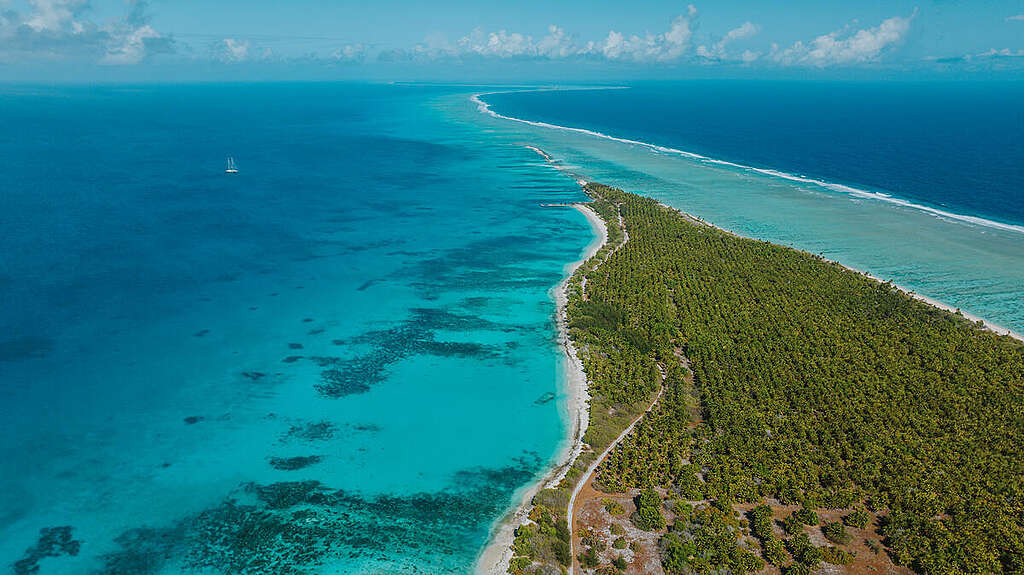
Unlike Chernobyl or Fukushima, where communities were devastated by catastrophic accidents, Bikini tells a different story. This was not an accident. The nuclear destruction of Bikini was deliberate, calculated, and executed with full knowledge that entire ways of life were going to be destroyed.
Bikini Atoll is incredibly beautiful and would look idyllic on any postcard. But we know what lies beneath: the site of 23 nuclear detonations, including Castle Bravo, the largest ever nuclear weapons test conducted by the United States.
Castle Bravo alone released more than 1,000 times the explosive yield of the Hiroshima bomb. The radioactive fallout massively contaminated nearby islands and their populations, together with thousands of U.S. military personnel. Bikini’s former residents were forcibly relocated in 1946 before nuclear testing began, with promises of a safe return. But the atoll is still uninhabited, and most of the new generations of Bikinians have never seen their home island. As we stood deep in the forest next to a massive concrete blast bunker, reality hit hard – behind its narrow lead-glass viewing window, U.S. military personnel once watched the evaporation of Bikini lagoon.

On our visit, we noticed there’s a spectral quality to Bikini. The homes of the Bikini islanders are long gone. In its place now stand a scattering of buildings left by the U.S. Department of Energy: rusting canteens, rotting offices, sleeping quarters with peeling walls, and traces of the scientific experiments conducted here after the bombs fell.
On dusty desks, we found radiation reports, notes detailing crop trials, and a notebook meticulously tracking the application of potassium to test plots of corn, alfalfa, lime, and native foods like coconut, pandanus, and banana. The potassium was intended to block the uptake of caesium-137, a radioactive isotope, by plant roots. The logic was simple: if these crops could be decontaminated, perhaps one day Bikini could be repopulated.
We collected samples of coconuts and soil—key indicators of internal exposure risk if humans were to return. Bikini raises a stark question: What does “safe” mean, and who gets to decide? The U.S. declared parts of Bikini habitable in 1970, only to evacuate people again eight years later after resettled families suffered from radiation exposure. The science is not abstract here. It is personal. It is human. It has real consequences.
Stop 3: Rongelap – setting for Project 4.1
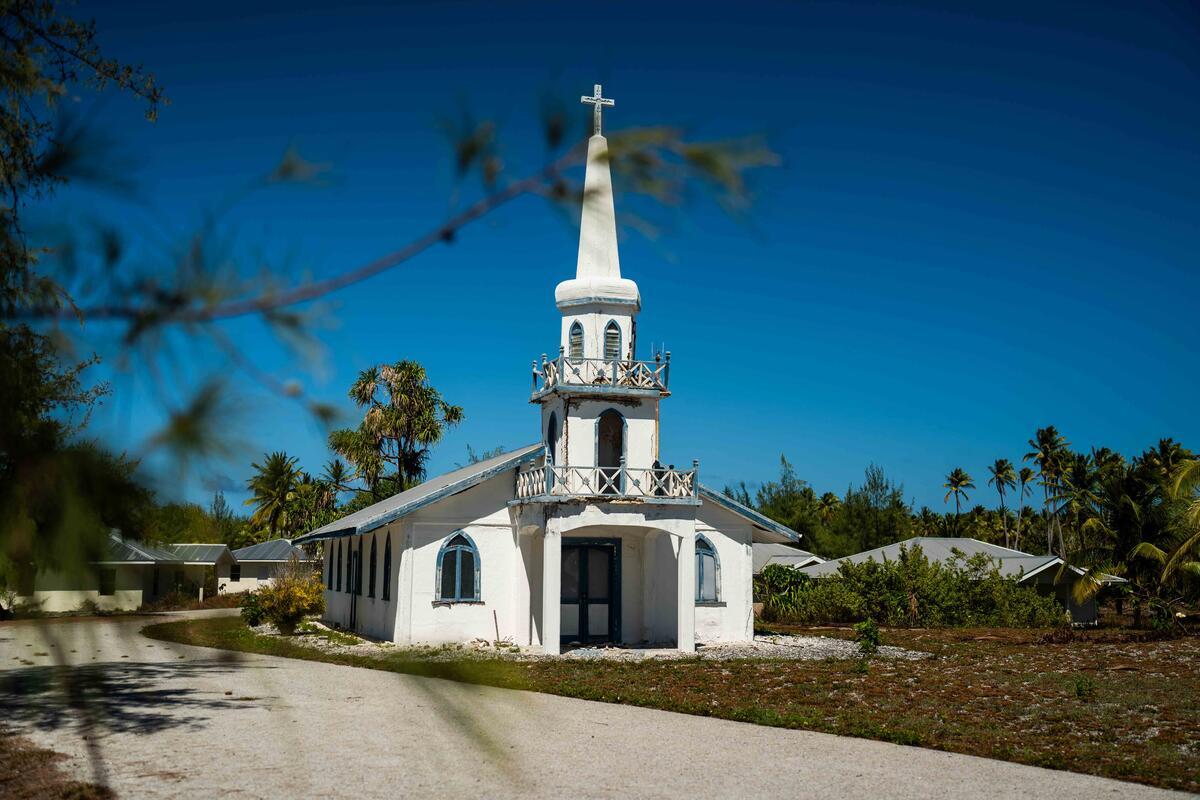
The Rainbow Warrior arrived at the eastern side of Rongelap atoll, anchoring one mile from the centre of Rongelap Island, the church spire and roofs of “new” buildings reflecting the bright sun. In 1954, fallout from the Castle Bravo nuclear detonation on Bikini blanketed this atoll in radioactive ash—fine, white powder that children played in, thinking it was snow. The U.S. government waited three days to evacuate residents, despite knowing the risks. The U.S. government declared it safe to return to Rongelap in 1957 – but it was a severely contaminated environment. The very significant radiation exposure to the Rongelap population caused severe health impacts: thyroid cancers, birth defects such as “jellyfish babies”, miscarriages, and much more.
In 1985, after a request to the US government to evacuate was dismissed, the Rongelap community asked Greenpeace to help relocate them from their ancestral lands. Using the first Rainbow Warrior, and over a period of 10 days and three trips, 350 residents collectively dismantled their homes, bringing everything with them – including livestock, and 100 metric tons of building material – where they resettled on the islands of Mejatto and Ebeye on Kwajalein atoll. It is a part of history that lives on in the minds of the Marshallese people we meet in this ship voyage – in the gratitude they still express, the pride in keeping the fight for justice, and in the pain of still not having a permanent, safe home.

Now, once again, we are standing on their island of Rongelap, walking past abandoned buildings and rusting equipment, some of it dating from the 1980s and 1990s – a period when the U.S. Department of Energy launched a push to encourage resettlement declaring that the island was safe – a declaration that this time, the population welcomed with mistrust, not having access to independent scientific data and remembering the deceitful relocation of some decades before.
Here, once again, we sample soil and fruits that could become food if people came back. It is essential to understand ongoing risks—especially for communities considering whether and how to return.
This is not the end. It is just the beginning

The team of Greenpeace scientists and independent radiation experts in Rongelap, Marshall Islands, with the Rainbow Warrior in the background. Shaun Burnie, author, first on the left. © Greenpeace / Chewy C. Lin
Our scientific mission is to take measurements, collect samples, and document contamination. But that’s not all we’re bringing back.
We carry with us the voices of the Marshallese who survived these tests and are still living with their consequences. We carry images of graves swallowed by tides near Runit Dome, stories of entire cultures displaced from their homelands, and measurements of radiation showing contamination still persists after many decades. There are 9,700 nuclear warheads still held by military powers around the world – mostly in the United States and Russian arsenals. The Marshall Islands was one of the first nations to suffer the consequences of nuclear weapons – and the legacy persists today.
We didn’t come to speak for the Marshallese. We came to listen, to bear witness, and to support their demand for justice. We plan to return next year, to follow up on our research and to make results available to the people of the Marshall Islands. And we will keep telling these stories—until justice is more than just a word.
Kommol Tata (“thank you” in the beautiful Marshallese language) for following our journey.
Shaun Burnie is a senior nuclear specialist at Greenpeace Ukraine and was part of the Rainbow Warrior team in the Marshall Islands.