VANCOUVER – Today, Greenpeace concluded its month-long science expedition to seamounts and hydrothermal hot springs in the Arctic deep sea. The expedition, known as the Deep Sea Arctic Expedition, launched on May 8, 2026, bringing together world-leading researchers and scientists to explore deep-sea ecosystems from depths down to 3,000 metres. A first-of-its-kind expedition in Greenpeace history, the Deep Sea Arctic Expedition explored places that have never before been seen by humans. Video footage of the journey and expedition was broadcast to the world, made available and free for viewing via livestream. The “divestreams” attracted more than 450,000 people, who tuned in on YouTube, TikTok and Instagram.
Following the end of the expedition, the scientists onboard will analyze the high-resolution video footage and all of the samples collected, as several potential new species are believed to have been discovered. With momentum from the expedition and scientific findings bolstering its decades-long global ocean campaign, Greenpeace will continue pushing for strong policy, legislation, and community action to establish marine protected areas in the ocean around the world.
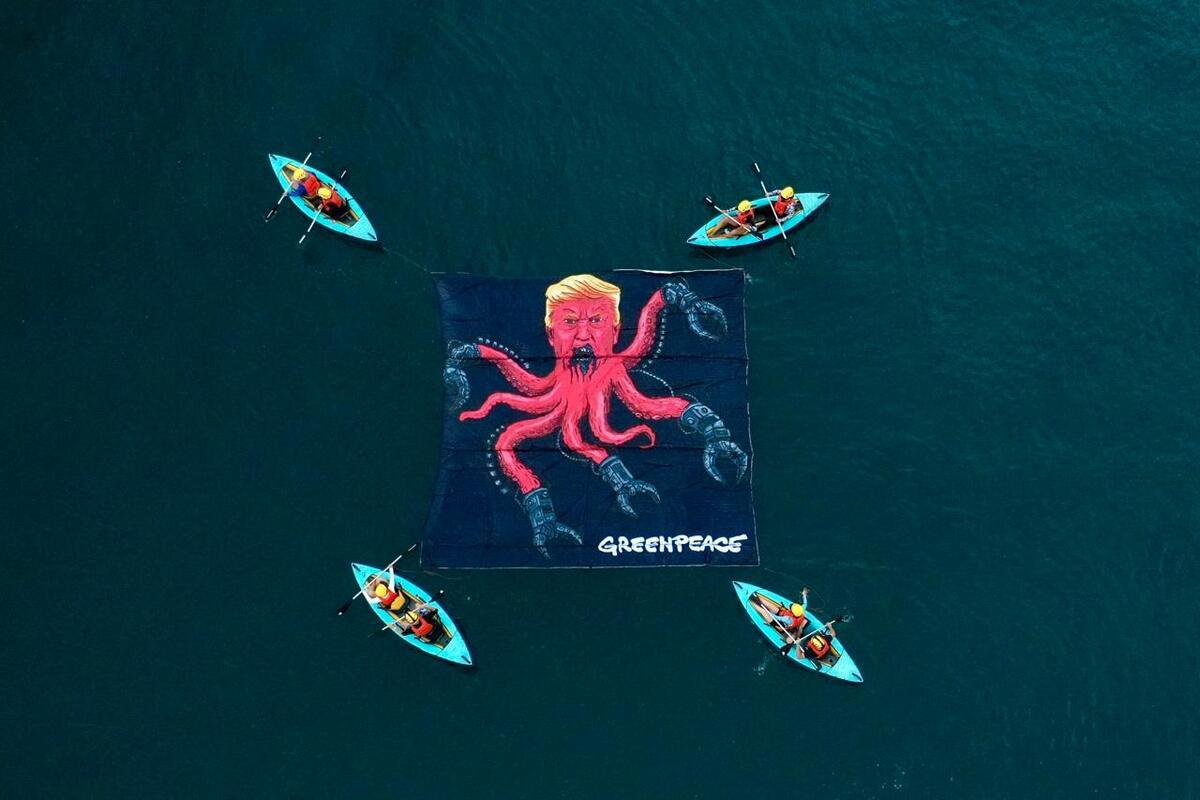
The Deep Arctic Expedition comes at a critical time in Canadian history. With the world’s longest coastline spanning the Arctic, Pacific and Atlantic oceans, the global community is watching how Canada will lead on ocean protection. Greenpeace has been actively campaigning globally for a moratorium on deep-sea mining and to protect at least 30% of the ocean by 2030, and is pushing for Canada to ratify the Global Ocean Treaty. Currently, Canada-based deep sea mining firm The Metals Company (TMC) is working with the Trump administration to bypass international laws to unilaterally mine the deep sea, while momentum to protect the ocean and stop deep sea mining is growing. More than 70+ major businesses and financial institutions, nearly 1,000 marine scientists, Indigenous communities and public society have made it known that deep sea mining is a threat, harms the environment and does not make economic sense.
Sien Van den broeke, Nature & Biodiversity Campaigner at Greenpeace Canada, said:
“We are living in a defining moment for ocean protection. As we discover the deep sea in real time, we have a chance to protect these fragile ecosystems from large-scale extraction. Deep sea mining is socially unacceptable, economically unviable and risks irreversible damage to ocean ecosystems. Canada must ensure a swift and strong implementation of the Global Ocean Treaty and support a global moratorium on deep sea mining.”
ENDS
BACKGROUND
In July 2025, Greenpeace Canada held a mural protest in front of TMC’s Vancouver headquarters with a clear message: “The ocean is not for sale.” Earlier this year, in March 2026, an investigative report on TMC released by Greenpeace Canada, Claiming the Commons, presented the inner workings of TMC’s attempts to bypass international laws and UN conventions to mine the deep sea for profit. Following this, in April 2026, Greenpeace Canada, alongside 40 organizations across Canada, sent a letter to Prime Minister Carney, urging the government to take decisive action on unilateral deep-sea mining to truly protect the people, land and oceans. The letter underlined Canada’s legal obligation as a signatory of the UNCLOS (UN Convention on the Law of the Sea), to ensure that no Canadian entities unilaterally mine the deep sea outside of the ISA framework.
Soon after, in May 2026, the US National Oceanic and Atmospheric Administration (NOAA) determined that TMC’s mining application was in full compliance. As their permitting process is progressing, the time is imminent to protect what is at stake.
Note to editors:
Photos, videos and maps are available in the Greenpeace media library.
The report, Claiming the Commons: The Legal Quagmire of The Metals Company by Greenpeace Canada, is available here.
For more information, please contact: Sarah Micho, Communications Campaigner, Greenpeace Canada [email protected], +1 647 428 0603