
It’s no accident that you’ve likely never heard of the massive LNG project proposed for Baie Comeau, on Quebec’s north shore of the St. Lawrence River.
There’s nothing about it on the website of the Norwegian company (Marinvest Energy) that wants to build it.
No information about this project, or the federal support it receives, can be found on the public websites of the Government of Canada.
Yet this is a huge project, with potentially massive environmental and social consequences. Under questioning from journalists following earlier Greenpeace Canada revelations, the company said that it wants to export 10 million tonnes of LNG per year from the Baie Comeau site, which would make it the third largest proposed or actual LNG project in Canada. Aside from a massive liquefaction and export facility, the project would require nearly 1000 km of new pipeline to transport fracked gas from Western Canada.
And it is being actively supported by the federal government behind closed doors.
Federal government has a “Marinvest Deal Team”: documents
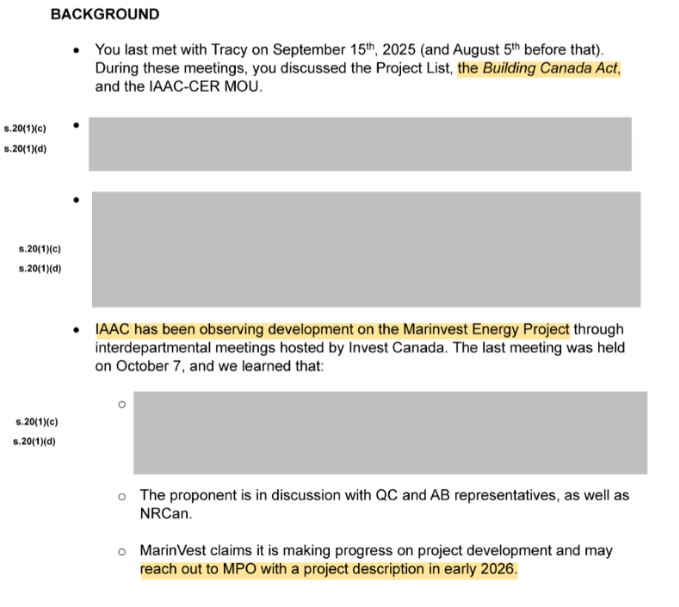
A review of the hundreds of pages of documents obtained by Greenpeace Canada under Access to Information legislation show that a federal agency (Invest in Canada) has put together a “Marinvest deal team” with a mandate to “provide advice and support for the project’s implementation.”
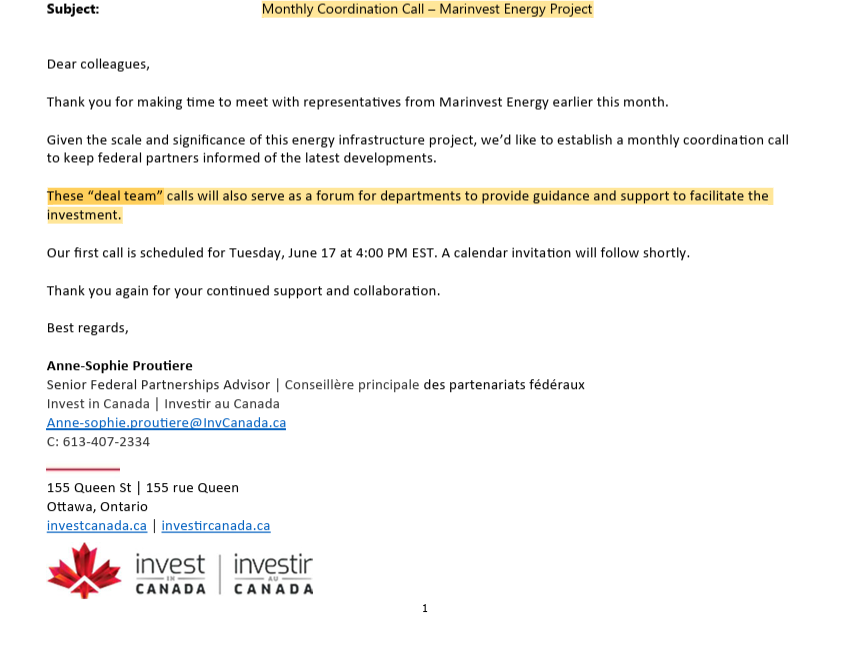
Invest in Canada coordinates monthly meetings between the project developer (Marinvest) and representatives from multiple federal departments and agencies, including the Canadian Energy Regulatory Agency and the Impact Assessment Agency (the federal agencies that would eventually be responsible for evaluating the project).
All of this coordination is taking place entirely behind closed doors and before Marinvest has publicly submitted its project to the regulatory authorities, at which point affected communities and the broader public can become involved.
Or maybe not. Marinvest has a massive lobbying effort underway and is likely trying to get its LNG project added to the Carney government’s list of “Projects of National Interest.” Once on that list, the company not only gets to skip over the usual environmental assessments, but could also be exempted from environmental laws once it is in operation.
Marinvest looking for taxpayer subsidies
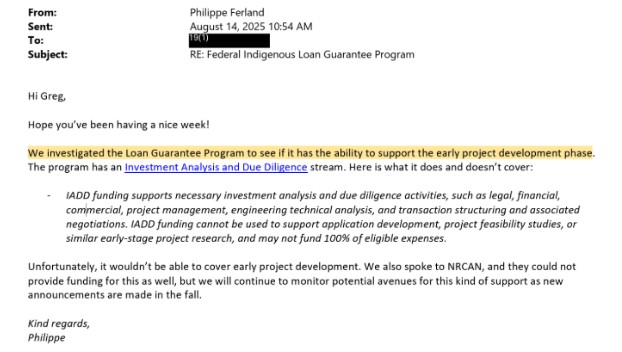
The documents obtained by Greenpeace Canada also reveal that federal support for Marinvest isn’t limited to advice or coordination: the government is also exploring avenues for public funding for the project.
Representatives from Indigenous Services Canada were invited to a May 12, 2025 meeting to inform Marinvest about available public funding programs. Invest in Canada subsequently confirmed in writing that it had examined whether a federal loan guarantee program could cover the project’s initial development phase, and committed to “continue to monitor potential avenues for this kind of support as new announcements are made in the fall.” The company was also seeking to identify government funding programs that would assist Indigenous communities to acquire a financial stake in the pipeline portion of the project.
Opposition is mounting in Quebec and among First Nations
While the project has largely flown under the radar in English Canada, there is growing opposition in Quebec amongst local communities and First Nations.
- Environmental groups, including Greenpeace Canada, Mères au front Baie-Comeau and Rouyn-Noranda, Nature Québec, and the David Suzuki Foundation have launched a petition against the project.
- Forty Quebec economists have spoken out against it.
- The Lac-Simon First Nation (whose territory would be directly crossed by the Marinvest pipeline) is categorically opposed to the project;
- Alain Webster, the chair of Quebec’s Advisory Committee on Climate Change, stated that Marinvest is “incompatible” with the path we must take not only to prevent global climate collapse but also to develop a resilient economy for decades to come.
- Jean Lemire, the Quebec government’s Special Advisor on Climate Change and Northern Issues, said “LNG export megaprojects like Marinvest Energy’s have no place in the context of the energy transition.”
Greenpeace Canada’s Louis Couillard has toured the region to meet with local communities, and he is calling on the Carney government “to put an end to these backroom deals with Marinvest and shut the door once and for all on the idea of exporting fossil fuel from Western Canada through Quebec.”