Activists protest with giant figures of Trump and Putin as EU ministers meet
Brussels, 26 January 2026 – EU ministers have finalised the EU’s ban on imports of Russian gas, after the European Commission, European Parliament and national governments reached a deal late last year, nearly four years after the full-scale invasion of Ukraine.
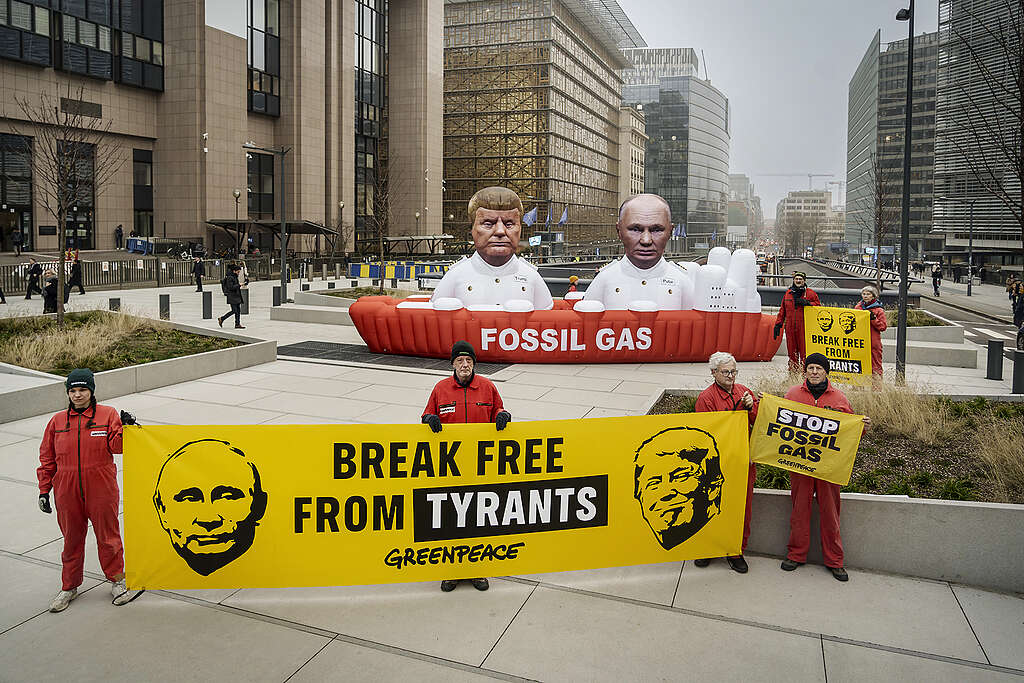
As EU affairs ministers rubber-stamped the Russian gas ban in Brussels, Greenpeace Belgium activists protested against the EU’s plans to just replace Russian gas with gas from the US. The activists inflated a 10-metre-long gas tanker, with representations of Putin and Trump inside, in front of the EU Council headquarters, to symbolise Europe’s dependence on fossil fuel imports from autocrats. They held a banner reading “Break free from tyrants”. An average of two to three tankers carrying liquefied gas from the US arrive in Europe every day, according to new calculations.
**High-quality photos free to use here**
Greenpeace, which has called since February 2022 for an end to all energy imports from Russia to stop funding the war, has warned that the EU risks developing dangerous dependencies on other autocrats like Donald Trump if Russian fuels are replaced with other imports instead of moving to 100% renewable energy. The EU has promised to import $750 billion worth of US energy products as part of a deal to avoid threatened tariffs.
Greenpeace EU campaigner Thomas Gelin said: “It’s great to see this overdue ban on Russian gas, and some of the temporary sanctions made more permanent, but the EU must not just replace this with gas from other tyrants. Europe was stuck bankrolling Putin’s war due to its massive dependence on Russian fuels, but risks giving the same power to other bullies like Trump. You can’t switch from vodka to bourbon and expect to sober up – at some stage you have to stop the booze and start drinking water. The EU must end all Russian fuel imports, oil and nuclear too, and shift to a completely renewable energy system, for a safe climate, for peace and human rights, and for people’s bills too.”
Ban on Russian gas imports
The ban requires imports of liquified gas and pipeline gas to end in April and June of 2026, respectively, where those imports are under short-term contracts. For long-term contracts, imports of liquified gas will have to stop in January 2027 and pipeline gas at the end of September 2027. The bans on liquefied gas imports, under both short- and long-term contracts, were already part of temporary sanctions on Russia, but have now been made more permanent.
Companies in breach of the ban face fines of a lump sum of €40 million, 3.5 percent of a company’s annual turnover or 300 percent of the value of the offending transaction.
National governments will have to present plans by March 2026 detailing how they intend to diversify away from Russian gas.
Since the February 2022 invasion, Greenpeace organisations around Europe have blocked shipments of Russian oil and gas – in Finland; in Britain; in Zeebrugge, Belgium; in Antwerp, Belgium; in Denmark; and in Italy. Greenpeace France also blocked the installation of a liquified gas terminal in Le Havre, warning it could be used to import Russian gas, and Greenpeace Spain shut down a gas power plant in Malaga burning gas from Russia.
Gas imports from the US
As part of an EU-US agreement to limit increases in tariffs, the EU has promised to import $750 billion in energy products from the US, primarily liquefied gas.
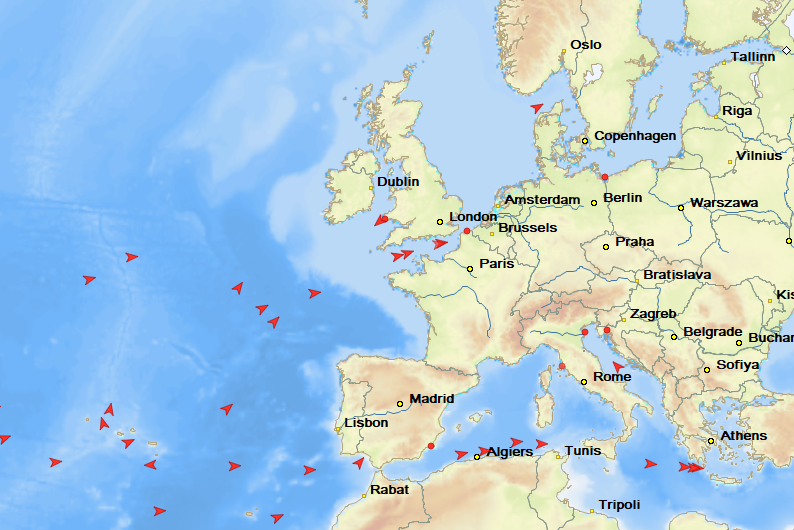
According to data extracted from LSEG Data & Analytics on 23 January 2026, from 1 to 23 January 2026, 61 US gas tankers arrived in EU countries – an average of over two per day. Between 20 January 2025 (Trump’s second inauguration) and 20 January 2026, EU countries imported 82.3 billion cubic metres of US gas, with an estimated value of €28 billion, based on the daily gas spot market price on the date of arrival as represented in the Dutch TTF Natural Gas Futures.
Analysis by the Institute for Energy Economics and Financial Analysis warns that by 2030, 80% of the EU’s liquefied gas imports could come from the US, up from 57% in 2025.
Greenpeace is calling on the EU to withdraw from the commitment to import $750 billion of US energy products, and to immediately halt all negotiations for new purchase agreements with US gas suppliers. Greenpeace is also asking for an EU plan to end dependence on US gas and terminate existing long-term supply contracts earlier, as well as additional measures to reduce Europe’s gas demand and accelerate the transition to homegrown renewable energy.
Contacts:
Thomas Gelin, Greenpeace EU campaigner: +32 (0) 473 57 04 46 [email protected]
Greenpeace EU press desk: +32 (0)2 274 1911, [email protected]
For breaking news and comment on EU affairs: Bluesky
Greenpeace is an independent global campaigning network that acts to change attitudes and behaviour, to protect and conserve the environment and to promote peace. We do not accept donations from governments, the EU, businesses or political parties. Greenpeace has over three million supporters, and 26 independent national and regional organisations with offices in more than 55 countries.
EU Transparency Register: 9832909575-41