The campaign to end fossil fuel sponsorship of the Olympic Games has escalated rapidly in recent weeks, placing the International Olympic Committee (IOC) under growing public pressure.
It began with a simple question: How can a company whose core business is fuelling the climate crisis, sponsor the Winter Olympics, an event that depends on stable snow and ice?
Greenpeace Italy launched a satirical video exposing the contradiction at the heart of Eni’s sponsorship of the Milan Cortina 2026 Winter Olympic and Paralympic Games. Eni is one of the biggest oil and gas companies in the world.
It highlighted the absurdity of a fossil fuel giant associating itself with winter sport while its emissions contribute to shrinking snow seasons and melting glaciers.
It struck a chord. The video, which generated over 3.5 million views across digital platforms, was shared by professional athletes Swedish skier Emelie Forsberg and British ultra runner Damian Hall, and triggered widespread international media coverage.
Talking FACTS, not feelings
The satire is backed up by science. As things are, by the 2080s more than half of suitable locations will be unable to host the Winter Olympics, according to a rigorous 2024 scientific study commissioned by the IOC.
Eni’s annual fossil fuel emissions could melt enough glacier ice to fill 2.5 million Olympic swimming pools, according to research that shows that for every 1 kg of CO2 we put into the air, we eventually lose about 15.8 kg of glacier ice.
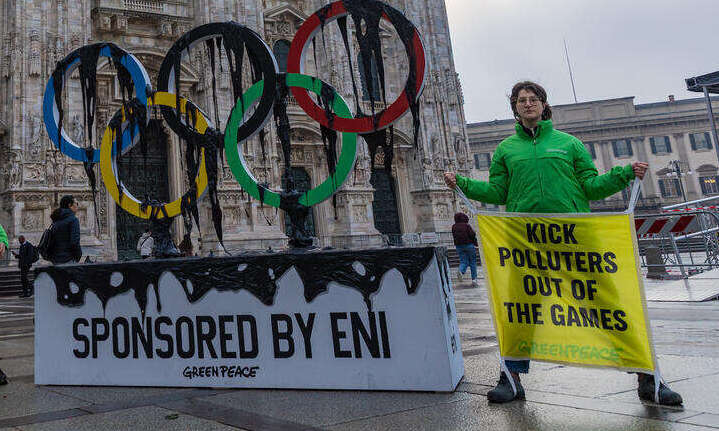
Shortly after the video release, Greenpeace Italy took the message to the streets of Milan. In Piazza Duomo, activists installed Olympic Rings appearing to drip oil. The visual was stark and deliberate. The Olympic Rings should represent excellence and respect. Instead, they are being used to soften the image of a company whose business model depends on expanding oil and gas production. The installation again drew extensive global media attention.
At the same time, Ski Fossil Free, led by Norwegian skier and filmmaker Nikolai Schirmer, delivered a petition with more than 21,000 signatures, including Olympians, to the IOC. Separately, a campaign led by athletes by For Future Games called for an end to fossil fuel sponsorship. Greenpeace supporters have also mobilised in large numbers, adding their voices to the demand through a petition.
When the issue was raised directly with IOC President Kirsty Coventry at a daily press briefing, rather than engaging with the substance of the concerns, Coventry responded with general statements that the IOC is always trying to do better and that she welcomes athletes having a voice.
Welcoming athletes’ voices is not the same as responding to them. Athletes, fans and winter communities are asking the IOC to end partnerships that allow fossil fuel corporations to use the Olympic brand as a tool for greenwashing. To sidestep that request while praising participation is not leadership. It diminishes the severity of the concerns being raised.
Eni’s history of greenwashing
Eni’s role in the climate crisis is real and undisputed by anyone not in the pocket of Big Oil. Oil and gas corporations like Eni reportedly spend tens of millions of dollars on sporting sponsorships to distract from the environmental damage caused by their operations.
Greenpeace Italy is currently being sued by Eni after stating that the company harms people. That statement was based on a Greenpeace Netherlands calculation that Eni’s self reported 2022 emissions could cause 27,000 excess deaths due to increased temperature alone before the end of the century. Instead of addressing the evidence, Eni has turned to legal intimidation.
Against this backdrop, fossil fuel sponsorship of the Winter Games makes a mockery of the Olympic values of respect for people and the environment. The climate crisis is already placing mountain communities and winter tourism under strain. The ski industry supports millions of livelihoods across Europe, and 60 million Europeans ski each year. Without a rapid transition away from fossil fuels, winter sports face an existential threat.
Public concern is not limited to a single action. In Milan, Greenpeace Italy joined a broad coalition of civil society groups at a protest rally highlighting the unsustainable nature and climate impact of the Games. Greenpeace’s message from that demonstration was clear: ‘Protect the integrity of the Olympics. Do not allow them to become a platform for polluters.’
Stop Eni’s Olympics sponsorship
From the outset, Greenpeace International and Greenpeace Italy have offered the IOC a constructive path forward sending them an open letter. The Olympic movement has previously shown leadership by banning tobacco advertising. It can do so again by ending fossil fuel sponsorship across all Olympic and Paralympic Games. The IOC occupies a unique position of global influence. Choosing integrity over greenwashing would send a powerful signal far beyond sport.
Eni is responsible for its pollution. But the IOC is responsible for the partners it chooses. By continuing to accept fossil fuel sponsorship, it risks becoming complicit in polishing the public image of companies whose core business threatens the future of the very Games they sponsor. The question now is simple: Will the IOC listen to athletes, fans and scientists and end fossil fuel sponsorship? Or will it continue to shelter planet heating corporations behind the Olympic Rings?
Martin Zavan is a freelance communications specialist with Greenpeace International, based in Sydney, Australia.
This blog was edited on 19 February 2026 to reflect that the ‘Oilympics’ video garnered over 3.5 million views and not nearly 7 million views as originally reported.