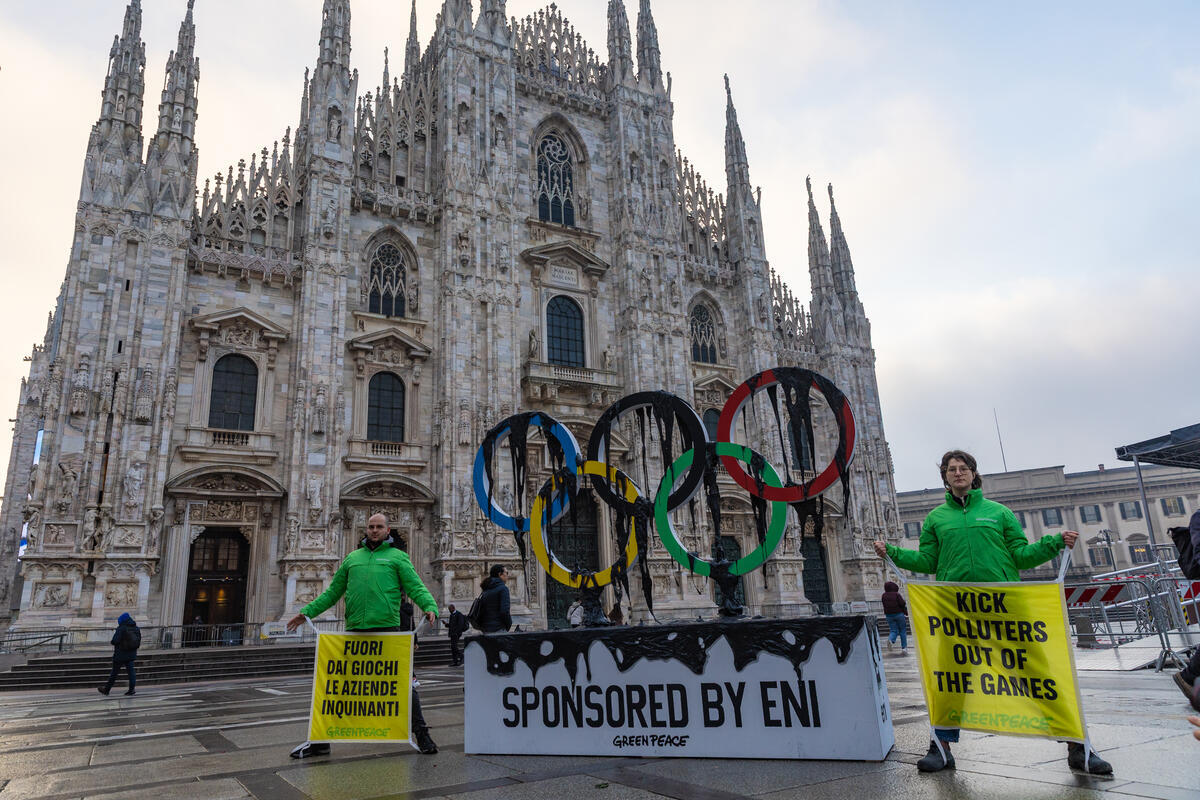
More than half of the potential host cities Winter Games will be “climate-unreliable” by the 2080s! That’s the verdict of a rigorous 2024 scientific study funded by the International Olympic Committee (IOC) itself, confirming the importance of reducing greenhouse gas emissions.
Experts Robert Steiger and Daniel Scott examined three different emissions scenarios and analysed the impacts on the weather in cities that could potentially host the Winter Olympics. They looked at the temperature and depth of snow. The results serve as a stark warning.
Under the mid-range emission scenario (which is considered the most likely scenario), only 46 out of the 93 locations they looked into will be “climate reliable”. This means that there are far fewer places in the future where athletes could compete safely and fairly.
Fake snow and cancelations
This does not come as a surprise – in an earlier study the same researchers found that among 21 previous host cities, only one is projected to be reliable by the end of the century if global emissions remain on the trajectory of the past two decades. But this is not solely a problem for the future. In 2022, the Beijing Winter Olympics set a precedent as the first games to use 100% artificial snow.
And the impacts of climate change on winter sports are not limited to the Olympics. The 2022/2023 Ski World Cup season started with warm weather and lack of snow, resulting in the International Ski Federation (FIS) cancelling or postponing seven out of first eight scheduled races.
Safety
These incidents, plus a lack of snow for practice sessions, more injuries and reduced climate reliability of host cities, led over 500 athletes to sign an open letter demanding the FIS take greater climate action, with Greenpeace International lending support. This led the FIS to implement a series of reforms on Winter Olympic viability, nonetheless, the impact of fossil fuels remains.
In a participant perspective survey involving around 400 Winter Olympic athletes, over 95% stated that climate change is/will negatively impact their sport, and winter sport culture in general by reducing training opportunities for the next-generation.
The problem with “sportwashing”
Fossil fuel corporations use sports sponsorships to “polish” their image. They want us to see their logo next to world-class athletes to distract from how their business is driving the climate crisis that threatens those very sports.
One such corporation is the Italian oil and gas giant, Eni, which is sponsoring the 2026 Winter Olympics and Paralympics in Milano and Cortina. That’s right, a company that is driving the climate crisis and putting winter sports at risk is using the Games to distract the public from its destructive impact.
And much like the climate, the battle is heating up. Eni is currently in a legal battle with Greenpeace Italy.
In 2023, Greenpeace Netherlands released a study applying the Mortality Cost of Carbon method, which projected that Eni’s self-reported emissions for 2022 alone could cause 27,000 temperature-related excess deaths by the end of the century. Instead of changing their business, Eni attempted to silence these legitimate criticisms by suing Greenpeace Italy. Lawyers call this a SLAPP (Strategic Lawsuit Against Public Participation) but in layman’s terms this is legal bullying and intimidation.
Doing the maths: Emissions and glaciers
To better understand the impact Eni’s emissions could have on ice, take a look at Eni’s own company reports. In 2024, Eni reported NET Greenhouse Gas lifecycle emissions of 395 million metric tonnes CO2e.
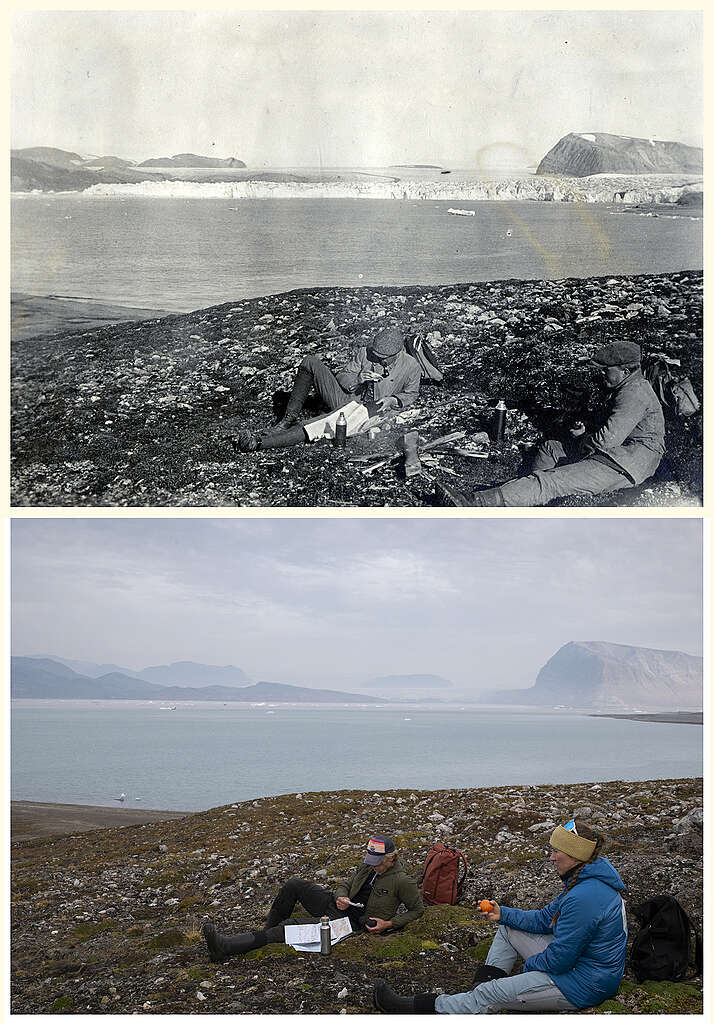
Attribution science is becoming more and more accurate at estimating likely future harms from today’s carbon emissions. The shrinking of glaciers, for example, is widely accepted as evidence of climate change. Glacier mass loss has been reported to be related to temperature increase, which is known to have a direct relationship with cumulative carbon emissions. Scientific modelling shows that for every 1 kg of CO2 we put into the air, we eventually lose about 15.8 kg (5.9–20.5 kg) of glacier ice.
When you apply that maths to the equivalent of Eni’s 2024 emissions, we are looking at a potential committed loss of 6.2 (2.3–8.1) billion tonnes of glacier ice over time.
Trying to visualise the damage
That’s a huge number, so let’s break it down into something we can see: Olympic-sized swimming pools.
- A standard Olympic pool holds 2,500 m3 of water.
- The glacier ice projected to be lost because of emissions equivalent to those reported by Eni for 2024 alone could fill almost 2.5 million pools (2,496,400 to be exact).

Imagine two and a half million swimming pools lined up – that’s the equivalent to the projected impact of one year of one company’s emissions.
How you can help to hold oil and gas corporations accountable
If these estimates shock you, you aren’t alone. We need to protect the future of winter sports by holding polluters accountable. Fossil fuel companies should be paying for the damage they cause through taxes and fines, not using our favorite sports to hide their impact.
That’s why Greenpeace is calling for the International Olympic Committee (IOC) to drop oil and gas sponsorship from the Winter Olympic and Paralympic Games – and commit to ending fossil fuel sponsorship across all Olympic Games.

Fossil fuel companies are greenwashing their image by sponsoring big sporting events to hide their destruction. Don’t let them get away with it.
Add your nameThis has happened before with tobacco advertising. Once the scientific consensus on the harms of smoking became too strong to ignore, the IOC banned tobacco advertising ahead of the 1988 Winter Olympics in Calgary. It played a key role in denormalising cigarette advertisements and set a strong precedent that was followed by sporting bodies and other event organisers around the world. It serves as a powerful testament to the power of the IOC to help shape policy at a global level and it shows that the same can be done with fossil fuel sponsorship and advertising.
Fossil fuel sponsorship benefits no one but oil and gas corporations; it distracts everyone from the environmental destruction they cause and the communities they harm. Fossil fuel corporations must be phased out as part of a just transition to renewable energy, not using sponsorships to polish their image while driving the climate crisis that threatens the future of winter sport.
Sophie Allain is a campaigner at Greenpeace International and is based in London, UK.
Note: This article was edited on 3 January at 18.45 CET to clarify two figures related to glacier ice loss.
Sources:
- Robert Steiger & Daniel Scott (13 Sep 2024): Climate change and the climate reliability of hosts in the second century of the Winter Olympic Games, Current Issues in Tourism, https://doi.org/10.1080/13683500.2024.2403133
- Marzeion, B., Kaser, G., Maussion, F. et al (2018). Limited influence of climate change mitigation on short-term glacier mass loss. Nature Clim Change 8, 305–308 (2018). https://doi.org/10.1038/s41558-018-0093-1
- ENI (2024). Annual Report. p17 https://www.eni.com/content/dam/enicom/documents/eng/reports/2024/ar-2024/Annual-Report-2024.pdf
- p223 –“Net GHG Lifecycle Emissions GHG Scope 1+2+3 emissions associated with the value chain of the energy products sold by Eni, including both those deriving from own productions and those purchased from third parties, accounted for on an equity basis, net of offset mainly from Natural Climate Solutions.”
- World Aquatics (2025). Swimming pool certification world aquatics qualifying events. https://resources.fina.org/fina/document/2025/11/04/ffb535ee-3c58-413e-86db-50216333029b/2025-10-01-WA-Qualifying-Event-Certification-Swimming.pdf
- François, H., Samacoïts, R., Bird, D.N. et al (2023). Climate change exacerbates snow-water-energy challenges for European ski tourism. Nat. Clim. Chang. 13, 935–942. https://doi.org/10.1038/s41558-023-01759-5
- Scott, D., Steiger, R., Rutty, M., & Fang, Y. (2019). The changing geography of the Winter Olympic and Paralympic Games in a warmer world. Current Issues in Tourism, 22(11), 1301–1311. https://doi.org/10.1080/13683500.2018.1436161
- Scott, D., Knowles, N.L., Ma, S., Rutty, M. and Steiger, R., 2023. Climate change and the future of the Olympic Winter Games: athlete and coach perspectives. Current Issues in Tourism, 26(3), pp.480-495. https://doi.org/10.1080/13683500.2021.2023480
- Scott, D., Steiger, R., Rutty, M., & Johnson, P. (2014). The future of the Olympic Winter Games in an era of climate change. Current Issues in Tourism, 1–18. https://doi.org/10.1080/13683500.2014.887664
- Knowles, N., Scott, D. and Rutty, M., 2024. Athlete Insights on Climate Change and Winter Sport: impacts, thresholds, adaptations, and implications for the future. Journal of Global Sport Management, pp.1-23. https://doi.org/10.1080/24704067.2024.2398746
- Rounce, D.R., Hock, R., Maussion, F., Hugonnet, R., Kochtitzky, W., Huss, M., Berthier, E., Brinkerhoff, D., Compagno, L., Copland, L. and Farinotti, D., 2023. Global glacier change in the 21st century: Every increase in temperature matters. Science, 379(6627), pp.78-83. https://www.science.org/doi/10.1126/science.abo1324
- Rypdal, M., Boers, N., Fredriksen, H.B., Eiselt, K.U., Johansen, A., Martinsen, A., Falck Mentzoni, E., Graversen, R.G. and Rypdal, K., 2021. Estimating remaining carbon budgets using temperature responses informed by CMIP6. Frontiers in Climate, 3, p.686058.https://doi.org/10.3389/fclim.2021.686058
- Roe, G.H., Baker, M.B. and Herla, F., 2017. Centennial glacier retreat as categorical evidence of regional climate change. Nature Geoscience, 10(2), pp.95-99. https://www.nature.com/articles/ngeo2863
- Roe, G.H., Christian, J.E. and Marzeion, B., 2021. On the attribution of industrial-era glacier mass loss to anthropogenic climate change. The Cryosphere, 15(4), pp.1889-1905. https://doi.org/10.5194/tc-15-1889-2021 https://www.nature.com/articles/ngeo2863
- POW, 2023: Athletes call for greater climate action and transparency from FIS https://protectourwinters.eu/athletes-call-for-greater-action-climate-action-and-transparency-from-fis/ (last accessed: 09/01/2026)
- FIS 2024: FIS Impact Report 2024 https://www.fis-ski.com/inside-fis/fis-future/fis-impact-programme (last accessed: 09/01/2026)
- WMO 2024: FIS and WMO partnership highlights the harmful effects of climate change on winter sports and tourism https://wmo.int/news/media-centre/fis-and-wmo-partnership-highlights-harmful-effects-of-climate-change-winter-sports-and-tourism (last accessed: 09/01/2026)