On 15 May, while most people were resting indoors, the Sunder Nagri community of North-East Delhi, India, stepped out into the heat to map their own neighbourhood. Women, youth, young girls, and school-going children gathered around the nearest local school, covering their faces with scarves, carrying pocket fans, base maps of the community, and the enthusiasm to identify heat hotspots and natural cooling spaces within their area.
The community heat mapping exercise was not just about measuring temperature. It was about understanding how people experience heat in their everyday lives and questioning why some neighbourhoods continue to remain more vulnerable to extreme heat than others.
Community heat mapping is a participatory process where residents walk through their neighbourhoods and identify:
- areas that feel extremely hot
- spaces with shade and natural cooling
- accessibility water
- places where people can sit and rest
- locations where heat makes movement and work difficult
Unlike technical heat maps created only through satellite data, community heat mapping helps capture people’s lived experiences of heat and understand what measures or interventions have been taken by the government or the community to cope with rising temperatures. It also documents how heat is unevenly felt across different streets, markets, public spaces, bus stops, work areas, and homes.
At 4 o’clock in the afternoon, the community began the walk by observing and marking trees, shaded areas, sitting spaces, and places where they felt unbearable, manageable, or relatively normal levels of heat. But the exercise was not limited to documenting spaces on a base map. It also became a space for conversations, discussions about why there are so few shaded public spaces where people can pause, sit, and find some relief from the heat.
As the group walked through the neighbourhood, they captured photographs and used thermal devices to record temperatures across markets, shaded spaces, parks, and streets. Although the walking route was hardly 500 metres long, it took almost 30 minutes to complete because residents carefully stopped to observe, discuss, and document different physical features, resources, and experiences along the route.
One of the young girls participating in the exercise raised an important concern. While doing the online mapping through an app, their mobile devices had started overheating and stopped functioning. She also mentioned that they were already feeling exhausted and too tired to continue walking for long.
The observation itself reflected the intensity of the heatwave. The participants had started the walk with excitement and curiosity, smiling and actively engaging with the process. But by the end of the walk, many were visibly frustrated, irritated, and drained by the heat.
However, the mapping exercise did not end there.
The entire community later assembled at “Happy Garden” – A garden maintained by women from the community. For many women, it remains one of the few accessible public spaces within the neighbourhood where they can comfortably sit and safely relax.
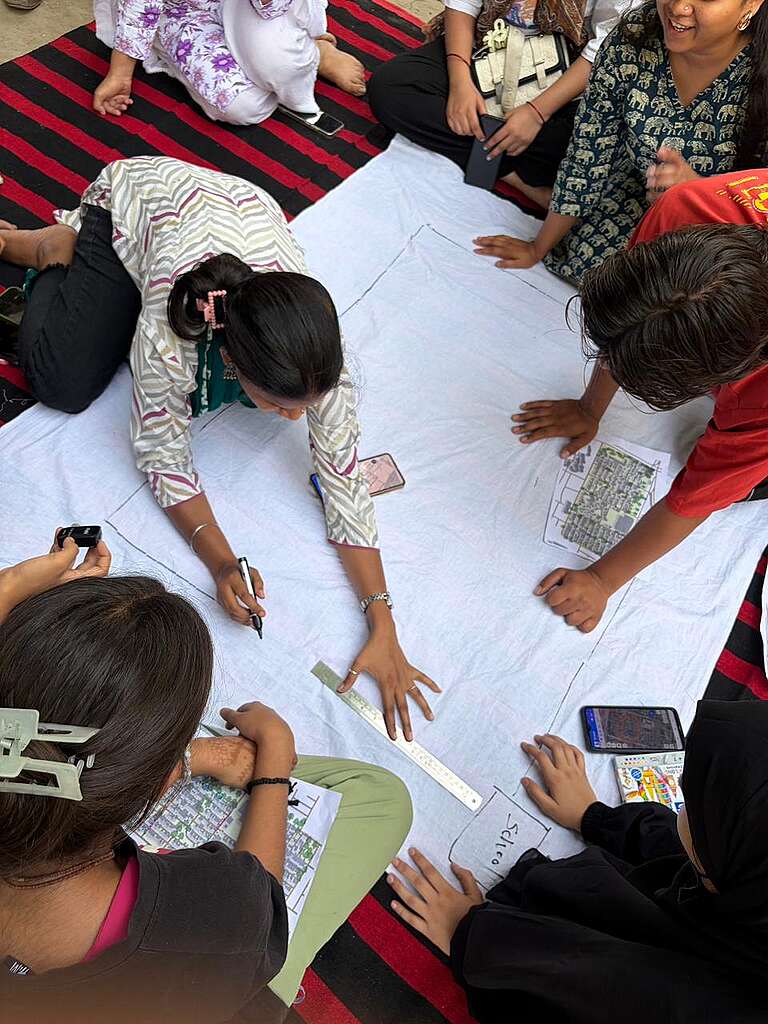
Inside the garden, residents collectively drew a large map of the community on a piece of cloth. They marked observations from the walk and colour-coded different spaces based on how they experienced them:
- blue for cooling spaces
- orange and red for heat hotspots
- and green for tree cover and shaded areas
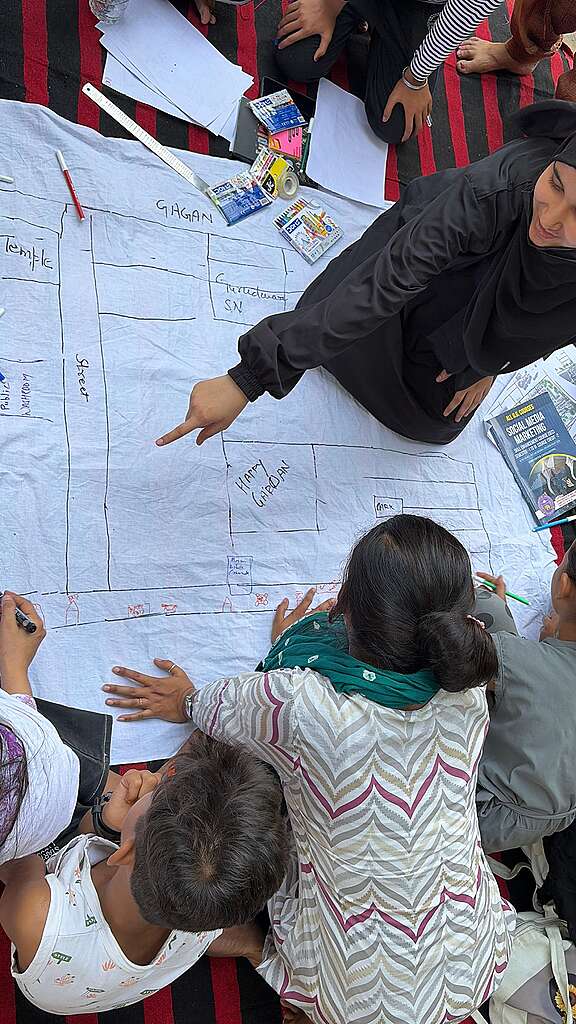
As the mapping continued, one of the strongest themes that emerged from the discussion was the lack of cool resting spaces and poor access to drinking water.
Residents pointed out that markets had almost no tree cover. Most vendors depended on tarpaulin sheets for shade, but instead of cooling the space, these sheets trapped heat underneath. When one of the community members checked the temperature through a thermal camera, the market area showed a temperature of nearly 51 degrees Celsius.
While collectively making the cloth map, residents discussed similarities across different neighbourhoods and reflected on who suffers the most during extreme heat. Conversations slowly moved towards larger questions around Delhi’s Heat Action Plan and its implementation on the ground.
One of the women pointed out that many announcements made by the government often remain limited to paper and fail to translate into actual relief for communities facing extreme temperatures every day. Another woman said, “They never asked what we wanted for our communities.” Residents emphasized the importance of community consultation when designing and implementing such heat action plans so that policies reflect the realities of people’s experience on the ground.
The discussion ended with larger questions around accountability and responsibility:
Who is responsible for creating heat-resilient neighbourhoods?
Who ensures access to shaded public spaces, water, cooling infrastructure, and safe resting spaces?
And most importantly, who gets to rest during intense heatwave crises?
These questions around accountability do not stop at the neighbourhood level. They also raise a larger question: Who should pay for the damages caused by climate change and environmental. Sunder Nagri is only one example where rising temperature, lack of cooling infrastructure, and damaged urban environments are directly affecting people’s daily lives, forcing communities to constantly adapt and survive conditions that are increasingly becoming unbearable. And, similar situations are unfolding across many neighbourhoods, cities, and countries.
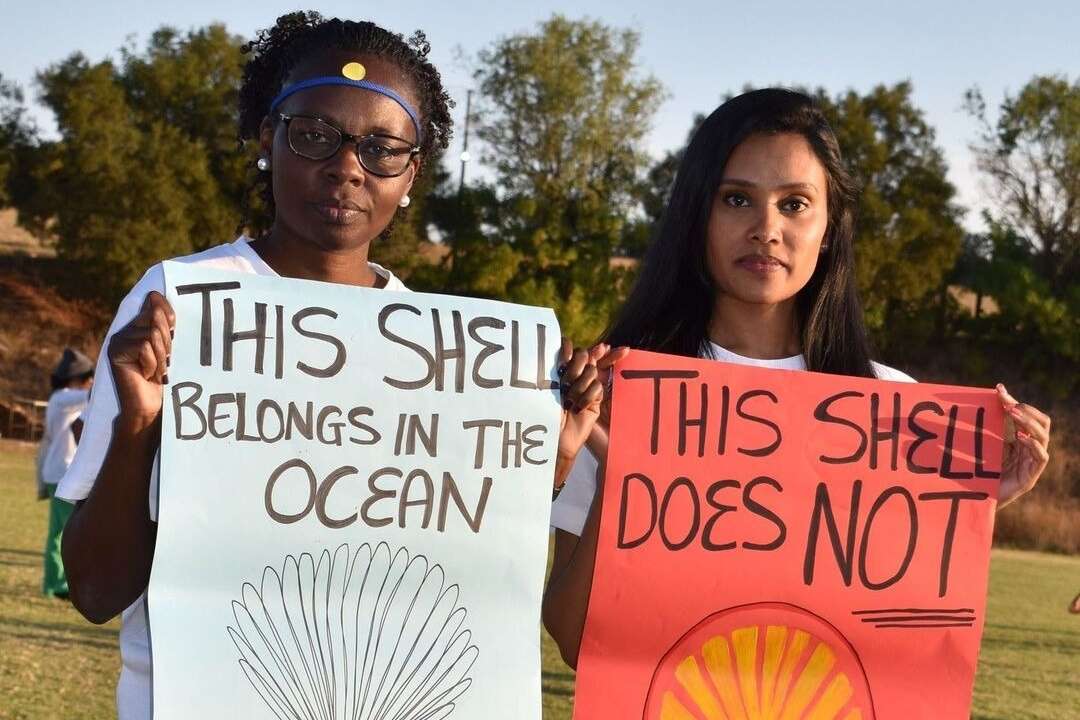
These environmental destruction is not accidental but damage caused by large industries, fossil fuel extraction, and profit-led development models despite knowing the long-term environmental consequences of their actions. The principle of “Polluter Pays” must be central to climate justice. Rich corporations and oil industries that have historically polluted the environment and profited from ecological destruction should be held accountable and made to pay for climate adaptation, public infrastructure, and the damages caused to communities globally.
As heatwaves continue to intensify across cities globally, community-led heat mapping exercises like this show that heat is not only a climate issue, it is also deeply connected to inequality, public infrastructure, health crises, mobility, and the right to rest with dignity.
Vaishali Upadhyay is the community campaign coordinator at Greenpeace India, based in New Delhi, India.