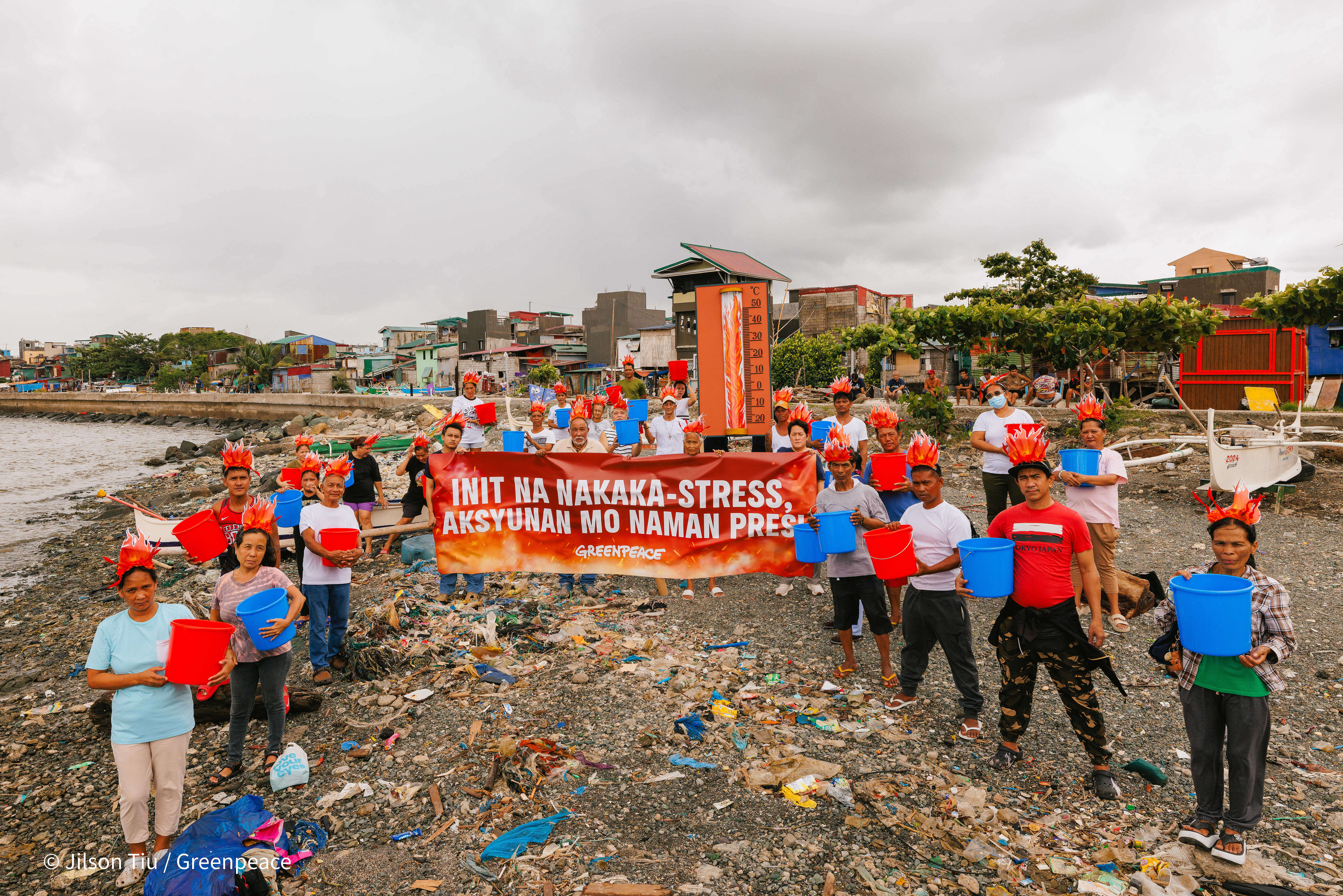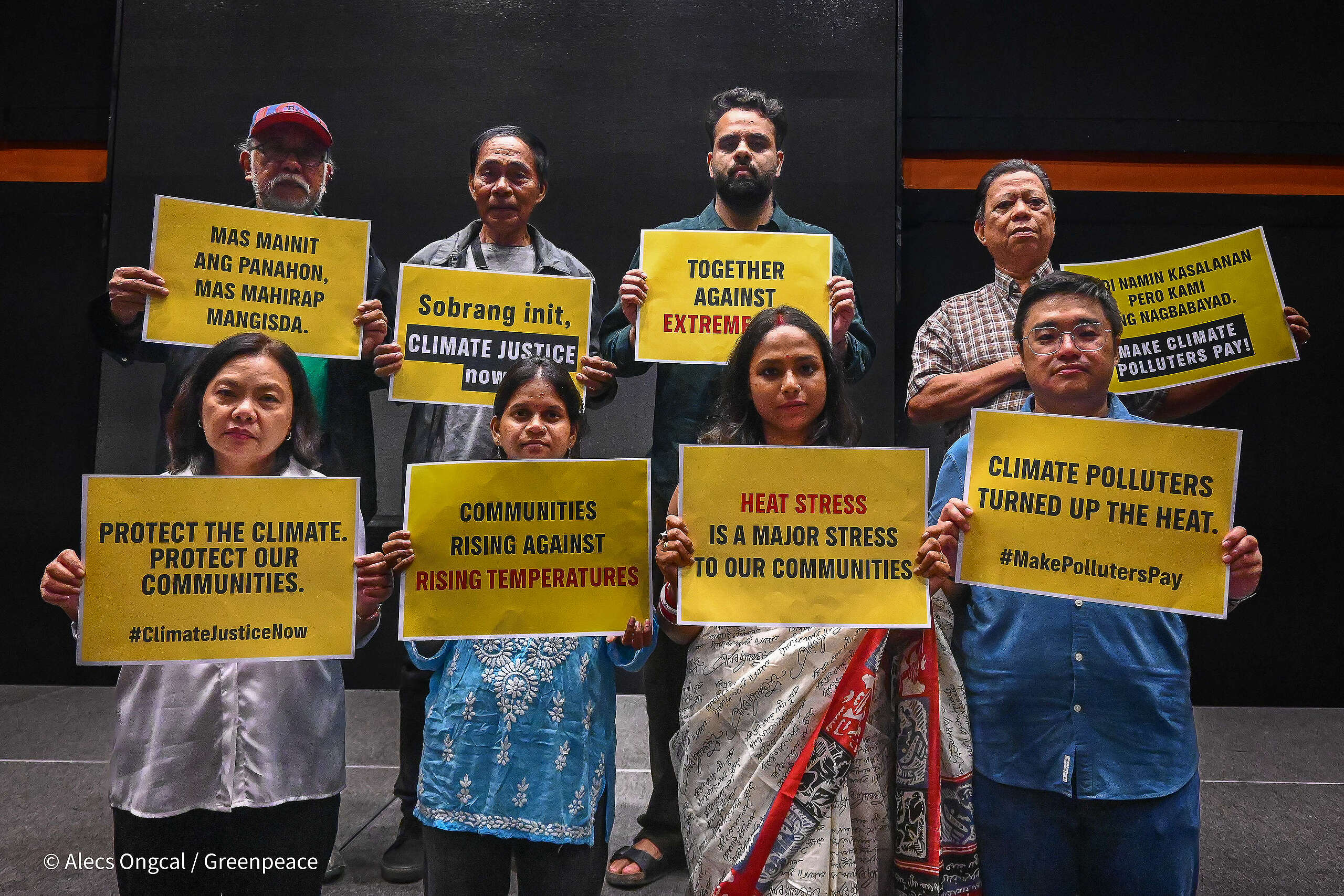
Quezon City — Greenpeace Philippines and the National Anti-Poverty Commission – Victims of Disasters and Calamities (NAPC-VDC) jointly launched Here Comes the Sun: Climate Justice-based Recommendations for Protecting Communities from Extreme Heat this Tuesday. The new report identifies critical policy and governance gaps hindering the country’s response to extreme heat, and proposes pathways toward climate accountability, including but not limited to the immediate passage of House Bill 4420 or the Climate Accountability Bill (CLIMA Bill).1
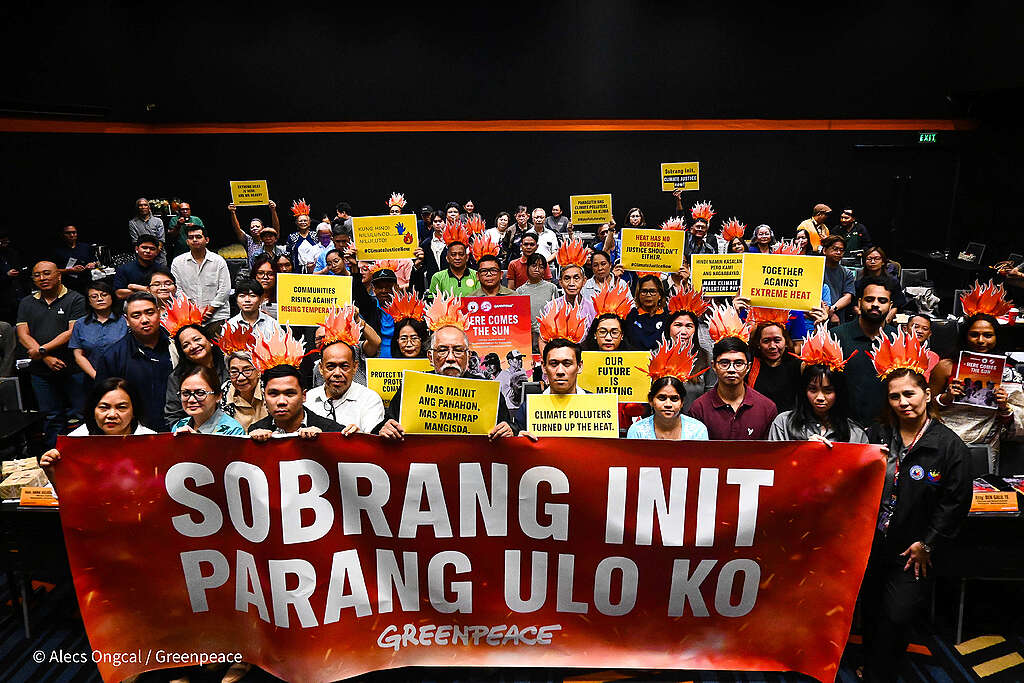
The report’s findings, gathered through seven focus group discussions conducted in Navotas, Bataan, Laguna, Siargao, Eastern Samar, Tacloban City, and Cadiz City, were presented during a media forum in Quezon City attended by environmental activists and advocates, grassroots organizations, experts, and government representatives.
Grounding its analysis in the lived experiences of frontline communities, the report features a case study of 71 fisherfolk across Luzon, Visayas, and Mindanao. Fisherfolk consistently rank among the poorest of the 14 basic sectors, with a poverty incidence of around 27.4% to 30.6%,2 nearly double than the national baseline of 15.1%, according to the Philippine Statistics Authority (PSA). The analysis highlights how worsening extreme heat is increasingly threatening the health, livelihoods, and overall wellbeing of fishing communities.
While the Philippine government has existing policies and programs that include heat as one of their triggers, the report finds that it lacks an overarching policy that addresses heat stress as a holistic phenomenon. The report also notes that the country’s disaster response and climate financing policy architecture related to heat stress remains fragmented across sectors, limiting the government’s ability to respond effectively. Critical gaps likewise persist in treating heat stress as a climate justice issue that requires coordinated, adequately funded responses.
The report also raises the important question of who should pay for the rising costs of heat-related loss and damage. Currently, much of the financial burden still falls on the public and the Philippine government through growing, increasing the risk of worsening public debt while allowing the world’s biggest climate polluters to evade accountability.
As the Philippines faces increasingly frequent and intense extreme heat driven by climate change, along with the effects of the ongoing El Niño phenomenon,3 the report calls on the government to urgently:
Pursue climate finance grounded in justice and reparations to address heat stress, ensuring that those most responsible for the climate crisis bear the costs of climate impacts
Fulfill its obligations under the International Court of Justice Advisory Opinion (ICJAO)4 on the responsibility of states in respect of climate change. This includes the national government to urgently head the recently filed House Resolution 1074,5 developing a scientifically defined criteria for declaring a state of imminent disaster, and President Ferdinand Marcos Jr. to certify as urgent a climate-lensed Magna Carta of Workers in the Informal Economy (MACWIE) Bill and CLIMA Bill to protect vulnerable sectors, with the latter aiming to make climate polluters pay.
Revamp sectoral integration mechanisms beyond “mainstreaming,” toward integrated governance mechanisms for addressing extreme heat.
Recenter human rights and human wellbeing as the primary organizing principles in sectoral responses to heat stress.
Digital copy of Heat Stress Report: HERE
QUOTES FROM ORGANIZATIONS, COMMUNITIES AND PARTNERS:
- “Pangulong Marcos, araw-araw naming hinaharap ang matinding init sa dagat upang may maipakain sa aming mga pamilya, ngunit kapalit nito ang aming kalusugan at kabuhayan. Kaming karaniwang tao ang napipilitang gumawa ng aksyon at mga inisyatiba tuwing lumalala ang krisis sa klima, imbis na ang mga totoong nagpapatindi nito. Ang climate justice ay nangangahulugang pananagutan ng pamahalaan na protektahan ang mga mangingisdang nasa unahan ng epekto ng matinding init at pagbabago ng klima. Panahon nang magpatupad ng kongkretong mga hakbang na tunay na magtatanggol sa aming buhay, kalusugan, at kabuhayan.” — Resituto del Rosario, fisherfolk leader from Bataan
- “Bilang single-parent at indirect fisherfolk, ramdam ko araw-araw ang tindi ng init habang nagsisikap kumita para sa pamilya. Umiiksi ang oras ko sa paglalako sa kalsada tuwing grabe ang init. Maliban dito, nailalagay din sa panganib ang kalusugan ng aking pamilya. Kay Presidente Bongbong, nawa’y hindi namin pasanin ang buong bigat ng krisis sa klima. Tanging hiling po namin ay proteksyon at tulong sa aming sitwasyon upang patuloy kaming makapamuhay nang maayos, ligtas, at may dignidad.” — Rosemarie Reyes, fish vendor from Navotas
- “Climate justice is non-negotiable. Fisherfolk and millions of Filipinos enduring relentless extreme heat are not “extra costs” to be written off—they are people whose rights, livelihoods, and futures demand protection. The Philippine government must act now, before the climate crisis escalates from scientific projections into an even harsher daily reality. President Marcos must take the first meaningful step toward climate justice by holding climate polluters, who have condemned the most vulnerable to a life of hardship in the name of profit, accountable under the law.” — Jefferson Chua, Greenpeace Philippines Climate Campaigner
- “The findings of the Heat Stress Study confirm what our basic-sector communities experience every day on the ground: rising temperatures are a slow-onset, deadly disaster devastating public health and local livelihoods. Yet, because extreme heat is not officially recognized under our national disaster framework, our local governments remain hamstrung without the mandatory protocols and emergency funds needed to protect vulnerable workers and families. We urgently call on the NDRRMC and our policy-makers to formally include Heat and Extreme Heat Events in the official national classification of natural disasters. Treating heat stress as the severe disaster it is will unlock crucial DRRM funding, enforce workplace thermal safety, and deliver true climate justice to those least equipped to survive it.” — Faith Bacon, Council Member, NAPC-VDC
Notes to the editor:
[1] Landmark climate accountability law to make corporate polluters pay pushed in Congress
[3] A strong El Niño spells more climate pain for the Philippines
[4] World’s highest court delivers historic protections for climate-impacted communities
[5] Greenpeace backs House Resolution 1074 on climate change, urges passage of CLIMA Bill
For more information and interview requests, please contact:
James Relativo, Communications Campaigner
Greenpeace Southeast Asia – Philippines
[email protected] | +63919 069 3424
Urge the Philippine Congress to protect our communities, future generations, and the environment by passing the Climate Accountability (CLIMA) Bill. Add your support by clicking the button below.