World’s leading climate scientists have just released their assessment of the climate emergency and ways to deal with it.
It’s a crucial report delivered at a crucial moment in time, when governments are taking stock of their action under the Paris Agreement. And in short, the verdict of the scientists is this:
“There is a rapidly closing window of opportunity to secure a liveable and sustainable future for all (very high confidence).
“Rapid and far-reaching transitions across all sectors and systems are necessary”
“The choices and actions implemented in this decade will have impacts now and for thousands of years (high confidence).”
Let that sink in for a moment.
The Synthesis of the IPCC Sixth Assessment Report forms a robust analysis of thousands of peer-reviewed research papers published over the past decade, with more details to be found in the underlying six reports. In summary, our take on it all in 10 key messages is this:
The situation is bad, and it’s rapidly getting worse
- It’s bad: Human-caused climate change is already widespread, rapid and intensifying
- It’s worse than expected: Impacts and risks are getting more severe sooner
- It’s deeply unfair: Those least responsible are hit the hardest
- Worse is to come: We’re on track to very high risks and irreversible losses
But we have an enormous opportunity to change our course
- 1.5°C is still within reach: With urgent action, the Paris long-term goal can still be met
- We have the solutions: We can halve global emissions by 2030, on the way to net zero
- Fossil fuel exit is needed fast: The fossil infrastructure we already have is too much
How we act, matters
- Real solutions, no delays. Solutions must deliver in real life, not only in models
- Equity and social inclusion are fundamental, finance gaps must be closed
- From incremental to transformative. It’s all sectors and all hands on deck, NOW!
Want to learn more? Keep reading.
Below you will find these 10 key takeaways explained in more detail.
1. Human-caused climate change is widespread, rapid and intensifying
Human-caused climate change is now affecting weather and climate extremes in every region across the globe. Impacts and related losses and damages to nature and people have been widespread.
Effects on ecosystems have been experienced earlier, are more widespread and with further-reaching consequences than anticipated. Half of all species are already on the move, due to climate change affecting their environments.
Evidence of observed changes in extremes such as heatwaves, heavy rain, droughts and tropical cyclones, and, in particular, their attribution to human influence, has only strengthened.
2. Impacts and risks are appearing faster and will get more severe sooner
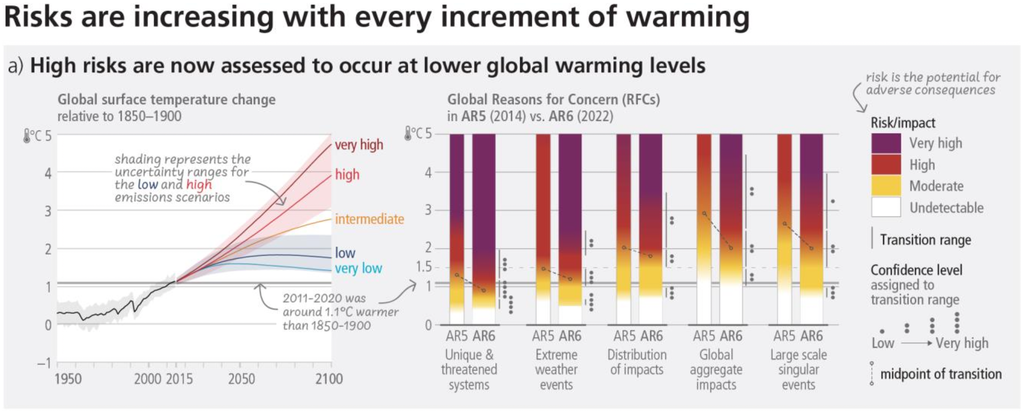
Global aggregated impact and risk levels are now assessed to become high to very high at lower levels of warming than previously assessed (AR5).
p.p1 {margin: 0.0px 0.0px 0.0px 46.0px; font: 13.0px ‘Helvetica Neue’}
Excerpt from SYR Figure SPM.4 (a), Global Reasons for Concern (RFC), comparing AR6 (thick embers) and AR5 (thin embers) assessments. Risk transitions have generally shifted towards lower temperatures with updated scientific understanding.
Currently, we are at around 1.1°C of average global warming, heading towards about 3°C.
Unique and threatened ecosystems are expected to be at high risk already in the very near term at 1.2°C, due to mass tree mortality, coral reef bleaching, large declines in sea-ice dependent species, and mass mortality events from heatwaves. At just 1.5°C, up to 14% of species assessed in terrestrial ecosystems will likely face a very high risk of extinction.
Reaching 1.5°C will bringmore and worseheat extremes and dangerous heat-humidity conditions, extreme rainfall and associated flooding, tropical cyclones, wildfires and extreme sea-level events.
Between 1.5°C–2.5°C, risks associated with large-scale singular events or tipping points, such as ice sheet instability or ecosystem loss from tropical forests, transition to high risk.
At about 1.9°C warming, half of the human population could be exposed to periods of life-threatening climatic conditions arising from the coupled impacts of extreme heat and humidity by 2100.
At sustained warming levels between 2°C and 3°C, the Greenland and West Antarctic ice sheets will be lost almost completely and irreversibly.
3. Those least responsible for the climate crisis are hit the hardest
Vulnerable communities who have historically contributed least to the climate crisis are most affected. Nearly half of the world’s population (3.3–3.6 billion people) live in contexts that are highly vulnerable to climate change. Between 2010 and 2020, human mortality from floods, droughts and storms was 15 times higher in highly vulnerable regions, compared to regions with very low vulnerability.
At the same time, only 10% of the wealthiest households contributed up to 45% of global consumption-based household GHG emissions.
4. We’re on track to high and very high risks and no decline in global emissions
With policies implemented by the end of 2020, we are on track to about 3.2°C warming
by 2100. (Estimates that cover more recent policies (NDCs announced prior to COP26 until 2030, with no increase in ambition), result in a slightly better assessment of 2.8°C median warming.)
Instead of halving global emissions by 2030, which would be required for respecting the Paris Agreement warming limit, there would be no decline in global emissions by 2030.
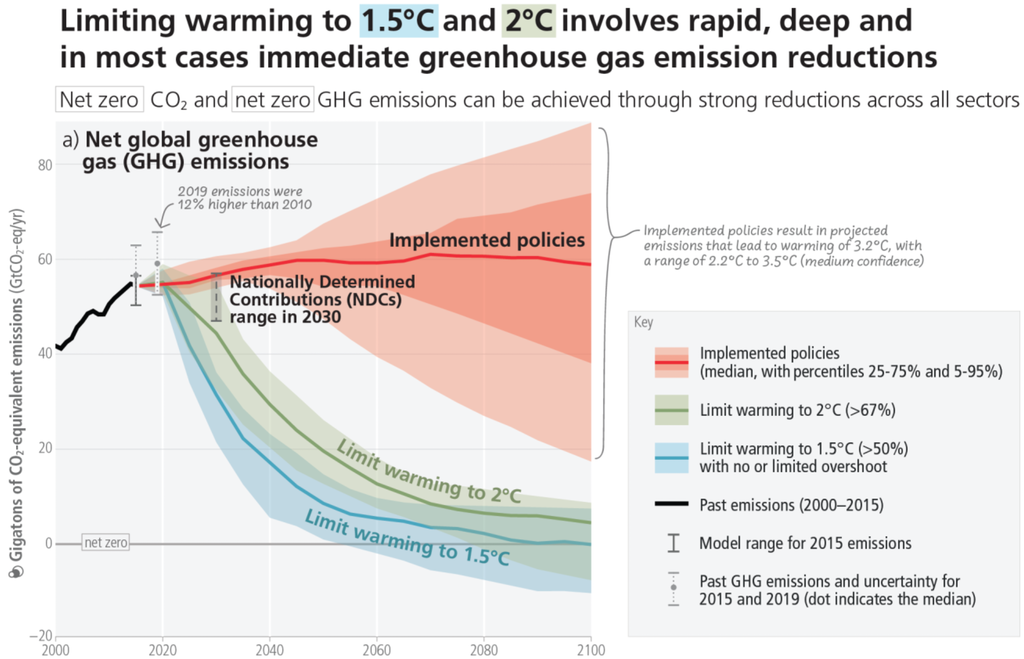
5. With urgent action, the Paris long-term temperature goal is still within reach
With continued emissions, we’re on track to reach around 1.5°C in the near term. But it is still in our hands to halt warming there to avoid the most severe impacts.
By following the strongest IPCC emission reduction pathways (C1), warming would peak between 1.4°C and 1.6°C and by the end of the century be below 1.5°C. (See Table 3.1)
So with urgent action, the Paris Agreement long-term temperature goal is still within reach. This would require roughly halving global emissions by 2030, followed by net zero CO2 by around 2050, and achieving and sustaining net negative CO2 (and GHG) emissions globally thereafter, with annual rates of carbon dioxide removal (CDR) being greater than remaining CO2 emissions.
Limiting as much as possible any overshoot of 1.5°C, for the shortest duration possible is essential, as the gradual cooling would not undo the irreversible impacts triggered by the peak warming (such as species loss or ice sheet melt). Furthermore, while some carbon dioxide removal is necessary by now, it comes with many uncertainties, so the reliance on it should be limited. As the IPCC concluded in its earlier AR6 reports:
“CDR deployed at scale is unproven, and reliance on such technology is a major risk in the ability to limit warming to 1.5°C. CDR is needed less in pathways with particularly strong emphasis on energy efficiency and low demand.” (IPCC SR15)
“(…)prioritising early decarbonisation with minimal reliance on CDR decreases the risk of mitigation failure and increases intergenerational equity.” (IPCC SRCCL)
6. This is the defining decade and we have all the solutions we need
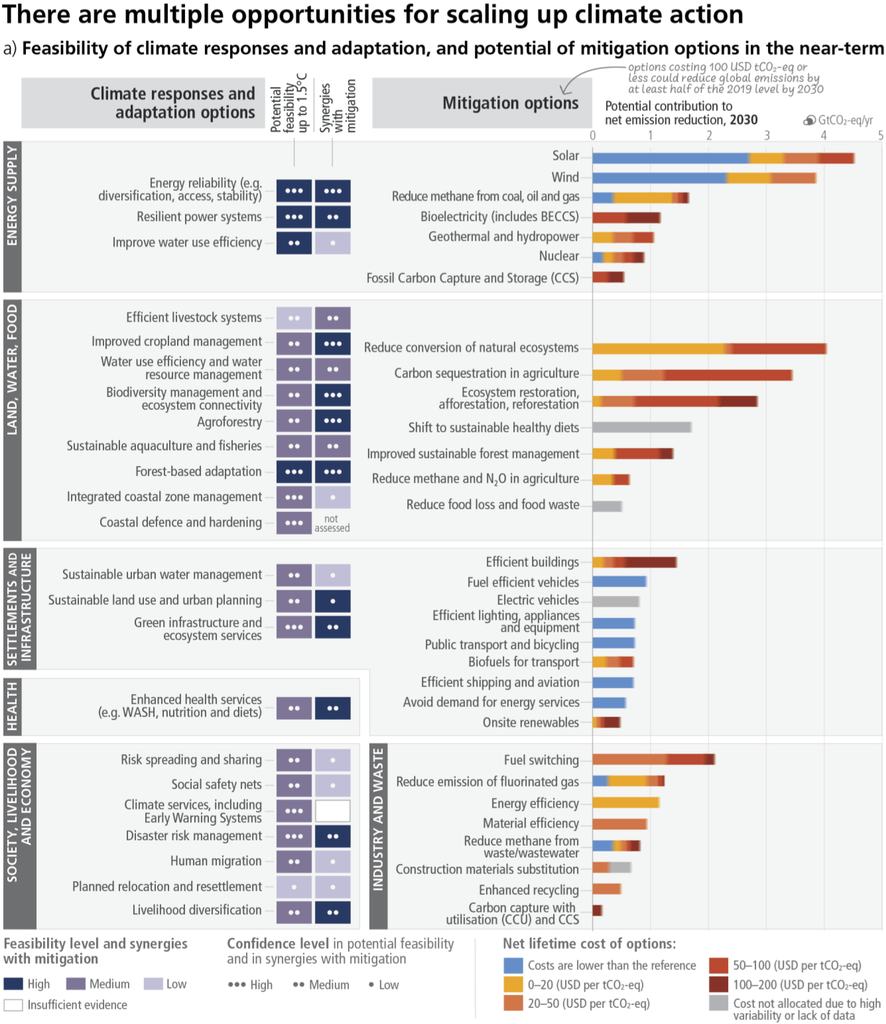
We have all the tools we need for at least halving global emissions by 2030. Half of this mitigation potential is estimated to be low-cost (less than 20 USD/tCO2-eq), or even to come with cost savings.
The biggest contributions would come from solar and wind energy, protection and restoration of forests and other ecosystems, climate-friendly food systems, and energy efficiency in its many forms.
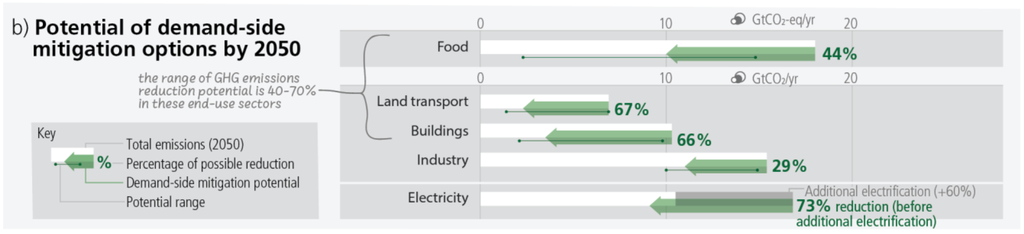
By 2050, demand-side measures can reduce global GHG emissions by 40–70% compared to baseline scenarios. These refer to societal choices about how we use technology and resources to meet our needs for food, shelter, mobility and products. One of the measures with the greatest potential, and synergies with adaptation and biodiversity conservation and human health, is the shift towards low-meat diets, termed “balanced sustainable healthy diets” by the IPCC reports. Overall, providing better services with less energy and resource input is consistent with providing well-being for all.
7. Fossil fuel exit needs to be fast: The infrastructure we already have is too much.
The fossil fuel infrastructure already in place is enough to exceed the 1.5°C warming limit, if allowed to be in use without further restrictions. So there is no room for any new fossil fuel infrastructure, and what exists needs to be phased out early, as is illustrated by the graph below.
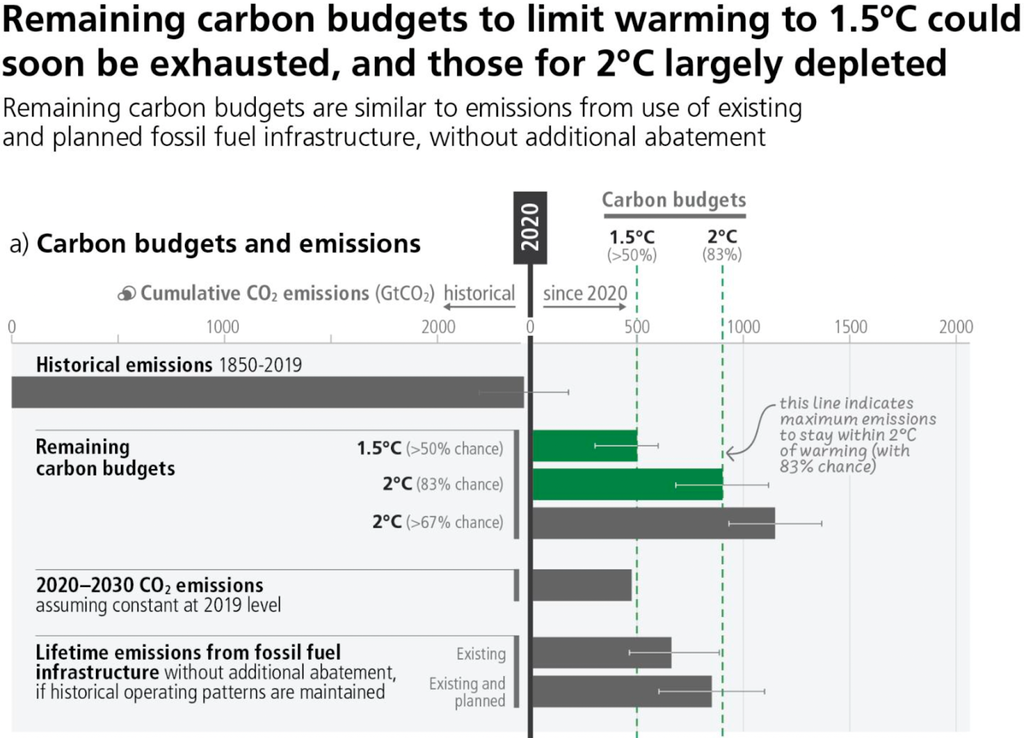
In other words, keep it in the ground:
“About 80% of coal, 50% of gas, and 30% of oil reserves cannot be burned and emitted if warming is limited to 2°C. Significantly more reserves are expected to remain unburned if warming is limited to 1.5°C.” (SYR longer report)
So there needs to be a major shift away from fossil fuels. But just how fast? It depends on many assumptions, and in the underlying mitigation report (AR6 WG3) the IPCC provides more detail.
In pathways that limit warming to 1.5°C with greater than 50 % likelihood and no or limited overshoot, the global use of coal is projected to decline by up to 100 %, oil by up to 90 % and gas by up to 85 % by 2050, with median values being lower. (See WG3, SPM C.3.2)
The fastest reductions are required in pathways that aim at 1.5°C with little to no overshoot, low reliance on carbon dioxide removal, low pressure on land and biodiversity and high efficiency in resource use. Such pathways are illustrated by the IMP-LD pathway, where the overall use of fossil fuels declines by about 85 % by 2050, from 2020 levels (See WG3, Figure 3.6 and SPM C.3.6).
8. Solutions must deliver in real life, not only in models
We have entered a critical decade, during which we must nearly halve global emissions while delivering on food security and protecting and restoring nature too.
Among the big game-changers since the previous assessment is the breakthrough of solar and wind, that are now reaching cost levels equal to or below those of fossil fuels, being ready to enable the decarbonisation of different sectors through electrification. These developments have occurred much faster than anticipated by experts and modelled in previous mitigation scenarios. It’s a game-changer.
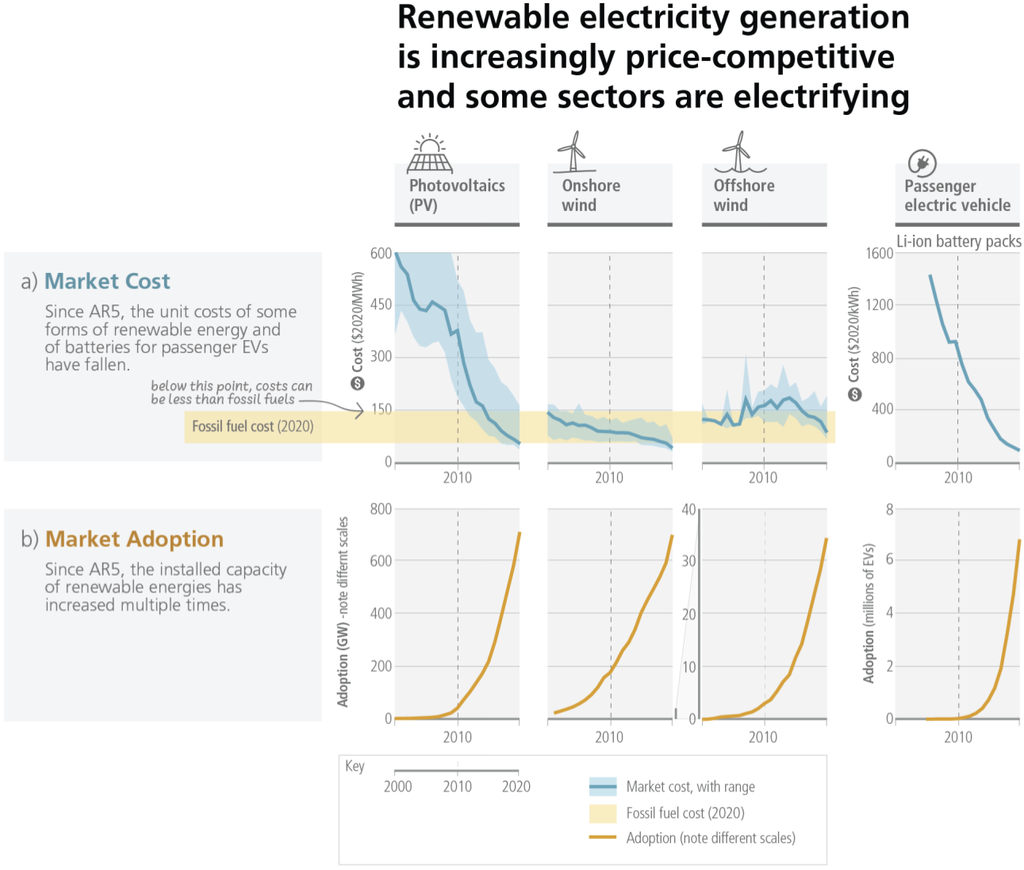
Carbon capture and storage (CCS), then again, has not made significant progress. It plays a big role in many emission reduction models, but still fails to deliver at scale in real life. As the IPCC mitigation report summed up:
“Deployment and development of CCS technologies (with large-scale storage of captured CO2) have been much slower than projected in previous assessments”.
“Implementation of CCS currently faces technological, economic, institutional, ecological-environmental and socio-cultural barriers.”
Technological carbon dioxide removal, where CO2 is captured directly from the atmosphere (DACCS), or from biomass energy (BECCS), also play a role in most mitigation models, but remain unproven at scale, and they come with many feasibility and sustainability constraints – as does large-scale afforestation.
So, as we navigate into the future, where carbon dioxide removal will be needed – though substantially less so with urgent, near-term action – it is essential to look beyond simplified models. Prioritising CDR solutions that maximise sustainability benefits and minimise risks, means prioritising options that work with nature and for communities, like reforestation, restoration of ecosystems or soil carbon sequestration in agriculture. This is critical in order to avoid conflicts with other land use needs or creating large environmental impacts and conflicts with human rights and food security.
9. Delivering on equity, social inclusion and finance is fundamental
The scale and speed of transformation needed will not be possible without equity and social justice, both between and within countries. According to the IPCC, integrating climate action with macroeconomic policies can support sustainable low-emission development paths, safety nets and social protection, and improve access to finance for low-emissions infrastructure access, especially in developing regions.
At the heart of equity considerations is finance. There’s enough money in the world to enact real change, if existing barriers are removed. But today, public and private finance flows for fossil fuels are still greater than those for climate adaptation and mitigation.
(Indeed, while the IPCC points to the growing finance and adaptation gaps vulnerable communities are struggling with, the IEA reports that last year alone, the oil and gas industries earned a whopping 4 trillion USD with businesses fueling the climate crisis!).
The annual investment requirements before 2030 are a factor of three to six greater than current levels, for mitigation alone, with the largest needs being in the developing world. To change this, both governments and financial institutions will need to align their goals and policies with 1.5°C, and remove barriers. On an international level, equitable solutions need to be found that meet the adaptation and mitigation needs and address loss and damage for those least responsible.
10. From incremental to transformative change, in all sectors, with all hands on deck
There’s a rapidly narrowing window of opportunity to implement climate resilient development. To achieve the Paris Agreement and other sustainability goals, we need to think beyond individual technologies, sectors and actors and adopt holistic, inclusive and transformative approaches that encompass both mitigation and adaptation.
Action that protects and restores our biodiversity is fundamental. By taking care of nature, we are taking care of ourselves. According to the IPCC, maintaining the resilience of biodiversity and ecosystem services at a global scale depends on effective and equitable conservation of approximately 30% to 50% of Earth’s land, freshwater and ocean areas, including currently near-natural ecosystems.
To achieve “rapid and far-reaching transitions across all sectors and systems” we need strong laws and policies and international co-operation. It’s all hands on deck and those with most responsibility and capability need to lead the way. This goes for governments, businesses, investors and high-income individuals alike.
So now what?
Scientists have delivered their toolbox for survival. Now it is our job to make sure the science is acted on, by governments, businesses, investors and citizens. And that we make it personal.
The life, well-being or suffering of our daughters, granddaughters, great-granddaughters and many more after them will look back at us and feel grateful for what we did, or perhaps what we did not do.
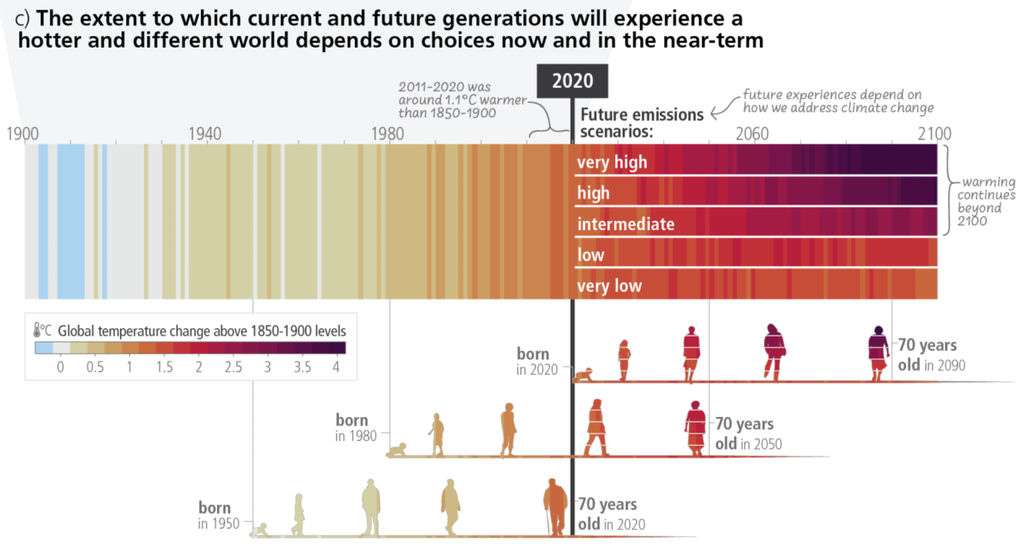
2100) changes in global surface temperature (relative to 1850–1900), which are linked to changes in climate conditions and impacts, illustrate how the climate has already changed and will change along the lifespan of three representative generations (born in 1950, 1980 and 2020).
Kaisa Kosonen is a Senior Policy Advisor with Greenpeace Nordic and Reyes Tirado is a Senior Scientist with Greenpeace Research Laboratories at University of Exeter.