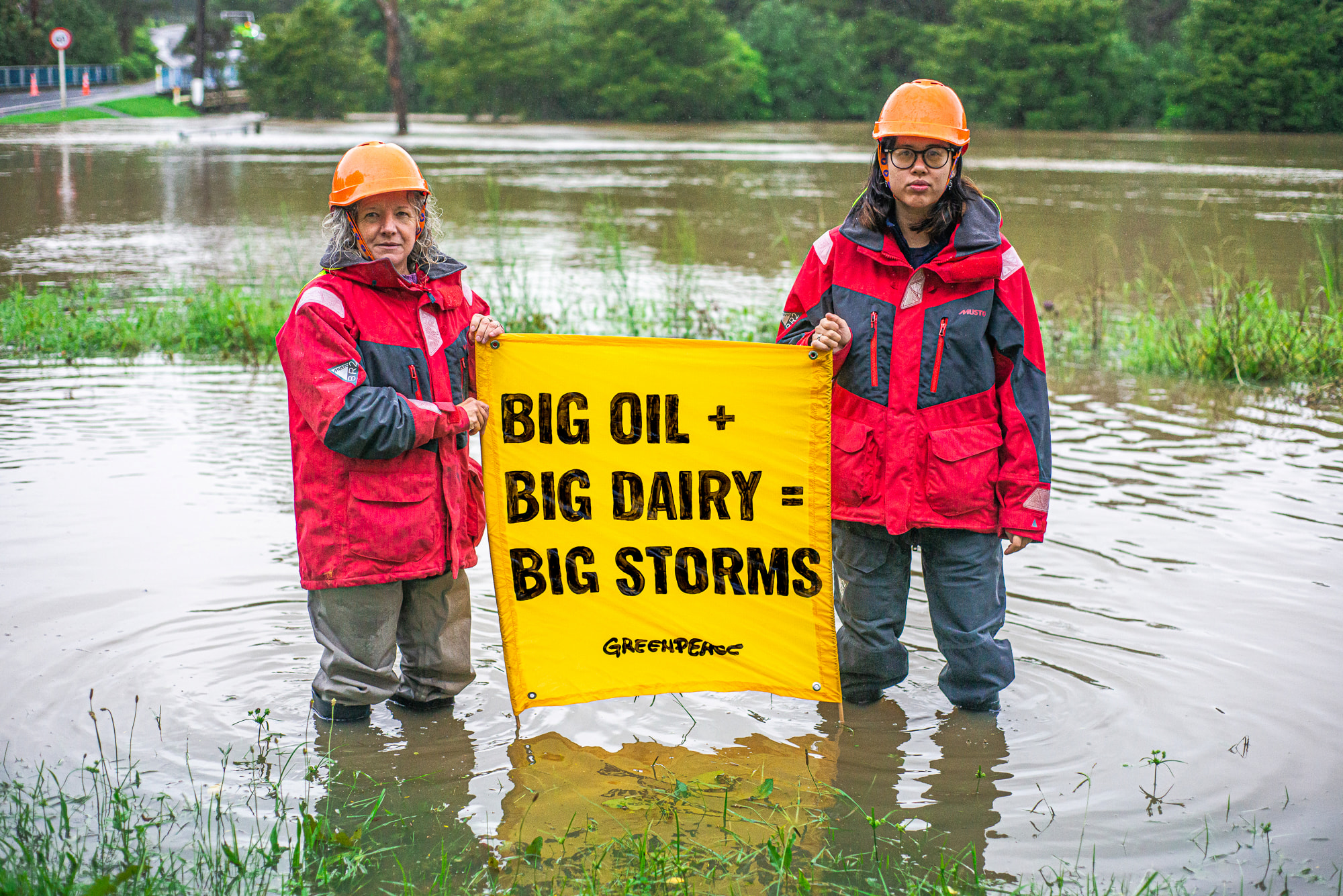
When the Luxon-led coalition took office nearly three years ago, its war on freshwater started within days. In the next three years the government made a bewildering number of changes leading to environmental harm. Greenpeace Aotearoa Executive Director Russel Norman has undertaken the gargantuan task of tracking them all.
It has been nearly three years since the formation of the Christopher Luxon led Government, a coalition between the National, Act and NZ First parties.
It has been three years of a veritable war on freshwater, largely driven by Fonterra and agribusiness, but supported by the government as a whole.
There have been so many freshwater pollution initiatives, across so many government agencies, through so many law and regulation changes, across a raft of budgets, it is exhausting to keep track of them all.
The aim of this article is to create a comprehensive timeline of them, to be a witness, to honestly see what we can see, as the starting point to do something about it.
I’ve gone through every week of the last nearly three years of the Luxon Government to pull out their freshwater policies and laid them out below. This article focuses on freshwater, but I have drawn the information from my longer War on Nature article.
I’m afraid this is really more of a reference document than an easy-to-read narrative, and it is unpleasant reading at the best of times. So here goes.
The War on Freshwater, week by week
Voting in the New Zealand general election finished on October 14, 2023 and the Luxon Coalition Government was sworn in on November 27, 2023.
Federated Farmers Vice President Colin Hurst was in touch with new Associate Minister of Agriculture Andrew Hoggard on December 3 2023 claiming that freshwater was not in decline but rather ‘is broadly maintaining current state’. He misrepresented the views of scientists to claim that intensive land use was not the driver of pollution (in spite of evidence to the contrary). He thought the real problem lay with the independent state of the environment reports being produced by Statistics NZ and the Ministry for the Environment, not with the actual state of the environment.
On December 4, 2023 the new Associate Minister of Agriculture Andrew Hoggard met with the agribusiness lobby group Federated Farmers, his former colleagues.
Government Ministers met with agribusiness lobby group Dairy NZ somewhere between December 11 and 13 2023. Dairy NZ’s demands for gutting freshwater protections and climate policy fell on fertile ground as we shall see.
On December 14 2023, to the joy of agribusiness, the Luxon Government announced the beginning of the process to remove the clean water rules – the National Policy Statement on Freshwater Management 2020, a regulation under the Resource Management Act that was one of the most important policies to cut climate and water pollution. Without the clean water rules (and/or a price on dairy emissions) dairy herds are growing again resulting in more climate and freshwater pollution. Dairy is the country’s most climate polluting industry and Fonterra is by far the single biggest climate polluting company. Agribusiness opposed the clean water rules and, with the former head of Federated Farmers, Andrew Hoggard as Associate Agriculture Minister, they were well placed to remove them.
On December 20, 2023 they repealed the Natural and Built Environment Act and the Spatial Planning Act which was the result of years of work by government, industry and environment NGOs to update and replace the Resource Management Act (RMA). Luxon would soon move to a fast track RMA approval process, while removing environmental guardrails.
2024
On February 14 2024 they repealed the Three Waters process for supporting councils to improve their water supply and waste water treatment plants. The repeal will ultimately result in more water pollution and higher costs to councils, rural councils in particular. It resulted in the hospitalization of six kids in Hamner from poisoned water.
On March 7 2024, former tobacco lobbyist and current Minister for RMA Reform, Chris Bishop, rejected officials’ advice to include ‘sustainable management’ in the purposes clause of the fast track law. The absence of environmental guardrails in the purposes clause of the bill meant the fast track law could, and would, be used for projects causing immense environmental harm and climate pollution, such as irrigation expansion for more dairy cows.
On March 20, 2024 Andrew Hoggard hosted a private dinner for the Dairy NZ board in the Beehive.
April 6th 2024 saw them announce a hand-picked review of the country’s methane reduction targets, based on the ‘no additional warming’ metric being promoted by the global and domestic livestock industry. This metric is at odds with the metric used by the Intergovernmental Panel on Climate Change, and opposed by the Climate Commission and the Parliamentary Commissioner for the Environment. Federated Farmers, the lobby group for agribusiness, applauded, and the review was chaired by a former director of Fonterra. Methane has so far contributed 30% to global heating and levels are increasing rapidly.
But April 9th 2024 saw new money to subsidise agribusiness research into magic methane reduction technology- the same research that has failed for two decades to produce any meaningful results. Fonterra’s Annual Report had to acknowledge that these novel technologies may never emerge. The real purpose of the research is to maintain the fantasy that New Zealand can cut emissions without reducing dairy cow numbers.
On April 10th 2024 the Government returned their attention to freshwater rules by announcing that Freshwater Farm Plans would be changed. Previously these plans were mandatory audited plans linked to achieving the actual in-stream water quality outcomes required by the National Policy Statement on Freshwater Management. Under the new industry-approved freshwater farm plans all that was required was to show industry ‘best practice’ regardless of whether that actually led to cleaner rivers. This announcement created regulatory confusion as regional councils in Waikato, Southland, the West Coast, Otago, and Manawatū-Whanganui had already started implementing the real freshwater farm plans.
May 23 2024 was a red letter day with the first Resource Management Act Amendment Bill being introduced. It removed Te Mana o Te Wai, the hierarchy embedded in the National Policy Statement on Freshwater Management, that directed decision makers to prioritise ecosystem health and human health, when making resource consent decisions such as freshwater allocation. Te Mana o te Wai was at the centre of a decision to decline agribusiness applications to take millions of litres from Hawkes Bay’s already overallocated aquifers. The consent panel in that case prioritised ecosystem health ahead of agribusiness. The Amendment Bill aimed to change this, so that commercial applications were given the same priority as ecosystems and human health in freshwater allocation.
The Bill also removed the rules keeping cows out of mud i.e. intensive winter grazing. And it removed the RMA blockage to new coal mines. This all means more cows and dirty rivers and coal mines and climate and water pollution.
And then we get to June 11th 2024 and agribusiness biological emissions, half of all New Zealand’s emissions. Under lobbying from agribusiness, the government announced that it will change the law so that agriculture and fertiliser companies will not face a price on emissions in 2025. This means there will be no financial incentive to cut emissions, unlike other sectors of the economy. Treasury and MfE said the government’s approach would not work in cutting emissions (surprise). And it went in the face of the Climate Commission, which supported pricing agricultural emissions as an essential tool to cut emissions. Fonterra’s claim that New Zealand is a low emissions dairy producer was debunked by their own reports, and Nestle remained skeptical of New Zealand’s claim to be a low emission producer of dairy. The Government also removed the reporting requirements on large meat and dairy processors so they don’t even need to disclose their pollution.
On July 17 2024, the Government published its draft Emissions Reduction Plan. However, the Plan was not serious as it was premised on magic – magic technology to cut methane emissions and magic Carbon Capture and Storage. Neither of which has any likelihood of appearing in the real world after 20+ years of government funded research. It made it seem like New Zealand is doing something about climate change. Still, the Plan showed New Zealand missing its targets in spite of a biblical commitment to planting pine trees.
On August 9 2024, the Government said it would overturn court decisions on sections 70 and 107 of the RMA, court decisions which restricted water pollution. The Minister for Agriculture, Todd McClay, said they would legislate over these decisions because the “the court decisions could result in more discharges needing consents, more consent applications being declined, and consent conditions becoming more restrictive, reducing the ability to improve freshwater quality over time.” So less pollution would make it harder to improve freshwater quality. Truly Orwellian.
After vigorous lobbying by agribusiness, on September 3rd 2024, the Government announced it was ‘pausing’ the rollout of freshwater farm plans designed to restrict water pollution. Which means more water pollution, more cows, more climate pollution.
It followed this up on September 4 2024 with the announcement of the second RMA Amendment Bill. This aimed to weaken the National Policy Statement on Freshwater Management, weaken drinking water standards, weaken protection for indigenous biodiversity to allow more quarrying and mining, remove local councils ability to set higher standards on forestry slash, stopping the rollout of freshwater farm plans until they were aligned to industry demands. More climate and water pollution.
On October 6th 2024, the Government was forced to release the list of 149 projects it planned to include in the fast track bill for automatic entry to the fast track process, after the Ombudsman intervened. It included coal mines, seabed mining, incinerators, and irrigation projects, which will increase emissions and biodiversity destruction. The list was released after the select committee process so that the public could not submit on the individual projects. It emerged that companies and individuals associated with these 149 fast track projects had given $500,000 to the ruling parties as election donations.
The Luxon Government discovered that some regions were already making progress on proper freshwater farm plans so they announced on October 9th that they would block the development of these freshwater farm plans while they worked with agribusiness lobby groups to replace them with weaker industry approved plans.
October 15th 2024 saw late rushed amendments included in First RMA Amendment Bill, this time amending section 107. This amendment was aimed at overturning a March 2024 court decision. The court decision said that Section 107 restricted pollution going into freshwater if it caused significant harm to aquatic life. The Government had previously told public submitters it was not changing section 107, so there was no chance for public input. The change allows councils to grant discharge permits, regardless that these discharges would cause significant adverse effects to aquatic life. The RMA Reform Minister Chris Bishop described the changes as ‘quick and dirty’ and for once it was an accurate characterization.
October 21 2024 saw the announcement of another RMA amendment, this time to section 70, which would be included in the Second RMA Amendment Bill. The proposed amendment would overturn important court decisions by the Environment Court, the High Court and finally, in 2024, the Court of Appeal. As summarised by David Williams, the court decision found that “before a regional council can include a rule in its regional plan permitting farm pollution, it needs to show there won’t be significant adverse effects on aquatic life.” Seems a pretty reasonable decision.
Fish and Game and Forest and Bird had won this series of cases against Fonterra, Dairy NZ, Federated Farmers and the Southland Regional Council. It cost them a fortune and was eight years since the Council first proposed the rule allowing the pollution.
Fonterra, flying in the face of decades of science, claimed “no evidence has been presented pointing to diffuse farming discharge(s) either individually or cumulatively causing any of the listed effects in section 70” i.e. significant harm to aquatic life (Fonterra submission 16-8-22). But the Environment Court disagreed with Fonterra and concluded that it was “highly likely that the result of the discharges of contaminants” would be significant adverse effects on aquatic life.
The Government believed agribusiness should not be required to get a consent to discharge pollution that caused serious adverse impacts on aquatic life, rather it should be permitted ie allowed without a resource consent. A pivotal moment.
As you can see removing constraints on agribusiness water pollution was an itch which the Government could not stop scratching.
The Government faced another constraint on water pollution which was that some regional councils planned to proceed with their updated regional freshwater plans, so on October 22 2024 the Government announced that they would legislate to retrospectively block regional councils from gazetting the regional freshwater plans, regardless of what regional councils may want.
Which meant the next day the Otago Regional Council had to cancel its meeting to approve the new Otago regional freshwater plan, due to central government intervention to stop them. The plan had been developed over many years with community input.
The first RMA Amendment Bill passed on October 23, 2024 (Resource Management (Freshwater and Other Matters) Amendment Act 2024). This Act did a number of things to remove protections for nature:
- Panels making resource consent decisions on water allocation could no longer give highest priority to ecosystem health and human health, ahead of commercial interests. The existing hierarchy – ecosystem health, then human health, then commercial – was known as Te Mana o te Wai and sat within the National Policy Statement on Freshwater Management (NPSFW). Henceforth, commercial water users have the same priority as other uses such as ecological or human drinking water.
- Overturned the rules controlling intensive winter grazing (mud farming) in the National Environmental Standards for Freshwater (NESF), to return to the previous situation where cows in mud was normal in Southland and Otago;
- Made consenting for coal mining easier;
- Suspended the requirement for councils to identify significant natural areas;
- Allowed councils to approve water pollution discharge consents that cause ‘significant adverse effects on aquatic life’ so long as the water was already pretty polluted ( ie it overturned the court decision on section 107 of the RMA);
- Changed the rules excluding stock from rivers and wetlands to allow more stock access;
- Paused the rollout of freshwater farm plans while government reworked them along the lines demanded by Federated Farmers and Dairy NZ;
- Retrospectively blocked the notification of regional council freshwater plans and policy statements developed under the existing National Policy Statement on Freshwater Management 2020;
- Changed the process for developing RMA national policy statements to remove the independent Board of Inquiry, and the Minister took over the whole process.
It was a wishlist from agribusiness and other industry lobby groups. This was no surprise given that the Associate Agriculture Minister Andrew Hoggard is the former president of Federated Farmers, a lobby group which vociferously opposed measures to clean up water pollution.
On November 12 2024 a GNS study of rural school drinking water for the Ministry for the Environment was quietly released. It found 100 schools (41%) with nitrates over 1mg/L, a level which has been linked to increased rates of colorectal cancer. The study concluded that the biggest future risk to school drinking water was nitrate contamination.
On November 21 2024 the Southland regional council’s requirement to develop a farm plan, to control water pollution, was deferred by central government. The farm plan requirements had been developed over a decade with input from civil society including farming interests. Southland has disastrous water quality due to the expansion of industrial dairy – from 40,000 to 640,000 cows in 30 years.
On December 11 2024 the Government also released its final Second Emissions Reduction Plan 2026-2030, which still relied on magic methane inhibitors to cut agricultural emissions, magic carbon capture and storage to capture energy emissions, and lots of pine trees on private and public land. Fossil gas and coal remained a key component of the projected future energy system. Fully a third of projected emissions ‘reductions’ were from carbon capture and storage. Pricing of agricultural emissions by 2030 was the cornerstone of the plan to cut agribusiness pollution. As would become clear soon enough, this was a work of fiction as the carbon capture and storage proved not feasible and in October 2025 the Government itself permanently ruled out pricing agriculture emissions.
The documents around the ERP acknowledged that ‘New Zealand is substantially off track to meet its [Paris Agreement] target”, (p.22) and that was before the Government ended 41 different initiatives to cut emissions .
2025
February 26 2025 found the Climate Minister telling Federated Farmers that there was no legal obligation to meet the Paris targets, and no liability.
On March 21, 2025 the Environment Court paused a court case brought by Fish and Game and Forest and Bird that would have restricted diffuse pollution discharges in Southland. The case was paused due to the pending Government’s changes to section 70 of the RMA to allow more pollution.
On March 24 2025, Bishop announced high level direction for two new acts to replace the RMA. They will be centred on protecting private property rights and providing compensation to property owners if local government interferes with their property rights in order to protect the environment. It is bound to have a very negative effect on environmental protection. For instance, regional councils that seek to regulate dairy companies to reduce their water pollution will find themselves facing the risk of having to pay compensation for lower stocking rates – regulatory takings – if their rules are more restrictive than central government direction.
On April 4 2025 we saw the last day of an eight week court case in which Ngāi Tahu sought co-management of freshwater in the South Island. This was driven by central government’s abject failure to protect the rivers and lakes of the South Island from dairy pollution resulting in widespread water contamination. The Government opposed it and wants to continue with its approach of further weakening freshwater protections. The judge is thinking about their decision.
The Ministry for the Environment released a GNS study of groundwater on April 8 2025 which found 41% of testing bores had elevated nitrate, particularly in dairy intensive areas like Canterbury.
On April 16, 2025 after stopping the rollout of freshwater farm plans that were designed to meet environmental outcomes, Cabinet agreed that freshwater farm plans just needed to align with industry best practice. Whether this resulted in more or less pollution was not the issue. Agribusiness had been pushing for this outcome ever since freshwater farm plans were floated as an idea.
Finally, on May 7 2025, after 310 days of a vacant Prime Minister’s Chief Science Advisor role, the Prime Minister nominated John Roche to the role, a dairy industry insider. Roche previously had a leadership role at the industry lobby group Dairy NZ, which lobbies against measures to cut climate and freshwater pollution. The majority of members of the government science advisory panel also had dairy and agribusiness backgrounds. But, to be fair, one of the panel members worked for an energy company, Genesis, which runs Huntly coal power station.
The Regulatory Standards Bill passed its first reading on May 22, 2025. The Parliamentary Commissioner for the Environment opposed the Bill stating that its ‘provisions could be interpreted to mean that regulations cannot prevent people from polluting or damaging property in public or common ownership.’ Or in plain language it protects corporations’ right to pollute the commons. The Bill meant that if regulations to protect freshwater resulted in limits on the size of a dairy herd, then there was an expectation of compensation. Around 99% of the 159,000 submissions opposed the bill.
And on May 29 2025 the New Zealand Government released a series of proposed changes to RMA regulations (rather than changes to the RMA itself). These changes are additional to, and sometimes overlapping with, the two RMA amendment bills (the first already passed in October 2024 and the second passed in August 2025). The proposed changes to RMA regulations would mean:
- Stock would be allowed to graze in natural wetlands that have endangered species;
- It would further entrench the changes to the hierarchy of water allocation and mean that freshwater can be allocated for dairy expansion even if it means there is not enough water for the ecosystem or human health;
- Removing or weakening the nitrogen fertiliser cap that currently exists for dairy farms;
- Weaker environmental bottom lines for freshwater – such as nitrate, sediment, phosphate – to allow more water pollution;
- Forestry slash could no longer be regulated by local councils to a higher standard than central government allowed;
- Making it easier to consent mining in ecologically important areas like wetlands.
The fact that only 10% of original wetlands remain, that most lowland rivers and lakes are highly polluted with nutrients mainly from intensive agriculture, and that three quarters of native freshwater fish and two thirds of our freshwater birds are threatened with extinction, does not appear in the discussion documents. All of the proposed measures would make this even worse by allowing more intensive agribusiness.
Next up on June 5 2025 was the Government’s move to gag the Fish and Game organisation. Fish and Game has played a crucial role over decades in raising issues around freshwater pollution, drawing attention to the role of intensive dairying, and litigating to protect rivers and lakes from pollution. Fish and Game were trying to protect the freshwater habitat of trout and salmon from dairy pollution. Hence it has been relentlessly attacked by Federated Farmers, which called for its advocacy function to be removed, after Fish and Game (and Forest and Bird) won a court case to restrict water pollution in Southland.
And hey presto, the Government announced plans to legislate to restrict Fish and Game’s advocacy function, which had allegedly ‘overstepped the mark’. Under the Cabinet paper, Regional Fish and Game Councils will only be allowed to file court proceedings ‘with the authorisation of the [Fish and Game] National Council or the Minister [for Hunting and Fishing] as appropriate”. The Minister was also given the power to review Fish and Game Councils at will, and sack elected councillors. If Fish and Game dares to challenge dairy pollution in court again, they can be overruled by the Minister.
Intensive agriculture on the Canterbury plains is driving the nitrate emergency and the Government decided to hand out $56m in loans to irrigation schemes at the heart of the pollution crisis on July 3 2025. Which will only make it all worse.
The second RMA Amendment Bill (Resource Management (Consenting and Other System Changes) Amendment Act 2025) passed its third reading on August 14, 2025. This Act delivered a number of changes including:
- As demanded by Dairy NZ and other agribusiness lobby groups, Freshwater Farm Plans can be signed off by agribusiness industry bodies approved by the Minister, and now apply to fewer farms;
- The changes to section 70 of the RMA empower a regional council to authorise the permitted discharge of contaminants to freshwater that may cause disgusting pollution (or in legal language ‘may result in the production of conspicuous oil or grease films, scums or foams; a conspicuous change in the colour or clarity of the receiving waters; any emission of objectionable odour; the rendering of fresh water unsuitable for consumption by farm animals’); or significant adverse effects on aquatic life in the receiving waters.
- It restricted regional councils ability to protect biodiversity in the inshore marine environment by giving the Director General of Ministry of Primary Industry the ability to veto any regional plan that restricts fishing (ie the new law overturns the Motiti court decision to protect inshore marine biodiversity);
- Coal fired or gas fired power plants must now have their consent applications fast tracked and processed within 12 months;
- It allows the Minister to change regional council plans and policy by regulation without normal consultation, overriding local democracy;
- It stops councils planning processes while the government’s new RMA replacement is being developed, but allows private plan changes to proceed. Private plan changes are used by private developers to override existing planning constraints.
EDS stated that “There’s nothing balanced here. The Government is systematically dismantling our environmental laws.”
The changes that Chris Bishop, Andrew Hoggard, and Todd McClay have driven through the RMA via these two amendment bills, will make a lot of activities that are currently illegal, legal. Most dairy corporation pollution is already legal, that which was illegal was seldom detected, and where it was detected it was very seldom prosecuted. The law changes mean that even less pollution will be prosecuted – no doubt the lower level of prosecutions will be claimed by agribusiness and the government as proof that pollution is improving when of course it will be the opposite.
On September 3, 2025 the courts found that the consents previously given to MHV irrigation scheme in Canterbury were illegal, as they breached section 107 of the RMA. The court found that the intensive agriculture facilitated by the irrigation scheme had caused ‘significant cumulative adverse effects on aquatic life.’ But the Government had subsequently changed s.107, so the courts saw little gain in overturning the consents as they could be re-issued under the new s.107. It was allowed to continue.
On September 11 2025 the Canterbury Regional Council revealed that half of private drinking water bore tests in the Selwyn district were over the legal limit for nitrate pollution (a legal limit which is itself eleven times above the level that increases rates of colorectal cancer).
On September 16, 2025, we found out that efforts to protect the famously pure water at Te Waikoropupu springs were threatened by Chris Bishop’s freeze on council plan changes, and Federated Farmers are trying to scrap the efforts permanently. The springs are facing rising nitrate pollution from dairy intensification which has led the local council to seek a Water Conservation Order which would restrict additional pollution. It is this WCO that is now in jeopardy. Federated Farmers want to abolish all WCOs altogether, and the Government is thinking about doing this.
Canterbury regional council – ECAN – declared a nitrate emergency on September 17, 2025. Nitrate levels are rising to dangerous levels across the region driven by intensive dairying. Public health academics and scientists applauded the declaration, pointed to the extra 1.1million dairy cattle in Canterbury since 1990 and the 300% increase in synthetic nitrogen fertiliser, and laid out steps for addressing the issue. However, as we’ve seen above, the government’s initiatives allow for more nitrate pollution, and place restrictions on regional councils ability to control dairying, and hence nitrates. Like an arsonist condemning a victim for shouting ‘fire’, the Government called the regional council declaration a ‘gimmick’. Meanwhile some Ashburton residents can no longer drink their bore water due to nitrate and faecal contamination, Gore town water had too much nitrate for safe consumption, as did Waimate.
On September 23, 2025 Fish and Game withdrew from the court case to restrict diffuse water pollution in Southland. Fish and Game, together with Forest and Bird, had won at the Court of Appeal, but the Government’s subsequent changes to section 70 of the RMA made it harder to keep winning. Federated Farmers were very pleased. The Southland Federated Farmers President Jason Herrick was reported as saying that having the Minister actively involved in setting the direction for Fish and Game meant it will be easier to collaborate in the future. The project to gag Fish and Game’s advocacy function, to gag civil society, was working as they had hoped.
To add to the assault on democratic norms, September 24, 2025 found Act Party Minister David Seymour telling the regional council that they should not enforce current laws on consenting. However, rule of law applies to the regional government whether Seymour likes it or not. As Prof Andrew Geddis pointed out, the regional council is required to follow the existing law, not some mooted whim of a Minister. This was similar to the actions of another Act Party Minister, Andrew Hoggard, who in March unlawfully tried to get councils to ignore their legal obligations to identify significant natural areas.
But still the scientists were not silenced yet, and on September 25, 2025 they published a peer reviewed paper based on thousands of water tests showing that one in three rural New Zealanders faced high levels of nitrate in their drinking water – in Canterbury it was approaching one half. The Maximum Acceptable Value (MAV) is 11.3 mg/L NO3-N, but there is evidence of elevated risk of pre-term birth at half the MAV and increased risk of colorectal cancer at 1mg/L. “Based on an estimated 646,600 rural residents in New Zealand using groundwater-sourced drinking water, there could be upwards of 21,200 people drinking nitrate contaminated water above MAV, and 101,000 people drinking water above ½ MAV across rural New Zealand.” Isotope testing found that dairy effluent was the main source of the nitrate.
Policy after policy was designed to increase industrial dairy and it was showing in Fonterra’s climate reporting. The 2025 Fonterra Annual report published on September 25, 2025 found that climate pollution had increased 2.2% from 2024.
And adding to the flood of science, on September 28 2025 Land and Water Aotearoa published data on 3500 river, lake and groundwater sites – 1200 of the testing sites have at least 20 years of quality data. The data showed “impaired ecological health at two-thirds of monitored sites across New Zealand, along with declines over time in pollution-sensitive aquatic species showing declining freshwater health in two thirds of the sites.” Two thirds of monitored sites are considered unsafe for swimming due to fecal contamination.
On September 29 2025 we got a glimpse of the wave of dairy conversions being approved under the weaker freshwater rules – at least 18,000 new cows in Canterbury alone – many in the most polluted zones. Each dairy cow has an effluent stream equivalent to 14 people, so the environmental impact of an extra 18,000 cattle is like 250,000 new people added to the Canterbury plains without sewerage treatment.
But the Environment Minister was busy, though not so much protecting the environment but rather pressuring environmental regulators to approve agribusiness projects with links in high places.
On October 1 2025 we found that Environment Minister Penny Simmonds had been pressuring Horizons regional council to renew water abstraction consents to a particular group of agribusinesses, one of which happened to be owned by her colleague, National Party MP Suzy Redmayne. Horizons had paid for an independent science assessment of groundwater levels in the area which found that they were dropping due to abstraction. The regional council was offering to renew these agribusiness abstraction consents, but with tighter conditions in order to protect the groundwater for all users and the natural environment. It was these conditions that were the reason for the complaint to the Minister and her intervention to pressure the Council. Good to know she’s busy in the freshwater space.
On October 4 2025, the Canterbury regional council revealed that it had already approved 21,000 extra dairy cattle this year, with another 15,000 in process of being approved. This will add to the nitrate contamination of the region.
And finally on October 12 2025, the Government announced that it plans to weaken New Zealand’s methane reduction target range to 14% to 24% reduction by 2050 from 2017 levels (the target was a 24% to 47% reduction). Methane is responsible for 48% of all New Zealand’s greenhouse pollution, overwhelmingly from agribusiness. The new target is built on the livestock industry’s preferred metric for methane warming (called ‘no additional warming’ or ‘GWP*’) rather than the science accepted by the IPCC, the Parliamentary Commissioner for the Environment, and the Climate Commission. The Government also plans to ensure that agribusiness never faces a price on its methane emissions, at the same time its policies are increasing the dairy herd. Pacific leaders were unsurprisingly disappointed.
The Climate Minister was forced to concede that the new methane target may not be consistent with global obligations to limit emissions to 1.5 degrees of warming. Pricing agricultural emissions, and uptake of mitigation technologies driven by this price, were responsible for 62% of all emissions reductions identified for the 2031-35 Emissions Budget (ERP2 p.16)! This single decision on weakening the methane target will result in increased warming equivalent to the entire UK annual emissions.
The climate talks were underway in Brazil and on November 18 2025 New Zealand was awarded the ‘Fossil of the Day’ prize for the Government’s to slash methane reduction targets in the middle of a climate emergency.
Four days after introducing the Climate Change Response (2050 Target and Other Matters) Amendment Bill, the Government passed it under urgency on December 12 2025. No public submissions were allowed. The Bill cuts New Zealand’s methane reduction target from a minimum of 24% to a minimum of 14%. Officials told the Ministers that the new weaker target was consistent with 2.7 degrees of warming or higher – a level the UN has described as catastrophic. The Government said it acted to advance the profitability and trade competitiveness of agribusiness. This will mean more cows and more water pollution.
2026
On February 7 2026 we found out that the annual Rakaia River salmon fishing competition was cancelled as there were no salmon. The competition has been running for over 40 years and used to attract 1000 anglers. Intensive dairying has killed the fishery and, as we have seen above, the Government intends to have more and more cows.
On February 11 2026 the Government was forced to admit that the UK Government has been raising concerns with New Zealand ministers about the backtracking on climate and biodiversity policy. Earlier Ministers had denied it had ever been mentioned.
On March 18 2026, Opuha Dam irrigators were denying peer reviewed science that their scheme was causing major ecological damage to the region’s rivers. The irrigation company had written to the Government asking them to pressure the regional council to not enforce the environmental conditions of their resource consents, because their pollution was so great. Locals were getting sick taking their drinking water from local streams, streams that used to be clean and full of life before the irrigators arrived. Agribusiness celebrated Opuha irrigation as a boon for the environment, community and local agribusiness companies – in fact only one of this trifecta benefitted.
On March 19 2026 the New Zealand and Irish Governments announced a joint plan to pretend that they can cut emissions without cutting cow numbers. Both Governments are trying to overturn agreed climate warming science to claim that methane isn’t really such a problem.
Meanwhile UK officials were meeting with their NZ counterparts on March 24 2026 as part of the UK NZ free trade agreement and asking them to explain how the decisions to subsidise fossil fuels and weaken the methane reduction targets are consistent with the environmental provisions in the agreement. NZ risks breaching the UK and EU free trade deals, which include provisions not to weaken environmental protection, and this could result in costs to NZ exporters.
On April 1, 2026 Fonterra admitted it had been misleading customers by claiming its Anchor butter was “100% NZ Grass Fed”. In fact a large part of Fonterra cows’ diets is palm kernel, sourced from palm plantations responsible for destroying rainforests in Indonesia and Malaysia. The Commerce Commission had refused to act against Fonterra’s blatantly unlawful advertising so it was left to Greenpeace to prosecute them.
And just to prove the point about the dire state of freshwater, on April 9 2026 the Department of Statistics and the Ministry for the Environment released their State of the Environment Report on Freshwater. Groundwater, rivers and lakes are all in trouble. Just to pick a few random stats: half of groundwater monitoring sites had e.coli levels above legal minimums at some point; nitrate pollution was getting worse at about 40% of groundwater sites; half of total river length was unsafe for swimming due to pollution; nitrogen pollution was getting worse in more than half of monitored lakes. And so on.
The growth in dairy pollution was also seen in the Greenhouse Gas Inventory report for 2024, released a week later on April 16 2026. Emissions rose from increased milk production and synthetic nitrogen fertiliser use even as they fell in other areas such as sheep.
Regional council plan changes were frozen by Chris Bishop back in July 2025, stopping the rollout of new regional freshwater plans, such as in Otago, that would have tightened rules on water pollution. So why did Bishop decide on April 23, 2026 to allow Canterbury regional council’s plan change 8 to partially proceed? He let the part of Plan Change 8 proceed which would allow water-take consents to be transferred between different uses, such as from wool scouring to new dairy irrigation. But he blocked the part that would have tightened the rules on dairy intensification. Say no more.
Meanwhile on May 4 2026 the Government was announcing (in the middle of a 222 page technical publication) its decision to allow beef cattle and deer to graze in wetlands even if those wetlands had identified populations of threatened native species (p.135). Also it decided to strip councils of their ability to regulate forestry planting and slash (p.68-9), slash which had caused truly massive damage during Cyclone Gabrielle.
In order to protect climate polluters from legal action, National announced on May 12 2026 that they would legislate to stop citizens going to the courts to seek common law relief for the harm that climate polluters have caused them. The law would retrospectively protect Fonterra and Z Energy from current court action brought by Mike Smith.
Meanwhile it was revealed in court documents on May 25 2026 that Fonterra and Z Energy had been secretly passing their briefing documents to the private email address of the PM’s chief policy advisor and providing documents in hard copy form. These documents provided the template for the government’s legislation to block climate tort law. The PM’s office unlawfully failed to disclose these documents under the Official Information Act. Fonterra and Z Energy are leading members of the Climate Leaders Coalition – but where exactly are they leading?
On the freshwater front there was another victory in the courts on June 8 2026 when the Environment Court approved Waikato Regional Council’s Plan Change One, which restricts water pollution in the Waikato catchment. The Plan Change was opposed by major polluters, such as corporate dairy farmers Wairakei Pastoral, in the courts for a decade. Entities linked to Wairakei Pastoral are major donors to the ruling parties and ominously these parties made noises to protect the interests of their donors.
On July 6 2026 we found out that 40% of dairy agribusinesses were illegally not reporting their synthetic nitrogen fertiliser use, as they are required to under national regulations. The former head of agribusiness lobby group Federated Farmers, and now current Associate Agriculture Minister, said he wasn’t concerned about it. Increase in fertiliser use was identified in the national Greenhouse Gas inventory as a key driver of increased climate pollution, as well as water pollution.
On July 14 2026 a landmark study linked nitrates in drinking water with increases in pre-term births. The nitrate levels were well below existing legal maximums. This means the increased cow numbers that the Government is driving is a major public health issue (not to mention bowel cancer). The study was widely endorsed by scientists in the field but was criticised by Peter Cressey from the Government-owned New Zealand Institute for Public Health and Forensic Science, who initially claimed no conflict of interest but then had to admit some of his work was funded by… Fonterra.
And in a key moment for the Luxon Government, the RMA replacement bills were reported back from select committee on July 20 2026 and they were an environmental disaster. The Government plans to require councils to pay compensation for environmental protections affecting private property (regulatory relief). Councils won’t be able to afford this. There is no clear requirement to protect nature or impose limits on pollution. There are further limits on public participation in decision making. And much more.
While the Climate Commission is entirely powerless to cut emissions it can nonetheless issue reports, and it put out a scathing Emissions Reduction Monitoring Report on July 22 2026. The Commission found that New Zealand’s emission reductions stalled in 2024 and we are on track to miss the reduction targets, which surprised no-one. Dairy cow emissions increased 1.1% in 2024 compared to 2023 – they pointed out the obvious: without a price on agricultural methane agribusinesses will not take steps to cut emissions, and indeed only 7% intend to do so.
But Cantabrians are drinking the results. On July 23 2026 Environment Canterbury information showed that over a third of Cantabrians on private bore water faced levels of nitrate contamination that were increasing the risk of preterm birth for pregnant mothers.
The Government used its Parliamentary majority on August 18 2026 to pass a law retrospectively blocking citizens from going to court to seek redress for the harm caused by companies’ climate pollution. Lobbying by Fonterra and Z Energy, kept secret in breach of the Official Information Act, led to an urgent law change to block a current court case against them by Mike Smith, even after the Supreme Court ordered that it could proceed. There was a wave of opposition.
They followed this up on August 19 2026 with an announcement that they would make a raft of last minute changes to the Natural Environment Bill and the Planning Bill, which are replacing the RMA, to make them even worse. This frenzy of last minute changes will lock in a profoundly anti-environmental resource management system which, if there is a change of government, agribusiness will say needs to stay in place to avoid regulatory flip-flop and uncertainty.
Included in these changes were new clauses to override the Environment Court decision on the Waikato’s Plan Change One, and Manawatū-Whanganui Plan Change 2. PC1 was designed by elected regional councillors, in consultation with local communities and iwi, to reduce water pollution. PC1 had been stuck in the courts for a decade as polluting companies and lobbyists fought to stop it. Having finally lost that battle in court the polluters asked the government to protect them from clean water rules, and they did. Similar story for Plan Change 2 in the Manawatū-Whanganui. It means more water pollution in rivers that are already heavily polluted. It also means the Treaty Settlement with Tainui, which included cleaning up the Waikato River, has been broken by the Crown
Other last minute changes essentially removed environmental limits from the NEB, including allowing new consents for pollution to waterways even when pollution limits were already breached. They removed the goal to avoid net loss of native biodiversity, and blocked regional councils from having higher environmental standards than the national rules (e.g. forestry in Gisborne).
And freshwater farm plans, long a bugbear of agribusiness, were to apply to a smaller number of agribusiness operations and industry could self-audit them, under the rushed amendments. An audit was only needed once every six years. Agribusiness groups including Fonterra, Beef and Lamb, Dairy NZ, Federated Farmers had given the government a list of changes to weaken environmental protection and the government delivered.
In preparation for the passage of the new Natural Environment Bill, the Government released drafts of the National Policy Direction that would be a regulation sitting under the new Bill on August 28 2026. It was predictably terrible:
- development objectives trump the protection of the ‘life supporting capacity of ecosystems’;
- assumes environmental limits will be breached with the remedy being a vague future non-regulatory pathway;
- requires councils to allow mines and forestry to continue even when environment limits are breached;
- blocks councils from requiring consents for farms if they have an industry approved farm plan; etc etc.
And in what Chris Bishop surely considers the highpoint of the War on Nature, on September 22 2026 the Natural Environment Bill and the Planning Bill, the Government’s replacements to the Resource Management Act, were passed through Parliament. The bills are a wholesale attack on environmental protection, as EDS said “The bills were seriously deficient when introduced, deteriorated at select committee and even further through extensive last-minute amendment papers”. Here are some lowlights:
- Urban tree protections effectively removed.
- Removed resource caps eg fertiliser caps
- Regulatory relief means councils will have to compensate landowners for biodiversity protection etc
- No enforceable environmental limits so eg dairy companies can pollute already polluted rivers even more
- Removing marine protected areas introduced by regional councils
- Removing the precautionary principle
- Removing the hierarchy of Te Mana o te Wai – that ecosystem health and human health had to come before commercial interests when making water consent decisions
- Climate change cannot be considered when making planning or consenting decisions
- Public participation is highly limited
And while on the one hand on September 22 2026 the government was removing regulatory constraints on dairy pollution and expansion with the new Natural Environment Bill, on the other they were subsidising new irrigation projects that will lead to more dairy pollution with $36 million in cheap government loans.
The new welfare code for dairy cattle was released on September 23 2026. Dairy cattle in NZ are left to stand in deep mud up to their udders, as part of the controversial intensive winter grazing method of ‘mud farming’. The new welfare code does not ban intensive winter grazing, nor does it specify how much time each day cows must have access to dry pasture rather than mud, it just says ‘sufficient’ time whatever that means. Nor does the new code require that dairy cattle have access to shelter from the rain, snow or sun. Nor does it ban calving in mud. The guidance is so vague as to be unenforceable. Dairy cattle will continue to live in miserable conditions as industrial milk machines for five years before being turned into hamburgers.
But a small quirk is that Minimum Standard 5 – Drinking Water says “Dairy cattle must have easy access to sufficient palatable and clean drinking water.” People living in rural Canterbury could do better if this applied to them!
Not to be outdone on the climate pollution competition, Fonterra released its annual report on September 24 2026 showing its annual emissions have increased by one million tonnes in just two years. They are now up to 25.3 million tonnes per year, which is about a third of NZ’s total gross emissions or almost a half of the net emissions (though some of their emissions occur overseas).
Of course there is no cost to Fonterra for all the pollution as the government exempted their emissions from the ETS, though under the Paris climate agreement the New Zealand taxpayer is responsible for buying credits to cover Fonterra’s pollution. But again, it’s unclear how the current government will honour the Paris agreement, if at all.
Fonterra’s climate pollution was only one part of the story and the other part became clear when LAWA published their annual survey of freshwater quality trends on September 24 2026. They found that over two thirds of all monitored sites were ecologically impaired while 90% of lowland lakes were in poor or very poor condition. When nine out of ten lakes are poor or very poor you can see that the industrial dairy system is having landscape scale pollution impacts.
Meanwhile Fonterra told us on September 28 2026 they are planning to increase milk processing capacity in the South Island as tens of thousands of new cows provide more milk (and urine, faeces and methane). Its South Island milk went from 618 million kg milk solids in 2022 to 685 million kgMS in 2026 with 20 more conversions this season.
On September 30, 2026 the environmental NGOs had enough and co-sponsored a complaint to the EU about the NZ Government breaching the sustainability chapter of the EUNZ Free Trade Agreement.
Three years of the War On Freshwater
Parliament has risen and the three years of the Luxon led Coalition Government is coming to a close. No doubt there are things I have missed in the list above but probably not much. The evidence is plain – we have a Government which is engaged in a systematic War on Freshwater as part of a broader War on Nature. Greenpeace and many others are fighting back, defending nature. If you treasure the beauty and wonder of this living planet of ours, join us.