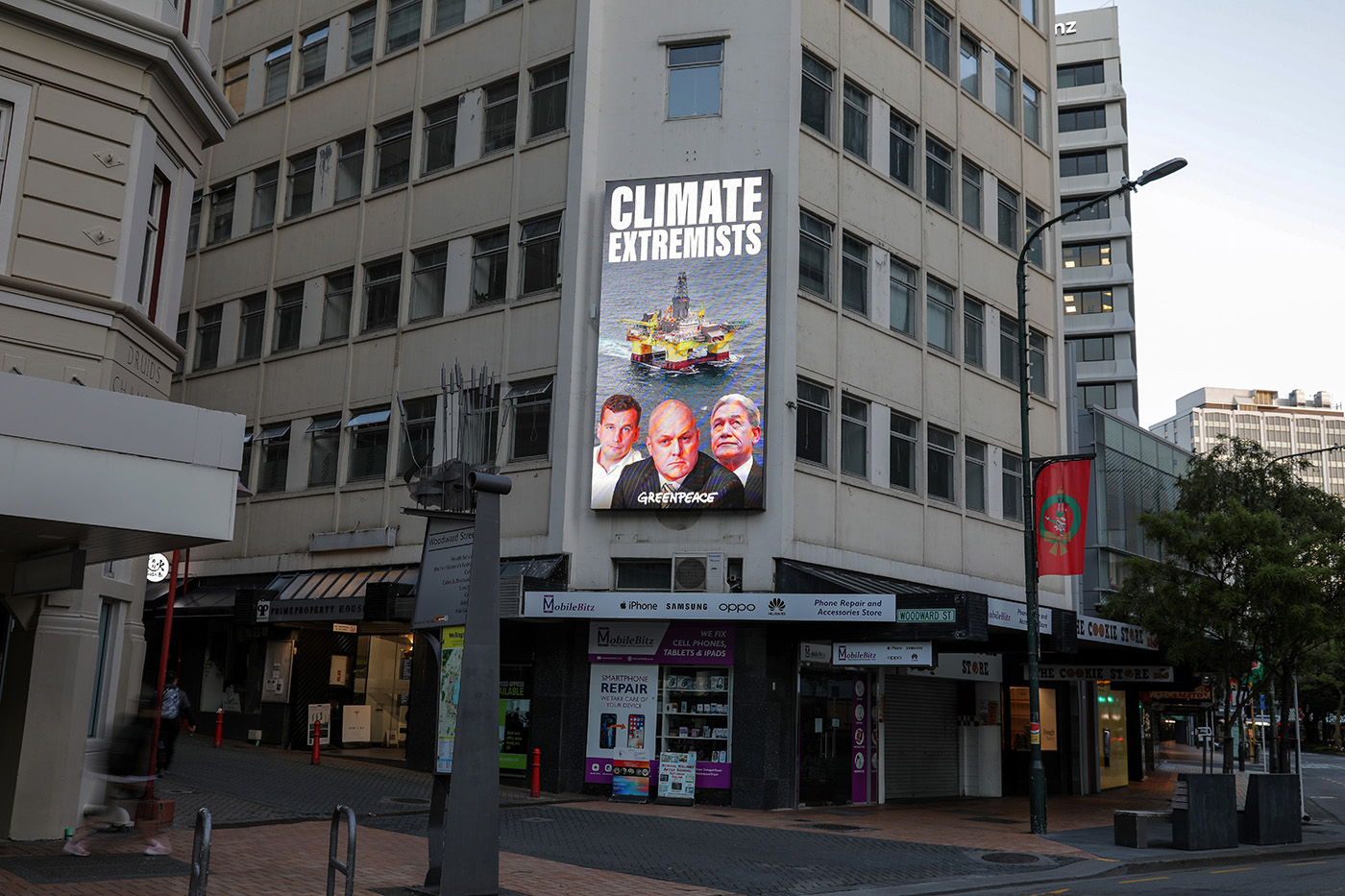
Russel Norman, Greenpeace Executive Director, compares the just-released State of the Climate Report with a ‘War on the Climate report’.
The Government today released its latest State of the Climate Report, which looks at the level of greenhouse gases in the atmosphere and the current and likely future impacts of those elevated levels on New Zealand. The report is largely non-political, produced by the Department of Statistics and the Ministry for Cities, Environment, Regions and Transport.
To go alongside the State of the Climate Report, yesterday I published an updated The War on the Climate Report, which documents the climate policies of the New Zealand Government over the last three years.
On the one hand the State of the Climate Report documents the increasingly negative effects of rising climate pollution, while the War on the Climate report documents the many policy, budgetary and regulatory decisions of the current Government to increase climate pollution. It is a jarring juxtaposition.
The State of the Climate Report found that the levels of greenhouse gases in the atmosphere are the highest recorded and are increasing. The three most important greenhouse gases they identified were carbon dioxide, methane and nitrous oxide:
- Concentrations of carbon dioxide at Baring Head (Wellington) were 423.1 parts per million in December 2025, up 5.5 percent since December 2016. This is around 51 percent higher than pre-industrial levels of 280 parts per million.
- The highest concentrations of methane on record at Baring Head were 1,901.7 parts per billion in September 2025. This is around 163 percent higher than pre-industrial levels of 722 parts per billion.
- The highest concentration of nitrous oxide measured at Baring Head was 338.3 parts per billion, recorded in December 2025. This is around 25 percent higher than pre-industrial levels of 271 parts per billion.
New Zealand is an outsize climate polluter on a per capita basis – New Zealanders make up 0.06% of global population and 0.17% of global climate pollution.
The New Zealand pollution profile is dominated by the super-pollutant methane from dairy and agribusiness and, as stated in the report, methane concentration in the atmosphere is sitting at 163% of pre-industrial levels and rising.
New Zealand’s biggest polluter by far, Fonterra, has increased its annual climate pollution by one million tonnes over the 2024-26 years, mostly from methane from dairy cattle.
The report found that New Zealand had warmed by 1.36 degrees Celsius since reporting began in 1909, with 7 of the 10 warmest years on record occurring in the last decade.
New Zealand glaciers are melting pretty quickly – they peaked in 1997 at 56 cubic kilometres, and have since decreased to 30 cubic kilometres in 2023.
There have been a recent series of extreme rainfall events “including the Auckland Anniversary Weekend floods and Cyclone Gabrielle in 2023, flooding in Otago in 2024, flooding in Nelson, Tasman and Marlborough in 2025, and the severe Wellington flooding in April 2026 when some locations received more than 70 millimetres of rain in one hour.” Climate change is likely to make these kinds of climate events more extreme.
Climate change is impacting natural ecosystems. Sometimes they can adapt but often they have limited ability or space to adapt. And it is impacting human health.
The State of the Climate Report lists many many more negative consequences of climate change for people and the planet and I recommend people have a look. However, there is a real disjunction between that report and the government actions listed in my War on Climate Report.
The War on Climate Report documents a government that is systematically introducing policies which are increasing emissions or slowing down emissions reductions. Their efforts are mostly focused on delivering policies that suit agribusiness expansion and profits, leading to more cows, more climate pollution and more water pollution. The second focus is transport where the government has increased funding to motorways, withdrawn funding from alternatives to motorways, and reduced incentives to decarbonise the light vehicle fleet. In the electricity and energy sector they are subsidising fossil gas, though with limited success.
We live in strange times where the science around climate change and its negative effects are better understood than ever, yet we find governments, under the sway of polluting companies like Fonterra, introduce policies that make it worse.
Sometimes governments like Luxon’s argue that we are too small to make a difference, but as the government’s own state of the climate report says, countries whose emissions are less than 1% of the global total, collectively make up a quarter of global emissions. And moreover, as officials have warned the Government, if New Zealand reneges on its climate commitments it will give licence to bigger polluters like China to do the same.
Civil society groups like Greenpeace all over the planet are coming together to pressure governments to act in our collective interests, to act with a global mindset not a parochial national freeloader mindset. Join us.