Do we need more gas? No.
They’ve been lying to you about needing new fossil gas to “keep the lights on”. There is no shortage of gas.
In one of the most unreported good news stories of the year, the New Zealand Government Ministry of Business, Innovation and Employment (MBIE) recently released their updated report on Electricity Demand and Generation Scenarios looking out to 2050.
And the report confirmed that there is no need for new fossil fuels to keep the lights on. Wind and solar are the cheapest sources of new electricity generation.
The report concludes that while there will be a need for some peak electricity generators, to meet peak load on winter nights, these could be ‘green peakers’ such as utility scale batteries, green hydrogen generators, or forestry waste burnt in the Huntly thermal plant.
And this is a pretty conservative report from a pretty conservative Government Ministry – we can actually do a lot better than this if we have better policies.
Hence the energy security scare campaign being run by the current Government, to justify more fossil fuel exploration, is built on nonsense.
There is no shortage of fossil gas, there is a shortage of brains in the Beehive.
So what does this green energy future look like in the MBIE modelling?
1. A big increase in electricity demand
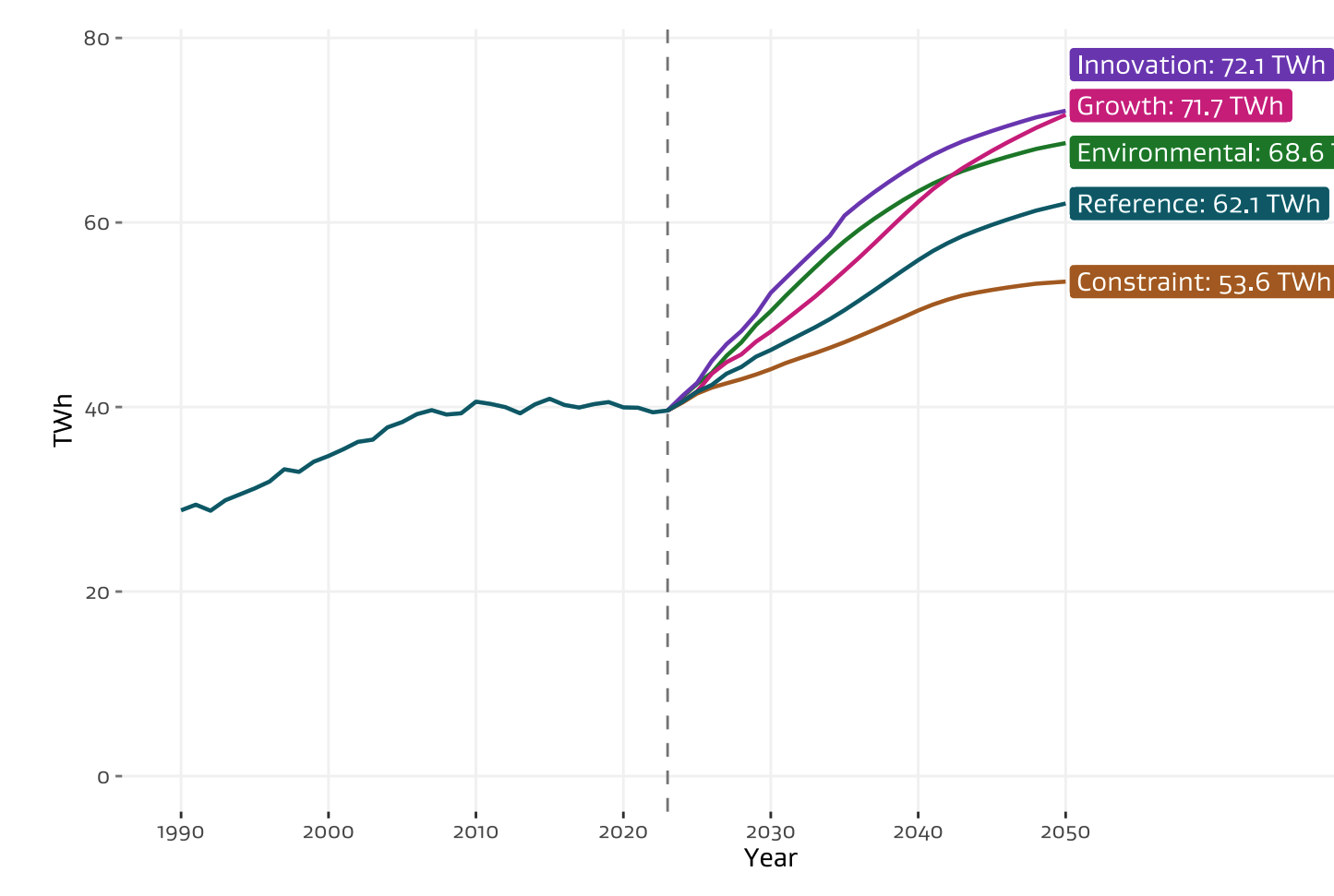
One of the takeaways from the MBIE electricity system modelling is that there is a big increase in demand for electricity. This is driven by the electrification of industrial processes, such as replacing coal with electricity in dairy plants, and by the electrification of transport.
Added to this is population and GDP growth, plus a significant load from new datacentres. You can see this in the five modelling scenarios below (for more detail on the scenarios see the report):
Figure 13: Total Electricity Demand
This means we can produce our own transport energy from renewable electricity generation rather than importing petrol and diesel.
This is a double win for Aotearoa:
- Reduced greenhouse emissions from burning petrol and diesel
- Reduced costs from energy imports
2. A big increase in wind and solar – the lowest cost generation
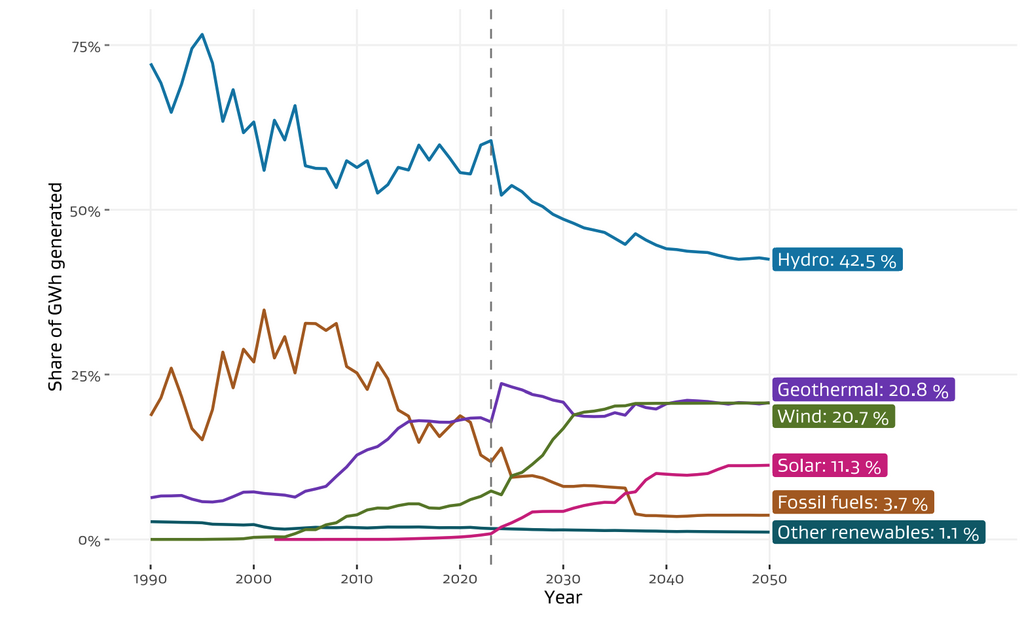
The report finds that the significant increase in electricity demand will be met by a big increase in solar and onshore wind generation. This is because they are the cheapest forms of new generation.
The speed of this wind and solar growth depends, in part, on the rollout of new consenting rules for renewables, which has been slowed down by the ridiculous fast track bill.
Another factor is the policy framework around distributed rooftop solar, which can be a huge part of the new generation with the right policies in place.
But regardless of the short-term mistakes of current government policy, solar and wind will be the major growth areas due to their cost effectiveness.
MBIE also projects a smaller increase in geothermal and hydro.
Geothermal provides constant baseload power which is a huge advantage to the New Zealand electricity system. The fact that it essentially can’t be turned off also means that we often have cheap power overnight when there isn’t much demand and this can be used to charge up electric vehicles.
New Hydro generation could be an ecological problem depending on whether they want to dam more rivers or have run-of-river hydro, which has much lower impacts. Nonetheless hydro is a great baseload component of the system as it can be turned on and off quickly to meet changing loads and back up more variable wind and solar.
Alongside this growth in renewables, MBIE are projecting the retirement of old fossil fuel generation which is expensive to run and is outcompeted by wind and solar on price alone.
Figure 2. Share of electricity generation by commodity in the reference scenario
3. Renewable generation goes over 98% in the MBIE scenario
Because the growth in electricity demand is met by cheap renewables, the proportion of generation coming from renewable sources continues to increase quite radically. The percentage of renewables in 2050 ranges from 96.2% to 98.3% across the five scenarios modelled by MBIE.
They model a small amount of expensive fossil fuel generation continuing in the system but even that can be eliminated, which I’ll come back to below.
4. Peak loads – a critical variable
The more we are able to shift the electricity load away from the winter evening peak, the less peaking generation (or utility-scale batteries) we need.
The report identifies variable time-of-use pricing to encourage people to move their usage into the late night where possible (e.g. electric vehicle charging). Distributed batteries will help reduce peak load as people can draw on the batteries at moments of peak load and/or get paid to feed into the grid.
Large scale demand side management of the kind we have already seen at Tiwai aluminium smelter will also help.
5. Electricity Storage
One of the most remarkable global developments in electricity grids is the growth of utility-scale storage. New Zealand is already seeing the early shoots of this growth with a number of large lithium batteries built and planned.
The advantage of these batteries is that they can meet the peak evening demand using power that was generated from intermittent sources such as cheap solar and cheap wind.
Storage allows more use of renewables like wind and solar and reduces the peak generation needed, which saves money for everyone as less generation needs to be built.
Existing hydro can also meet some of the need for relatively short term storage. The increase in solar and wind allows more of the hydro system to be saved to perform this shorter term storage role.
The wild card issue for New Zealand is long term storage to meet the risk of a dry winter, when insufficient water comes into the hydro generation system that underpins the grid.
The pumped hydro scheme at Onslow (the Big Battery) was planned to store 5000 GWh of electricity – compared with the largest lithium battery which can store just 2 GWh. Moreover, lithium batteries can’t store energy for the length of time that a pumped hydro scheme can.
The Onslow project has been cancelled by the current New Zealand Government, and has not been included in the MBIE modelling, but is likely to come back as we are likely to need the insurance of a large battery with long term storage capacity.
6. Green Peaker Generation
The last possible use for fossil fuels identified in the MBIE electricity generation modelling is a small amount of fossil gas for peaking generation. However, this is only one of the options for peakers. As MBIE states:
“It is possible that these gas peakers may be replaced by green technologies such as biomass, biogas, waste-to-energy, or hydrogen peakers. It is also possible that peakers will become less necessary if large-scale grid batteries are deployed at scale, allowing peak demand to be met with stored renewable electricity.”
The defenders of exploring for new fossil fuels are clinging to the supposed need for transitional fossil gas to meet this relatively small-scale peak demand. We don’t need it if we use green peakers.
To the extent that we are currently using fossil gas for electricity generation, there is already sufficient gas reserves to cover the demand while new renewables are built.
Furthermore, as the really big users of fossil gas close operations or move to electricity instead of gas, there will be more than sufficient fossil gas reserves to cover legacy generation needs. For example, MBIE is projecting that Methanex, the biggest user of all fossil gas at about one-third of all use, will close in the decade ahead. Taxpayers currently subsidise Methanex’s operation by about $50m per year of free carbon credits.
As the Concept Consulting report concluded in 2023, once Methanex closes, the ongoing demand for gas could be easily met from onshore fields during the decarbonisation transition away from gas.
“Existing onshore fields have more than enough gas reserves and resources to meet non-petrochemical demand for the duration of the transition away from fossil gas.”
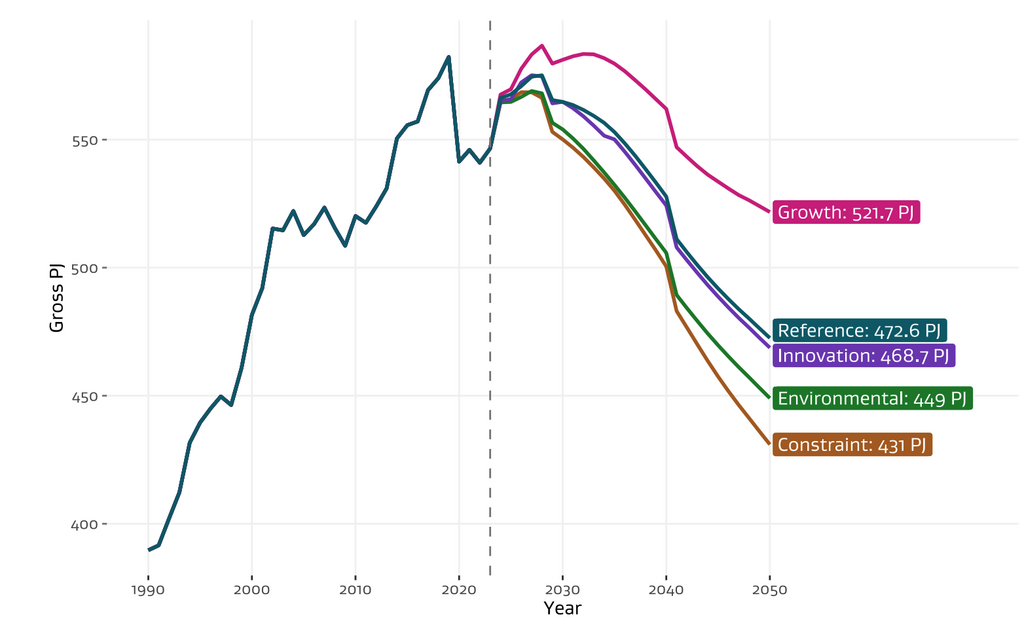
7. Total Energy Consumption falls
The truly amazing dimension of this story is that total energy consumption actually falls. This is because using electricity for things like transport is just so much more efficient than burning petrol and diesel. So the total energy we will need will fall, even with a bigger population and a larger GDP. And the cost of importing this energy will fall dramatically as we import less fossil fuels.
The energy reduction will be even better if transport policy supports mode shift away from individual cars towards cycling, walking and public transport. But that would require some different government policy than we currently have.
And of course the really really big win is that we will have much lower climate pollution from transport, electricity generation and industrial processes. Agribusiness is another story, but they own the government so….
Things could go even faster with better policy
This underappreciated report from MBIE shows that Aotearoa is nicely placed to decarbonise our energy system with significant dividends, both financial and environmental.
We can safely ignore all the National / Act / NZ First Party hot air about the need for more fossil fuel exploration to keep the lights on. It is just fossil fuel propaganda.
This decarbonisation would happen even faster if we didn’t have a 1950s-style government desperately fighting a Trumpian culture war over climate and fossil fuels. They are trying to hold back the tide of renewable energy with policies to slow down the process and keep us dependent on expensive dirty fossil fuels.
For instance, one of the key drivers for industrial electrification is carbon pricing. The current New Zealand Government has intervened to collapse the carbon price and the last ETS auction did not receive a single bid to buy carbon units.
In the energy efficiency space the government is weakening the energy efficiency standards on imported vehicles and is talking about weakening the standards for home insulation. Both of these policies will mean we need more energy.
The policies to cut funding for public transport and cycle-ways and increase spending on new motorways will likewise increase energy demand. So too the removal of support for electric vehicles and removing climate change as a consideration in transport decisions.
The Government’s fast track bill is slowing down work on regulations to facilitate renewable energy generation while simultaneously threatening the future of a huge offshore wind project off the coast of Taranaki.
I’ve written more about the Government’s War on Nature already.
But in spite of their best efforts, the Trumpian climate denialism won’t work. They might slow us down and gather some fossil fuel money to line their parties’ pockets, but we will overwhelm them.
We have to.

Call on the New Zealand Government to put solar panels and batteries on 500k homes by 2030
Take Action