Autumn 2023.
That was when everything began. Two weeks after the first rounds of mutual shelling started on 8 October 2023, waves of forced displacement from the villages along Lebanon’s border strip intensified. The villages bled dry of their residents, and press reports documented thousands of displaced people every day. By the end of the year, dozens of Lebanese villages were deserted. And before the media began framing it as a “war,” more than 90,000 people had already been driven out of their homes and villages by Israeli attacks.
Ruin spread, black as a cloud.
Human displacement and environmental destruction
It wasn’t until autumn of 2024 that the media began framing events as war. However, from the humanitarian and environmental standpoints, what local and international media had now begun describing as a war was, in fact, a massive expansion in the scale of destruction that had followed exchanges of fire on 8 October 2023.
In practice, what this meant was that the border villages of South Lebanon were no longer alone in their tragedy. The rest of the villages in the governorates of the South, Nabatieh, and the Bekaa joined them, and soon the war reached the heart of the capital, Beirut, and its suburbs, and touched all Lebanese territory. The cloud gradually widened: No longer a phantom haunting the edges, it had become a beast on the attack. Rockets and shells rained down from every direction. Yaroun, Deir Seryan, Maroun al-Ras, Aita al-Shaab, Blida, Mays al-Jabal, Houla, Khiam, and other villages were left on their own, without their people, to face the war and the attempts at forgetting. It was not possible for their names to be dropped from circulation, because land, wherever it faces colonialism, defends itself by itself, with its name, its history, and its memory.
On 27 November 2024, a ceasefire agreement entered into force. Residents returned and saw the destruction up close. During that period (from October 2023 to end November 2024), and before the return of war and displacement on March 2 of the current year (2026), southerners counted the losses and pain they had endured. Data in my report focuses on this first period (8 October 2023 to the end of November 2024) for which more definitive figures and statistics are available. Yet war renewed in the winter of 2026, and this second period (from 2 March 2026), marked by intense suffering and solidarity, is still ongoing. To this day, war continues, against the plains, the valleys, the rivers, the mountains, the trees, and all sources and sustainers of life (even solar panels).
White phosphorus: Fire in the soil
Upon contact with oxygen, white phosphorus ignites. It keeps eating into the skin until it reaches the bone. On October 16, 2023 according to Amnesty International, the Israeli army launched an indiscriminate attack on the border village of Dhayra, after which nine people were taken to hospitals with cases of suffocation. A month later, the village of KfarKila saw the same scene, with the same weapon. White phosphorus seeks no specific target because, quite simply, and in the literal sense of the word, it burns everything.
It does not stop at killing innocent human beings. As UN Habitat details, phosphorus leaves behind scorched soil poisoned with chemical particles that remain active after the bombardment, destroying vegetation cover, causing direct contamination of crops and water sources, accelerating soil erosion, and driving biodiversity into decline. As for the toxic smoke it releases, and the fires that follow it, they act like arms gripping the neck of the ecosystem, slowly choking it. After the repeated white phosphorus attacks, the fields and woodlands in the two villages turned into pale, charred expanses, unable to return to what they had been for many long years. Amnesty again documented phosphorus attacks, internationally prohibited, on the villages of Mays al-Jabal to the east and Aita al-Jabal in the centre. And as happens in most wars of extermination, the perpetrators always seek to push the world into growing accustomed to the crime.
International law bans the use of white phosphorus under Protocol III of the 1980 Convention on Certain Conventional Weapons, yet evidence of Israel’s unlawful use of white phosphorus in Lebanon abounds. And while the world went on with its life, the outlines of an ecocide were taking shape in South Lebanon, in parallel with genocide unfolding in Gaza.
An official report by Lebanon’s National Council for Scientific Research (CNRS-L) revealed that soil exposed to phosphorus does not undergo blanket contamination so much as an uneven “map of damage” grows within it, forming in hot spots, which dispels the idea of uniform poisoning and points to a more complex and dangerous pattern. Clearly, the figures reveal the degree of deterioration: phosphorus concentrations reached 1,858 parts per million in some sites in South Lebanon, reinforcing the hypothesis that white phosphorus bombs were used. Chromium concentrations exceeded permitted limits in 45% of the samples, and 59% of these exceedances were classified as “very high,” while zinc exceeded allowed levels in 22% of the samples, and copper in 9% of them. Beyond that, lead contamination was detected at a single isolated site in the Bekaa town of Boudai in eastern Lebanon, reaching 230 parts per million.
Figures like these do not point to chemical pollution of an ordinary degree, rather, they indicate a reshaping of the very structure of the land itself, at a deep level.
Woodlands erased with villages and farms causes immediate harm and represents a long term environmental threat
In satellite imagery, the villages have been erased, as if they never stood. Rubble upon rubble. No memories, no stories, no shared life that once bound the residents to the place. Residents following events with a mix of anxiety and pain say that all the roads have been bulldozed, with no trace left of the olive groves that bore witness to the lifetimes of Lebanese villages. Olives are part of South Lebanon’s identity, as the region produces around 38% of the country’s olive harvest overall, more than a third. Yet Israeli attacks have burned and bulldozed no fewer than 65,000 olive trees, including ancient ones.
Losses mount with each passing day. Recovery on the environmental front cannot be equated with infrastructure repair or financial restitution, difficult as those undertakings certainly are. According to recommendations issued in official Lebanese reports, recovery must be approached as a long process, in the face of deep environmental damage that has affected forests, agricultural lands, and existing ecosystems. We are speaking of woodlands fires, chemical pollution that has ravaged the soil, as well as contaminated rubble. All of this is not merely a temporary consequence of war, but it represents a long-term environmental threat.
Ecosystems are far more than just beautiful natural scenery. They form a basic economic infrastructure, tied to agriculture, health, and social stability. For this reason, destruction is not confined to demolished buildings. It goes beyond visible damage to a hidden, long-lasting harm: the disintegration of ecosystems and the loss of their ability to endure. According to Lebanese state estimates, environmental damage has kept on spreading across a wide geographic area, especially during periods of intensified military attacks, with the most severe impacts recorded in South Lebanon and Nabatieh Governorate.
The forestry sector’s disaster extended beyond the burn zone. Basic environmental and economic functions collapsed. The burning of woodlands’ cover led to direct losses in resources, including pine production and firewood generated through traditional forest management, with the cost estimated at around 6 million US dollars. But the deeper loss lies in the destruction of vital environmental services, including soil protection, the preservation of biodiversity, and the regulation of the local climate. In this sense, the affected areas did not lose trees alone, they lost the lines of defense that had protected surrounding communities from erosion, drought, and gradual environmental collapse.
Across coast and hills: A quarter of the land in flames
Let’s not forget that these figures do not constitute a final assessment of the situation. Conditions continue to deteriorate in both the agricultural and livestock sectors, according to official Lebanese statements. The livestock sector has suffered heavy losses, including the death of around 1.8 million heads of poultry and livestock, in addition to more than 29,000 beehives and over 2,000 tons of fish. To date, the cumulative area of agricultural land damaged by Israeli attacks has reached 22.5% of Lebanon’s farmland, nearly a quarter of the country’s agricultural area. This has had a direct and negative impact on Lebanese food security, with the share of emergency food assistance rising from 17% to 24%, leaving one million people living in Lebanon in urgent need of food supplies.
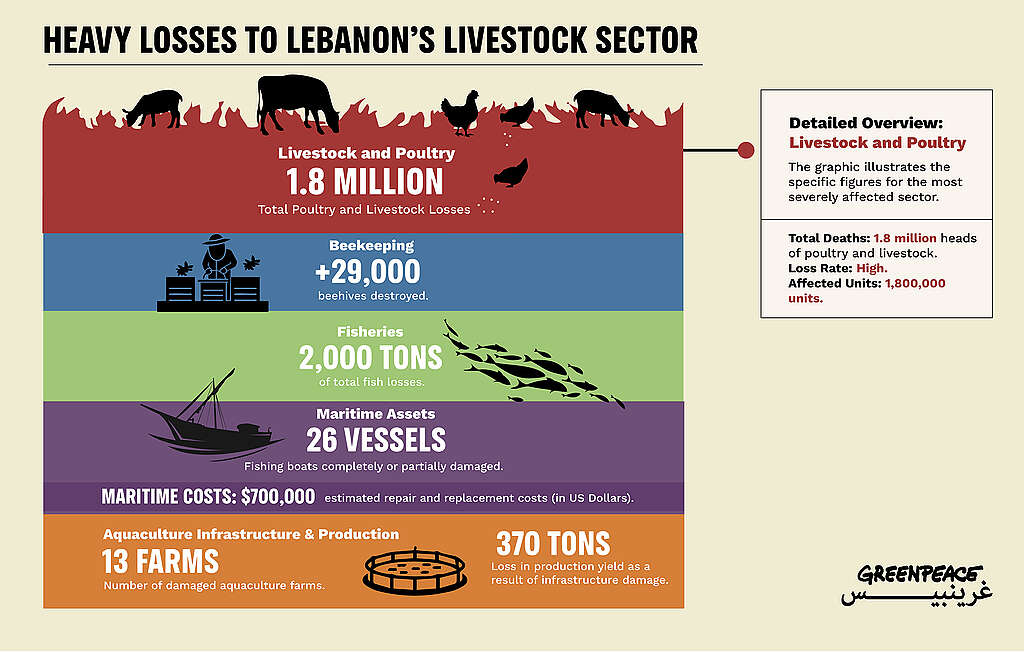
Small-scale farmers are the most affected. The limited plots managed by individuals or families make up around 80% of total agricultural holdings in the South, which has intensified the war’s impact on rural households and the local economy. This trajectory exposes a brutal dimension of colonial warfare: around 78% of farmers in the South are displaced from their villages and barred from returning, leaving only 22% able to remain on their land. The sea too is in mourning: 26 boats lie sunk within it.
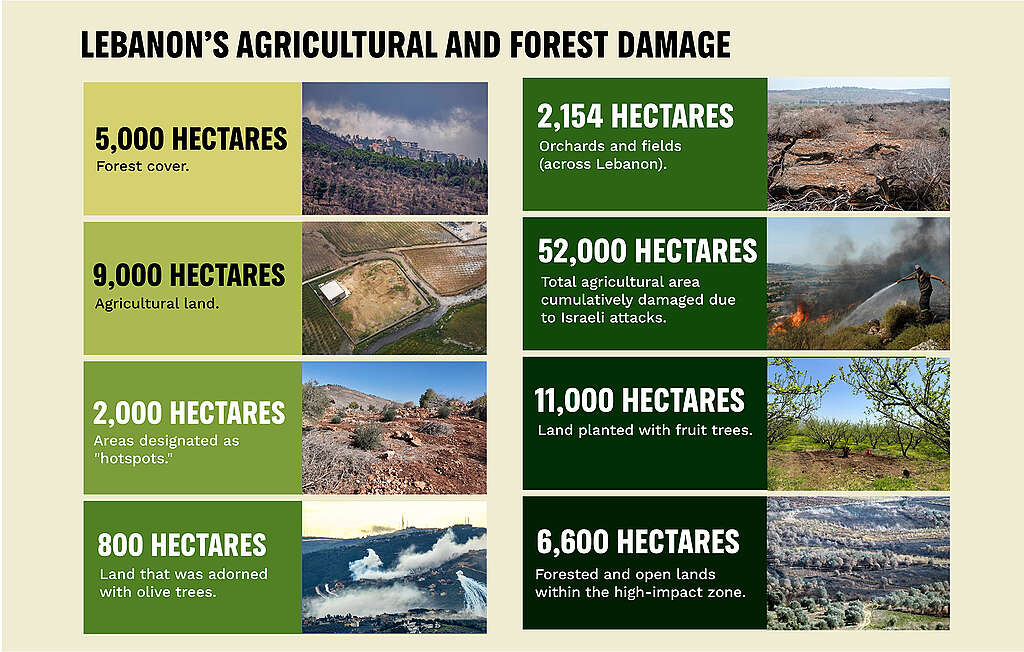
Infographic: The extent of damage to Lebanon’s agricultural and forested lands due to Israeli attacks, including forest cover, orchards, and farmland.
Managing the rubble
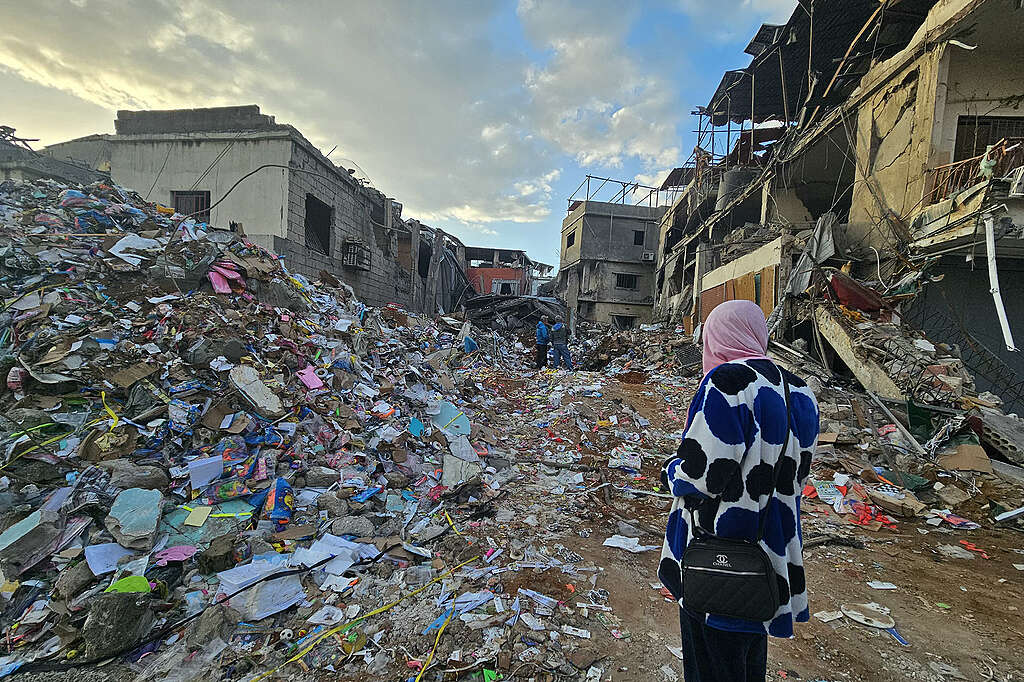
Rubble is not simply debris. It is not just what remains, but what has been violently undone. The debris left by the war has become something like a “second disaster,” not only because of its sheer scale, but because of its capacity to generate long-term pollution. According to preliminary data, the volume of rubble (up to the end of 2024) was estimated at around 16 million tons, equivalent to roughly 10 million cubic meters of debris weighing down the natural landscape.
Simply clearing it away is not enough. The debris, and what accumulates above and beneath it, constitutes a direct environmental threat, as it may contain asbestos, lead-based paints, silica dust, and heavy metals. The random dumping of such materials in valleys, forests, and agricultural lands can contaminate soil and water and fragment ecological habitats.
At the time of preparing this report, 40 temporary storage sites had been identified. It must be stressed that any delay in transporting the rubble to final, regulated sites will increase the likelihood of it becoming a permanent part of the landscape. That would amount to yet another disaster.
Proposals are under discussion at the planning and implementation levels based on a model of “circular recovery,” aimed at turning rubble from an environmental burden into a reusable resource. The Lebanese Ministry of Environment has put forward a plan to recover and recycle around 70% of the debris, with 30% of inert materials to be used in rehabilitating damaged quarries across 17 potential sites for final disposal and restoration (including 4 public and 13 private sites), with priority given to public ones. However, this transition depends on the early sorting of hazardous materials and on organised management that avoids improvised solutions. By early this year, the total cost of debris management was estimated at around 145 million US dollars.
Regardless of the figures (which will likely far exceed that amount) reconstruction alone, or the mere removal of rubble, will not restore life. What is required is a rethinking and redesign of the relationship between infrastructure and the environment on more sustainable foundations.
During 45 days of war, up to the end of 2024, the war on Lebanon had completely destroyed 21,700 housing units, while another 40,500 units were damaged. Although homes are not environmental structures in themselves, no account of a recovering land is possible without acknowledging those who return to it, and whom it, in turn, receives: people who know the land and are known by it. As the war intensifies, with a sharp rise in figures compared to pre-March 2, 2026, there is still no definitive data on the current number of housing units destroyed in South Lebanon, despite figures circulating in the media, as the war has not ceased.
From an environmental standpoint, the only possible response is continued monitoring, alongside sustained warnings about the ecocidal impact of the ongoing military operations on the ecosystems of southern Lebanon. As for the consequences, they continue to intensify relentlessly, mirroring the grief of residents confronted with the ruins of their lives scattered across their villages.
Greenpeace MENA is supporting the Lebanese Red Cross in their humanitarian effort.
Donate TodayZeinab Othman is a Digital Content Editor for Greenpeace Middle East and North Africa (MENA) based in Beirut, Lebanon.
This article is based on official publications issued by governmental institutions and non-governmental organisations. It was originally published by Greenpeace MENA on 19 May 2026.