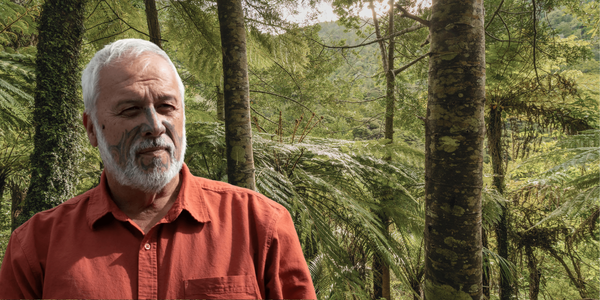
I am Māori, the original people of New Zealand. And, as Māori, we are shaped by principles like whakapapa (our ancestral lineage and connection to all things) and utu (the obligation to restore balance when harm is caused). We are connected to te taiao (the natural world) not as owners, but as part of a beautiful and delicate web of life.
I have spent most of my adult life involved in struggles for justice. For years, I have been locked in a legal battle against six of New Zealand’s biggest greenhouse gas emitters in the agriculture and energy sectors: Genesis Energy, Dairy Holdings, New Zealand Steel, Channel Infrastructure and BT Mining. This case includes the world’s biggest dairy exporter, Fonterra and a major fuel supplier, Z Energy who together with the other companies are responsible for about a third of the country’s total climate emissions.

Smith v Fonterra
The core argument behind my case has always been that if corporations knowingly contribute to dangerous climate harm, then surely there must be some legal mechanism to hold them accountable. I don’t think this is a radical proposition, and nor do most people. Courts exist precisely to examine difficult questions where public harm and private power intersect.
In 2024, we won a historic victory. The Supreme Court of New Zealand unanimously ruled that my case could go to a full trial. It was a massive breakthrough for global climate litigation. Our trial was locked in for April 2027.
But corporate power does not accept defeat quietly. Fearing the evidence that would come out in an open courtroom, these big polluters bypassed the public and went straight through the back door to the highest office in the land.
New Zealand Parliament proposes to ban climate tort cases
The New Zealand government is now rushing through the Climate Change Response (Tort Liability) Amendment Bill – a law effectively ghostwritten by the polluters themselves.
This proposed law bans citizens from suing heavy polluters for climate damage, and it applies retrospectively to kill my court case before it can even start. The government has stepped in to rewrite the law, specifically to protect the country’s biggest climate polluters. By doing this, they are shutting the courtroom doors in the faces of ordinary people.
This decision strikes at the foundations of democracy. It raises profound questions about the rule of law, the separation of powers, and whether ordinary citizens can still seek justice when their interests clash with those of politically influential industries.
The people v politically influential industries
The question that comes sharply into focus is Who holds power, and who is forced to live with the consequences of decisions made by that power?
We hold obligations to those who came before us, and to those who will come after us. That worldview stands in direct conflict with political systems that treat the environment as expendable whenever profit margins or electoral calculations are at stake.
Recent investigations, including a scathing finding by the Ombudsman, revealed the shameful truth of how this new law was born. Executives from Z Energy and Fonterra had direct access to the Prime Minister’s Office. They handed over private briefing documents suggesting exactly how the law should be rewritten to exempt them from accountability.
When investigative journalists and watchdogs asked for these documents under official transparency laws, the Prime Minister’s Office hid them, keeping the corporate collusion secret from the public.
When ordinary people finally manage to get their concerns before a judge, the government shouldn’t be allowed to simply change the rules midstream to ensure the case never reaches a conclusion.
Climate justice rally call around the world
These corporate giants are aware of the legal precedent this case could set, it is no surprise they are trying to shut down the courts.
What is happening in New Zealand is a warning sign for the rest of the world. Across the globe, climate litigation is breaking new ground. Activists are successfully using the courts to force change. If they succeed in New Zealand, other polluting industries could use this same playbook of secret lobbying to strip away your rights next.
Democracy isn’t self-sustaining – rights survive only when people are willing to stand up and defend them. We cannot allow corporate bullying to override democratic justice.
It is time to resist
The climate crisis is accelerating. Public trust in institutions is fraying. Economic inequality is widening. Indigenous rights remain contested. These interconnected symptoms reflect a political system struggling to balance concentrated power with the public good.
The response can’t be silence or resignation. People need to organise, speak out, challenge misinformation, support independent journalism, engage in public debate, stand with communities already suffering the impacts of climate change, and vote with a clear understanding of what’s at stake. Real change has always come from ordinary people deciding that the direction of their country matters enough to fight for.
That’s the challenge before us now.
I intend to continue that fight, both inside and outside the courtroom, because the issues at stake are bigger than any one case and any one generation. I hope you will stand in solidarity with me.
E tū e tū! Tutū te puehu! (Rise up! Kick up the dust!)
Call on the New Zealand Government and the Governor General
Sign hereMike Smith (Ngāpuhi, Ngāti Kahu) is a climate change activist, father and grandfather from Aotearoa, New Zealand. He has more than 30 years’ experience in climate education and strategic organisation and action in Aotearoa and internationally.
A version of this article was first posted on E-TANGATA.