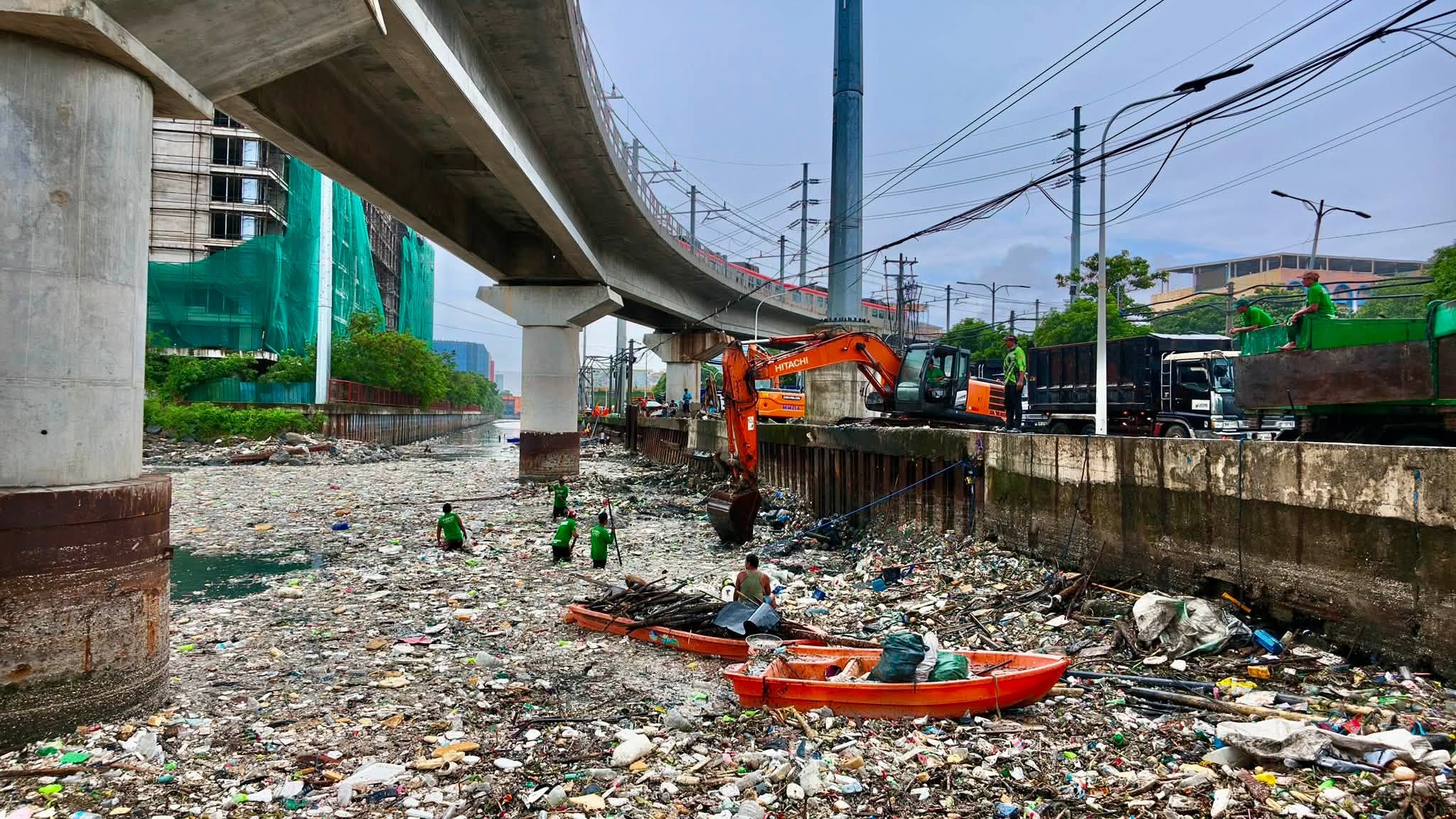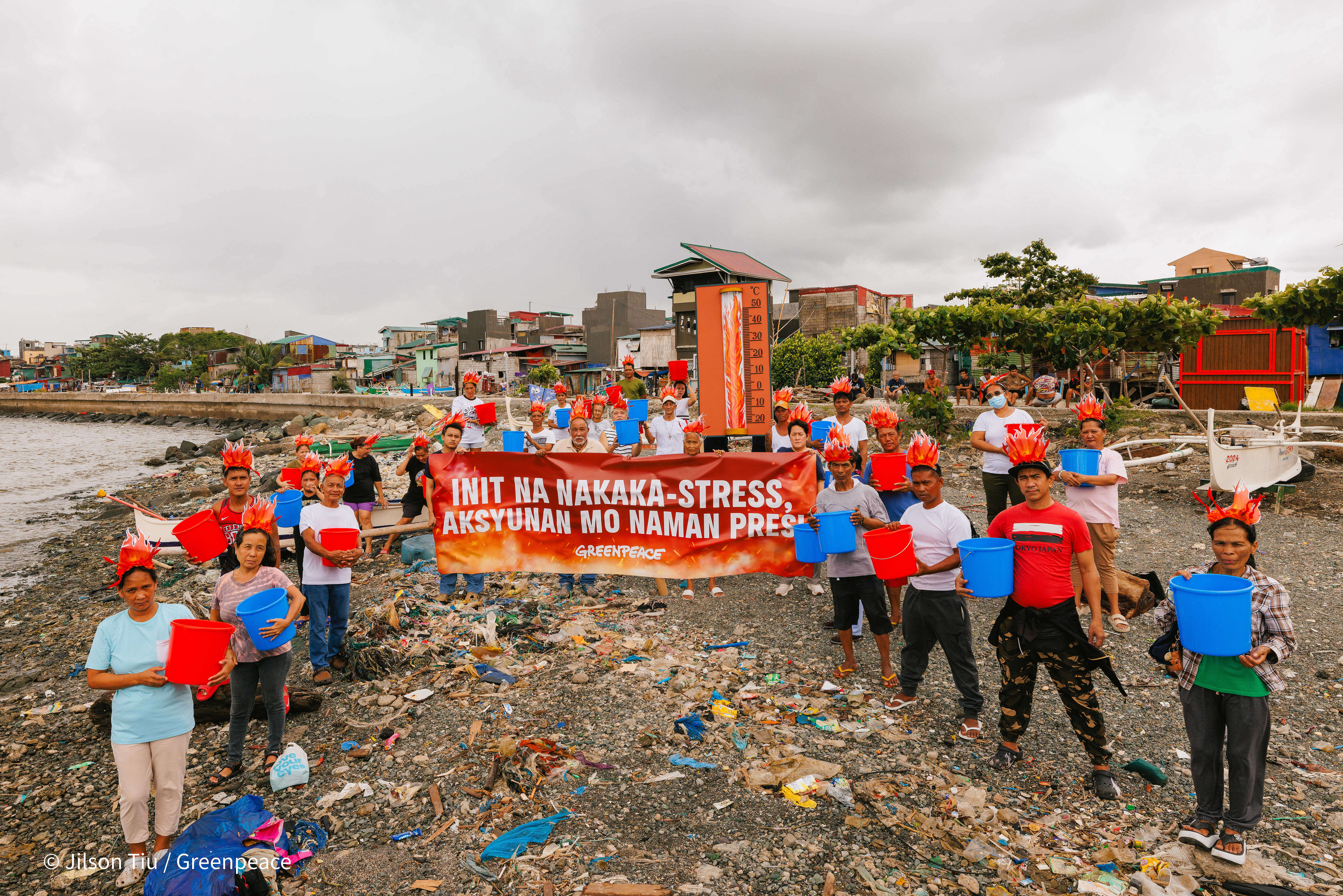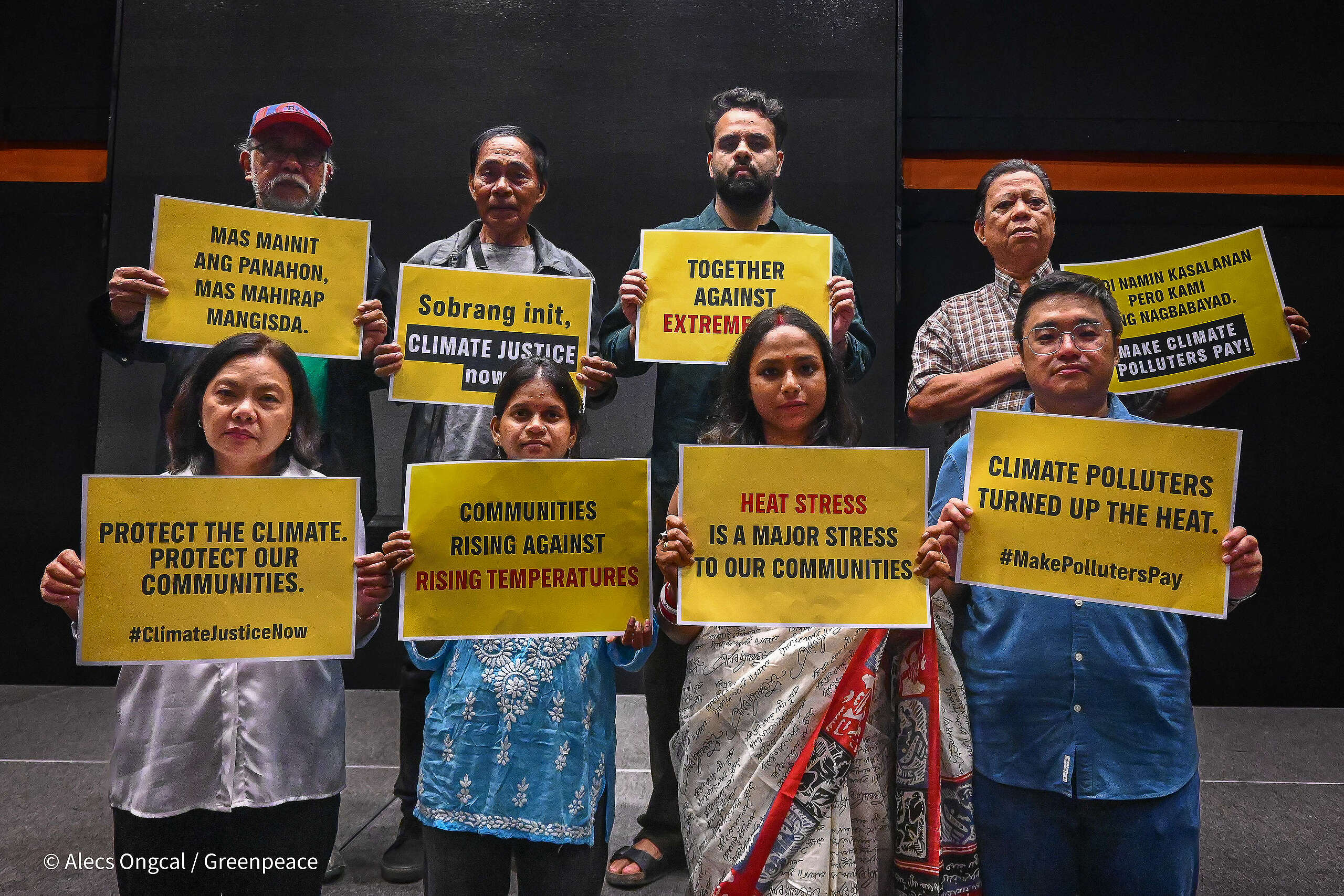
Quezon City / London — On the morning of Shell’s Annual General Meeting, environmental groups, campaigners, and allies from across the UK, the Philippines, and Nigeria yesterday joined forces to show international solidarity and support for legal action against the company.
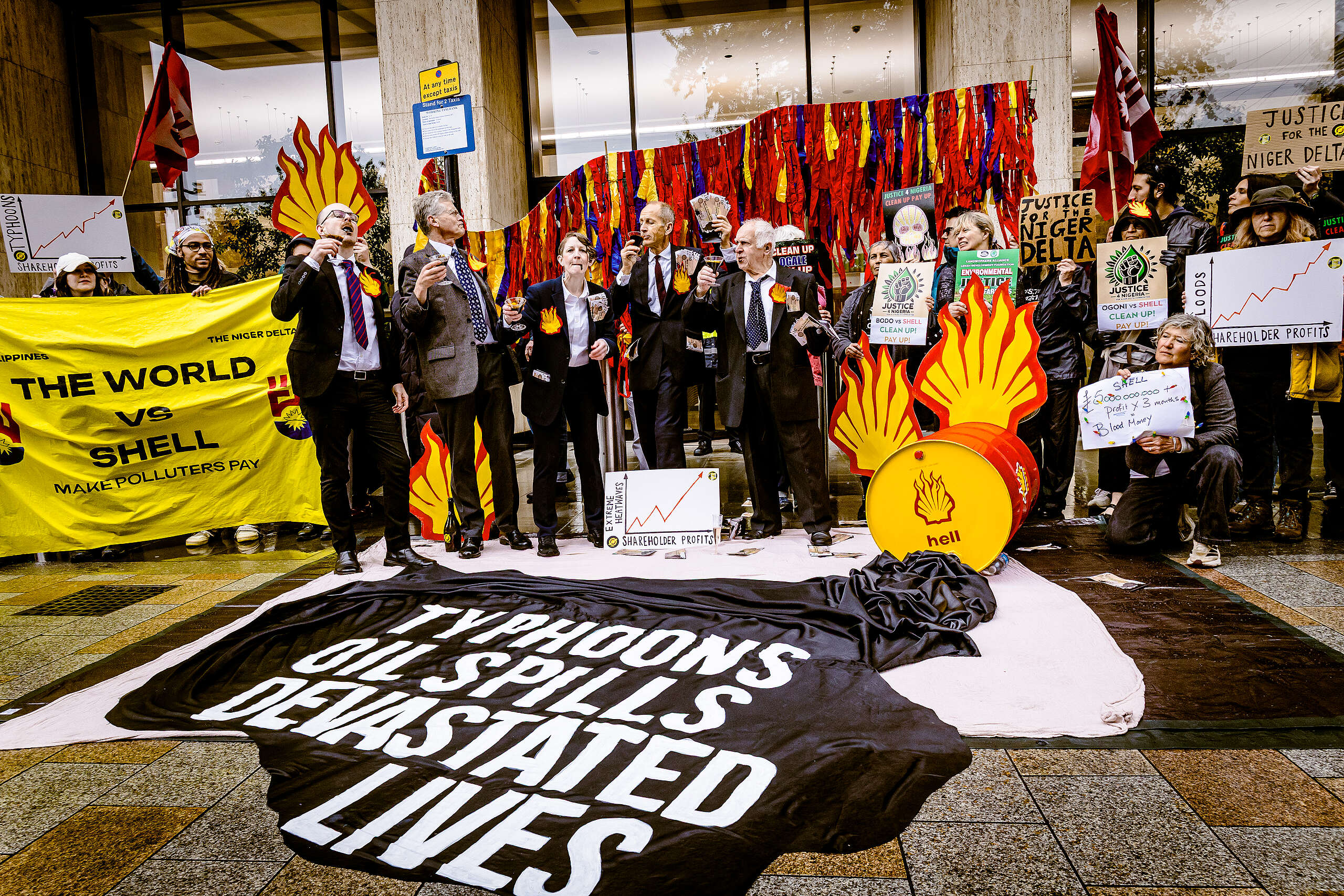
The protest led by UK-based campaign group Fossil Free London brought the human cost of Shell’s recent $6.92 billion quarterly profit to the company’s front door. A massive oil barrel highlighting the company’s major role in environmental destruction leaked out oil, while campaigners dressed as oil executives drank from oil-filled champagne glasses. The action was accompanied by crowds standing behind a banner reading “The World vs Shell.”
Uniting two frontline struggles for justice in the Philippines (Odette Case) and the Niger Delta, the protest was organized with both communities lodging cases against Shell in London courts.
This display of creative defiance and international solidarity comes just after Shell announced massive profits and faced public criticism for ‘profiteering’ from conflict and the rise in global fuel prices. The groups said that this demonstration exposes how fossil fuel dependence deepens both the climate crisis and the rising cost of living amid geopolitical tensions related to the US-Israeli war on Iran.
The demonstration comes a day before the UK Climate Change Committee will release an Independent Assessment of UK Climate Risk. The report, five years in the making, will provide comprehensive evidence on national climate risks and, for the first time, set out actionable solutions to address them.
The groups stress that companies like Shell and national governments must take climate change seriously and recognize its impacts are already here. Super Typhoon Odette, a typhoon made more severe and more likely by climate change, affected more than 8 million people in the Philippines, many of whom lost their lives, homes, and livelihoods.
Despite these risks, Shell’s annual report and accounts (2026) reveal that it is continuing to follow an oil and gas agenda, fueling climate change:
- In 2024, Shell emitted four times the annual emissions of the Philippines.
- In 2025, Shell cut 11,000 jobs, reducing their workforce by around 12% between 2024 and 2025.
- 70% (or over two-thirds) of Shell’s investment in 2025 went towards oil and gas, whilst just 7% was invested in “low-carbon energy solutions”.
- In 2025, for every $1 invested in “low-carbon energy solutions”, Shell invested $9 in oil and gas and handed $15 to shareholders.
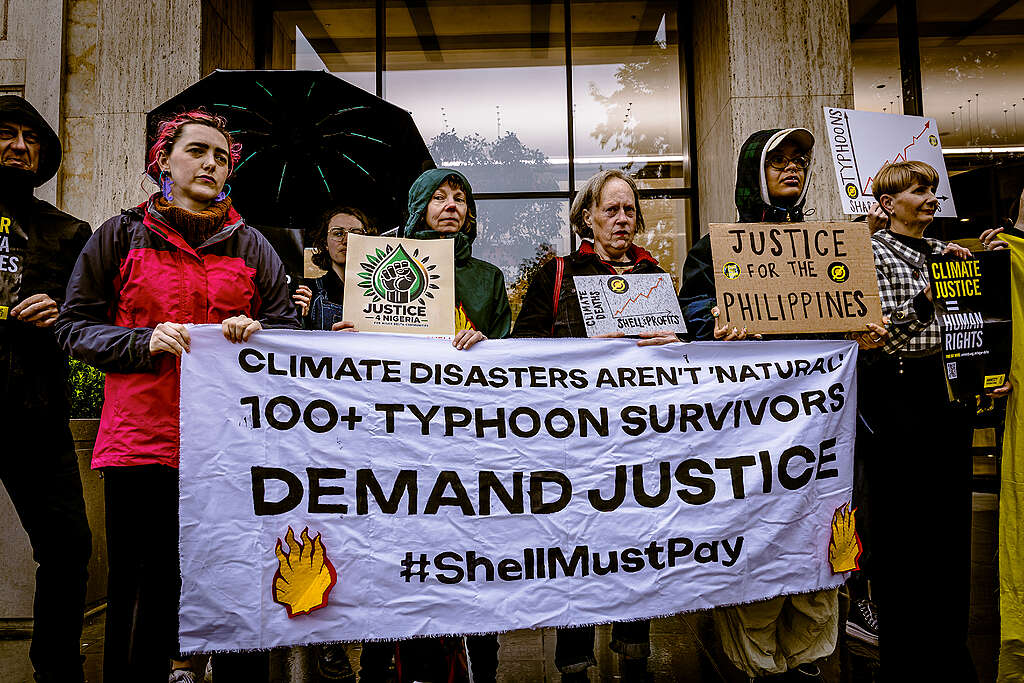
In the Philippines, Greenpeace is challenging President Ferdinand Marcos Jr. to accelerate fossil fuel phase-out and hold major polluters accountable through the passing of landmark legislation such as the Climate Accountability Bill. According to them, governments should make polluters pay and ensure affected communities receive justice and compensation for damages.
In the Niger Delta, thousands of members of the Ogale and Bille communities are suing Shell and its subsidiary SPDC for oil spills, asserting that their oil-producing activities in the region caused environmental damages, destroyed livelihoods, and caused health problems in local communities. Like survivors of Typhoon Odette, they are calling for accountability from said corporations as their profits continue to balloon.
Quotes:
Joan Jayma, claimant, said: “Filipinos, Nigerians, and many other voices around the world are united in holding Shell accountable for its role in the destruction of the environment, livelihoods, and countless lives. Bringing them to court marks the beginning of justice—not only for communities long harmed by fossil fuel companies, but also for our children, whose future is at risk because of the lack of accountability of major oil corporations.”
Prima Dano, claimant, said: “Niabot nalang ko ug arong tuiga, kato pa gyud ko kasugat ug grabeng bagyo, sa akong nasugatan sa tibuok nakong kinabuhi. […] Nawad an kog apo tungod atong hitabu-a. Nakahibawo na gyud sila ana daku daku na silage nag-contribute nga kadaut sa kalibutan. Kinahanglan silang manubag sa ilang mga sala ngadto sa katawhan, sa atong katawhan.”
[I have reached this age (55 years old), and I have never seen a typhoon as devastating as (Typhoon) Odette. I lost my grandson because of Odette. They (Shell) already knew they were contributing significantly to the destruction of the world. They should be held accountable for their sins to the people, our people.]
King Odidiomo Afolabi, a monarch out of the Niger Delta (Nigeria), said: “Shell is trying to shirk responsibility for seventy years of oil extraction in the Niger Delta. Meanwhile, the pollution remains severe. We have to go to another community outside the Niger Delta to buy drinking water. The air is polluted by gas flaring.”
Jefferson Chua, Greenpeace Philippines climate campaigner, said: “This action is a testament to the growing solidarity between communities that have chosen the bold step of taking Shell to court for their role in worsening climate impacts and environmental damages. Their wanton profiteering amid wars and worsening environmental and economic impacts will not go unopposed. We, alongside their many allies, will continue to echo the need to make climate polluters pay.”
Robin Wells, Director of Fossil Free London, said: Shell is seeing bumper profits, whilst we’re all paying the price. In the UK, energy costs are ballooning; in the Philippines, the climate crisis drives deadly typhoons; and in the Niger Delta, decades of oil spills have left it one of the most polluted places on earth. It’s clear Shell’s harms are global, but so is our fight for justice. This is why we came together from across the world today, to protest the lives ruined by the decisions made inside Shell’s AGM. And to make it clear: in the streets and in the courts, we’re fighting back.
Madeleine Lynch, Odette Case campaigner, said: “Shell made nearly $7 billion in profits in just three months, boosted by Trump’s invasion of Iran. It can — and must — pay for the damage it has inflicted on the Filipino people. Now, more than 100 Filipinos who lost everything in a typhoon made worse by climate change are demanding compensation and justice from Shell. They argue that for decades, Shell knew fossil fuels could drive dangerous climate change. It had every chance to change course. Instead, it misled the public and helped block our shift to clean energy, all to protect its profits. Their case shows the immense harm companies like Shell are causing — from the Philippines to the Niger Delta, and the UK. People are furious that fossil fuel giants keep making obscene profits while ordinary people suffer. Shell’s role in fuelling the climate crisis is undeniable. It is time it was held to account.”
Elle Bartolome, PMCJ senior executive officer, said: “At a time when survival and recovery become a privilege for the people, it is shameful that oil giants like Shell report record profits by exploiting the oil price spike caused by the US-Israel war on Iran. These gains made entirely at the expense of the people show exactly why Shell is accountable. Over 100 Filipino claimants are already refusing this normalized business-as-usual approach. It is only a matter of time before this accountability movement spreads like wildfire in the Philippines and beyond as more and more people recognize Shell’s conscious doubling down on fossil fuels while treating our suffering as a business opportunity, making us most vulnerable to every crisis.”
Atty. Ryan Roset, Legal Rights and Natural Resources Center (LRC) Senior Legal Fellow, said: “Communities in the Global South have long disproportionately suffered the effects of the climate crisis from the unfettered business interests of fossil fuel companies, who flex their earnings to their shareholders. Those in power, still enamored by antiquated economic systems, could not care less about the urgency of this catastrophe, and hide behind token solutions with insignificant impact. Climate change, however, does not lie in the future; it is here and now, and its effects are becoming more palpable each year. Marginalized communities the world over have had enough, and are taking the legal fight against corporate actors, and governments to seek accountability, and shape the policy landscape. This wave of climate litigation is growing, yet it is far from reaching its crest.”
Notes to the editor:
For more information or to request interviews, please contact:
Madeleine Lynch [email protected] +44 7556 054 146
James Relativo [email protected] +63 960 480 0297
A range of photography and video footage relating to the protest can be found here.
Greenpeace Philippines, the Legal Rights and Natural Resources Center (LRC), the Philippine Movement for Climate Justice (PMCJ) and Uplift have partnered to develop an international campaign (the Odette Case) to support the claimants in their fight for justice. The Odette Case campaign is independent of the litigation itself and does not represent the legal team or their legal strategy.
The following spokespeople are available for interview:
- Jefferson Chua, Campaigner at Greenpeace Southeast Asia
- Attn. Aaron Pedrosa, Head of Legal Team, the Philippine Movement for Climate Justice
- Joy Reyes, Policy Officer, Grantham Institute based at London School of Economics (works on the connection between climate attribution science and legal cases)
Members of the claimant cohort available for interview:
- Joan Jayma (biography upon request)
The claim is being brought under the Philippines Civil Code and the Philippines Constitution. The remedies sought by the claimants include compensation for the loss and damage they suffered during Typhoon Odette, as well as moral damages related to the alleged historic climate deception and misinformation from Shell, and potential injunctive relief.