Have you ever noticed that legislation always seems ready to go the moment an industry wants it?
It’s almost like someone else… wrote it in advance?
Recently, I wrote an article seething about how the New Zealand government is changing the law specifically to protect corporate polluters from being sued in court – like in the case brought by Mike Smith against Fonterra and the other largest polluters in NZ. Since then, they’ve gone from letting the mask slip to tossing it in the bin.
If you want to know what a Corporate Bodyguard State actually looks like in practice, look at the headlines coming out of New Zealand. When a polluting industry wants a piece of legislation, it doesn’t wait around for the democratic process. They just write it.
Recent investigations have revealed that briefings from industry lobbyists miraculously reappeared, basically verbatim, as government reform legislation. After being compelled by the courts to be accountable for their climate emissions, Fonterra and Z Energy worked with their lawyers to draft a change in legislation that would override that specific court decision. They wrote the policy, handed it to the Prime Minister’s Office, and watched the state cover up the paper trail.
And it’s not the first time this has happened. Look at the Ashburton Lyndhurst Irrigation court case, where the Environmental Law Initiative successfully sued the regional council in Canterbury for granting a pollution discharge consent to a local irrigation scheme. The High Court agreed that the law strictly prohibited councils from allowing pollution that causes “significant adverse effects on aquatic life.”
It was a monumental win for freshwater and accountability. But instead of cleaning up their act, the corporate farming lobby—spearheaded by Beef + Lamb, DairyNZ, and Federated Farmers—went straight to the Beehive. Panicked that this ruling would threaten intensive, polluting land use across the country, they lobbied the government to fundamentally weaken the law. The government complied, rewrote the law, and completely hollowed out the High Court’s ruling.
As political commentator Bryce Edwards aptly put it, “Same year. Same model. Lose in court, draft the law you would prefer, slip it under the right ministerial door, and watch Parliament hand it back to you in legislative form.”
We now know that entities linked to applications for the Government’s Fast-Track Approvals Bill poured over $1 million into political donations. For a million dollars, it seems, corporate interests can buy an Act of Parliament, bypassing environmental protections.
Victoria University law academics Graeme Austin and Bjørn-Oliver Magsig hit the nail on the head, “Courts do things governments cannot… They cannot be lobbied. They decide on evidence and law.” A government that can be lobbied has now systematically used legislation to eliminate the one institution that cannot be.
They’re gaslighting us
The hypocrisy reached a fever pitch last week. At the United Nations, New Zealand voted to support a landmark resolution endorsing the International Court of Justice’s Advisory Opinion (ICJAO) on climate change. The global resolution establishes that countries have a legal obligation to protect their citizens from greenhouse gas emissions and can be held liable for climate harm.
Our government signed up to it. They stood on the world stage and agreed that climate change is a matter of binding legal accountability, not just political choice.
But back home they’re drafting laws to ensure domestic courts can never hold our own corporate giants to account. They are championing international accountability in New York while passing a legal gag order in Wellington to kill off Mike Smith’s landmark case against our biggest emitters like Fonterra.
It is the ultimate gaslight. They look us in the eye and tell us that climate policy should be made by the government, not set in the courts. But the only reason citizens are forced into the courtroom in the first place is because the government is actively reneging on its fundamental duty to protect us. They say they care, while throwing climate policies onto a bonfire, cutting climate emergency response funding to pay for tax cuts for the already-wealthy, and calling it a “climate dividend.”
The path of a reluctant radical
Which brings me to a question I get asked a lot—How did I end up here? When people see photos of me scaling a building, or when they hear about my criminal conviction for trespassing on Fonterra’s Te Rapa factory in protest against their pollution, they assume I’m a natural rule-breaker. They think I have a predisposition for disruption.
The complete opposite is true! I am a near-pathological rule-abider.
I come from a politically conservative family. For most of my life, even the idea of going on a protest march felt deeply uncomfortable. I’ve cared about nature my whole life and felt compelled to act on climate change since I first learned about it when I was 13 years old, but my first instinct was to try to change the system from within.
I studied ecological economics. I worked in Corporate Social Responsibility (CSR), genuinely believing we could steer these corporate giants in the right direction. But I was quickly disillusioned when I discovered that CSR is mostly just a marketing exercise. Companies will happily drop their climate targets the moment they’ve milked the good PR.
So I turned to the next natural avenue— democratic advocacy. I have spent years of my life writing dense submissions, giving oral evidence, compiling facts, and meeting with MPs and the executives of our most polluting companies. I made the evidence-based arguments.
It did not work.
I started caring about climate change when I was 13. I became radicalised in my mid-thirties. That is what I call reluctant radicalisation. I wasn’t driven by a desire to break the law; I was driven by sheer necessity, because the system has been captured.
Two standards of justice
Look at the stark disparity of the system we live in today.
When I break a minor law to pull the emergency brake on a corporate giant that is destroying our biosphere, I face the consequences. I am charged, I am convicted, and I now carry a criminal record. You can bet your life that I won’t be invited to drop off a letter at the Prime Minister’s Office asking him to rewrite the law so my conviction disappears.
But when Fonterra, Z Energy, or Federated Farmers are taken to court on the evidence and the facts, they get to slip a preferred draft of a law under the right ministerial door, and watch Parliament hand it back to them as legislation.
When we break the rules to save the planet, we get a criminal record. When they break the planet, they get to rewrite the rules.
The current New Zealand government is setting a dangerous precedent – becoming a shield for climate polluters, protecting them from the courts, from the voters, and from reality.
I did not want to be a radical. I wanted the submissions to work. But when the state becomes the personal security detail for the entities destroying our future, abiding by the rules is no longer a moral virtue. It is compliance in our own destruction.
If they can rewrite the laws to erase our democratic victories, then active resistance is the only response we have left.
History shows us that when the rules are rigged, real people standing together and resisting is what moves the world forward. We kicked deep-sea oil out of Aotearoa, and we can win our democracy back again.
This post was republished from Substack with the kind permission of the author.
Greenpeace is calling on world leaders to regulate the intensive livestock sector to prevent the worst of the climate crisis. Join us today – sign the petition now.
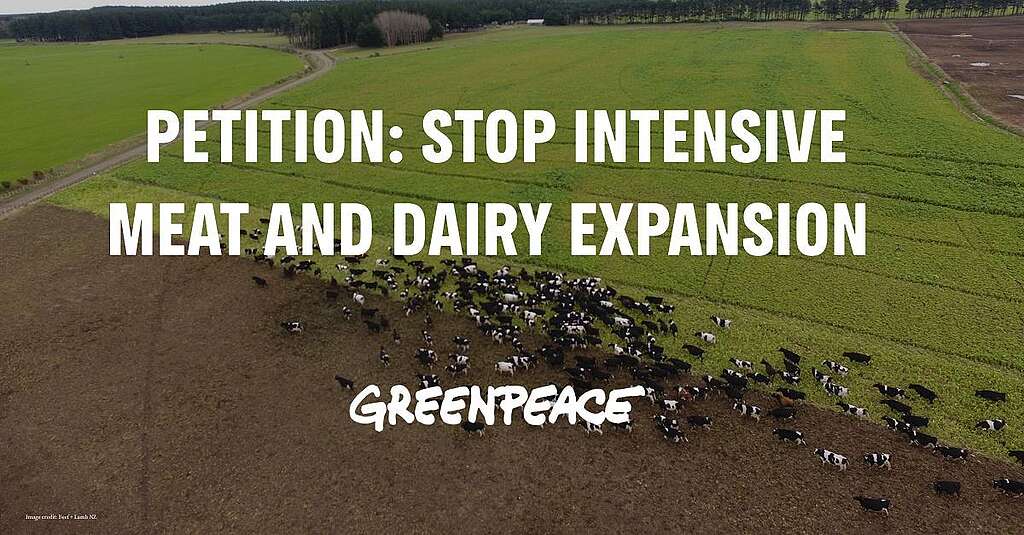
Call on world leaders to stop intensive meat & dairy expansion.
Take Action