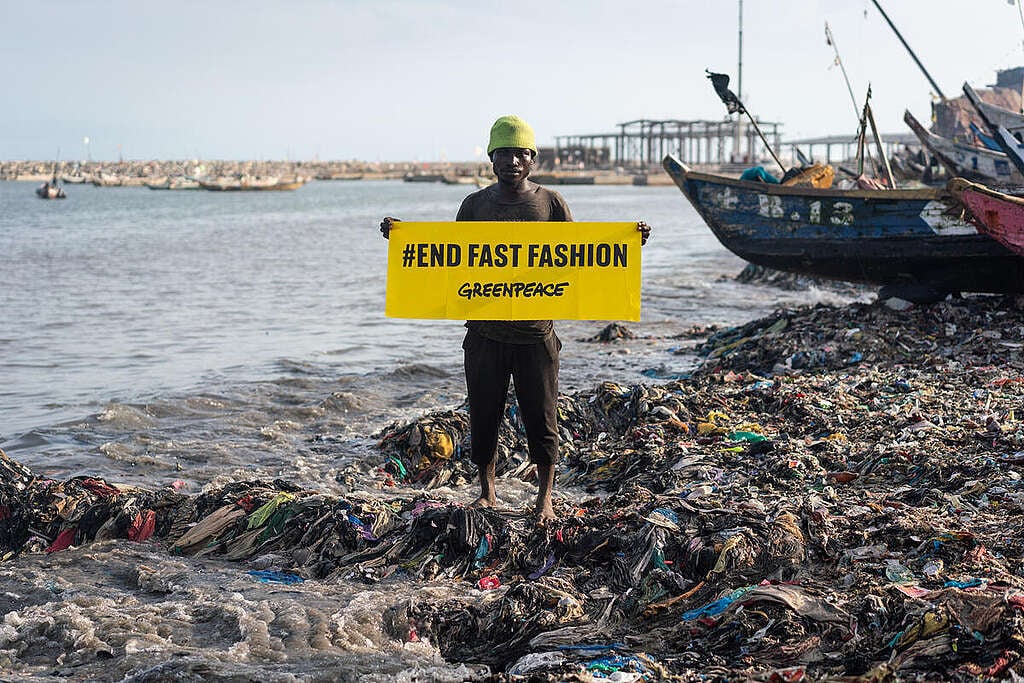
A shocking new report by Greenpeace Africa and Greenpeace Germany revealed the alarming scale of environmental and public health damage caused by the global second-hand clothing trade in Ghana. It exposed the devastating impact of discarded clothing from the Global North (much of it fast fashion) on its environment, communities, and ecosystems
Millions items of clothing are received in Ghana every week – but nearly half of these clothes are unusable and end up in informal dumpsites or burned in public washhouses, leading to severe contamination of air, soil, and water resources, putting the health of local communities at risk.
Second-hand clothing trade is a common practice in many other African countries, including Kenya, Nigeria, Tanzania, South Africa, and Uganda. The decline in the quality of second-hand clothes is evident elsewhere on the continent too. In 2021, about 458 million of the 900 million used clothing imported in Kenya were worthless; more recent data suggests that Kenyan traders part with approximately 20-50% of clothes purchased due to their flawed condition.
The Global North’s fashion addiction is fueling environmental disasters across Africa. Here are four activists from the continent pushing back…
Chemitei Janet (Kenya)
Chemitei Janet is an environmentalist and slow fashion educator passionate about social and climate justice, with experience in environmental education and sustainable waste management. She uses her social media platforms to highlight the impact of the fashion industry in Kenya, encouraging mindful clothing habits. Chemitei aims to share African stories and foster youth development through creative sustainability. She serves as the youth chairperson of Clean Up Kenya and is the Africa Regional Coordinator for Threading Change.
Follow Chemitei Janet on Instagram.
Sammy Oteng (Ghana)
Sammy Oteng is a trained fashion designer based in Ghana who repurposes second-hand clothes for over a decade. Within his work he is keen on making a socio-political statement, exploring issues of neo-colonialism, sexuality and gender fluidity. Sammy leads community engagement on the impact of second-hand clothing trade in Accra for the OR Foundation, and has led a research project on the topic before joining the organisation.
Craig Jacobs (South Africa)
Many know Craig Jacobs for his tongue-in-cheek fashion column in one of South Africa’s biggest Sunday papers. But, he is also well respected for his activism, as the founder of Africa’s leading sustainability brand, Fundudzi by Craig Jacobs. And while some might feel that he dabbles in two competing worlds altogether; for this eco-warrior by day and wordsmith by night, sustainability is more than aspiring to live a net-zero life, it’s about forging new pathways and inspiring others.
Follow Craig Jacobs on Instagram.
Joseph Obel (Kenya)
Joseph Obel is a performance artist, model, and mental health advocate whose work explores the interconnectedness of human bodies and water bodies. He’s modelled for Kibera Fashion Week and performed two conceptual solo shows: Kundi-Nyota, examining human constellations, and My Body Betrays Me Again, exploring bodily adjustments to environmental pressures. Joseph started creating his costumes using recycled materials after realising how much the film and theatre industry contributes to fast fashion by designing new costumes with every production, which pile up in a corner afterwards.
Follow Joseph Obel on Instagram.
#EndFastFashion
Global fast fashion brands are churning out more clothes than the planet can handle. Today’s trends are tomorrow’s trash with our clothes made cheaply and disposed of quickly. This waste is often dumped in Global South countries, becoming our problem, diminishing our quality of life and impacting our health. It’s time to redress the balance, challenge the throwaway mentality and invest in quality over quantity.
Global fast fashion brands are churning out more clothes than the planet can handle.
Take action