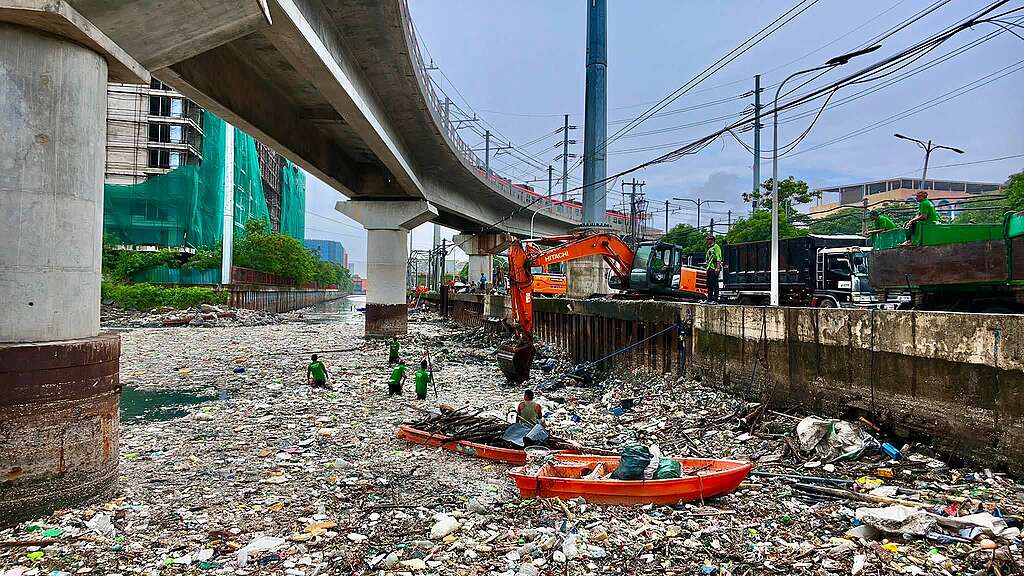
13 August 2026, Quezon City — A “sea of garbage” from Manila Bay near Baclaran Church[1] went viral after several days of monsoon rains that inundated several parts of Metro Manila and nearby provinces.
Reacting to this, Greenpeace Philippines Campaigner Patrice Valero said:
“This is not the first time urban waste has made headlines after several days of monsoon rains.[2] This recurring “sea of garbage” choking rivers leading to Manila Bay is a predictable consequence of a throwaway economy.
“While cleanups are necessary as an emergency response, they cannot be the government’s recurring strategy for this crisis. Dredging waterways and scooping trash out of the water will never fix a crisis fueled by corporations flooding our markets with unmanageable, single-use plastic products.
“We also cannot burn our way out of this waste crisis. President Marcos Jr.’s push for Waste-to-Energy (WTE) incinerators is a dangerous, costly misstep.[3] WTE does nothing to stop plastic from choking our waterways; it simply burns waste after the damage is already done. Incineration releases carcinogenic dioxins, toxic ash, and greenhouse gases—all while creating an insatiable financial demand for the very disposable materials we need to eliminate.
“The government must tackle the crisis at its source by immediately declaring sachets and other problematic plastics as Non-Environmentally Acceptable Products (NEAP) under the Ecological Solid Waste Management Act (RA 9003). To promote genuine solutions, the government must also institutionalize affordable, accessible refill and reuse systems across public markets, sari-sari stores, supermarkets, and government procurement.
“Corporate polluters must be held accountable. The government must strengthen the Extended Producer Responsibility (EPR) Act by enforcing mandatory plastic-reduction targets for corporations, ensuring that collection schemes cannot substitute for actual production cuts.
“Communities and local government units must also be empowered as part of the solution through local initiatives such as composting, fully functional Materials Recovery Facilities (MRFs), well-maintained trash traps, and fair wages and full protection for waste workers.
“We do not have to remain trapped in an endless cycle of pollution and disaster. The path to a flood-resilient Philippines is clear: turn off the plastic tap, hold producers accountable, and invest in real, community-centered solutions. By prioritizing reduction and scaling up reuse and refill systems today, we can secure a safe and sustainable future the Filipinos deserve.”
###
NOTES:
[1] Sea of garbage: https://www.facebook.com/share/p/19Yx97HvYA/
[2] MMDA collects 600 tons of garbage in NCR streets, pumping stations | Philippine News Agency
[3] Marcos says garbage problem ‘critical’, eyes waste-to-energy plants | ABS-CBN News
For more information and interview requests, please contact:
Karl Orit
Communications Campaigner
Greenpeace Southeast Asia – Philippines
[email protected] | +63 919 457 1064 (Viber & WhatsApp)