

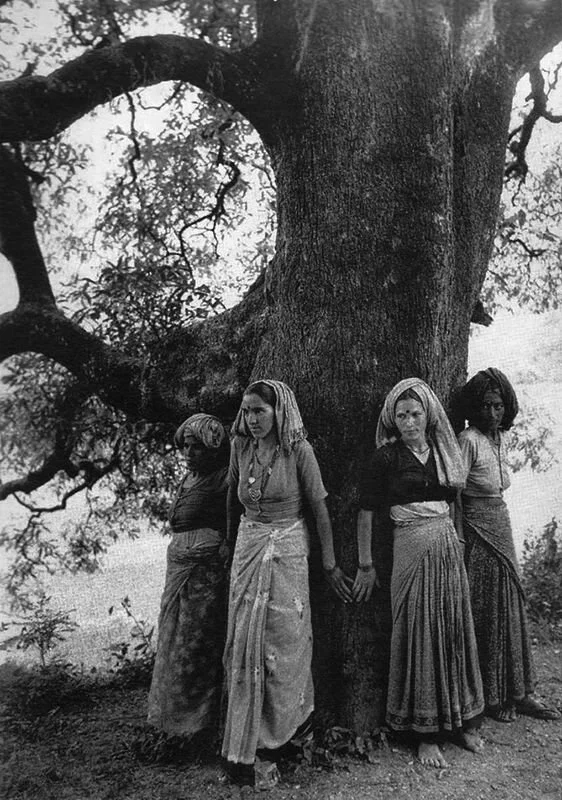
There are some movements we remember through images. Images that get etched into our brains. For me, this image of women standing around trees in the Himalayas is one.
We might not remember the names, the meetings, the months of walking between villages, or what was said before anyone stepped forward. We may not remember the the village councils, where women’s voices were most often absent, or the contractors and forest officials they confronted directly.
We might remember the embrace. These arms around the tree. Women placing their bodies between forests and those who came to fell them. Some movements are etched into us this way, as one frame that outlives everything around it.
It would be easy to tell this as a history of places saved. It isn’t. Some forests still stand because people refused to leave them. Others were saved, then taken anyway years later by a different permit or company. Some were gone before the fight began. What these movements leave behind is something else: people learning to stand up for the places that sustain them, and finding that protecting nature cannot be separated from livelihoods, dignity and the right to decide their own future.
That history was at the heart of From Chipko to Climate Change, a conversation held in Bengaluru on 19 September 2026 as part of Greenpeace India’s Bengaluru Rising campaign. Ramachandra Guha was joined by climate campaigner Amruta S.N., educator Preeti Sunderajan, conservationist Rachana Ravikiran, researcher Kaustubh Rau and former forest officer Ravindra to ask what the movements that shaped Indian environmentalism can teach us today.
Guha placed Chipko in a longer timeline. Environmentalism, he explained, is a modern idea, born alongside industrialisation and humanity’s growing power to damage the natural world. In India, it became intertwined with livelihood, inequality and survival.
Chipko is one of the clearest examples. Communities were defending forests that were part of their everyday lives and economies. The movement challenged the idea that environmental protection is separate from ordinary people’s concerns, and showed that those who depend most on the natural world often understand best what is at stake.
That legacy runs through decades of struggles over forests, rivers and fisheries, and now a new generation organising around air pollution, climate impacts and vanishing urban green spaces. The thread through all of them: people have always been at the centre of environmental protection.
Non-violence, collective action and people power are how communities become harder to ignore, by creating knowledge, documenting what is being lost and building alliances. This is why remembering matters. Climate change makes every story feel urgent and new, but many of our questions have been asked before. Who decides what happens to common land? Whose knowledge counts? The answers are scattered through decades of organising, writing and research.
In Bengaluru, that memory meets a city changing at extraordinary speed. The conversation moved from Chipko to the city’s lakes, wetlands, trees and other urban commons, and to how neighbourhood concerns grow into wider movements. One framework captured the journey simply: belonging, care, agency, shared agency, institutions. We begin by knowing a place. We notice what is changing. We care enough to act. Then we find others who care too.
We saw this happen in Bengaluru just weeks ago. In late August, the Karnataka government passed the Parks (Preservation) Amendment Bill, allowing up to 5% of protected parkland to be diverted for public infrastructure and utilities. The possibility of losing more of our iconic green spaces brought citizens together. On 27 August, people gathered at Lalbagh carrying a simple message: not 5%, not 1%, not one inch. Thousands of Bengalureans joined the campaign in that week, bringing together walkers, resident groups, environmental campaigners and citizens from across the city.
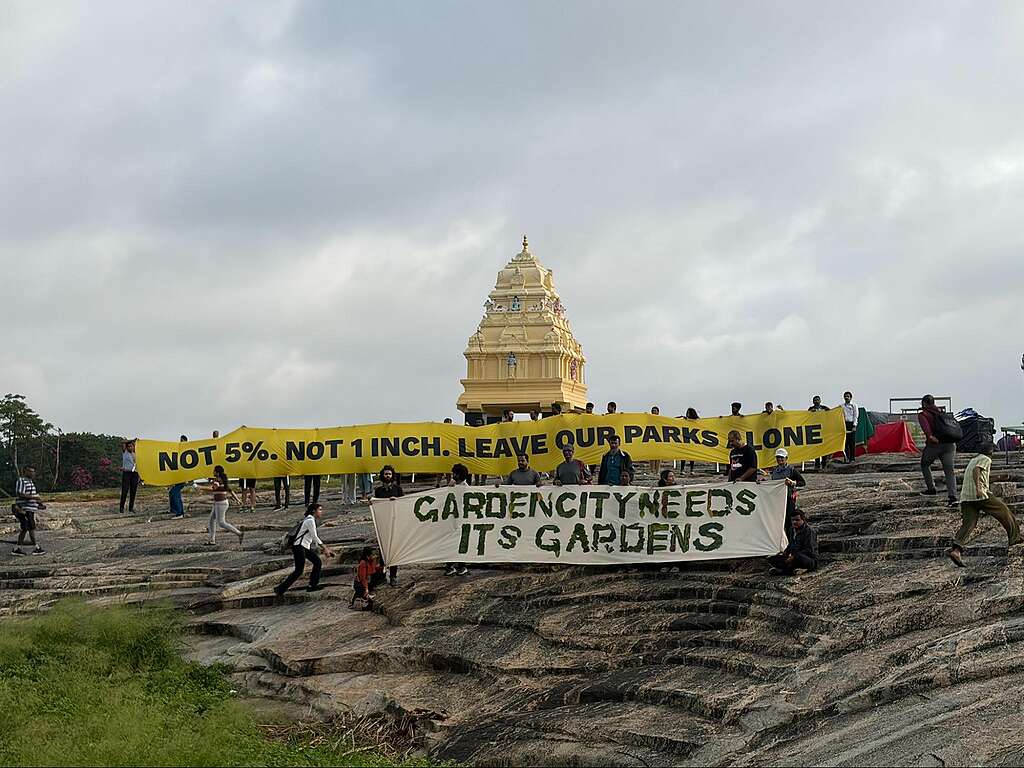
We collected 28,000 signatures on our Save Blr Parks petition and the pressure continued. On 1 September, the government indicated that it would reconsider the Bill, and on 3 September the state cabinet withdrew it, saying it would first be placed in the public domain for discussion.
That is the spirit of Bengaluru Rising: the future of our cities is something we all have a hand in shaping. It lives in the neighbour who speaks up for a lake, the young person demanding cleaner air, the community protecting a patch of green. Organisations like ours are allies, not owners, supporting the communities, campaigners and civic groups whose knowledge and organising already exist, and bringing the evidence and public pressure to turn local concerns into lasting change.
Perhaps that is what we should carry forward. The task is not only to preserve forests, lakes or wetlands. It is to preserve the relationships, knowledge and collective power that make protecting them possible.
The story from Chipko to climate change is still being written. It is written every time people choose to care for a place they call home, every time communities organise rather than accept what seems inevitable, and every time different movements find one another.
The question before us is not whether there is a history to learn from. It is whether we are willing to remember it, and carry it forward to create alternative futures rooted in hope, solidarity and care.

The 22-acre Mysore Lamps campus forest, a former industrial site that has grown into a dense, biodiverse green space whose future is still being decided.
SIGN NOW-

The right to peaceful protest is essential for a healthy democracy
Greenpeace India stands in solidarity with students exercising their democratic right to peacefully protest and calls for accountability over the harm caused to young protesters.
-

Disappearing Canopies: Why the Fight for Hyderabad’s Greenery is a National Warning Sign
Walking through the streets of Hyderabad in May feels increasingly like standing directly behind the exhaust of a giant air conditioning unit. The air outside the gates of Kasu Brahmananda…
-

Remembering Ananth
Today we celebrate the life of a visionary leader, a mentor, and a friend. As the first Executive Director of Greenpeace India and a tireless advocate for human rights and…