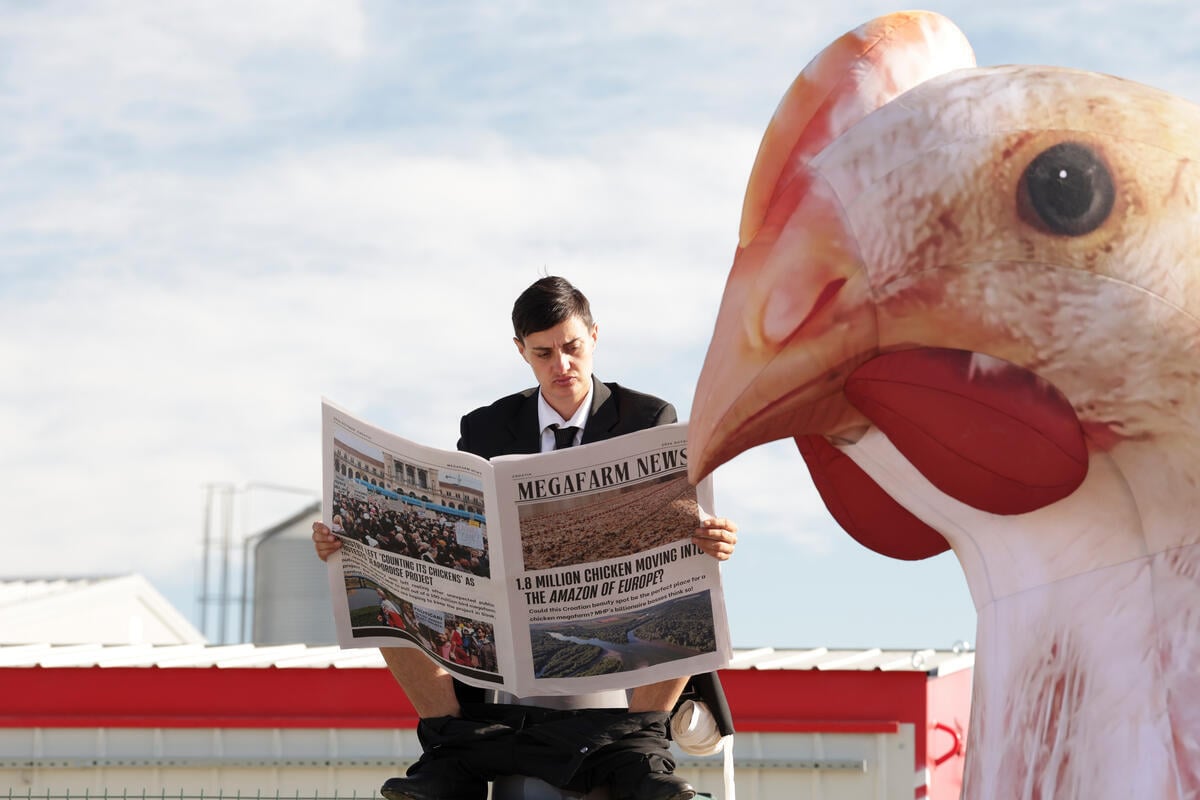
Would you like to live next to a facility that slaughters 100 million chickens a year? I wouldn’t.
I’m Dániel Nyitray, a campaigner at Greenpeace International. Recently, I traveled to Croatia to join a community fighting an unimaginable threat: a massive meat factory mega project that aims to slaughter, in just one small town, four times more chickens than the entire country currently produces.
The spirit of Sisak
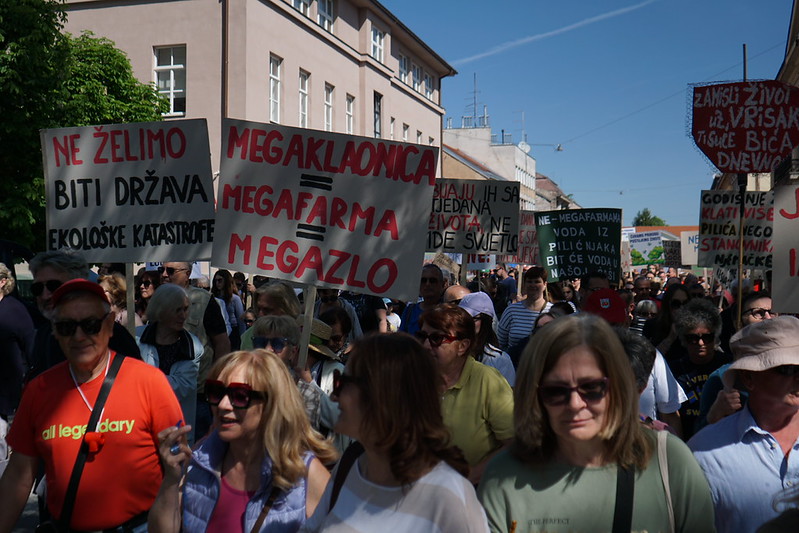
In a country of fewer than 4 million people, concentrating a 100-million-chicken industry in one region is not “farming”, it’s an industrial invasion. After a 5,000-person rally in the capital, Zagreb this February, a grassroots coalition of 12 affected communities, supported by Zelena Akcija (Friends of the Earth Croatia) and Animal Friends Croatia, organized a follow-up protest in the town of Sisak.
As I stepped off a 10-hour bus ride from Budapest to Sisak, the energy was already electric. Sisak is a town of 40,000 people still bearing the scars of a major earthquake from five years ago. Despite the economic hardships the locals refused to be bribed by the empty promise of “new jobs.” We are all too familiar with the empty promises of big corporations; they are masters at promising the moon and the stars until the facility is built, only to become the worst neighbors imaginable.
The organizers held a short press conference, where the sheer number of media microphones showed the massive public interest. No wonder: they have the support of a nationwide famous singer, and Hollywood actor Goran Višnjić (ER’s Doctor Luka Kovac) sent a video message of solidarity. When the crowd started moving through the narrow streets, the sight of 3,000 people marching together was truly uplifting.

My favorite moment? A famous local musician leading the crowd in a folk song, rewritten to protest the mega-farm. When it was my turn on stage, I shared that their struggle isn’t isolated, it is part of a global network of “site battles” spanning from Mexico to Nigeria, from Spain to New Zealand. I closed with a line I practiced all morning: “Hvala, ali ne megafarmama!” (Thanks, but no mega-farm!)
If you want to raise your voice against Big Ag’s toxic greed and its destructive meat and dairy mega-projects, sign our petition here.
Big Ag’s global playbook of dirty tricks
Why are we so worried? Beyond the ethical nightmare of industrial slaughter, these projects are “Extractive Machines.” They pollute groundwater with nitrates (increasing cancer risks), pollute the soil and air, and overwhelm local infrastructure with stench, dust, and heavy traffic.
But Big Ag doesn’t play fair. They follow a “dirty playbook” similar to Big Oil. They target regions with high unemployment or weaker regulations, hoping the community is too desperate to fight back.
We see the same “Salami-Slicing” tactic everywhere: In Croatia the investor split the project into 20 separate permits to bypass a Cumulative Environmental Impact Assessment. We’ve seen this before: similar has happened for example in Spain, where a developer split a massive pig project into 25 units to dodge regulations. But, even this way, we’ll stop it!
In Mexico, my colleague Carlos reports a devastating situation in the heart of the Selva Maya forest: hundreds of industrial pig farms have invaded this beautiful rainforest, with the majority of them built without any legal permits, contaminating the biggest underground water reserve in Mexico.
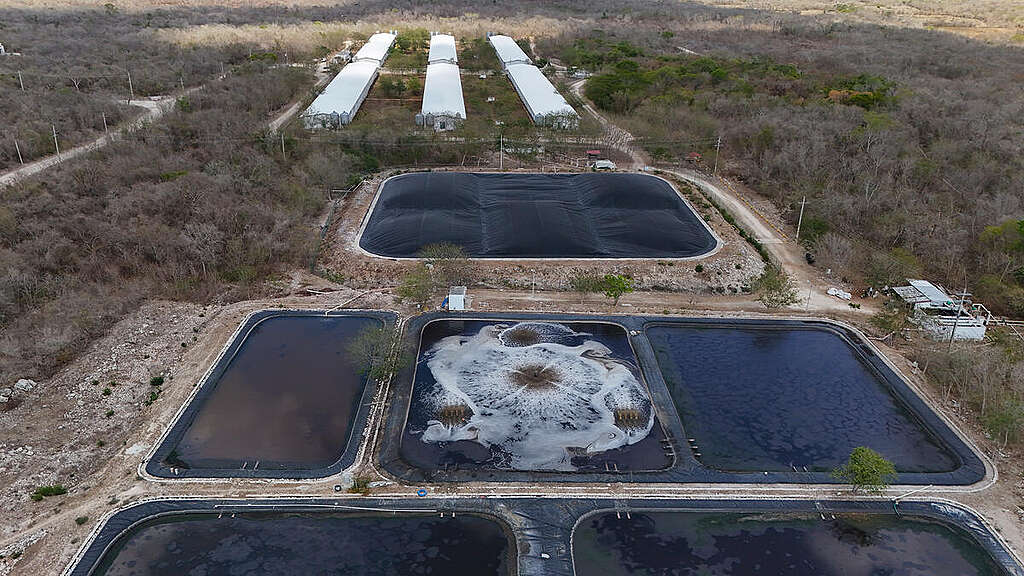
Vista aérea de la granja porcícola de Sitilpech, Yucatán.
Similarly, my Spanish colleague Luís has been fighting for years to stop the spread of these “animal factories.” When confronted, the factory farm industry tried to silence him with a lawsuit. While they have secured significant victories in the past, they are currently locked in a fresh battle alongside local residents in San Clemente, a little village in the forgotten, but beautiful Spanish countryside. Its new facility is designed to cram one million hens and produce over 235 million eggs a year.
Industrial meat and dairy production is even expanding its toxic model into new frontiers. JBS, the world’s largest meat empire, is planning a massive megafarm project for Nigeria. For decades, JBS has been the market leader in Brazil’s beef industry, which is the primary engine behind the destruction of the Amazon rainforest. In addition to being directly implicated in corruption scandals, JBS has through its supply chain relationships, been linked to severe human rights abuses and to cattle grazed illegally on indigenous lands. Now, to line the pockets of its billionaire shareholders, it is trying to expand this destructive model into Sub-Saharan Africa. Nigeria has already seen first-hand the devastation fossil fuel companies like Shell cause to their environment, human rights and the climate. Now, JBS is gearing up to follow. So local communities are fighting back.
Unfortunately, this list goes on and on. The pattern is undeniable: Big Ag corporations are aggressively pushing these mega-projects across the globe, completely disregarding the interests of local communities. Their goal is clear: to maximize profit at any cost, showing total indifference to the suffering of animals, the health of our food and water sources, the destruction of nature, and the lives of the people who live there.
Not here, not anywhere
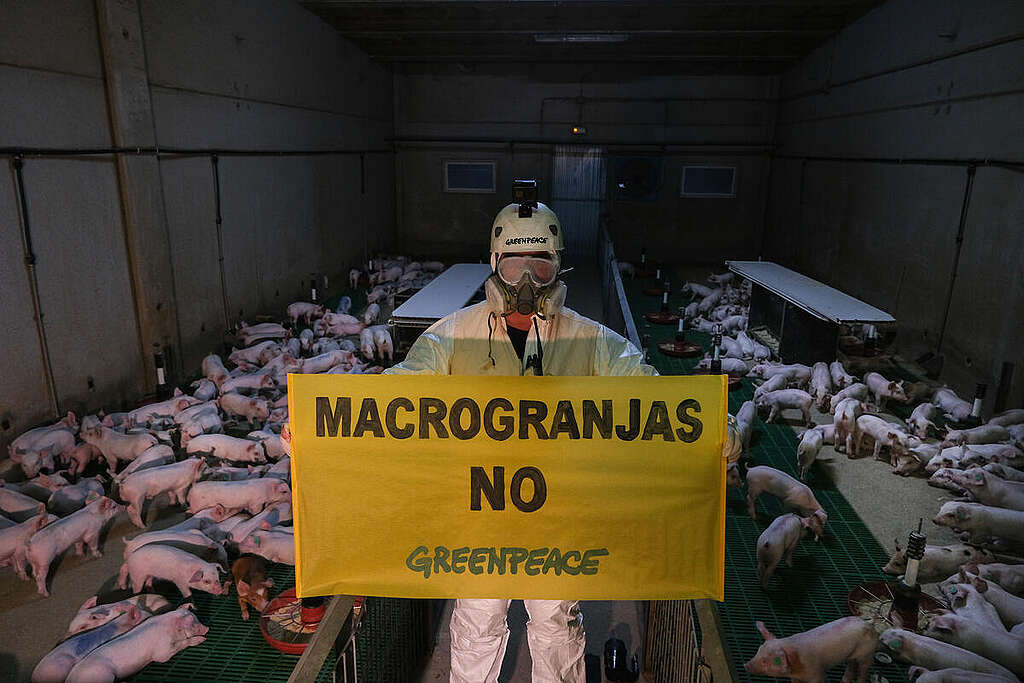
This isn’t just about chickens; it’s about Community vs. Extraction. Big Ag views our land as a commodity to be exploited and discarded. But the people of Sisak reminded me that our land is our heritage.
Our land is not just a commodity to be extracted, it is our heritage and the source of our life.
But right now, Big Ag is sacrificing our home for selfish extraction. From the savannas of Nigeria to the villages of rural Europe, corporate mega-projects are bulldozing local livelihoods to feed an industrial machine that only serves a few. We are taking a stand to protect our land, our culture, and our right to a better world for future generations.
Not here, not anywhere.
Help us stop Big Ag’s expansion.
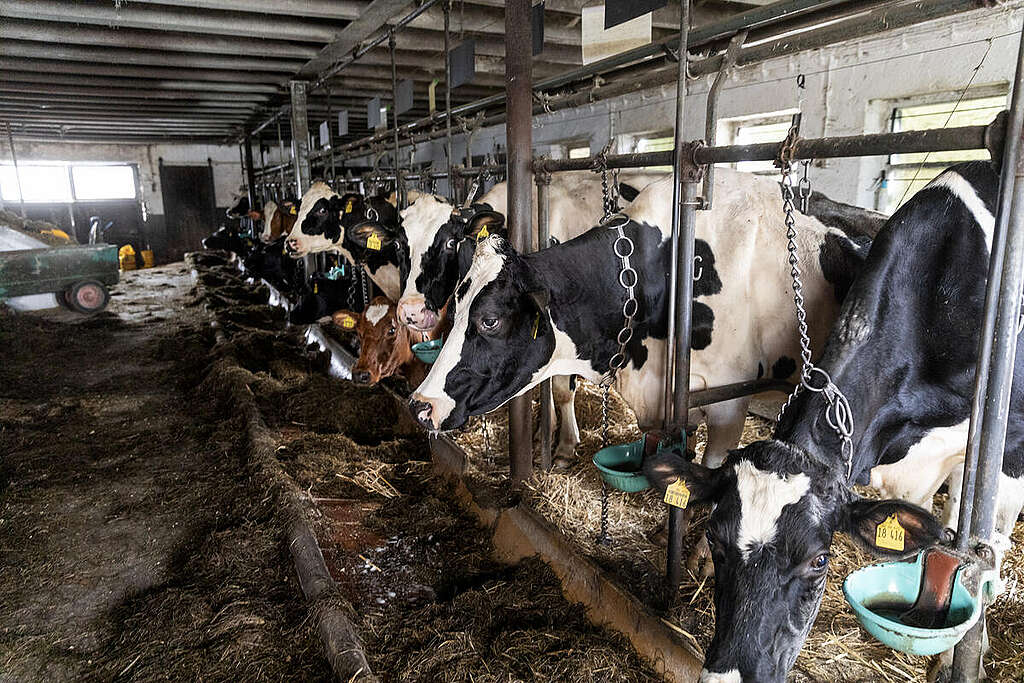
It’s time to cut through corporate lies, cut agriculture emissions and shift towards sustainable agroecology.
Sign now!Dániel Nyitray is Global Campaign Lead for Big Ag at Greenpeace International based in Hungary.