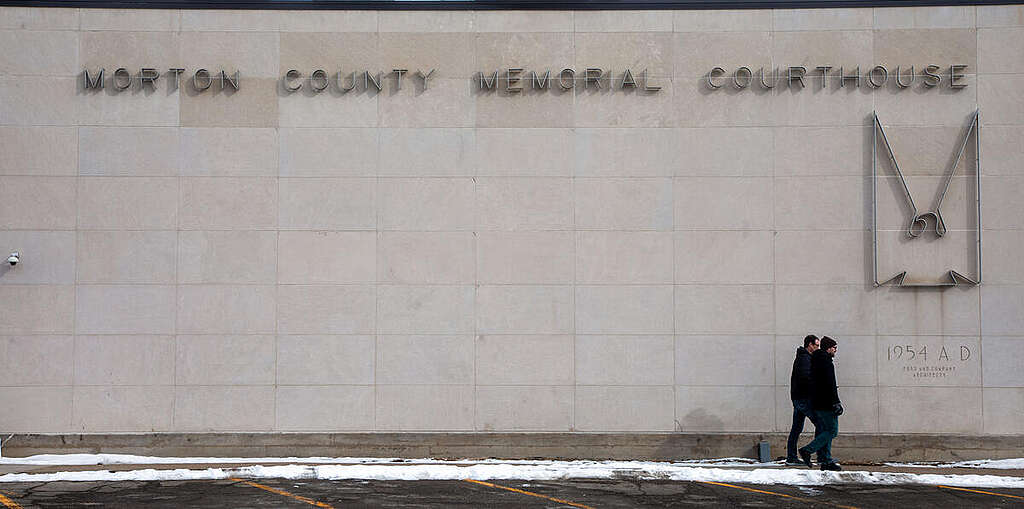
The right to a fair trial heard by an impartial jury is enshrined in the U.S. Constitution and is the bedrock foundation of our justice system. The trial held in Mandan — located in Morton County, North Dakota — where three Greenpeace defendants were found liable for $667 million (later reduced to $345 million) did not meet this standard in multiple respects.
In March of this year, the Greenpeace defendants filed a motion for a new trial. The full briefing can be read here.
This trial simply should not have been held in a community that was so heavily impacted by the protests against the Dakota Access Pipeline (DAPL). Indeed, a recent analysis of the case by EarthRights International called it “one of the biggest and most flawed trials in North Dakota’s history” and “an example of a strategic lawsuit against public participation (SLAPP) — a retaliatory lawsuit to silence free speech — that has spiraled out of control.” Marty Garbus, a prominent civil rights lawyer who monitored the trial, has said: “I think this is one of the worst First Amendment decisions in American history.”
There are many reasons that this case never should have gone to trial to begin with, and that these claims should have been dismissed. Greenpeace USA’s and Greenpeace International’s actions were fully protected by the First Amendment, while Greenpeace Fund had no involvement in the DAPL protests at all. But even if there had been enough evidence to support Energy Transfer’s case, the trial was still fundamentally flawed in multiple ways.
1. Morton County was the wrong place to hold this trial.
No fair or impartial trial could have been held in Morton County.
The Standing Rock protests brought thousands of protesters to the region for many months; while the protests were motivated by opposition to a dangerous fossil fuel project that faced Indigenous objections, there is no question nearly everyone in the community experienced some disruption. A 2022 survey of people eligible to serve on a jury found that a staggering 97% said they could not be a fair or impartial juror in the case. Among the prospective jurors, a majority “had negative opinions of Greenpeace defendants, organizations that oppose the use of fossil fuels, and/or protests in general.” Although the pipeline passes less than a mile from the Standing Rock Sioux Reservation, because none of the reservation land is inside Morton County, no Standing Rock tribal members living on the reservation were included in the jury pool.
During jury selection, one prospective juror summed it up saying, “I don’t think that there’s anyone that was a resident at that time that couldn’t tell you that there wasn’t complete disruption in our community because of the protests. I think you’ll find a tough time finding people that are completely unbiased on that, because it affected everyone.” When asked who else felt the same way, nearly every potential juror raised their hand. On top of that, every single judge in the region recused themselves from the case due to conflicts of interest, and the trial judge had to be brought in from another part of the state.
The Greenpeace defendants made multiple motions for a change of venue to another county in North Dakota, but all requests were denied.
2. Someone was sending suspicious mailers and texts to influence the jury pool.
Against this backdrop of negative opinion about the protests, print versions of a shady online news outlet were mailed directly to Morton County residents starting in October 2024 and in the months leading up to the start of the trial.
The mailers seemed to be from a “local” paper called the Central ND News, but were actually published by a national organization called Metric Media, which reportedly operates over a thousand so-called “pink slime” media outlets around the country. Past reporting has shown that some Metric Media outlets have engaged in what appear to be “pay-to-play” operations that have attempted to influence recent elections in states all across the country.
The online site published over 30 “On This Date in 2016” stories that dredged up eight-year-old incidents of disturbances and arrests, and seemed designed to reactivate negative emotions about the protests. Needless to say, it is not common practice for a local newspaper to re-run stories from eight years previous. The paper mailers that arrived in Morton County reproduced some of these stories, as well as others praising Energy Transfer’s donations to the community. Other members of the community received unsolicited text messages with links to the articles, which were crafted to raise fears that “the trial could negatively impact their job and the economy.”
The mailers have been described as an “influence operation” targeted at the jury pool. One prospective juror even brought a copy of the mailer to court during jury selection.
Did Energy Transfer have something to do with this? Here’s what we know:
- In September 2024, Energy Transfer’s Chair Kelcy Warren donated $5 million to a Super PAC named “Turnout for America,” his only contribution to this entity.
- That same month, Turnout for America paid $250,000 to “Northern CB Corp.” for “media services.”
- Northern CB Corp.’s president is Brian Timpone, who is also the operator of Metric Media, the publisher of Central ND News.
- The physical copies of Central ND News that were mailed to Morton County residents were sent under USPS mailing permit number 1851, which is registered to FMC Printing in Dallas, Texas, where Energy Transfer is headquartered.
To be clear, we do not know for sure who was behind the mailers. But that’s why the Greenpeace defendants requested additional discovery to get to the bottom of who was sending them. Although the Court said it took an “extremely dim view” of “attempts to influence a jury panel before the trial”, the motion was denied.
3. Energy Transfer mounted a public relations push in Morton County.
While we don’t have proof of who was behind the Central ND News, we know that Energy Transfer openly waged a campaign to burnish its image, and the pipeline’s, before and during the trial.
The Energy Transfer donation lauded in the October 2024 mailer was a $5 million gift (made back in January 2019) to the University of Mary to support engineering and workforce development. In June 2019, just months after filing the North Dakota lawsuit, Energy Transfer donated $3 million to the City of Mandan itself to improve the public library and local parks. Energy Transfer also made numerous smaller grants to local organizations and charities in the months leading up to the trial.
Both prior to and during the trial, Energy Transfer ran commercials on local television stations promoting DAPL, which at least seven prospective jurors said they had seen.
4. The Court failed to strike jurors with serious biases.
Perhaps most importantly, the concerns about the jury pool were borne out at trial.
The way jury selection works is that an initial pool is brought into the court, and then some jurors are excused — usually either because sitting on a long trial would be a hardship for them, or because they have some knowledge or association with the case that justifies excusing them for “cause.” Written questionnaires, as well as direct questions from the lawyers and the judge, are used to explore whether jurors have prior knowledge or biases. After this, each side can exercise a few “peremptory strikes” — removing a juror without the need to prove a cause for removal — and at the end, at least nine jurors are needed to hear the case.
Of the final 20 prospective jurors, the Greenpeace defendants moved to strike 12 of them for cause. This was because, on the juror questionnaire and in response to direct questions, these jurors had reported direct personal experience with the protests, family members who had been impacted, close personal or financial ties to the fossil fuel industry, or stated bias against the Greenpeace defendants.
All of those motions to strike for cause were denied, and as a result, seven of the nine final jurors (plus one of the two alternates) were seated despite evidence of bias.
One empaneled juror was actually employed by a petroleum company that owns a stake in the Dakota Access pipeline itself. Two other jurors reported family members who had worked for DAPL subcontractors or security during the protests. Another juror indicated that they owned mineral rights. Other jurors stated that the Greenpeace defendants started “at a disadvantage” with them or would have to affirmatively prove their innocence. One juror stated that “she would be uncomfortable finding against the pipeline industry and could not be fair.”
None of these seven jurors should have ever been permitted to resolve this case, and a new trial must be granted.
5. The jury was not given a chance to determine how much others contributed to Energy Transfer’s claimed injuries.
The plaintiffs’ legal case was designed to blame the Greenpeace defendants for every single thing that happened during the Standing Rock protests, no matter how illogical or impossible. The plaintiffs’ expert witnesses testified they were instructed to simply tabulate the total alleged damages without any attempt to link any damages to any specific action by any Greenpeace defendant.
And indeed, the plaintiffs did not present any evidence at trial that any Greenpeace defendant actually caused any of their alleged losses. On the contrary, evidence presented in court identified numerous other causes unrelated to the Greenpeace defendants for the alleged damages.
For example, Energy Transfer said that a letter signed by Greenpeace USA and Greenpeace International, which the jury found contained defamatory statements, caused banks to delay financing, costing it millions. (There was no evidence for this.) But over 500 other organizations also signed that letter, which was organized by a different group. Even if the letter did cause this harm, these Greenpeace defendants only had a small part in the letter.
North Dakota law requires juries to assess not just how much the plaintiff was harmed, but who contributed to that harm, and how much. But the Court’s verdict form did not provide a way for jurors to decide how much other actors might have contributed to these harms. “Plaintiffs proposed — and the Court ultimately adopted without entertaining argument from the parties on the Sunday evening before closing arguments — a verdict form that provided the jury no opportunity to apportion or allocate fault between the Greenpeace defendants, the plaintiffs, and third parties.”
In the end, the jury awarded nearly 100% of plaintiffs’ requested compensatory damages without considering whether other actors also contributed to ET’s claimed harm. This failure, in and of itself, warrants a new trial.
6. Greenpeace International should never have been included in the case, because it is not subject to jurisdiction in North Dakota.
Greenpeace International (GPI, a Dutch NGO) did not set foot in North Dakota and was not involved in protest activities there. It has never done business in North Dakota or registered there. The plaintiffs did not meet the standard for establishing that the Court has jurisdiction over GPI.
Indeed, GPI’s only relevant action in this lawsuit was co-signing (along with 500 other groups) “an open letter authored by another non-profit from the Netherlands, BankTrack, calling on certain banks, none of which were based in North Dakota, to adhere to international banking standards.” A federal court had previously determined that this exact evidence was not sufficient for Energy Transfer to sue BankTrack in North Dakota. The same standard should apply to GPI.
The Court only made a preliminary determination of jurisdiction based on Energy Transfer’s allegations, but still has never resolved, based on the evidence submitted, whether it actually has jurisdiction over GPI — despite GPI repeatedly raising the issue.
7. Greenpeace International and Greenpeace Fund were held liable for statements they did not make.
Even if GPI could be sued in North Dakota, it only did one of the many things that Energy Transfer claimed was wrongful: added its name to the BankTrack letter noted above, signed by over 500 other groups. Greenpeace Fund did nothing that it was accused of. GP Fund is only a grantmaking organization; it does not engage in any advocacy or campaigning. Energy Transfer argued, however, that it should be liable for the same letter, because the letter was also signed by Annie Leonard as Executive Director of “Greenpeace USA.” At the time, Leonard was Executive Director of both Greenpeace Inc. (the campaigning organization) and Greenpeace Fund. So Energy Transfer argued that she was signing that letter for both organizations.
And yet GPI and GP Fund were held liable for all nine allegedly defamatory statements. The BankTrack letter contained only two of those nine statements. There was no evidence at all that either GPI or GP Fund had anything to do with any of the other seven statements, but the jury found both entities liable for all nine statements.
8. The Verdict is manifestly against the weight of the evidence.
Finally, the motion argues that a new trial is warranted because the Verdict is manifestly against the evidence. There was not evidence to support key elements of each and every one of the offenses for which the Greenpeace defendants were found liable. The Greenpeace defendants have made these arguments repeatedly and in great detail, including across seven motions for summary judgment and in our Trial Analysis.
To give just one particularly glaring example, there was no connection between the evidence about what the Greenpeace defendants did and what damages they were assigned. For example, Energy Transfer claimed that the allegedly defamatory statements had caused both delays in financing by major banks, and a delay in permitting by the U.S. Army Corps of Engineers. But there was no evidence indicating that the banks made their financing decisions based on the statements at issue. And the Army Corps’ own documents indicated that it refrained from issuing the permit because of the Standing Rock Sioux Tribe’s environmental lawsuit – not because of anything any Greenpeace organization said.
For these, and many other reasons, justice demands a new trial.