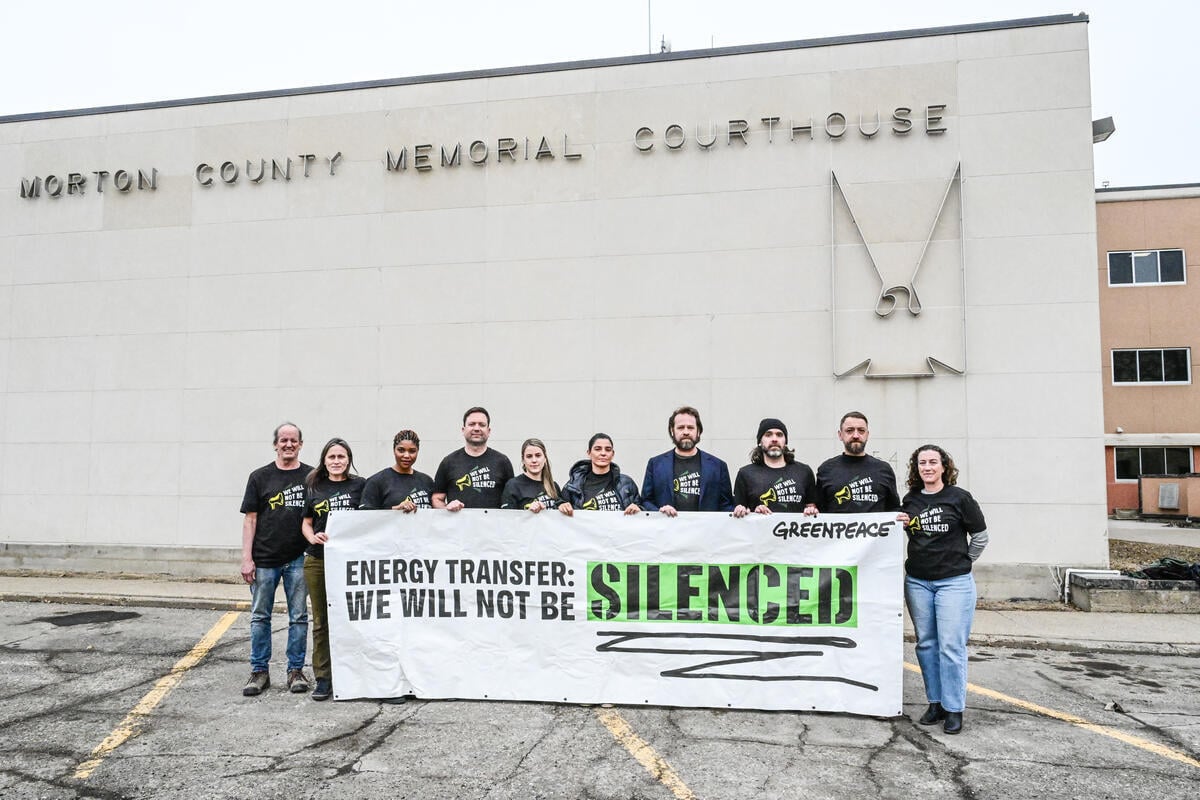
MANDAN, N.D. (February 27, 2026) — Greenpeace organizations in the U.S. and Greenpeace International announce they will seek a new trial and, if necessary, appeal the decision with the North Dakota Supreme Court following a North Dakota District Court judgment today awarding Energy Transfer (ET) $345 million. ET’s SLAPP suit remains a blatant attempt to silence free speech, erase Indigenous leadership of the Standing Rock movement, and punish solidarity with peaceful resistance to the Dakota Access Pipeline. Greenpeace International will also continue to seek damages for ET’s bullying lawsuits under EU anti-SLAPP legislation in the Netherlands.
“Speaking out against corporations that cause environmental harm should never be deemed unlawful,” said Marco Simons, Interim General Counsel at Greenpeace USA and Greenpeace Fund. “It is guaranteed by the U.S. Constitution, and is essential to the protection of communities and the health of democracy. This is a setback, but the movement to defend people and the planet has always faced setbacks and resistance, and Energy Transfer will fail in its goal of silencing its critics.
“The absurdity of this judgment can easily be illustrated. These Greenpeace organizations have been held responsible for supposedly delaying a pipeline that to this day does not have legal authority to operate, and which was actually delayed by the decisions of the US Army Corps of Engineers. The judgment includes tens of millions of dollars for signing a letter also signed by 500 other organizations, which echoed statements made in United Nations reports. If the courts still believe in justice, this result will not stand.”
The Court’s final judgment today rejects some of the jury verdict delivered in March 2025, but still awards hundreds of millions of dollars to ET without a sound basis in law. The Greenpeace defendants will continue to press their arguments that the US Constitution does not allow liability here, that ET did not present evidence to support its claims, that the Court admitted inflammatory and irrelevant evidence at trial and excluded other evidence supporting the defense, and that the jury pool in Mandan could not be impartial.[1][2]
ET’s back-to-back lawsuits against Greenpeace International and the US organizations Greenpeace USA (Greenpeace Inc.) and Greenpeace Fund are clear-cut examples of SLAPPs — lawsuits attempting to bury nonprofits and activists in legal fees, push them towards bankruptcy and ultimately silence dissent.[3] Greenpeace International, which is based in the Netherlands, is pursuing justice in Europe, with a suit against ET under Dutch law and the European Union’s new anti-SLAPP directive, a landmark test of the new legislation which could help set a powerful precedent against corporate bullying.[4]
“Energy Transfer’s attempts to silence us are failing. Greenpeace International will continue to resist intimidation tactics,” said Mads Christensen, Greenpeace International Executive Director. “We will not be silenced. We will only get louder, joining our voices to those of our allies all around the world against the corporate polluters and billionaire oligarchs who prioritise profits over people and the planet.
“With hard-won freedoms under threat and the climate crisis accelerating, the stakes of this legal fight couldn’t be higher. Through appeals in the US and Greenpeace International’s groundbreaking anti-SLAPP case in the Netherlands, we are exploring every option to hold Energy Transfer accountable for multiple abusive lawsuits and show all power-hungry bullies that their attacks will only result in a stronger people-powered movement.”
Greenpeace USA recently released a meticulously researched report on Energy Transfer’s pattern of pollution and legal violations, documenting hundreds of incidents and violations including four major disasters since September 2024. “If Energy Transfer thought their lawsuit would silence us, they are seriously mistaken,” said Tim Donaghy, Greenpeace USA Research Director and lead author of the report. “There’s something wrong with a system that too often lets polluters off the hook but penalizes those who call out harm. Free speech is an essential tool in building a healthier and more sustainable world. If people do not feel free to speak out against those who are polluting the air and water, and whose business model is driving us toward climate collapse, then what chance do we have of enacting solutions to these problems?”
Energy Transfer’s SLAPPs are part of a wave of abusive lawsuits filed by Big Oil companies like Shell, Total, and ENI against Greenpeace entities in recent years.[3] A couple of these cases have been successfully stopped in their tracks. This includes Greenpeace France successfully defeating TotalEnergies’ SLAPP on 28 March 2024, and Greenpeace UK and Greenpeace International forcing Shell to back down from its SLAPP on 10 December 2024.
Photos and Videos can be accessed from the Greenpeace Media Library.
Notes:
- The judgment entered by North Dakota District Court Judge Gion follows a jury verdict finding Greenpeace entities liable for more than US$660 million on March 19, 2025. Judge Gion subsequently threw out several items from the jury’s verdict, reducing the total damages to approximately US$345 million. [
- Public statements from the independent Trial Monitoring Committee
- Energy Transfer’s first lawsuit was filed in federal court in 2017 under the RICO Act – the Racketeer Influenced and Corrupt Organizations Act, a US federal statute designed to prosecute mob activity. The case was dismissed in 2019, with the judge stating the evidence fell “far short” of what was needed to establish a RICO enterprise. The federal court did not decide on Energy Transfer’s claims based on state law, so Energy Transfer promptly filed a new case in a North Dakota state court with these and other state law claims.
- Greenpeace International sent a Notice of Liability to Energy Transfer on 23 July 2024, informing the pipeline giant of Greenpeace International’s intention to bring an anti-SLAPP lawsuit against the company in a Dutch Court. After Energy Transfer declined to accept liability on multiple occasions (September 2024, December 2024), Greenpeace International initiated the first test of the European Union’s anti-SLAPP Directive on 11 February 2025 by filing a lawsuit in Dutch court against Energy Transfer. The case was officially registered in the docket of the Court of Amsterdam on 2 July, 2025. Greenpeace International seeks to recover all damages and costs it has suffered as a result of Energy Transfers’s back-to-back, abusive lawsuits demanding hundreds of millions of dollars from Greenpeace International and the Greenpeace organizations in the US. The next hearing in the Court of Amsterdam is scheduled for 16 April, 2026.
Contacts: Madison Carter, National Press Secretary, Greenpeace USA: [email protected], [email protected]