


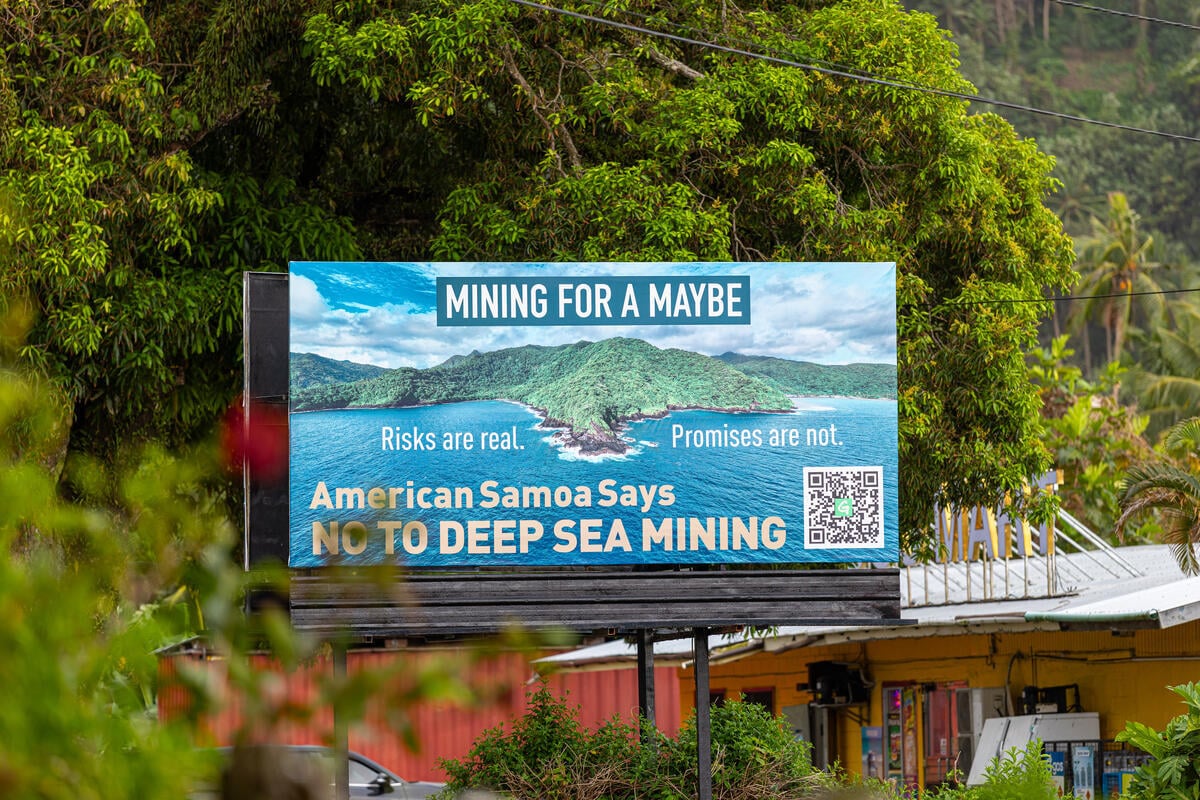
THOUSAND OAKS, Calif. (November 19, 2026) — The U.S. government issued its first deep sea mining commercial leases Thursday in federal waters off American Samoa, despite repeated opposition from the territory’s leaders and residents. The leases came three days after a federal judge threw out a key agency finding, ruling that regulators had failed to fully assess the risks to protected marine life including endangered blue, fin, sei and sperm whales, five sea turtle populations and five threatened coral species.
The Marine Minerals Administration offered two areas totaling about 31.5 million acres and awarded both leases to one bidder for $3 million each, a total of $6 million.
Sabrina Suluai-Mahuka, founder of Finafinau, American Samoa’s youth and environment nonprofit said: “We had hoped it would never come to this. More than 76,000 public comments, repeated calls for meaningful consultation, and now a federal court ruling that the government violated the Endangered Species Act. Yet here we are, watching our ocean being auctioned to the highest bidder. As a mother, I cannot accept that my daughter’s future, and the futures of generations yet to be born, are being treated as acceptable risks for an industry we never asked for.
“This is not just seabed on a map. This is our home, our livelihoods, our identity, and our responsibility to protect. We are here at Moana Rising because our people deserve more than being heard and ignored. They deserve a meaningful say in decisions that will affect generations. Ocean rights are human rights, and our home is not for sale.”
In a separate lawsuit, filed October 19, a council of Samoan chiefs (matai) and community groups, represented by Earthjustice, is challenging the federal government’s authority to lease the seabed off American Samoa, arguing the Marine Minerals Administration lacks the authority to auction seabed leases in U.S. territories under the Outer Continental Shelf Lands Act and historic treaties with American Samoa. A third lawsuit, filed Nov. 18 by Finafinau and the Natural Resources Defense Council, asks the court to strike down any leases issued.
As the auction took place, Pacific community members, Greenpeace USA activists and other allies gathered near the venue for Moana Rising: Stand with the Moana. At the center of the gathering was an ʻava bowl filled with ocean water brought from American Samoa. Through Samoan songs, prayers and remarks, elders, young people and other community members from across the Pacific honored their ties to the ocean and spoke about their responsibility to protect it for future generations.
Leila Tamale, North America Regional Representative, Sustainable Ocean Alliance, said: “What BOEM and corporate interests have done inside that room today is a great injustice. Throughout this process, American Samoan community members, political leaders, industry voices, and scientists have spoken out against deep-sea mining. The people most impacted by the decisions made in that room have not consented.
“As Indigenous people of Oceania, we carry our ancestors and our responsibilities to our land, ocean, and sky relatives wherever we go. Distance does not end our obligations to home. We carry our moana with us, and as young people, we are ending the status quo of exploitation and extraction that threatens her and our communities. Our ancestors were forced to sacrifice so much. We refuse to let that sacrifice become the inheritance of every generation that follows. We are standing up for our people, our ocean, and the generations yet to come.”
American Samoa imposed a moratorium on deep sea mining in its territorial waters in 2024. Territorial leaders and village councils opposed the federal plan to lease areas off American Samoa. The Bureau of Ocean Energy Management received more than 76,000 comments in response to its initial request for public input. Most opposed offshore leasing.
Arlo Hemphill, Oceans Are Life Campaign Lead at Greenpeace USA, said: “The U.S. just gave the deep sea mining industry its first foothold in U.S. waters after a court found it failed to consider the full scope of potential harm to endangered species. The industry will push to move from surveys to exploration to extraction, putting profits ahead of marine life and trampling the culture, livelihood and objections of communities that have said no again and again. Once mining strips away habitat that took millions of years to form, no amount of money can bring it back. Congress should press the administration to suspend these leases before work begins.”
The leases allow preliminary work such as seabed mapping and environmental surveys. Physical exploration, equipment testing and commercial mining would require separate federal approvals. At their closest point, the lease areas are about 3 miles from Rose Atoll Marine National Monument, one of the most pristine coral atoll ecosystems in the world and an important nesting habitat for the endangered hawksbill sea turtle.
Contacts:
Tanya Brooks, Senior Strategic Communications Specialist at Greenpeace USA, [email protected].
Greenpeace USA Press Desk: [email protected]
Greenpeace USA (Inc.) is part of a global network of independent campaigning organizations that use peaceful protest and creative communication to expose global environmental problems and promote solutions that are essential to a green and peaceful future. Greenpeace USA is committed to transforming the country’s unjust social, environmental, and economic systems from the ground up to address the climate crisis, advance racial justice, and build an economy that puts people first. Learn more at www.greenpeace.org/usa.