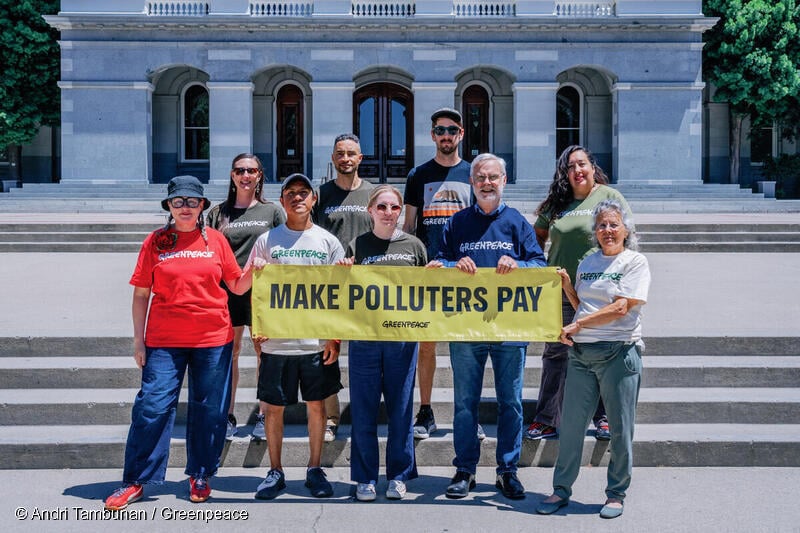
Banner Action at Connecticut Coal Plant. © Greenpeace
© Greenpeace

There are a lot of things about the wild west-style expansion of AI that are unbelievable. One of the worst is the resurgence of coal to power new data centers. Coal power has been on the decline in the US since the mid-2000s, and despite the historically low price of renewables, data center developers, tech companies, and the Trump administration are so eager to get data centers online and operating that they are pulling coal plants out of retirement.

In the last year, the U.S. Department of Energy (DOE) ordered five coal plants that were scheduled for retirement to keep running. These five coal plants have been estimated to cause 124 deaths per year as of 2019. Resurrecting coal plants is meant to help meet the rising demand for electricity driven primarily by data centers, but also part of Trump’s stated goal of bailing out the dying coal industry. In February, the DOE approved $175 million to upgrade seven more coal plants to keep them polluting for longer as part of public-private partnerships with the utility companies operating the coal plants. 

Energy Secretary Chris Wright told Reuters in September 2025, fueling AI data centers is a major driver for keeping existing coal capacity running. As the New York Times reported, DOE officials claim this is “just the beginning”. DOE has been ordering plants to stay open using authority from the Federal Power Act Section 202(c), which is reserved for “emergency” conditions.

The phasing out of U.S. coal power has had tremendous benefits for health, environmental justice, and the climate. Coal power comes with devastating air pollution, groundwater contamination, and health risks for children, workers, and local communities. Fine particulate air pollution from coal is responsible for an estimated 460,000 deaths between 1999 and 2020 in the U.S. alone. One study estimated that closing coal power plants between 2005-2016 saved over 22,000 lives as coal-related pollution dropped. 

Research shows that closing a significant emissions source like coal plants have immediate and long-term benefits in the region. After the Shenango coal coking plant closed in 2016, researchers saw a 20.5% decrease in weekly respiratory emergency visits and 41.2% decrease in emergency visits for pediatric asthma immediately after the shutdown, and respiratory emergency visits continued to drop for months. In 2023, coal accounted for just 16% of U.S. power supply, down from 53% in 2000, and retirement rates were accelerating. Although many existing coal plants are nearing their retirement age, the current administration has recklessly decided to attempt to revive the industry.

Most of these plants are also more than 50 years old and in need of expensive repairs to stay open, on top of the major health and climate impacts they bring with them. In case the world has forgotten, let’s tour twelve of the major coal power plants in the U.S. that are being reanimated or upgraded to service the reckless dash to build more AI.

The Coal Plants

Centralia Generating Station

Photo by Pete Forsyth / CC BY 3.0

The Centralia Power Plant in Lewis County, Washington is owned and operated by TransAlta Energy Corp. One unit for the plant was retired in 2020, and the second unit was scheduled for retirement in 2025. DOE ordered TransAlta to keep the plant open past its scheduled retirement in the same year. 

The Clean Air Task Force estimates that the plant was responsible for 25 deaths per year in 2019. According to the EPA, the Centralia Plant produced 940 tons of SO2, 3,536,937 tons of CO2, and 2,824 tons of NOx in 2024 alone. The plant released 19.7 pounds of mercury, an extremely dangerous neurotoxin, in the same year.

R.M. Schahfer is one of 2 coal plants in Indiana that the DOE ordered to stay open past their retirement dates at the end of 2025. Energy Secretary Wright claimed the plants were essential to meeting power demand for data centers being built in the Midwest. 

R.M. Schahfer is a generating plant in Jasper County, Indiana. The Clean Air Task Force estimates the plant causes 23 deaths per year as of 2019. In 2024, the remaining units of the Schahfer plant released 395 tons of SO2, 1,991,422 tons of CO2, and 1,351 tons of NOx.

Schahfer is also one of eleven coal plants with “high hazard” unlined coal ash ponds operating beyond their original closure date. Coal ash ponds are areas for depositing coal waste near plants, and unlined holding ponds like the two still in use at Schahfer leak and contaminate nearby groundwater. The U.S. Environmental Protection Agency delayed the closure of the ponds at the end of 2025. Ponds are designated as “high hazard” when their failure would lead to a significant loss of human life.

R.M. Schahfer Generating Station

Photo by Chris Light / CC BY-SA 4.0

F.B. Culley Generating Station

Photo by Peter Burzynski / CC BY-SA 3.0

The F.B. Culley Generating Station is a coal plant in Warwick County, Indiana was also targeted by the DOE to continue operating at the end of 2025. The F.B. Culley plant is partially retired, and is operated by CenterPoint Energy. The small, 14-MW coal unit at the plant was scheduled to close at the end of 2025 but DOE ordered it stay online.

Despite being a relatively small plant, F.B. Culley contributes to 11 deaths per year according to the Clean Air Task Force research on 2019 emissions. In 2024, the EPA recorded 1,615 tons of SO2, 2,407,767 tons of CO2, and 1,572 tons of NOx being released from the plant.

The J.H. Campbell Generating Plant is a coal plant in Ottawa County, Michigan. DOE delayed the planned retirement of the plant in spring 2025, despite the Michigan Public Service Commission insisting that there was “no existing energy emergency in either Michigan or MISO [the regional grid operator, Midcontinent Independent System Operator]” that would justify keeping the plant online. Sierra Club and Earthjustice are challenging the Department’s order in court, calling it an illegal use of emergency authority.

Consumers Energy, the utility that owns and operates Campbell, reportedly spent $29 million to keep the plant running in the first month after the DOE’s emergency order, and that number reportedly grew to $135 million by February 2026 – and these costs are borne by the ratepayers. 

U.S. EPA data shows the Campbell plant released 5,424 tons of SO2, 8,934,623 tons of CO2, and 3,232 tons of NOx. In 2024, the plant produced 62.8 pounds of mercury emissions. The Clean Air Task Force estimates the plant causes 44 deaths and over 450 asthma attacks per year from the plant’s pollution, as of 2019.

J.H. Campbell Generating Plant

Photo by NAIP Public Image Services / U.S. Public Domain

Craig Generating Station

Photo by Jimmy / CC BY-SA 2.0

The Craig Generating Station in Moffat County, Colorado was expected to retire one of its coal power units in 2025 and the remaining two in 2028, until DOE ordered it keep all units in operation beyond 2025. The unit scheduled for closure in 2025 was shut down in December due to a mechanical failure. Now that the plant is meant to come back online, the operator Tri-State Generation and Transmission has said “will likely require additional investments in operations, repairs, maintenance and, potentially, fuel supply, all factors increasing costs”.

According to Colorado state air rules, the unit scheduled to retire first must be taken offline because it cannot meet Colorado’s air pollution standards. Craig Generating Station’s pollution is responsible for 27 deaths and 8 heart attacks per year, according to estimates from the Clean Air Task Force. 1,304 tons of SO2, 5,879,473 tons of CO2, and 4,332 tons of NOx, and 25.2 pounds of mercury emissions came from the plant in 2024. In 2019, Clean Air Task Force found that Craig’s pollution led to 21 deaths per year. The Craig Station was one of three coal plants who were exempted from complying with mercury and other pollutant emission standards by Trump in 2025.

The Mountaineer Power Plant in Mason County, West Virginia is one of two coal power plants owned and operated by Appalachian Power Company that are receiving $87.7 million in funding to upgrade and maintain their coal-fired infrastructure. DOE will provide over $34 million to the power company for the upgrades, to be shared between Mountaineer and the John E. Amos Power Plant. Mountaineer emitted 2,165 tons of SO2, 5,057,232 tons of CO2, and 3,087 tons of NOx in 2024, according to the EPA. The Clean Air Task Force estimated it to cause 39 deaths as of 2019.

Mountaineer Power Plant

Photo by Nyttend / Public Domain

John E. Amos Power Plant

Photo by Tikilucas / CC BY-SA 4.0

The John E. Amos Power Plant in Putnam County, West Virginia will also receive an unreported share of the $34 million in funding Appalachian Power Company received from DOE to upgrade the two coal plants. A massive 4,333 tons of SO2, 10,479,852 tons of CO2, and 5,744 tons of NOx, and 54 pounds of mercury were emitted from the plant in 2024. The Amos Plant also caused 30 deaths per year based on its 2019 emissions and pollution.

The Cardinal Plant in Jefferson County, Ohio is a coal power plant owned and operated by Buckeye Power Inc. The Trump administration announced that Cardinal will receive over $97 million to upgrade two of the coal power units at the plant. DOE will provide $34 million of public funding for the units to receive “extensive modernizations” to keep the antiquated fuel burning. Public health research has shown the plant is responsible for 168 deaths and over 1,400 asthma attacks per year as of 2019, and in 2024 the plant released 12,073 tons of SO2, 10,095,511 tons of CO2, 3,388 tons of NOx, and 62 pounds of mercury in 2024. 

The NRDC found that Cardinal was one of the biggest mercury emitters in the Great Lakes region in 2012, most of which could be eliminated with technologies available at the time. In 2025, Trump exempted Cardinal and two other plants (including the Craig Station) from having to comply with mercury pollution limits until 2029.

Cardinal Plant

Photo by Roseohioresident / CC BY-SA 3.0

Belews Creek Steam Station

Photo by David Dalton / CC BY 4.0

Belews Creek Steam Station is a coal plant in Stokes County, North Carolina. DOE announced that its owner, Duke Energy Carolinas LLC, will receive $34 million from the agency out of a total funding package of just under $100 million. The funds are meant to upgrade two of the coal units to “increase the availability factor of the plant, add generation capacity, and deliver a return on investment”. The power station emitted 1,218 tons of SO2, 6,711,897 tons of CO2, and 8,225 tons of NOx in 2024. The Clean Air Task Force attributed Belews Creek to cause 39 deaths per year as of 2019.

Ghent Generating Station in Carroll County, Kentucky is a coal plant operated by Kentucky Utilities Corporation. DOE will provide $35 million in funding to the utility company, and the total funding package is a whopping $187.3 million. The Ghent Station is the biggest carbon emitter on our list. Ghent released 9,157 tons of SO2, 11,399,878 tons of CO2, and 6,988 tons of NOx in 2024. The significant emissions and pollution from the plant caused an estimated 95 deaths per year as of 2019.

Ghent Generating Station

Photo by Antony-22 / CC BY-SA 4.0

Fort Martin Power Station

Photo by FirstEnergy / CC BY-ND 2.0

Fort Martin Power Station is a power plant in Monongalia County, West Virginia with two coal-fired units. The owner and operator, Monongahela Power Company, will receive a total of over $8.5 million for upgrades and maintenance, with over $4 million coming from the DOE. In 2024, Fort Martin released 1,912 tons of SO2, 3,969,328 tons of CO2, and 5,001 tons of NOx pollutants. Research indicates the plant has caused 56 deaths per year as of 2019.

The Kyger Creek Station in Gallia County, Ohio is a coal plant owned by Ohio Valley Electric Corporation. The utility will receive over $33 million from DOE for “modernizations” and upgrades – part of a $73 million funding package. According to the EPA, Kyger Creek emitted 3,736 tons of SO2, 5,557,469 tons of CO2, and 3,434 tons of NOx in 2024. Based on its 2019 emissions and pollution, Kyger Creek is responsible for an estimated 43 deaths. 

Kyger Creek Station

Photo by FunksBrother / CC BY-SA 4.0

Affordability

A major driver of coal plant closures is simple economics. Many of the coal plants across the country have become too expensive to operate, as the revenue they generate doesn’t make up for their repairs and maintenance costs.

Consider the case of the J.H. Campbell coal plant in western Michigan and its operator, Consumers Energy. Consumers Energy had planned to retire all coal generation by 2025 – 15 years faster than it had previously projected – because phasing out coal would be easier on the pocketbooks of consumers without sacrificing reliable power. The original plan claimed it would “save customers an estimated $600 million through 2040” on top of the environmental and health benefits.

But who pays when coal plants stay open? Utilities fund coal upgrades and repairs, and these costs get passed on to ratepayers. Consumers Energy, for example, has recently stated that they expect the cost to operate the J.H. Campbell plant be spread among ratepayers across the Midwestern regional grid, even outside of Michigan. Tri-State, the operator of Colorado’s Craig station, made it clear that reopening the plant will force ratepayers to “unnecessarily bear the full cost of complying”.

According to a report from Grid Strategies, preventing the nation’s aging coal and fossil-fired power plants from retiring over the next three years could cost consumers at least $3 billion per year. And the healthcare costs for people suffering the pollution of coal plants is far worse. Health-related costs from coal cost billions of dollars per year – 13 times more than the amount ratepayers pay for electricity alone. The Rocky Mountain Institute estimates that between 2015 and 2023, coal power racked up a staggering $236 billion in health costs for families and communities. The EPA just announced they will weaken even more regulations on limits for hazardous pollutants from coal plants, including mercury, which will further ramp up the health toll.

A genuine commitment to affordability would mean embracing the phase-out of costly coal and fossil fuels. Luckily, today renewables are best for consumer affordability, health, and the climate. For example, by co-locating renewable energy infrastructure with data centers, ratepayers would be spared the burden of expensive utility upgrades, prevent thousands of air pollution-related deaths and illnesses, and save millions of dollars spent each year, per plant, on direct health impacts.

It’s unclear how successful the Trump administration will be at prolonging coal’s lifespan. But what is desperately clear is what’s at stake: lifelines for coal pose serious threats to human health, the climate, and our wallets. Coal is an expensive, dirty fuel that has become an economic burden and an environmental harm. It’s time to say goodbye to coal.