As AI dominates public attention, markets, and investor interest, focus has turned to major tech companies like Microsoft, Amazon, OpenAI, and Meta. These tech giants have received major scrutiny for their approaches to building the data centers for their contested AI products – but the companies providing critical hardware have received less scrutiny. The supply chain emissions and environmental impacts for the chips required for the AI boom are proving to be just as consequential as data centers themselves. Enter the industry leader: Nvidia.
The environmental impacts of Big Tech’s desperate buildout of data centers has received significant backlash – and for good reason. The public pressure to stop data center projects for fear of ratepayer impacts, grid instability, emissions, and water scarcity has even led legislatures to propose a moratorium to Congress.
Nvidia is a Silicon Valley-based tech company led by CEO, president, and co-founder Jensen Huang. Nvidia’s core business model is the design and development of graphics processing units (GPUs), semiconductors, and chips. Originally focused on gaming applications, Nvidia has expanded into AI and other advanced computing and is now the top supplier for almost all other Big Tech companies. They are now the first company to reach a $5 trillion valuation.
In February 2026, Nvidia announced a record $215.9 billion in revenue, and a quarterly revenue of $62.3 billion from data center projects alone. The earnings reflect a tour de force of Nvidia’s contracts across the industry, including Amazon, Google, Microsoft, Oracle, Meta, CoreWeave, Anthropic, plus robotics, automobiles, gaming companies, public initiatives like the U.S. Department of Energy’s Genesis Mission.
Yet the dominance of Nvidia’s semiconductor supply and the data center buildout that Huang actively encourages comes at a huge, and largely hidden, environmental cost. Data centers are not the only place major climate and environmental impacts are building up. Greenpeace East Asia has been investigating the sustainability of the tech supply chain for years. Because so much of the supply chain for tech exists outside of the U.S., this critical part of the picture is woefully underappreciated by U.S. media coverage. But the impacts on climate are tremendous and wildly more difficult to track than data centers alone – making Nvidia’s role in incentivizing the expansion without guardrails all the more concerning.
In 2025, Greenpeace East Asia (GPEA) ranked Nvidia and 9 other tech companies based on their operational and supply chain sustainability. The report was one of the first in-depth studies to compare supply chains among tech majors and qualify how they are working toward sustainability. Nvidia received an overall ‘F’ score.
A “decarbonization deficit”
Researchers at GPEA recently examined Nvidia’s supply chain, which is largely concentrated in East Asia, to investigate the environmental impacts of designing, developing, and manufacturing of the company’s products. GPEA analyzed Nvidia’s top 20 suppliers, which include major firms like TSMC, Samsung, and SK Hynix.
GPEA found that Nvidia’s climate impact was staggering. 99.8% of the company’s greenhouse gas emissions came from outside of their own operations and are not reflected in their reported Scope 1 and 2 emissions. The 6,925,529 MtCO2e that Nvidia released in 2025 were almost entirely from their Scope 3, or indirect, emissions across their supply chain. 87% of those were estimated to come from upstream suppliers concentrated in East Asia.
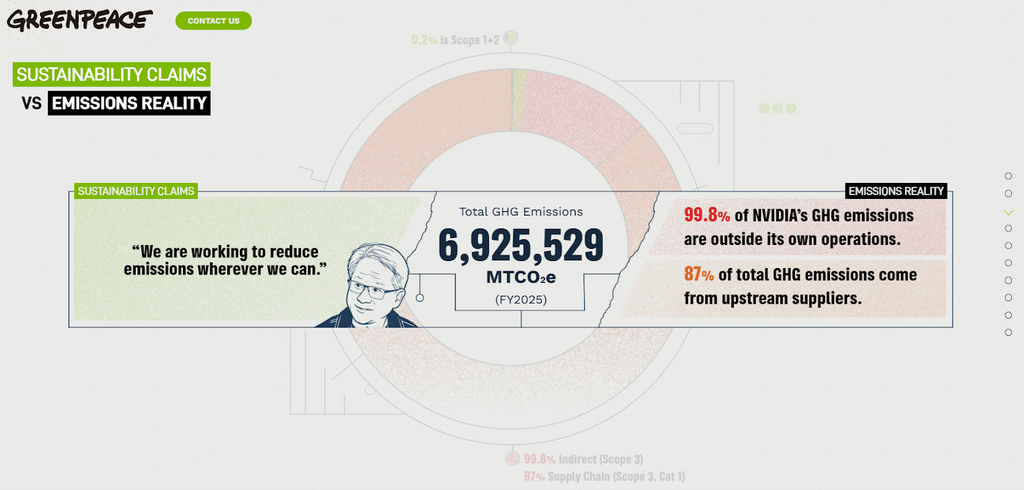
Despite these dizzying numbers, Nvidia claims to be “setting new standards for environmental responsibility” and contributing to a more sustainable world. But over the last three years, Nvidia’s emissions have more than doubled as the company secures major deals across the tech sector and capitalizes on the AI boom. Nvidia has not set emissions reductions targets and has no renewable energy transition plan for its supply chain. This lack of real decarbonization efforts across Nvidia’s supply chain has real climate impacts and risks locking in more fossil fuel infrastructure for decades.
The man behind the vision
Beyond its failures to back real climate and sustainability progress, Nvidia and its CEO have been central in the public push for AI investment and adoption. Nvidia has positioned itself at the heart of circular dealmaking that has made experts wary of a financial bubble and the risks of cascading losses from overinvestment. For instance, Nvidia has made substantial investments in companies like OpenAI and xAI, which have in turn contracted Nvidia to supply their AI operations with chips.
At Nvidia’s GPU Technology Conference in March 2026, Huang’s keynote speech made it clear that the company’s ambitions are to “define the whole physical plant of the AI economy”. Two months earlier, the leader of the world’s biggest chip company also insisted at the annual World Economic Forum summit in Davos, Switzerland that “trillions of dollars of AI infrastructure needs to be built. He claimed that investors shouldn’t burden AI companies with concerns about return-on-investments.
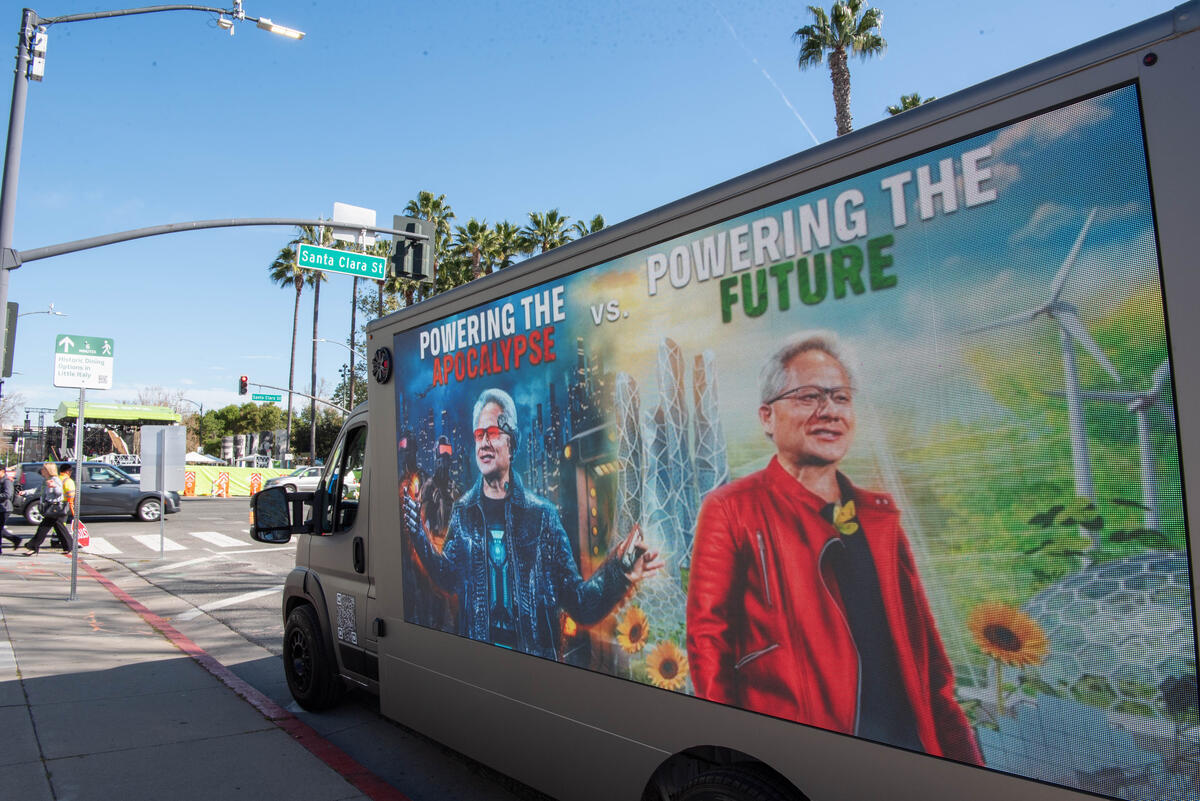
In 2025, Huang appeared on the Joe Rogan Experience podcast to promote false solutions for AI’s “energy bottleneck” (after praising President Trump’s “genius”). Huang asserted that nuclear energy, including small modular reactors, and off-grid power were the solution to get AI online. He also argued that letting tech companies become power companies was an obvious and valuable solution to grid instability risks. And despite the diverse evidence to the contrary, Huang has promised that the expansion of AI and data centers will also create many new jobs and be the most important development in human history.
Huang’s extravagant assertions need a major reality check. Real technological transformation that uplifts humanity cannot come at the expense of the climate and local communities. Any expansion of AI must be coupled with direct renewable energy investments, transparent supply chain accountability and decarbonization, and meaningful emissions reduction targets. If the AI boom is not built on climate justice, it becomes just another engine driving the planet toward climate catastrophe.
The problem is only growing
On top of Nvidia’s irresponsible supply chain, they are increasingly partnering with oil and gas firms to enable more emissions and entrench the world in more fossil fuels. Recently, Nvidia has announced expanded contracts with SLB, a multinational oilfield services company that focuses on petroleum exploration and production. The deal will not only provide SLB with advanced compute and AI tools to drive SLB’s growth, but will also position SLB to act “as a design partner for modular AI data centers” that will be fashioned with Nvidia’s products. Shell has also been a large customer, for which Nvidia is providing both compute and support for building generative tools for the company’s petrochemical program.
Like its supply chain, Nvidia has authority to partner with business customers that will contribute to global decarbonization in earnest. Despite the company’s attempt to greenwash some of these deals as improving the environmental impact of oil and gas operations, any support or tools that perpetuates fossil fuel dominance is inherently against decarbonization or fossil fuel phase out reality.
Sign the petition to tell Nvidia to take real climate action across its supply chain.