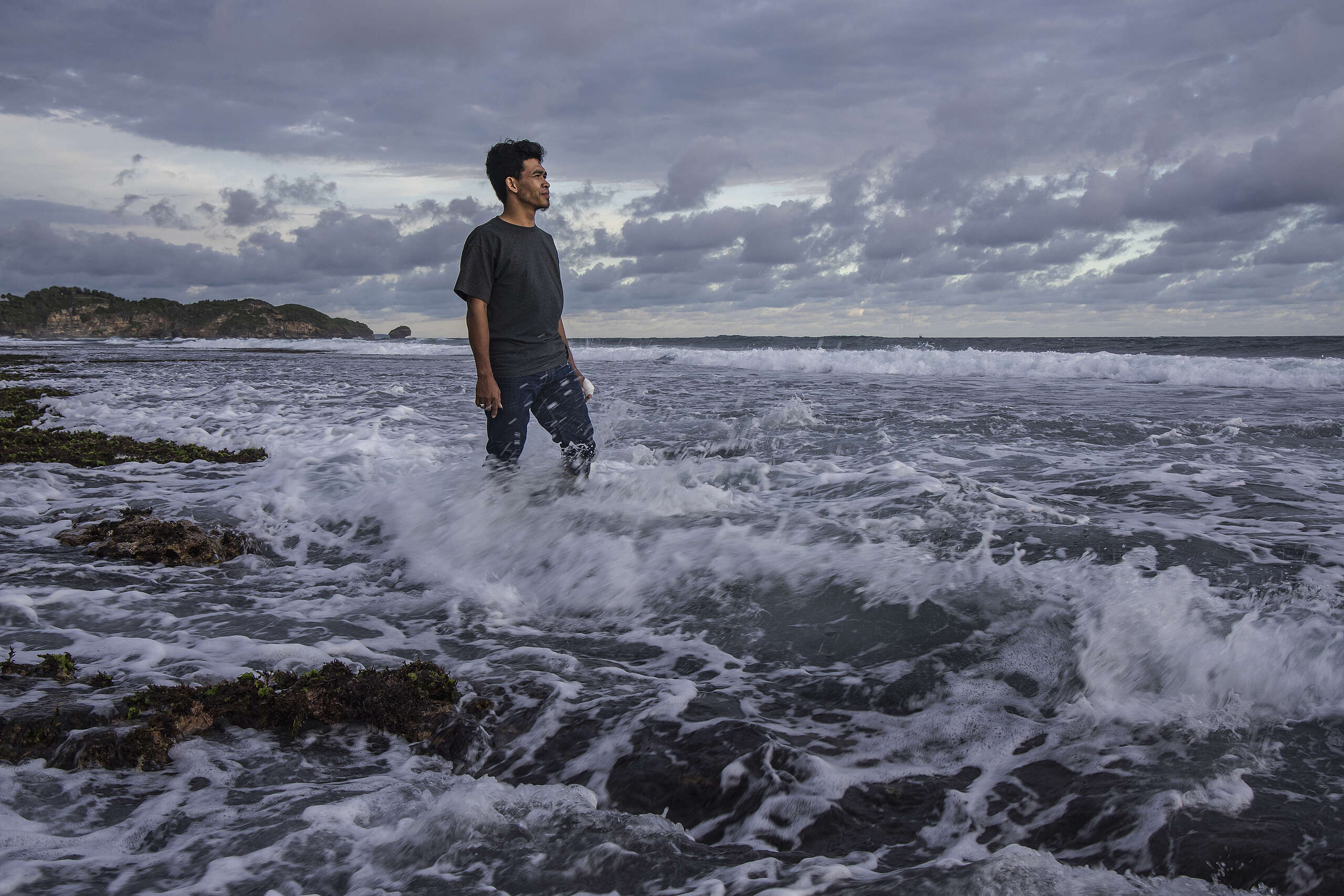
When Akhmad felt liquid pooling in his boot, he thought seawater was leaking in. He later realized it was his own blood.
Muhammad Syafi’i alleges he suffered severe burns from hot oil while working as a cook aboard a distant-water fishing vessel and was denied medical treatment.
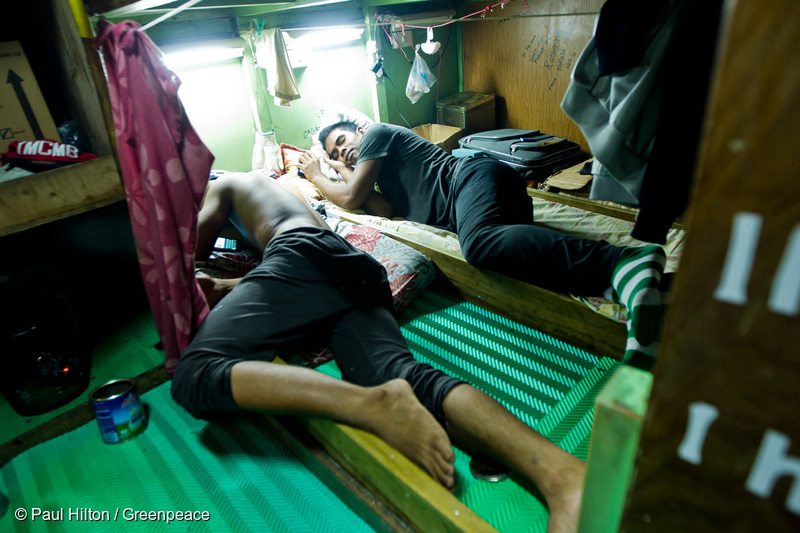
Both men allege in a legal complaint that they were trapped at sea for months, forced to work excessive and exhausting hours under threats and isolation, with no safe way to leave.
Their complaint outlines that the tuna they helped catch travelled through a complex global supply chain and ended up on supermarket shelves in the United States.
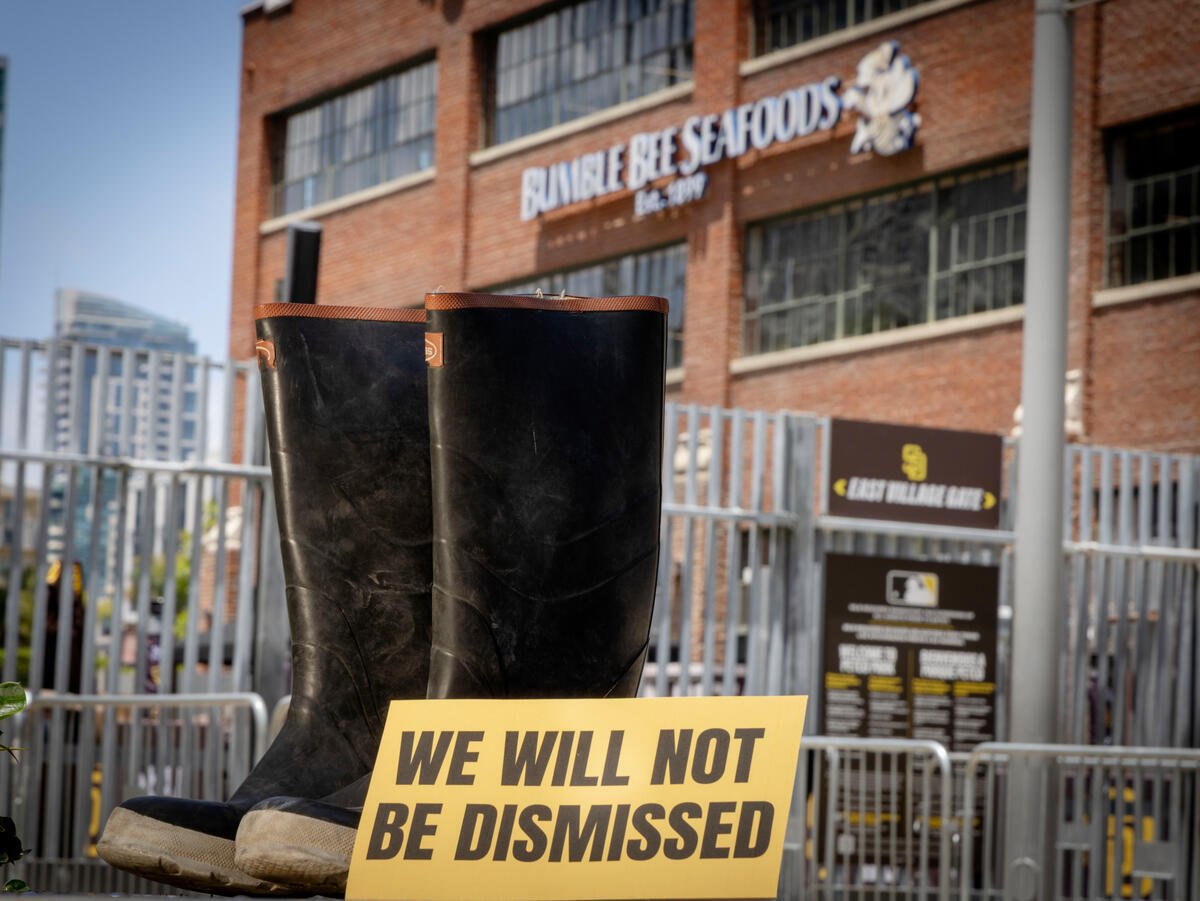
In March 2025, Akhmad, Syafi’i, and two other Indonesian fishers took a step that few workers in the abuse-ridden global fishing industry have ever been able to take: they filed a lawsuit in a U.S. court against one of the country’s largest tuna brands. The complaint alleges the U.S. company, Bumble Bee Foods, benefited from their forced labor aboard distant-water fishing vessels in its supply chain.
Their case is a classic David-and-Goliath struggle — four workers from rural Indonesia challenging a multibillion-dollar industry. But it is also something more: a bid to transform how seafood is produced and traded so that protecting oceans goes hand in hand with protecting the people who depend on them.

Why their voices matter
Industrial fishing often takes place thousands of miles from land, where oversight is minimal and help is out of reach. Workers in vulnerable positions, seeking the universal dream of a better life for themselves and their families, can instead find themselves isolated on vessels for months or even years.
The experiences alleged by these four fishers reflect well-documented patterns across distant-water fleets worldwide: dangerous working conditions, withheld wages, physical abuse, and the inability to leave. The International Labor Organization (ILO) estimates that at least 128,000 people around the world work in conditions of forced labor aboard fishing boats.
“I want justice … For myself, for my fate. And for my friends who are still out there,” Muhammad Syafi’i said when the case was filed.
Akhmad hopes the lawsuit will spare others from the suffering described in his complaint. “So many men are out there right now, trapped in the same dangerous situation that I was,” he said. “They deserve to work free from abuse.“
Their courage is extraordinary because it’s dangerous to speak out. In an industry shaped by powerful global supply chains, fishers often enter these jobs burdened by recruitment debt and face threats to their own safety and that of their families if they resist. The risk of permanent blacklisting — from work that may be one of the few viable paths to a livable income in their communities — keeps many silent, allowing abuses to persist far from public view. Against those odds, their decision to come forward challenges a system that has long relied on workers’ invisibility.
Confronting a system that exploits workers and depletes oceans
According to the complaint, the men worked on distant-water fishing vessels that supplied tuna to Bumble Bee as part of its “trusted network” of suppliers. Bumble Bee is a more than $1 billion U.S. company and the country’s most popular brand of canned albacore tuna. It purchases a whopping 41,000 metric tons of albacore tuna every year—approximately 20% of this species that is pulled out of all of the world’s oceans in a single year.
The vessels identified in the complaint used both transhipment at sea and longline fishing—practices that increase risks for workers while placing heavy pressure on marine ecosystems.
Through transhipment at sea, fishing vessels transfer their catch to refrigerated cargo ships while taking on fuel and supplies without returning to port, allowing them to remain at sea for months or even years. For crews, this often means prolonged isolation without inspections, medical care, or meaningful contact with the world beyond their ship. Limited or nonexistent internet access further cuts workers off from family members, unions, and government authorities, making it difficult to report abuse or leave unsafe conditions.

The Rainbow Warrior is in the South Pacific Ocean to expose longline fishing and call on governments to ratify the Global Ocean Treaty and create a network of protected areas in the High Seas.
As fish stocks close to shore have been depleted, industrial fleets have pushed farther out to sea and remain at sea for longer periods to maintain high catch volumes and profitability. Longline fishing, deploying lines that can stretch for up to 50 miles and carrying thousands of baited hooks, targets tuna but also ensnares sharks, sea turtles, seabirds, and other marine wildlife in large numbers, accelerating the decline of ocean biodiversity.
Together, these dynamics form a reinforcing downward spiral: declining fish stocks push fleets farther out to sea; transhipment enables continuous operations with limited oversight; and prolonged isolation increases the risk of worker exploitation, while intensifying pressure on marine ecosystems. In this business model, environmental harm and human rights abuses are not separate problems — they enable and reinforce each other through a lack of transparency at sea.
A hard-won step toward accountability
The lawsuit was filed under the Trafficking Victims Protection Reauthorization Act (TVPRA), a U.S. law with strong bipartisan support, that allows survivors to sue U.S. persons and corporations that knowingly benefit from forced labor, even when the abuse occurs overseas.
In our increasingly globalized world, where almost everything in our homes has passed through multiple countries before arriving in our hands and where nearly 17.3 million people are in forced labor in the private sector, these provisions are a path towards justice for workers who make our clothes, grow our food, and catch our fish.
| TVPRA Supply Chain Cases Since 2008, this law has been used by workers who allege they were subject to forced labor producing disposable gloves in Malaysia, mining cobalt for cellphone batteries in the Democratic Republic of Congo, and processing shrimp at a factory in Thailand. Major Developments in the Bumble Bee Case |
Bringing such a case in the fishing industry, which involves complex and opaque supply chains, is extraordinarily difficult. Investigations and supply chain research from the Greenpeace global network’s fisheries campaigns were used by the litigants’ attorneys to support this complaint.
Since the case was filed in March, Bumble Bee has sought dismissal. But in November 2025, a federal judge allowed it to proceed — a significant milestone for overseas labor claims, as it became one of only a few TVPRA supply chain cases to move past the motion-to-dismiss stage. The court found the plaintiffs presented sufficient allegations that, if proven by the evidence, could establish Bumble Bee’s liability.

If successful, this case could help set a legal precedent for holding major seafood companies accountable for conditions in their supply chains.
Prayer for relief: beyond compensation, towards a systems shift
Every lawsuit includes a section known as a “prayer for relief” — where plaintiffs formally state what they are asking the court to grant for their pain, suffering, or as compensation for their losses. To some, the phrase may sound quaint in a legal proceeding, but its plain meaning still resonates; a plea for justice, for repair, for a different future.
In this case, the fishers are seeking compensation for the alleged forced labor they endured. But their request goes beyond damages. They are asking one of the biggest players in the global seafood industry to change the way it does business so that they and others can work safely.
Among other measures, they call for vessels to carry appropriate medical equipment and for fishers to be able to be treated onshore in a timely manner. They seek reasonable rest and sleep after extremely physically demanding labor, access to Wi-Fi to maintain regular communication with family, and the right to return to shore every three months.
If adopted, these changes would not only improve safety for workers on vessels supplying Bumble Bee but also begin to break the isolation that has allowed the abuse of fishers to persist. Greater oversight, communication, and time in port can also reduce the secrecy that enables illegal and destructive fishing practices.
The court has not yet decided whether all of the requests will be considered as part of the case. But by placing them on record, the fishers have already expanded the conversation about what justice at sea could look like.

A case for hope and a warning for Big Seafood
For decades, abuses at sea have been extraordinarily difficult to challenge because they occur far from witnesses, regulators, and courts. Workers often lack documentation, legal support, or safe ways to report what they have endured or witnessed, leaving harm to remain hidden on the vast high seas.
By bringing their claims to a U.S. courtroom, these four men are challenging the long-standing tacitly held notion that distance shields powerful companies from responsibility. Their case forces companies, policymakers, and consumers alike to confront the human and environmental realities embedded in the global seafood supply chain.
Pressure on Big Seafood has been building for years through exposé after exposé, consumer action, and workers unionizing, advocating, and seeking justice. Now, that pressure has reached the doorstep of a U.S. brand in U.S. courts, directly challenging the idea that companies can profit from distant supply chains without taking responsibility for what happens at sea.
Big Seafood — companies at the top of the supply chain, such as global brands and mega-retailers — shape how fishing is conducted worldwide, influencing both labor and environmental practices. By confronting one of these companies directly, these fishers are advancing not only their own pursuit of justice but also the rights of workers across the industry and the protection of the oceans we all depend upon.
Out of sight is no longer out of mind. Big Seafood has been put on notice: what happens at sea is increasingly visible and subject to accountability. For workers, the message is equally powerful — they are not invisible. Their experiences and voices can drive change.