Summary
Greenpeace USA’s fourth edition of the High Cost of Cheap Tuna report found that only two of the 16 major U.S. retailers received passing scores for their human rights and sustainability practices within their tuna supply chains. The U.S. remains one of the world’s largest consumers of tuna and a significant import market: in 2023, the U.S. imported 80-90% of its seafood, with a total value of $25.3 billion USD. 1
Most importantly, the report found that no retailer is fully addressing the human rights abuses and environmental destruction within its supply chain, with ten retailers scoring at or below 40%.
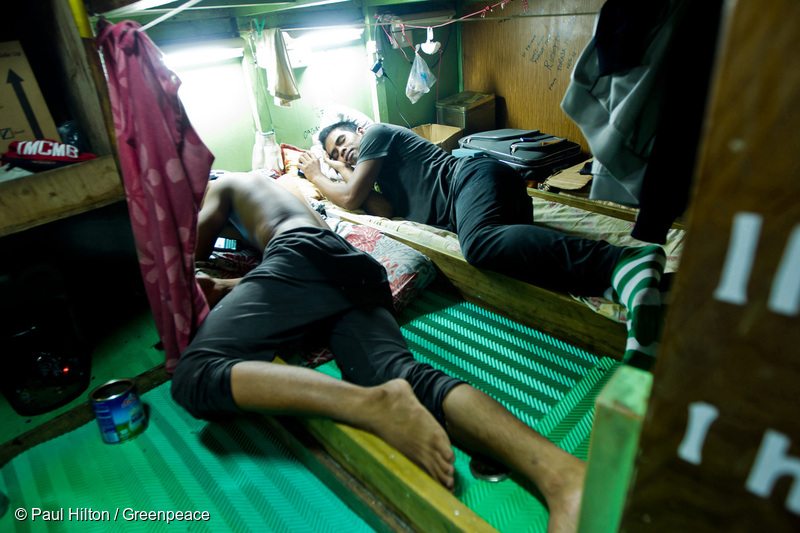
The Greenpeace network is urging seafood retailers and producers to take the following actions to end isolation at sea:
- Ensure that fishers have access to free, accessible, and secure Wi-Fi.
- Limit time spent at sea to a maximum of three months.
- Mandate 100% human observer or electronic monitoring coverage on fishing vessels.
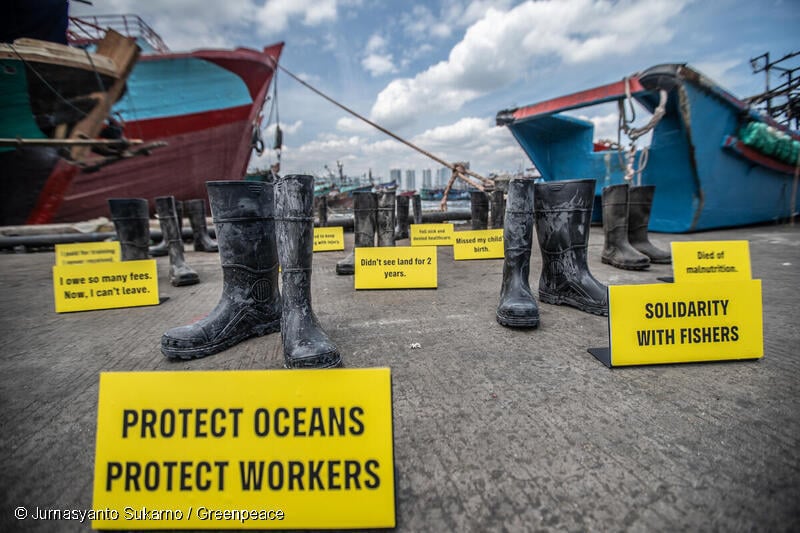
Profit-driven cost-cutting in the seafood industry—often at the expense of workers, marine life, and ocean ecosystems—has fueled a dramatic rise in sustainability and human rights violations. The market power of retailers shapes fishing practices and labor conditions across the seafood industry, providing retailers with the ability to meaningfully address issues such as overfishing, destructive fishing methods, and widespread forced labor at sea.
Additionally, recognizing the freedom of association and allowing workers access to labor unions are crucial rights that help ensure worker protections throughout the supply chain. It is essential to have accessible, secure, and responsive grievance mechanisms, including those available at sea.
Additional key findings include:
- For the first time, Whole Foods ranked at the top of the scorecard, primarily due to its new Seafood Code of Conduct, which tackles the forced labor issues within its supply chain. These include banning recruitment fees paid by workers, mandating clearer grievance mechanisms so workers can seek remedies, and ensuring that crew members have access to communication to contact their families, unions, and governments. While the Code of Conduct makes strides to address forced labor risks, it falls short of the systemic changes necessary to end isolation at sea. One of the most effective ways to protect workers is to limit their time at sea to three months, yet Whole Foods’ Code still allows for an extensive 11 months at sea, increasing the risk of human rights abuses.
- Aldi and Hy-Vee, which previously held top rankings, fell in this assessment mainly due to decreased federal & local advocacy during this evaluation period
As global trade remains unstable—creating new risks for labor rights2 3 —and tuna populations face mounting pressure from overfishing, climate change,4 and the potential expansion of deep-sea mining,5 retailers have an urgent responsibility to act now.
1 White, C. February 12, 2024. US seafood trade deficit hit USD 20.3 billion in 2023. Available online at: https://www.seafoodsource.com/news/supply-trade/us-seafood-trade-deficit-hit-usd-20-3-billion-in-2023
2 The Freedom Hub. April 20, 2025. Tariffs and Human Rights: Navigating Business in Turbulent Times. Available online at: https://thefreedomhub.org/article/tariffs-and-human-rights/?srsltid=AfmBOoq-OLXwZ_pHILflcYnIsB2xuRWiDcv6VZD7Z8lAGPVUIjAQfr0W
3 The Business and Human Rights Centre. April 4, 2025. Supply Chain Stability Threatened by New Tariff Regime – Global Brands Must Step Up to Protect Workers, Human Rights Experts Warn. Available online at: https://www.business-humanrights.org/en/from-us/press-releases/supply-chain-stability-threatened-by-new-tariff-regime-global-brands-must-step-up-to-protect-workers-human-rights-experts-warn/
4 Chase, C. Seafood Source. November 4, 2025. MSC research finds tuna fisheries are at most risk from climate change. Available online at: https://www.cell.com/cell-reports-sustainability/fulltext/S2949-7906(25)00251-4
5 Thaler, A. D. 2025. Impacts of Deep-sea Mining on Migratory Species: Review and Knowledge Gaps. CMS Secretariat, Bonn, Germany. Available online at: https://www.cms.int/sites/default/files/document/2025-11/cms_cop15_doc.25.2.3_annex1_dsm-report_e.pdf