Amnesty bekymret for Greenpeace-dom
Ritzaus Bureau 10. juni 2005 kl. 1710
København, fredag
/Ritzau/
Flere andre organisationer er betænkelige ved grundlaget for
fredagens Greenpeace-dom. Heriblandt Amnesty, som frygter for en
svækkelse af organisationsarbejde. Amnesty International er
betænkelig ved fredagens Greenpeace-dom.
Menneskerettighedsorganisationen er bekymret for konsekvenserne
af dommen, som fastslår, at en organisation i sin helhed kan dømmes
for de aktioner, som dens aktivister foretager.
- Vi vil meget nødigt se et mønster, hvor danske organisationer
hele tiden bliver idømt bøder. Det vil føre til en svækkelse af
organisationsarbejdet herhjemme, siger Amnesty Internationals
generalsekretær i Danmark, Lars Normann Jørgensen.
Han er bekymret for, at indførelsen af terrorpakken efter
angrebet på USA den 11. september 2001 danner grundlag for, at
Greenpeace kunne anklages i sagen.
- Vi er bekymret for, om man dermed bruger terrorbestemmelserne
til at stramme grebet om organisationernes aktiviteter. Det er en
udvikling, man i så fald bør kigge meget kritisk på, siger Lars
Normann Jørgensen.
En paraply af andre miljøorganisationer, heriblandt Danmarks
Naturfredningsforening, har tidligere vist deres støtte til
Greenpeace under sagen.
/Ritzau/
Greenpeace fined 4,000 euros under new Danish terror law
Agence France-Presse English Wire 06-10-2005
COPENHAGEN, June 10 (AFP) - The Environmentalist group
Greenpeace was on Friday fined 30,000 kroner (4,900 dollars, 4,000
euros) by a Copenhagen court, becoming the first organization
sentenced under a new Danish anti-terror law.
Greenpeace was charged under new legislation introduced after
the attacks in New York and Washington on September 11, 2001,
following a protest in October 2003 against genetically modified
organisms (GMOs) in the Scandinavian country's booming pork
industry.
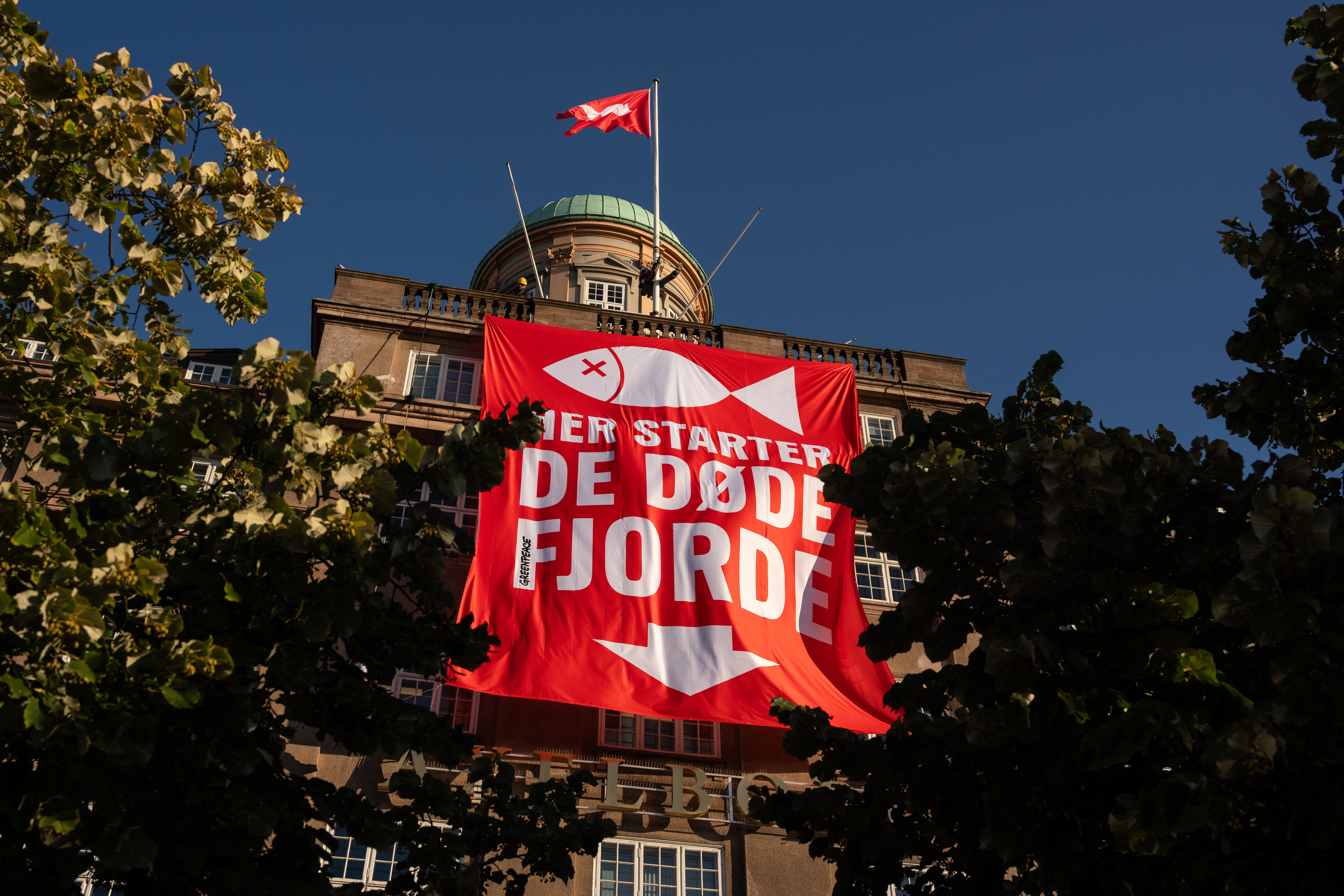
The 15 individual protestors, who entered the Copenhagen
headquarters of the Danish Agriculture association and reportedly
hung a banner reading "No to GMO swine" from a window, were each
fined 1,500 kroner several months ago for violating domestic
peace.
The terror legislation allows the courts to hold organizations
responsible for the actions of their individual members, which
prosecutors said cleared the way for the charges to be brought
against Greenpeace.
The group has meanwhile claimed that the charges constitute a
violation of the new laws, which it insists are meant to lay
responsibility for terrorist acts on the organizations that support
them, and not punish "peaceful" groups for activist protests.
"When the terrorism laws were introduced, the rule was that
organizations could be punished for doing something illegal. But it
was clear that the aim was to target organizations that supported
terrorism... Now, they are trying to use the laws against a
peaceful group like Greenpeace," Greenpeace lawyer Steen Beck said
when the charges were pressed last month.
Greenpeace Denmark spokesman Mads Christensen told AFP on Friday
that the group was "shocked by today's judgement".
"This shows that the courts have now found a law paragraph that
can be used to clip the wings of the civil society," he
insisted.
The group also told Danish newswire Ritzau that it feared the
court ruling would have a negative impact on the work of Danish
grassroot organizations going forward.
Greenpeace, which has two weeks to file an appeal, will probably
decide next week whether or not to do so, Christensen said, adding
that the organizaition most likely would try to get the public to
help sway politicians to change the law.
"The way the court has interpreted the word of the law doesn't
seem to give us much room to maneuvre," Christensen said.
Police prosecutor Jens Rasmussen meanwhile told Ritzau that he
was satisfied with the outcome of the case, though he said he had
hoped for a fine of 100,000 Danish kroner, which he felt would have
been a stronger signal with greater preventive effect.
str-nl/po/g
Denmark-justice-environment-biotech-GMO-Greenpeace
Här är de nya terroristerna
Aftonbladet editorial 10 juni 2005.
Tusentals svenska organisationer måste registreras och
övervakas
Några aktivister från Greenpeace hängde upp en banderoll i
centrala Köpenhamn. Protesten mot genteknik i jordbruket var
fredlig. Ändå kan organisationen fällas för brott efter att lagarna
skärpts för att hindra terrorismen. I går fick nordiske chefen
Lennart Daléus stå till svars i en dansk rättssal. Det är ännu ett
exempel på hur svepande lagstiftning fått dramatiska effekter efter
11 september 2001.
Kränker föreningsfriheten
Folkrörelserna i Sverige varnar för nya planer. Tusentals
svenska organisationer måste registreras, övervakas och
kontrolleras, enligt ett förslag från den internationella
arbetsgruppen FATF. Syftet är att strypa penningflödet till
terrorgrupper. Effekten kan bli kränkningar av föreningsfriheten
och stora svårigheter att ge stöd till demokratirörelser i andra
länder.
Justitiedepartementet lovade inför veckans FATF-möte att ta
hänsyn till protesterna. Regeringen är tystare om vad som händer i
EU. Att övervaka ideella organisationer är en av hundratals punkter
i den uppdaterade handlingsplan mot terrorism som EU:s toppmöte ska
godkänna nästa vecka. Innehållet är brännande. Övervakning och
hårdare tag står mot rättssäkerhet och integritet. Thomas Bodström
gick igenom handlingsplanen med sina kollegor förra veckan.Men i
EU-nämnden fanns inte dokumentet på bordet. Justitiedepartementet
brydde sig inte om att skicka det till riksdagen, trots att det
fanns flera dagar i förväg.
Kränker integriteten
Även det svenska förslaget att lagra uppgifter om telefonsamtal
och sms har fått hård kritik. Förra veckan spelade
justitieministern ned betydelsen. "I dag kan operatörerna lagra
informationen hur länge som helst", sa han till Expressen. Flera
experter hävdar att det är fel. EU:s dataskyddsdirektiv hindrar
företagen från att lagra uppgifter om telefonsamtal obegränsad tid.
Thomas Bodströms förslag är något nytt, ett krav på lagring av alla
medborgares kontakter utan brottsmisstanke.
Svårt hitta balansen
Hotet från terrorismen är verkligt. Vissa av förslagen i EU:s
handlingsplan behövs för att hindra nya dåd, andra är djupt
tveksamma. Det finns ofta konflikter mellan säkerhet och personlig
integritet. Att hitta rätt balans är svårt. Just därför behövs
politisk uppriktighet. När Göran Persson informerar EU-nämnden
nästa vecka står grundlagskrisen och EU:s budget i förgrunden. Det
får inte betyda att förslagen mot terrorismen slinker igenom utan
öppen debatt. EU-toppmötet handlar också om föreningsfrihet och
rättssäkerhet.
Something Rotten in Demark
Adbusters 9.August 2005
Anti-Terror Law Hits Greenpeace
Danish authorities have used a new law - which was supposed to
be an anti-terrorism measure - to convict Greenpeace for actions
committed by its individual members.
"This is the first time they have applied this law and it is a
huge threat to what we can do," said Dan Hindsgaul, spokesperson
for Nordic Greenpeace.
Steen Bach, lawyer for Nordic Greenpeace, said that "we are
appealing on the grounds that when the Justice Minister brought in
the legislation, we were assured that it would not be applied to
situations of protest and civil disobedience." The legislation was
originally brought in to comply with the post-9/11 UN Convention on
the Suppression of Financing of Terrorism, but the judge found no
basis in the legislation as written for applying the regulation
solely in connection with terror activities.
The action Nordic Greenpeace is charged with being responsible
for happened in October 2003 in Copenhagen. Members entered the
Agricultural Council building, blocked the doors, went upstairs and
unfurled a banner before surrendering peacefully to police. The
individuals were charged with unlawful entry and accepted their
punishment. The separate charge, against Nordic Greenpeace as an
organisation, followed in May 2005.
"We were trying to bring attention to a hidden fact - that
Danish pigs are fed genetically engineered soy - which is
information 98% of the Danish population says it wants," said
Hindsgaul. "Most major changes against unjust and unpopular laws in
the last century have been achieved by these methods of civil
disobedience. They are the mark of a free society," said
Hindsgaul.
Danish authorities are also appealing the judgement against
Nordic Greenpeace, because they think the fine of 30,000 kroner
(about $4,900 US) was too low. "They have set the precedent and
will now try to deter us by making the cost of protest too high,"
said Hindsgaul.
Eleanor Allen
http://adbusters.org/blogs/Something_Rotten_in_Denmark.html
Denmark: Greenpeace verdict introduces collective punishment in
Danish law
STATEWATCH
http://www.statewatch.org/news/index.html
Statewatch News Online, May 2004
In a court verdict on Friday, 10 June, the environmental
organisation Greenpeace Nordic was sentenced to pay 30.000 Danish
kroner (4.000 €) for being the responsible organisation behind a
group of activists, who had climbed to the top of the headquarters
of the Danish Agriculture Council in the centre of Copenhagen on 13
October 2003. Having barricaded the entrance with heavy chains and
locks they hoisted a banner denouncing the use of GMO food.
When the police came the activists peacefully went to the police
station and were all released shortly after. The activists have
each accepted a fine of 1.500 Danish kroner for entering the
building without permission. Their climbing equipment has been
confiscated.
The new development came when Greenpeace Nordic were charged as
being responsible for the action. This was made possible because
the Danish Penal Code (§ 306 (1)) was amended in 2002 to follow the
recommendations of the UN and EU provisions on fighting terrorism.
In this particular case Greenpeace have been sentenced according to
a paragraph, which can hold a company or organisation responsible
for its members' individual acts.
The General Secretary of Greenpeace Nordic, Mr. Lennart Daléus,
said afterwards:
"The fine is big for an organisation like ours, who only funds
our work through voluntary contributions from individuals. This
verdict shows with great clarity that the politicians and others,
who expressed concern that the terror law could also be used to
other things than to deal with international terrorism, were right.
The verdict is a break with the fundamental principals in a
democratic society where the individual is responsible for their
own actions. This case means that collective punishment have been
introduced in Denmark."
Since Greenpeace Nordic were charged (see Statewatch News
Online, May 2005, see b
elow) the police argued that this was not a terror case, and
that they only wanted Greenpeace sentenced for entering private
property and thereby sending a signal that can deter other
organisations from doing the same. In court the public attorney
asked for Greenpeace to be fined 100.000 d.kr.
The position of the police have during the whole case been
questioned by the defence with reference to the fact that the
amendment made this particular paragraph broader only to follow the
international decisions in UN and EU regarding terror, and that
Greenpeace Nordic would not have been charged had it not been
because of this change.
The defence lawyer, Mr. Steen Bech, told Statewatch:
"I think that a lot of the politicians now feel that this is an
unpleasant case and that this use of the amendment was not what
they intended. This amendment is a very fundamental change of the
Penal Code, which is being sneaked into the law, this way."